What if a math problem had a secret shortcut? Sometimes it does. When you add or subtract, you do not always have to follow the order in which the numbers first appear. Numbers can be moved or grouped in helpful ways. These useful strategies are called properties of operations, and they help you think clearly and solve problems more efficiently.
[Figure 1] When we add, the numbers we add are called addends. A property is a rule that is always true. Some addition rules tell us that we can switch numbers or group them in different ways and still get the same answer.
Properties of operations are rules about numbers. These rules help us add and subtract in easier ways. For example, we can sometimes turn numbers around or group them to make a friendly sum such as making a ten.
[Figure 2] These rules are helpful because our brains like friendly numbers. A problem such as \(2 + 8 + 3\) is easier when we see \(2 + 8 = 10\) first. Then \(10 + 3 = 13\).
One important idea is the commutative property of addition. This means you can switch the order of the addends, and the sum stays the same. For example, \(3 + 2 = 5\) and \(2 + 3 = 5\).
If you have \(4\) toy cars and then get \(1\) more, you have \(4 + 1 = 5\). If you think of the \(1\) new car first and the \(4\) old cars next, you still have \(1 + 4 = 5\). The order changes, but the total does not.
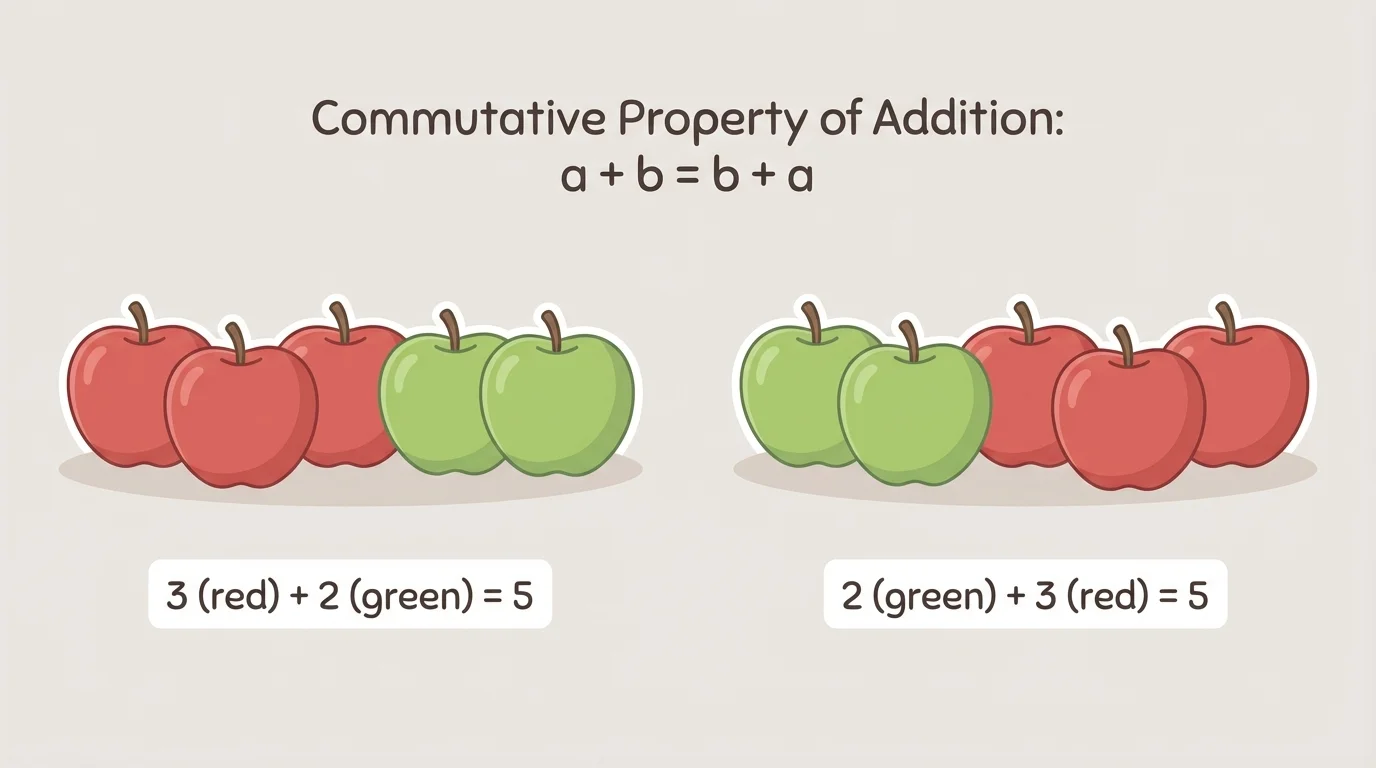
This turn-around idea works for all addition facts. \(6 + 2 = 8\) and \(2 + 6 = 8\). \(5 + 0 = 5\) and \(0 + 5 = 5\). When one order feels easier to think about, you can use that order.
Your brain often notices small numbers first, so many children solve \(1 + 7\) quickly by turning it into \(7 + 1\).
Subtraction is different. If you change the order in subtraction, the answer usually changes. For example, \(5 - 2 = 3\), but \(2 - 5\) is not the same kind of answer for first grade subtraction. So the turn-around rule helps addition, not subtraction.
Another useful idea is the associative property of addition. This means you can group addends in different ways, and the total stays the same. Grouping helps you make easy sums. Look at \(2 + 8 + 3\).
You can add the first two numbers: \((2 + 8) + 3 = 10 + 3 = 13\). You can also add the last two numbers first: \(2 + (8 + 3) = 2 + 11 = 13\). Both ways give \(13\).
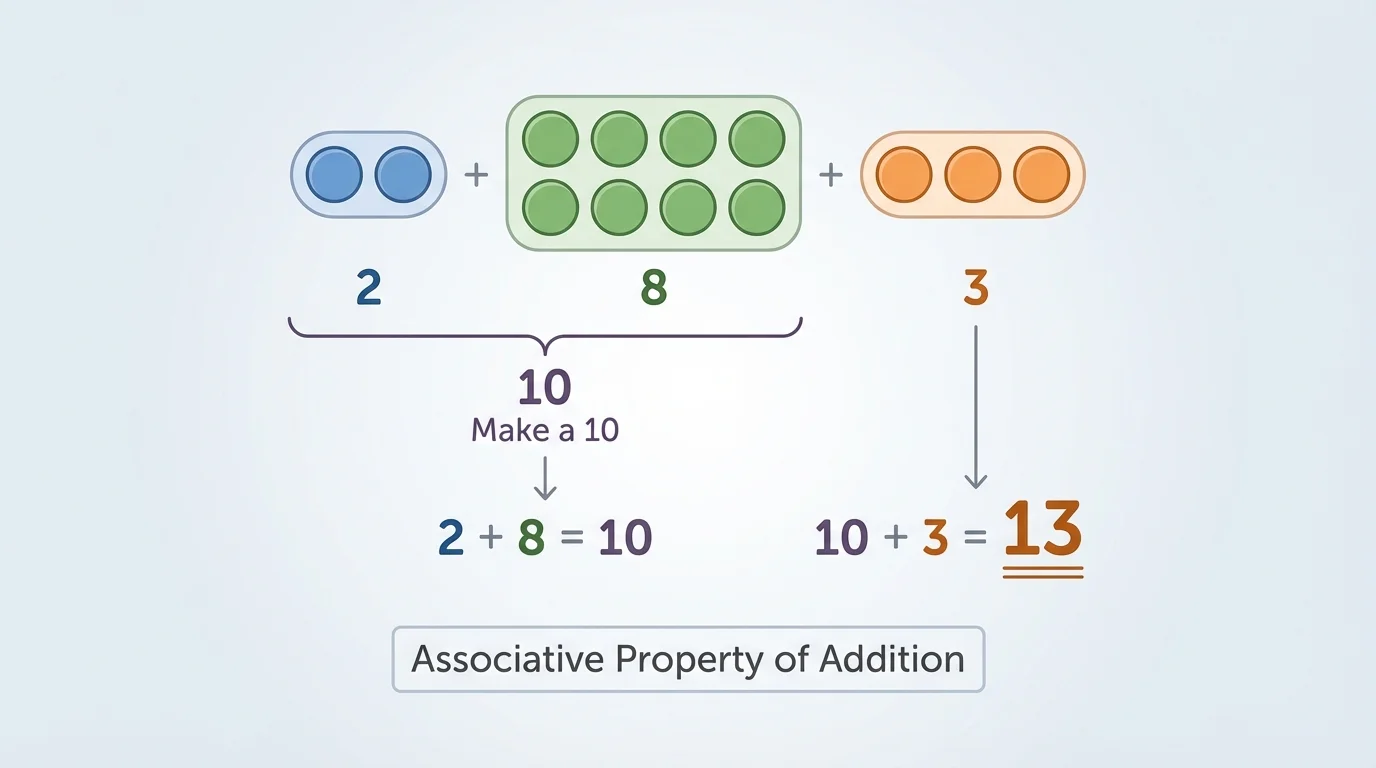
Good groupings help you make \(10\). For example, in \(1 + 9 + 4\), it is smart to group \(1\) and \(9\) first. Then \(1 + 9 = 10\), and \(10 + 4 = 14\). That is often easier than starting with \(9 + 4\).
We can write this idea like this:
\[(1 + 9) + 4 = 1 + (9 + 4) = 14\]
When you see three addends, look for a pair that makes \(10\). The grouping in [Figure 2] reminds us that smart grouping makes addition feel simpler.
Zero is a special number. The identity property of addition tells us that adding \(0\) does not change the number. So \(7 + 0 = 7\) and \(0 + 7 = 7\).
This makes sense in real life. If you have \(6\) crayons and get \(0\) more crayons, you still have \(6\) crayons. Nothing was added, so nothing changed.
You already know that subtraction means taking away. If you take away nothing, the number stays the same: \(9 - 0 = 9\).
[Figure 3] Zero helps us think carefully in subtraction too. If you start with \(5\) and take away \(5\), then \(5 - 5 = 0\). There is nothing left.
Addition and subtraction are part of the same fact family. They are connected through one set of numbers. If you know \(4 + 3 = 7\), then you also know \(3 + 4 = 7\), \(7 - 4 = 3\), and \(7 - 3 = 4\).
This is helpful because one addition fact can unlock two subtraction facts. If \(5 + 2 = 7\), then \(7 - 5 = 2\) and \(7 - 2 = 5\). Addition helps you check subtraction, and subtraction helps you think about a missing addend.
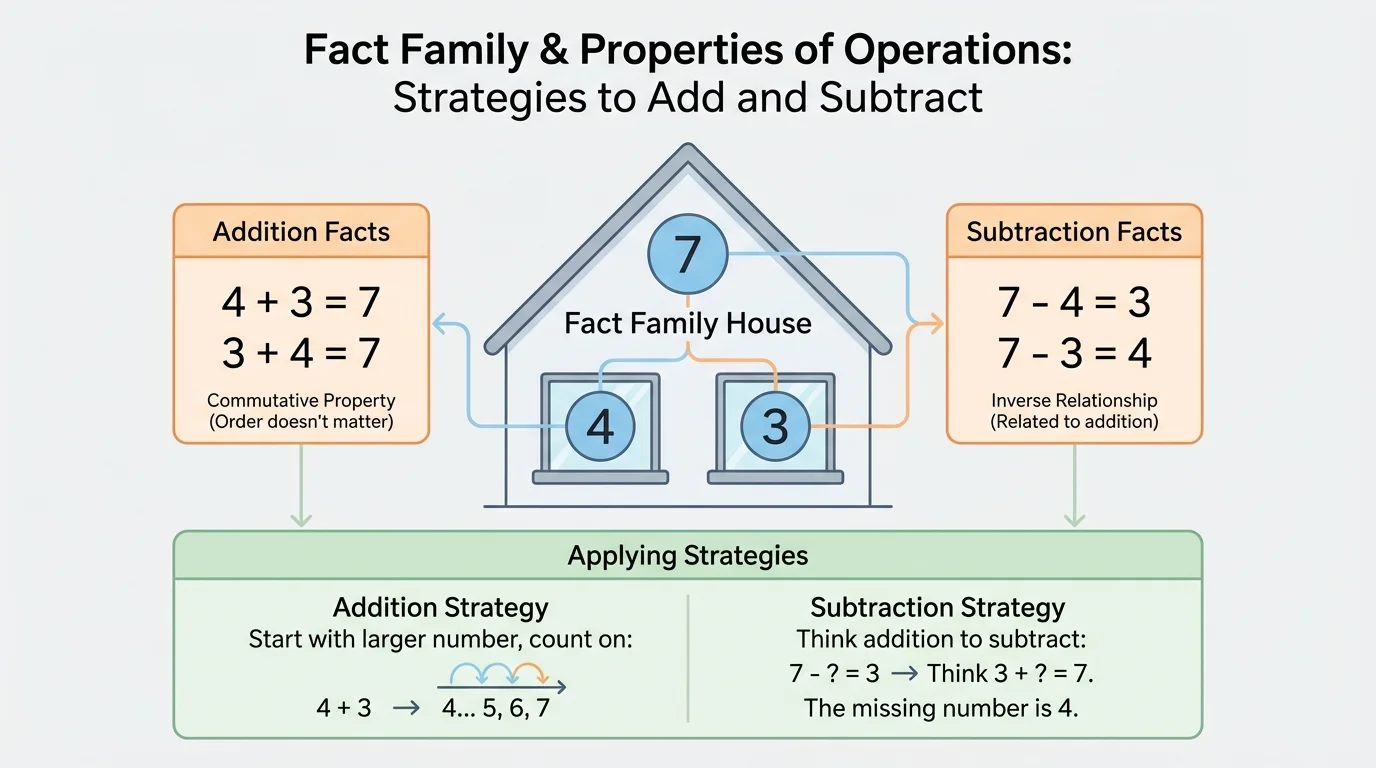
For example, if you see \(8 - 6\), you can think, "What number goes with \(6\) to make \(8\)?" Since \(6 + 2 = 8\), the answer is \(2\). This is a smart subtraction strategy.
How addition helps subtraction
Sometimes subtraction is easier when you think about adding. To solve \(9 - 7\), ask: "What number added to \(7\) makes \(9\)?" Since \(7 + 2 = 9\), we know \(9 - 7 = 2\).
The fact family in [Figure 3] helps us see that the same three numbers can make both addition and subtraction facts.
Now let us use these ideas step by step.
Worked example 1
Solve \(2 + 5\).
Step 1: Turn the addends around if that feels easier.
Think of \(2 + 5\) as \(5 + 2\).
Step 2: Add.
\(5 + 2 = 7\)
The answer is \(7\).
This uses the turn-around idea from addition. It is the same idea shown earlier with apples in [Figure 1].
Worked example 2
Solve \(3 + 7 + 1\).
Step 1: Look for addends that make \(10\).
\(3\) and \(7\) make \(10\).
Step 2: Group those addends first.
\[(3 + 7) + 1 = 10 + 1\]
Step 3: Finish the addition.
\(10 + 1 = 11\)
The answer is \(11\).
This is why friendly groups matter. When you spot a pair that makes \(10\), as in [Figure 2], the problem becomes easier.
Worked example 3
Solve \(8 - 5\).
Step 1: Think about the related addition fact.
Ask, "What number plus \(5\) equals \(8\)?"
Step 2: Find the missing number.
\(5 + 3 = 8\)
Step 3: Use that fact for subtraction.
\(8 - 5 = 3\)
The answer is \(3\).
This subtraction strategy connects right back to the fact family idea we saw in [Figure 3].
Worked example 4
Solve \(6 + 0\).
Step 1: Notice the zero.
Adding \(0\) means adding nothing.
Step 2: Keep the same number.
\(6 + 0 = 6\)
The answer is \(6\).
Zero does not change the total in addition, and taking away zero does not change the starting number in subtraction.
These properties are not just for worksheets. They help in everyday life. If there are \(4\) children in line for the swings and \(2\) more walk over, you can think \(4 + 2\) or \(2 + 4\). Either way, there are \(6\) children.
If you have \(8\) crackers, then eat \(3\), you can solve \(8 - 3\) by thinking of the addition fact \(3 + 5 = 8\). So \(8 - 3 = 5\). That is often faster than counting back one by one.
In a classroom, if one table has \(5\) cubes, another has \(5\) cubes, and a third has \(2\) cubes, you can group the two \(5\)s first: \(5 + 5 + 2 = 10 + 2 = 12\). Friendly groups help you count objects quickly and correctly.
When you add, ask yourself, "Can I turn the numbers around?" or "Can I group numbers to make \(10\)?" These are smart ways to use properties of operations.
When you subtract, ask, "What addition fact do I know?" That question can help you find the answer without counting all the way back.
| Idea | Example | Helpful Thought |
|---|---|---|
| Turn-around addition | \(2 + 6 = 6 + 2\) | The total stays the same. |
| Friendly grouping | \((1 + 9) + 3 = 10 + 3\) | Make \(10\) first. |
| Add zero | \(7 + 0 = 7\) | Nothing changes. |
| Subtraction with addition | \(9 - 4 = 5\) | Because \(4 + 5 = 9\). |
Table 1. A quick comparison of addition and subtraction strategies using properties and related facts.
Good mathematicians look for easy paths. They use what they know about numbers to make each problem clearer.
