Have you ever read two short articles about the same animal, game, or weather event and noticed that each one told you something different? A strong reader does more than collect facts. A strong reader puts facts together, notices clues, and figures out ideas that are not stated directly. That skill helps you understand school subjects, news stories, websites, and research projects much more deeply.
To comprehend information means to understand what a source says and what it means. When you comprehend well, you can identify important details, explain the main idea, tell what information matters most, and connect ideas across a text.
Sometimes a source tells you something directly. For example, a paragraph might say, "Monarch butterflies travel long distances during migration." That is a stated fact. Other times, the source gives clues, and you must think carefully to understand an idea that is not directly written. That is where inference comes in.
Comprehension is understanding information you read, view, or hear.
Evidence is the facts, details, examples, or quotations from a source that support an idea.
Inference is a conclusion a reader makes by combining clues from a source with what the reader already knows.
Good comprehension also means noticing the difference between important information and extra information. A text may include many details, but not every detail is equally helpful. During research, readers focus on the facts that answer their question or help explain the topic.
For example, if your research topic is how community gardens help neighborhoods, an important detail would be that gardens provide fresh vegetables. A less important detail might be the paint color of the garden fence, unless your research question is about design.
A inference is not a wild guess. It is careful thinking based on evidence. In reading, inference often works like this: you gather clues from the text, add what you already know, and then form a conclusion, as [Figure 1] illustrates. If the clues do not support your conclusion, then the inference is weak.
Suppose a digital article says that a park was empty at noon, dark clouds covered the sky, and people nearby opened umbrellas. The article may never say, "It was about to rain," but that is a logical inference. The details point to that conclusion.
A valid inference must match the evidence. If a reader said, "The park was empty because everyone was at a concert," that would not be valid unless the source gave clues for that idea. Good readers stay close to the text.
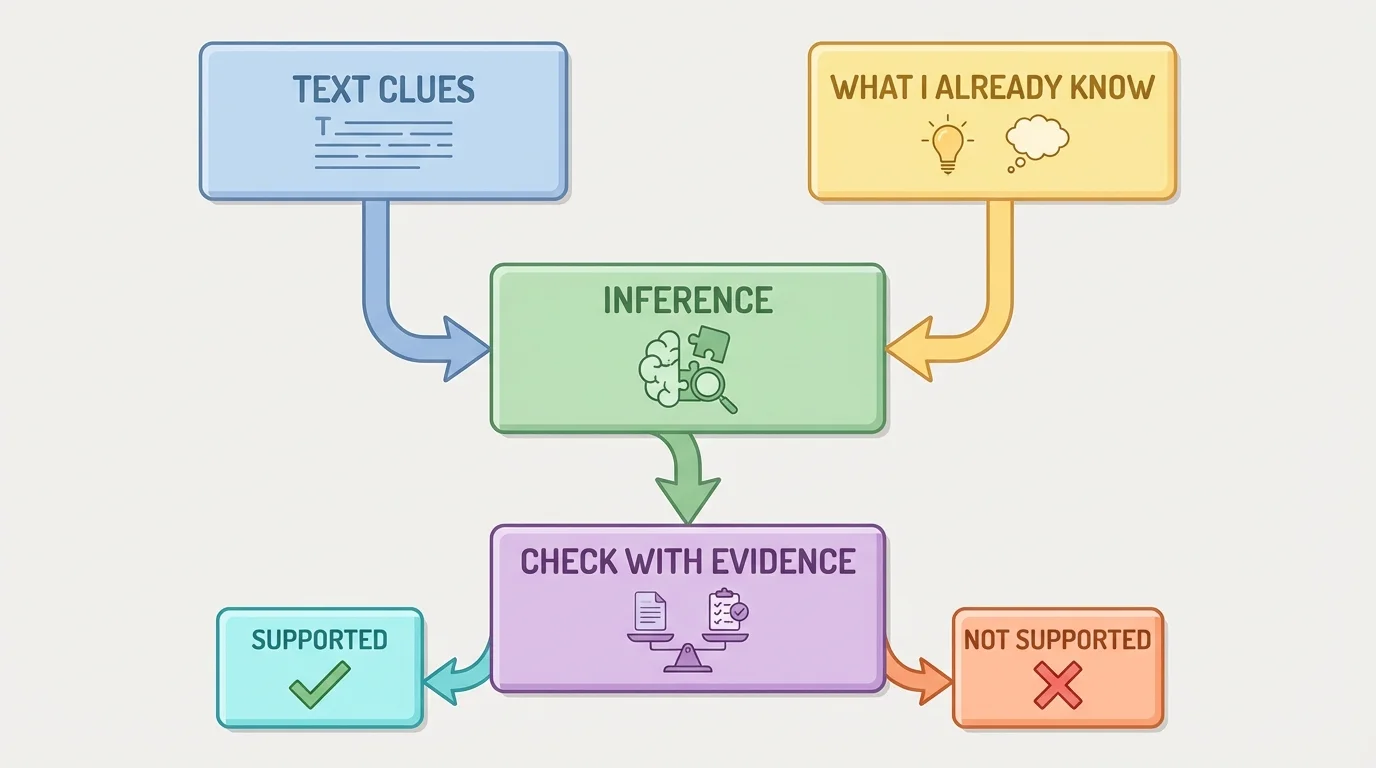
Readers often use guiding questions to make inferences: What do these details suggest? What is probably true? What can I conclude from the evidence? These questions help move reading from simple collecting to real understanding.
Consider this example: a print book about bees explains that some plants depend on bees for pollination, and a second paragraph says bee populations are decreasing in some places. A logical inference is that fewer bees may make it harder for some plants to reproduce. The book may not state that exact sentence, but the evidence supports it.
Clues plus knowledge lead to conclusions
When readers infer, they use both the source and their own background knowledge. Background knowledge helps, but it should never replace evidence. If your own idea does not fit the source details, it should not become your conclusion.
As we saw in [Figure 1], the last step is checking the inference against the evidence. This matters because some conclusions sound possible but are not supported. "Possible" is not the same as "proven by the source."
Research often includes sources such as books, articles, websites, interviews, videos, and charts. Print sources are physical materials like library books and magazines. Digital sources are online materials such as educational websites, digital encyclopedias, and online articles.
When you read a source, look for details that answer your research question. If your topic is school recycling, useful details might include what materials can be recycled, how much waste schools create, or how recycling helps the environment. A fact about the school mascot would not help unless the mascot is part of the campaign.
Good researchers also notice whether a source seems trustworthy. A trustworthy source is more likely to give accurate information. Readers can ask: Who wrote this? Is the information current? Does the source give facts, examples, or data? Is the website from a group that knows the topic well?
Comprehension includes recognizing when two sources agree, when they add different details, and when one source is too weak to trust. If one article gives clear facts and another makes exciting claims without support, careful readers know the stronger source gives better evidence.
Many research questions cannot be answered well with just one source. One source may explain the history of a topic, while another explains recent changes or provides examples.
Reading digital sources also requires paying attention to headings, captions, diagrams, and sidebars. Sometimes key information appears in a labeled picture or chart rather than in the main paragraphs. Strong readers gather meaning from all these text features.
To summarize means to tell the most important ideas in a shorter form. A summary includes the main idea and the key supporting details, but it leaves out small or repeated details.
A good summary is accurate, brief, and written in your own words. It should not change the meaning of the original source. If an article says sea turtles face dangers from plastic pollution and fishing nets, a summary should include those main dangers without listing every single example from the article.
Here is the difference between copying and summarizing. Copying repeats the source's exact words. Summarizing restates the important ideas. During research, summaries help you remember information without collecting too much extra material.
Example: Turning details into a summary
A student reads a passage explaining that bats eat insects, help some plants by spreading seeds, and live in many habitats around the world.
Step 1: Find the main idea.
The passage explains why bats are important animals.
Step 2: Choose the most important supporting details.
Bats eat insects, spread seeds for some plants, and live in many places.
Step 3: Write a short summary in your own words.
Bats are important because they help ecosystems by eating insects and spreading seeds, and they live in many habitats.
Notice that the summary is shorter than the original passage but still keeps the central meaning. That is a sign of good comprehension.
When readers synthesize, they combine information from more than one source to build a fuller understanding of a topic. This is more than summarizing one article. It means putting ideas together, comparing them, and creating a clearer overall picture, as [Figure 2] shows.
Suppose one source says bees pollinate crops, another explains that pesticides can harm bees, and a third describes how gardens with many flowers help bee populations. A synthesis might be: bees are important for plant growth, but they face dangers, and people can help them by creating safer habitats.
Synthesis helps researchers answer bigger questions. Instead of asking only, "What does this one source say?" they ask, "What do all these sources together teach me?" That is how knowledge grows during a short research project.
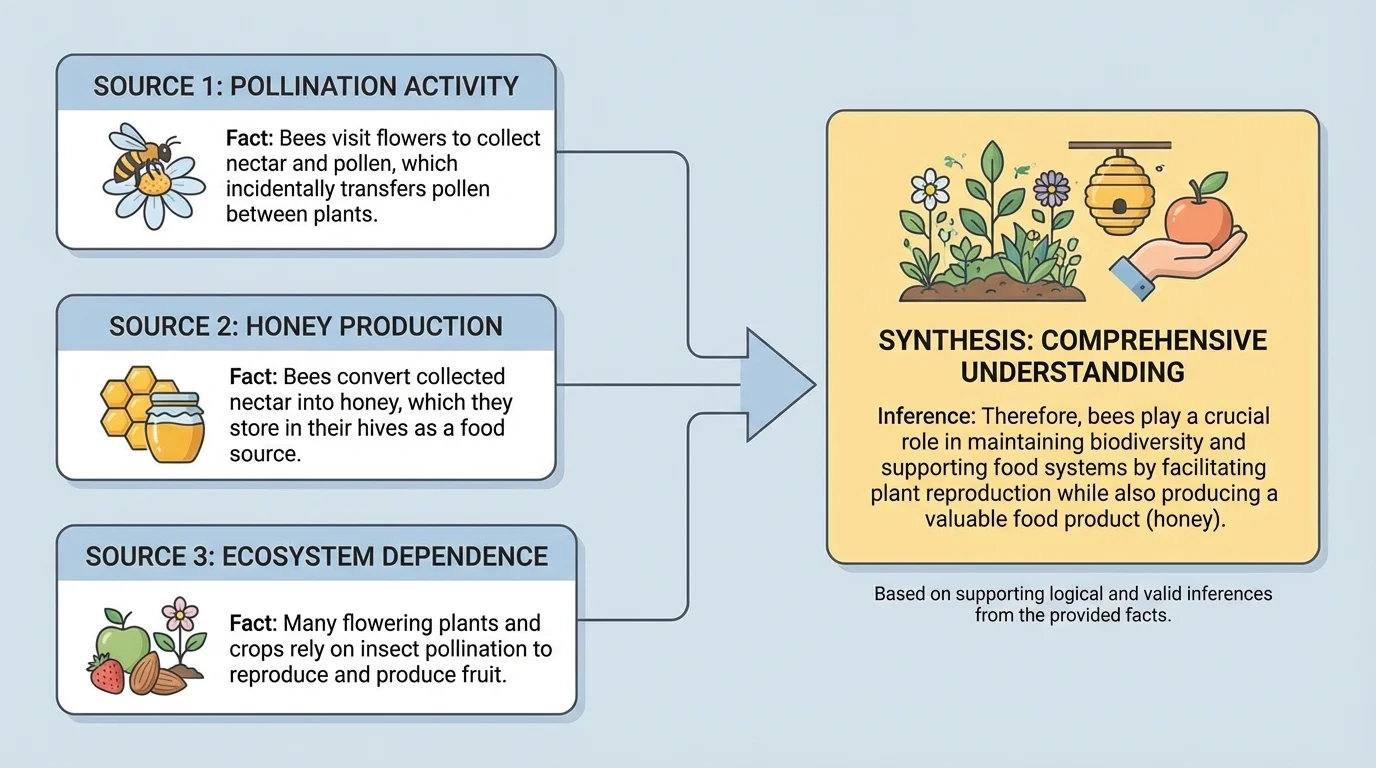
Sometimes sources agree. Sometimes they give different pieces of the same puzzle. For instance, a book may explain the science of volcanoes while a news article describes a recent eruption. Together, they help you understand both how volcanoes work and how they affect people today.
Later, when you write or speak about your findings, the synthesis becomes your explanation. As shown in [Figure 2], your final understanding should come from several pieces of evidence, not from one isolated detail.
| Reading Skill | What It Does | Example |
|---|---|---|
| Identify details | Finds facts and information from a source | "Bees help pollinate crops." |
| Summarize | Restates the most important ideas briefly | "Bees are important to plants and food production." |
| Infer | Draws a conclusion from clues and knowledge | "If bee numbers drop, some crops may be affected." |
| Synthesize | Combines ideas from several sources | "Bees are important, face dangers, and can be protected by human action." |
Table 1. Comparison of key comprehension skills used during research.
Strong researchers keep track of where information comes from. This process is called documenting information. Organized notes help readers remember which source gave which fact and keep evidence connected to conclusions.
Documenting matters because it shows that your ideas are based on real evidence. If you say, "Community gardens improve neighborhoods," you should be able to point to the sources that gave facts about fresh food, shared spaces, or local wildlife.
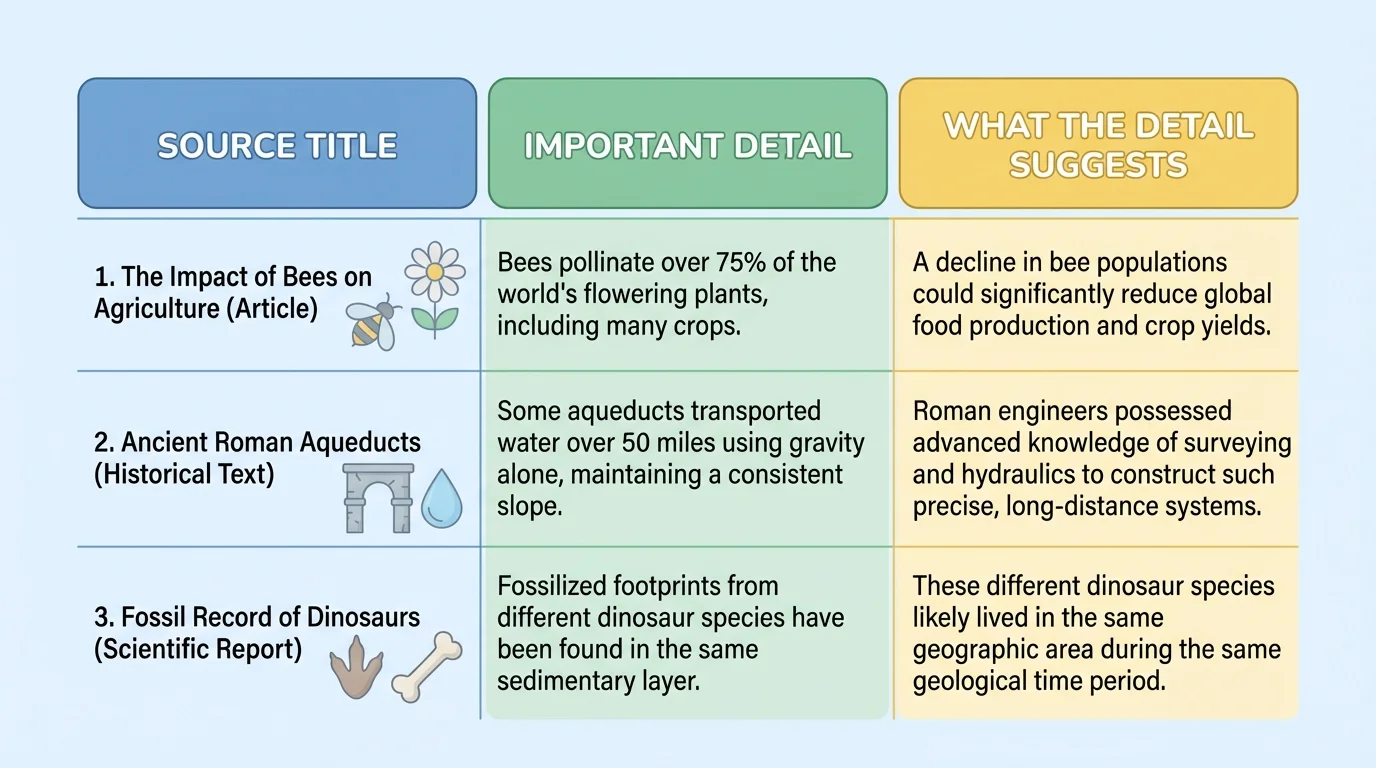
[Figure 3] One helpful note-taking method is to create columns for the source title, the important detail, and what that detail suggests. This helps you move from fact to inference without mixing them up.
For example, a source might say that students threw away fewer lunch items after a school started a compost program. Your note could record the detail and then add an inference: the compost program may have helped students think more carefully about waste.
Example: Evidence-based conclusion
A student researches whether reading outdoors helps children focus.
Step 1: Gather evidence from several sources.
One article says outdoor learning can reduce stress. Another says natural settings can improve attention. A teacher interview says students seem calmer outside.
Step 2: Compare the evidence.
All three sources point toward the same idea: outdoor settings may support focus and calm behavior.
Step 3: Write a conclusion supported by evidence.
Evidence from articles and an interview suggests that reading outdoors can help some children focus better because natural spaces may reduce stress and improve attention.
A strong conclusion does not say, "I just think this is true." Instead, it says, "The evidence suggests this is true." That difference is very important in research.
One common mistake is confusing an inference with a guess. A guess may come from imagination only. A valid inference comes from evidence.
Another mistake is using too little evidence. If one sentence in a source mentions that a river was low during one summer, you cannot automatically conclude that the river is always drying up. You would need more information from more sources.
A third mistake is letting personal opinions take over. If you love dogs, and an article says therapy dogs visited a hospital, you cannot infer that every patient became happy unless the evidence says so. Your opinion should not replace source details.
Remember that the main idea tells what a text is mostly about, while supporting details explain that main idea. Inferences depend on those supporting details.
Readers should also watch for overgeneralizing. Words like always, never, and everyone are often too strong unless the evidence truly supports them. Careful conclusions use accurate wording such as may, suggests, often, or in some cases.
These skills matter in real school projects. Imagine a class researching how extreme weather affects communities. One source explains hurricanes, another gives storm safety steps, and another describes damage to homes and roads. Students must comprehend each source, summarize key details, infer what challenges families might face after a storm, and synthesize the information into a strong explanation.
Research is like building a bridge from information to understanding. Facts are the boards, evidence is the support, and inferences help connect one idea to another. Without comprehension, the bridge is weak. Without evidence, the bridge cannot hold up your conclusions.
When you speak or write about your findings, explain not only what you learned but also how the sources support your thinking. This is what makes a response logical and valid. It shows that you are not only reading words but also understanding meaning.
As you grow as a reader and researcher, these habits become powerful tools. You learn to ask better questions, choose stronger evidence, avoid unsupported guesses, and build knowledge from several sources. That is the heart of deep comprehension.
