Almost every bite of food you eat and every breath of oxygen you take connects back to one process: photosynthesis. A slice of bread, an apple, a hamburger, and even the energy that lets a hawk fly or a fish swim can be traced back to organisms that capture sunlight. That is a powerful idea. It means green plants, algae, and some other organisms are not just part of the scenery. They are a major doorway through which energy enters living systems.
Photosynthesis is the process by which plants, algae, and some bacteria use light energy to produce sugars. For middle school science, the big idea is not the tiny chemical details inside cells. The important idea is that photosynthesis brings matter and energy into living systems in a usable form. Organisms need both matter and energy to grow, repair themselves, and carry out life functions.
Think about a tree. It starts as a small seed, but over time it becomes a giant living structure made mostly of carbon-based material. Where does that material come from? It does not come mainly from the soil. A large part of the tree's mass comes from carbon dioxide in the air and water from the environment. Photosynthesis is the process that helps turn those materials into sugars and other molecules the plant can use to build its body.
Photosynthesis is the process that uses light energy to make sugar from carbon dioxide and water.
Matter is anything that has mass and takes up space, including atoms and molecules such as \(\textrm{CO}_2\) and \(\textrm{H}_2\textrm{O}\).
Energy is the ability to cause change. In photosynthesis, light energy is captured and stored in chemical bonds.
Photosynthesis matters far beyond a single plant. It supports food webs, helps keep oxygen in the atmosphere, and plays a major role in the carbon cycle. Without it, most ecosystems on Earth would quickly collapse because the main source of incoming energy would disappear.
A plant leaf takes in materials and energy in a clear pattern, as [Figure 1] shows. The plant uses light energy from the Sun, water from the soil, and carbon dioxide from the air. From these inputs, it produces sugar, often represented as glucose, and releases oxygen into the air.
A simple way to write this relationship is with a word equation: carbon dioxide plus water, using light energy, produces glucose and oxygen. Scientists also use a chemical equation.
\[6\textrm{CO}_2 + 6\textrm{H}_2\textrm{O} \rightarrow \textrm{C}_6\textrm{H}_{12}\textrm{O}_6 + 6\textrm{O}_2\]
This equation helps show that atoms are not created from nothing. The carbon, hydrogen, and oxygen atoms in the products come from the reactants. For example, there are \(6\) carbon atoms on the left in \(6\textrm{CO}_2\), and there are also \(6\) carbon atoms on the right in \(\textrm{C}_6\textrm{H}_{12}\textrm{O}_6\). Matter is rearranged, not destroyed.
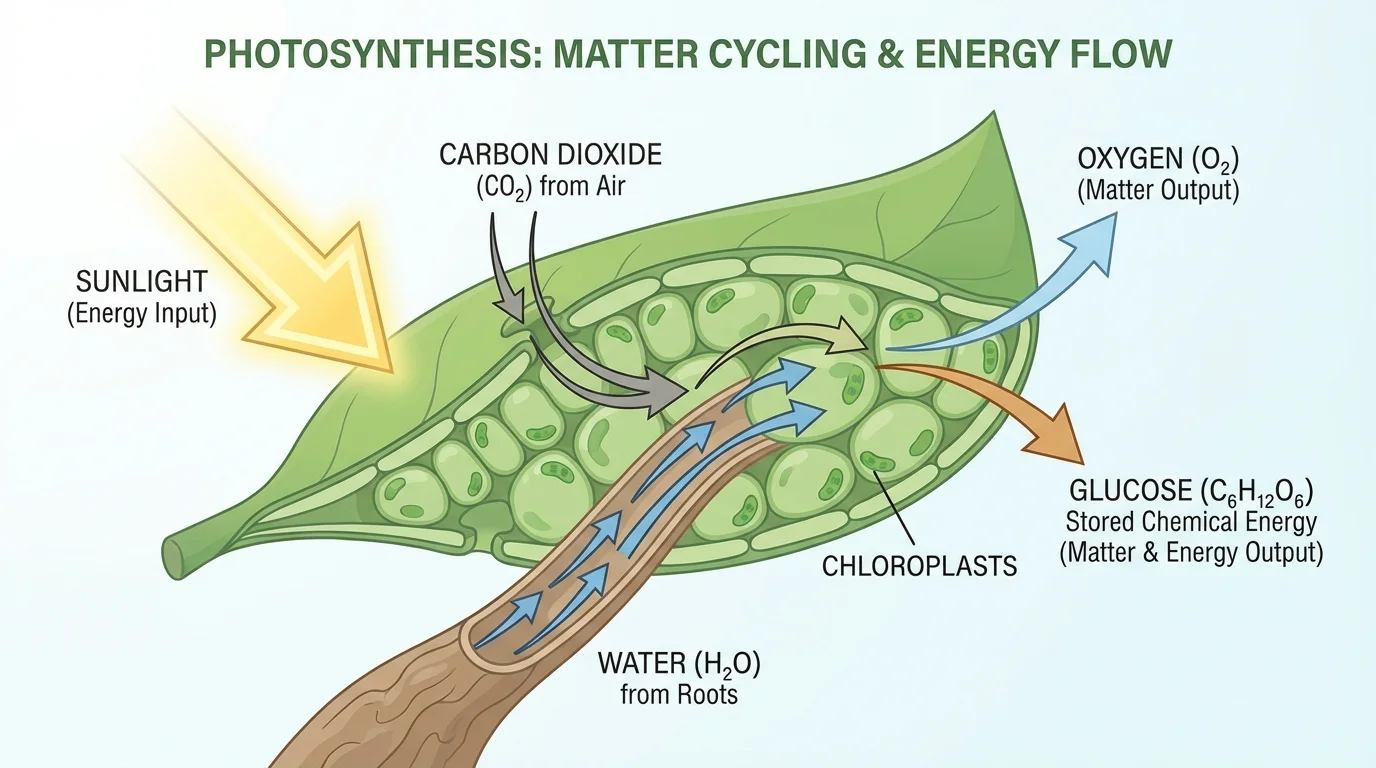
The sugar made during photosynthesis is important because it stores chemical energy. Plants can use that sugar right away or combine it into larger substances such as starch and cellulose. Cellulose helps build plant structures like stems, leaves, and wood. So when a plant grows taller or thicker, it is using matter from the environment and energy from sunlight to build more living tissue.
Notice something important: sunlight is not matter. Sunlight provides energy, but the atoms that make up the plant come mostly from water and carbon dioxide. Students often think plants get most of their mass from soil, but evidence shows that much of plant mass comes from gases in the air.
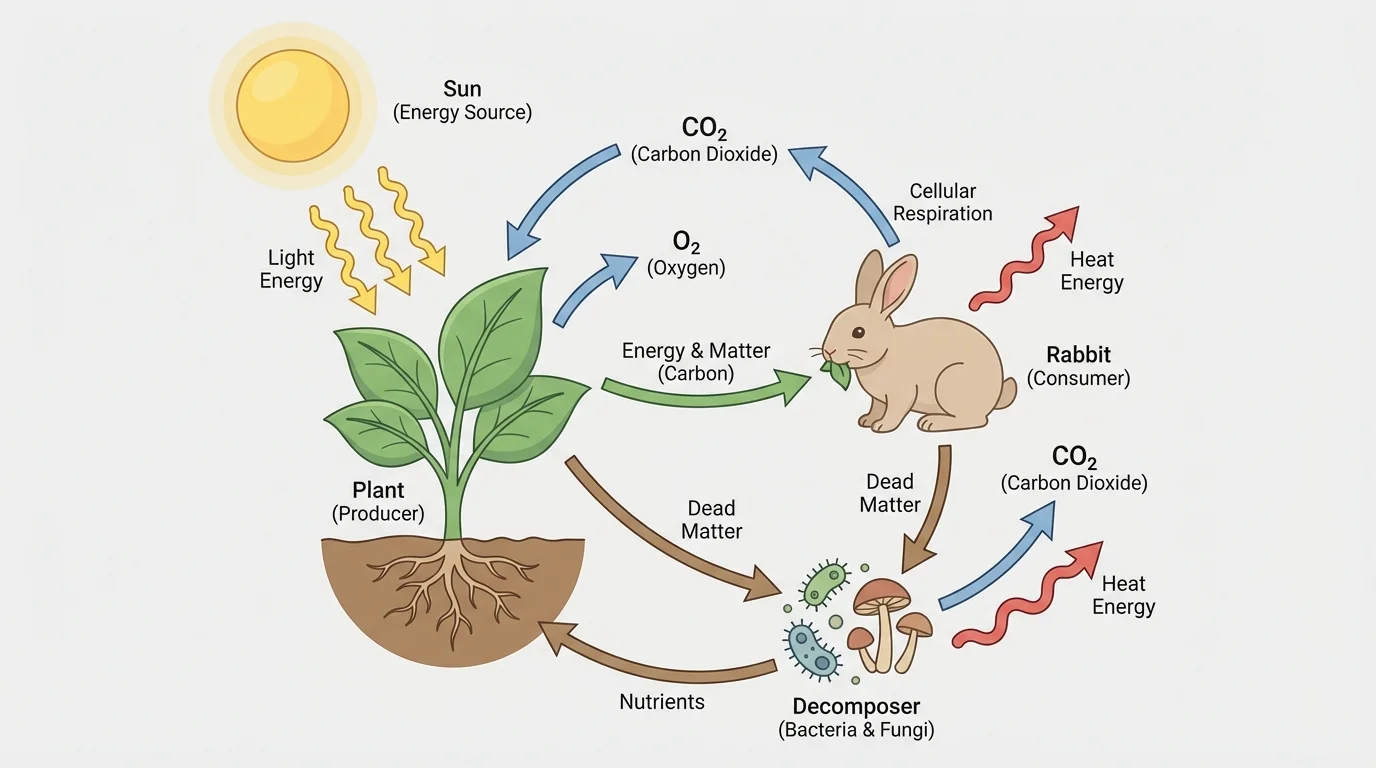
Carbon atoms move through ecosystems in repeating pathways, as [Figure 2] illustrates. This is why scientists say matter cycles. During photosynthesis, carbon from atmospheric \(\textrm{CO}_2\) enters a plant. That carbon becomes part of sugars and other organic molecules inside the plant.
Then an animal may eat the plant. The carbon atoms that were once in the air are now part of the animal's body. If another animal eats that herbivore, the same atoms can move again. Later, decomposers such as fungi and bacteria break down dead organisms and wastes, returning matter to the soil, water, and air.
Water also cycles through organisms. Plants absorb \(\textrm{H}_2\textrm{O}\) through their roots. Some water is used during photosynthesis, some becomes part of cells, and much of it later returns to the environment through processes such as transpiration and respiration. Matter keeps moving between living and nonliving parts of Earth.
This cycling idea is a key part of a scientific explanation. If a deer grows larger after eating grass, the deer's new body matter did not appear by magic. Atoms moved from the grass into the deer. The grass, in turn, got much of its carbon from carbon dioxide in the air through photosynthesis.
The same idea applies to humans. If you eat fruit, bread, rice, or vegetables, the matter in that food becomes part of your body or is broken down and released. Even if you eat meat, that matter can still often be traced back to plants that captured carbon through photosynthesis earlier in the food chain.
Matter cycles, but it changes form. Atoms are reused again and again. A carbon atom in the air can become part of a leaf, then part of a rabbit, then part of the soil, and later return to the air as \(\textrm{CO}_2\). The forms change, but the matter continues through the system.
As you continue to think about ecosystems, keep asking: where did the atoms come from, and where do they go next? That question helps scientists track matter through food webs, growth, decomposition, and the atmosphere.
Energy moves through ecosystems in a different way, and [Figure 3] shows this one-way pattern. Energy enters mainly as sunlight. Photosynthetic organisms capture some of that light energy and store it as chemical energy in sugars.
When a plant uses sugar, some of that stored energy powers life processes such as growth, repair, and transport inside cells. When an animal eats the plant, some of the chemical energy in the food becomes available to the animal. If a predator eats that animal, energy is transferred again.
But energy does not cycle in the same way matter does. At each step, some energy leaves the organism as heat. That means less usable energy is available at higher levels of a food chain. This is one reason ecosystems usually have fewer top predators than plants.
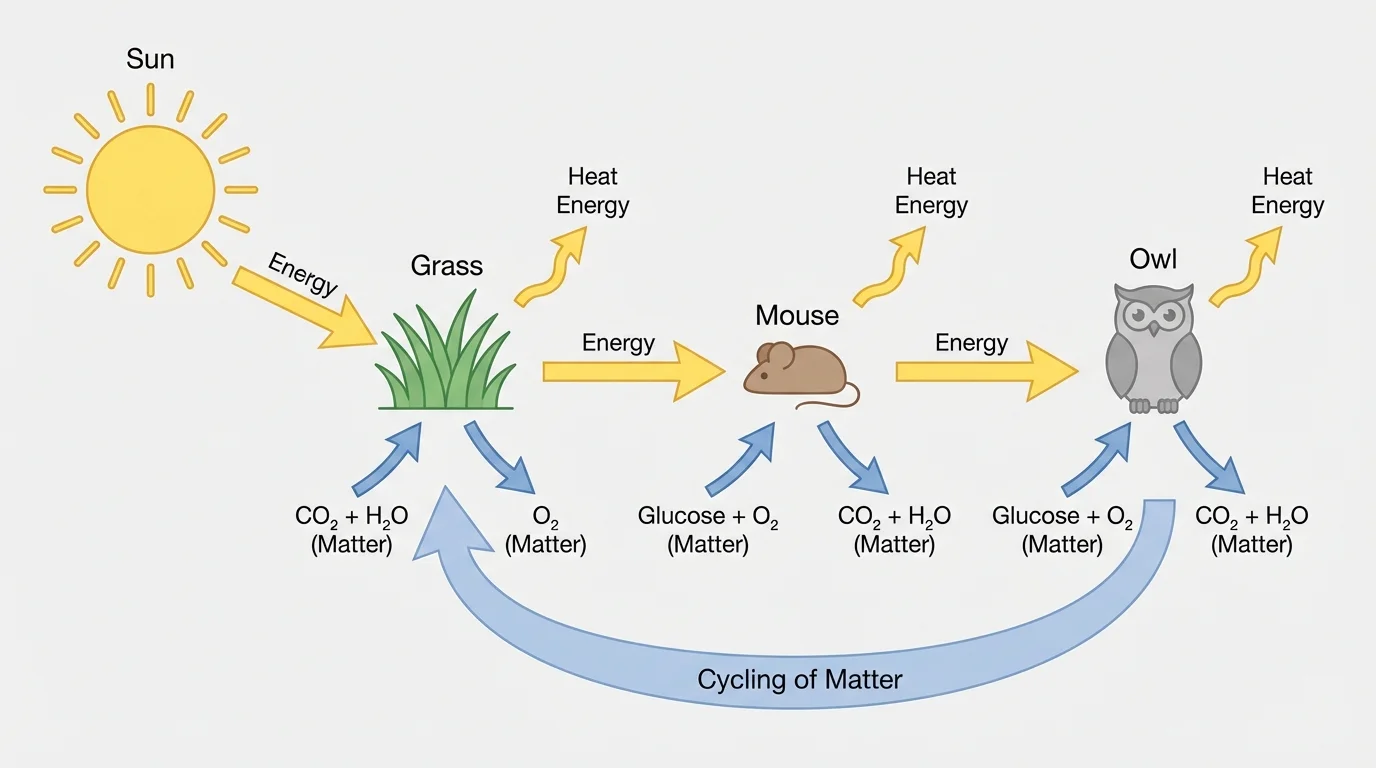
Consider a simple chain: grass, mouse, owl. The grass captures light energy. The mouse gets energy by eating the grass. The owl gets energy by eating the mouse. As this happens, energy flows from the Sun into the ecosystem and then out as heat. The energy is transformed, but it is not recycled back into sunlight by living things.
This difference between matter and energy is central to understanding life. Matter cycles through organisms and the environment. Energy flows into ecosystems, through organisms, and out as heat. Photosynthesis is the main step that brings that energy into biological systems in the first place.
"Nearly all life on Earth depends on the ability of photosynthetic organisms to capture sunlight and store it as chemical energy."
Later, when you study ecosystems in more depth, food webs make more sense if you remember this starting point: every consumer depends directly or indirectly on producers, and producers depend on photosynthesis.
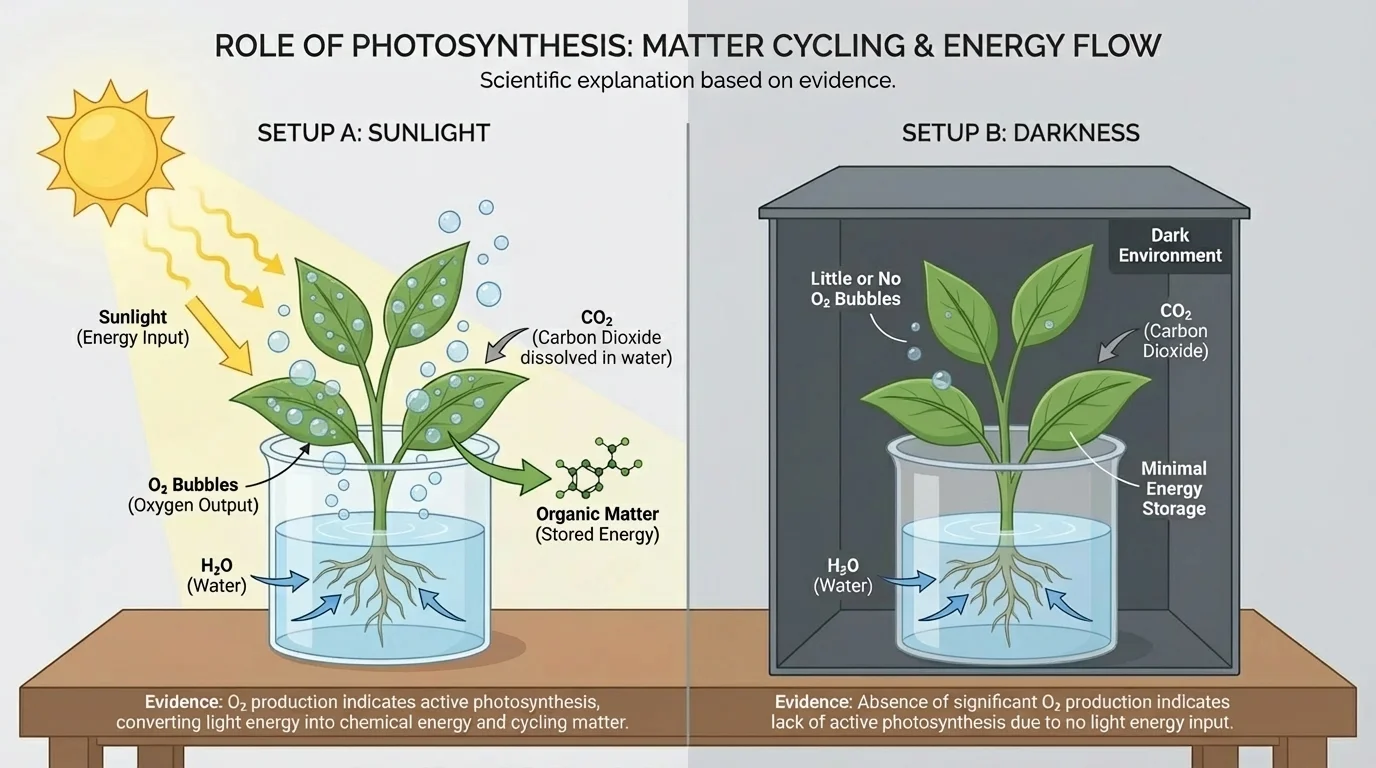
Scientific explanations need evidence, not guesses. In studies of photosynthesis, scientists use observations and measurements, as seen in [Figure 4]. One line of evidence is that plants in light can produce oxygen, while plants kept in darkness do not show the same result.
Another line of evidence comes from plant growth. A plant that receives light, water, and carbon dioxide can make more sugar and build more tissue. If one of these inputs is missing, growth is limited. This supports the explanation that photosynthesis requires these materials and that it provides matter and energy for growth.
Scientists also measure gases in the environment. During photosynthesis, organisms take in \(\textrm{CO}_2\) and release \(\textrm{O}_2\). During periods of active growth, forests and algae-rich waters can change the amounts of these gases in their surroundings. These measurable changes are evidence of photosynthesis happening.
Food web evidence matters too. If plants and algae are the producers at the base of most food webs, then the energy available to herbivores and predators depends on the amount of photosynthesis occurring. A drought, wildfire, or algae bloom can change photosynthesis rates and affect many organisms across the ecosystem.
Seasonal changes provide another clue. In spring and summer, many plants grow rapidly because longer days and warmer conditions often support more photosynthesis. In autumn and winter, some plants photosynthesize less, lose leaves, or become dormant. These changes can alter food availability for entire communities of organisms.
Using evidence to build an explanation
A scientist notices that an aquarium plant releases many bubbles in bright light but very few in darkness.
Step 1: Make the observation
More bubbles appear when the plant is exposed to light.
Step 2: Identify what the bubbles likely are
The bubbles are oxygen, \(\textrm{O}_2\), a product of photosynthesis.
Step 3: Connect the evidence to the explanation
If oxygen production increases in light, then light helps drive photosynthesis. This supports the explanation that photosynthesis captures light energy and produces oxygen.
This is not just a fact to memorize; it is an evidence-based scientific explanation.
When you write about this topic, strong explanations include both a claim and evidence. For example: plants use photosynthesis to move carbon from the air into living matter, supported by the fact that plants take in \(\textrm{CO}_2\), make sugars, and increase in biomass over time.
Cellular respiration is another important process connected to photosynthesis. In respiration, organisms break down sugars to release usable energy for cell activities. Plants do this, and animals do too. So plants are not only producers; they also use respiration to power their own life functions.
The two processes are linked. Photosynthesis makes sugars and oxygen. Respiration uses sugars and oxygen and releases carbon dioxide and water. At a simple level, the relationship can be shown like this: photosynthesis stores energy in food, while respiration releases some of that stored energy for life processes.
This does not mean the two processes are exact opposites in every detail, but they are strongly connected in ecosystems. Carbon dioxide released by respiration can later be used again in photosynthesis. Here we see matter cycling once more. As we saw earlier in [Figure 2], carbon moves between organisms and the environment again and again.
The energy story is different. Once energy has been used and transferred, some leaves as heat at each stage. That is why the one-way pathway in [Figure 3] remains important even when matter keeps cycling.
Cells are the basic units of life, and all organisms need energy to carry out functions such as growth, movement of materials, and repair. Photosynthesis and respiration are two major processes that help explain where that energy and matter come from and where they go.
For this topic, it is enough to understand what goes in, what comes out, and how these processes affect matter and energy. You do not need the detailed biochemical steps inside chloroplasts.
Photosynthesis affects daily life more than most people realize. In agriculture, farmers depend on it to grow crops. The amount of light, water, and carbon dioxide can affect how much plant matter is produced. Greenhouses sometimes manage these conditions to improve plant growth.
Forests are another major example. Trees remove carbon dioxide from the air and store carbon in wood, leaves, and roots. This is one reason forests are important in discussions about climate. When forests are cut down or burned, carbon stored by photosynthesis can return to the atmosphere.
Oceans matter too. Tiny photosynthetic organisms such as phytoplankton help support aquatic food webs and produce a large share of Earth's oxygen. Even though they are small, their total effect is enormous because there are so many of them.
Sports and human health connect here as well. The energy in your muscles during a game or a run originally came from food. That food came from plants or from animals that ate plants. The oxygen you breathe also connects back to photosynthetic organisms. In a very real way, your movement links sunlight, food, and the atmosphere.
Many of the oxygen molecules you breathe were likely produced by ocean-dwelling photosynthetic organisms rather than by land plants. Tiny producers can have planet-sized effects.
Engineers and scientists also learn from photosynthesis when designing solar technologies, biofuels, and systems for controlled plant growth in space habitats. Even when technology is involved, the key idea stays the same: capturing energy and turning it into a usable form is essential for sustaining life.
You can observe evidence of photosynthesis with a simple aquatic plant setup. Place an aquatic plant in water under a bright lamp or in sunlight, and observe whether bubbles form on the leaves. Then compare it with the same kind of plant in much lower light. The setup in [Figure 4] reflects this kind of investigation.
If more bubbles appear in brighter light, that observation supports the idea that light affects the rate of photosynthesis. The bubbles are often oxygen released by the plant. This is a useful example because it gives visible evidence of a process that is otherwise easy to miss.
To make the explanation stronger, scientists compare conditions carefully, repeat observations, and control variables. That means changing one factor, such as light, while keeping others as similar as possible. Good science depends on fair tests and evidence.
By this point, the pattern should be clear. Photosynthesis helps explain how plants gain matter, how food webs begin, how carbon enters living systems, and how sunlight becomes chemical energy that organisms can use. The process is one of the most important links between Earth's nonliving environment and living communities.
