A crash investigator can often work backward from the motions of two vehicles after impact and learn what happened just before the collision. That seems almost like detective work, but it depends on a deep physics idea: even when individual objects change speed dramatically, the total momentum of the system can remain unchanged. This is one of the most powerful ways to describe interactions between objects, especially when forces act over short times.
In everyday life, we often focus on speed alone. But in physics, speed by itself does not tell the whole story. A slowly moving truck and a fast-moving tennis ball can have very different impacts because mass matters too. The quantity that combines mass and motion is momentum. Momentum helps explain what happens in collisions, rebounds, and push-offs, from two skaters leaving each other to two carts colliding on a track.
When scientists make the claim that total momentum is conserved, they do not mean that each object keeps its own momentum. In fact, during an interaction, the momentum of each object usually changes. The important claim is that the sum of the momenta of all objects in the system remains constant if there is no net external force on that system.
You already know from Newton's laws that forces cause changes in motion. You also know that velocity in one dimension needs a sign: for example, rightward might be positive and leftward negative. That sign convention is essential when working with momentum.
To support the claim of conservation of momentum, we need both clear physical reasoning and mathematical representations. That means equations, signs, and numerical examples must all agree with the physical situation.
[Figure 1] Momentum is the quantity of motion an object has because of both its mass and its velocity. In one dimension, momentum is calculated by the equation \(p = mv\), where \(m\) is mass and \(v\) is velocity. Because velocity can be positive or negative, momentum can also be positive or negative under a rightward-positive sign convention.
The SI unit of momentum is \(\textrm{kg} \cdot \textrm{m/s}\). For example, if a \(2 \, \textrm{kg}\) cart moves to the right at \(3 \, \textrm{m/s}\), its momentum is \(p = (2)(3) = 6 \, \textrm{kg} \cdot \textrm{m/s}\). If the same cart moves to the left at \(3 \, \textrm{m/s}\), then \(v = -3 \, \textrm{m/s}\), so \(p = (2)(-3) = -6 \, \textrm{kg} \cdot \textrm{m/s}\).
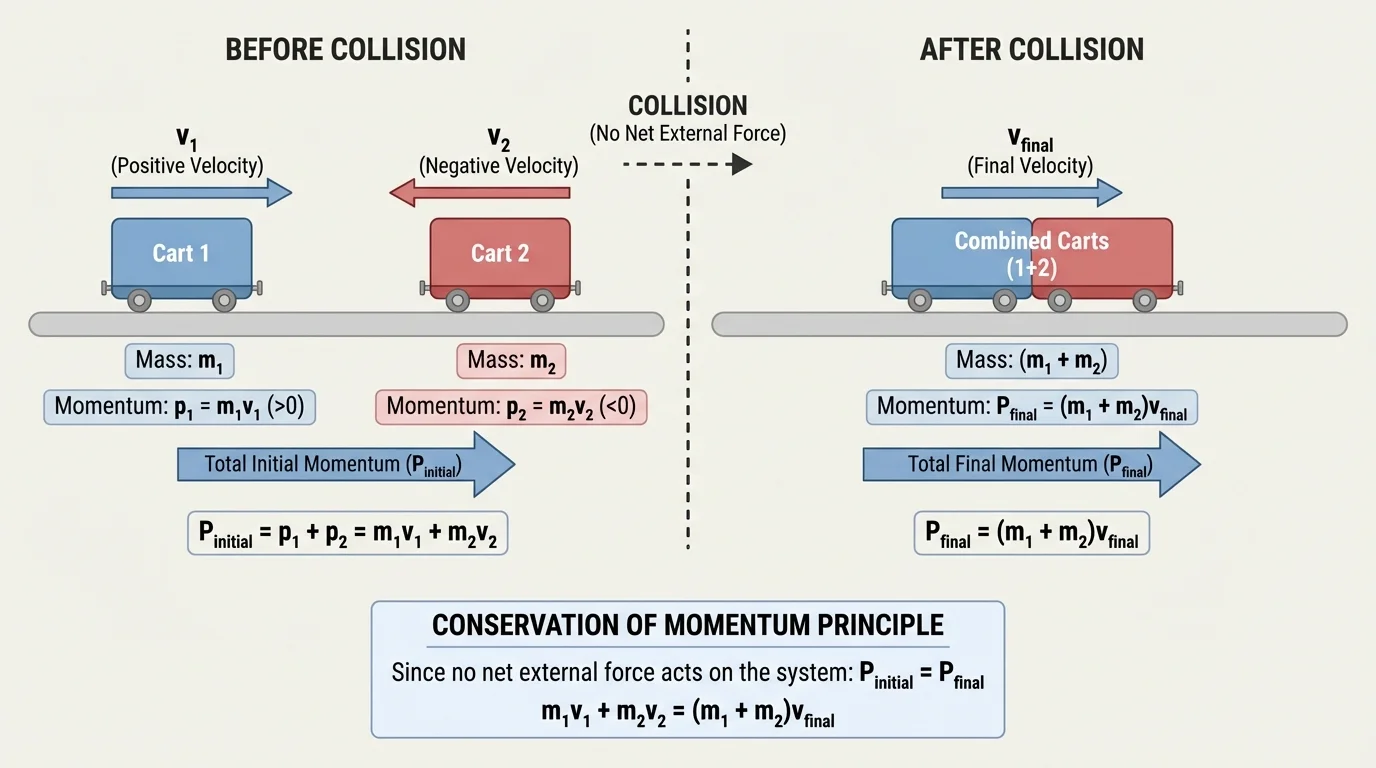
This sign is not just a math detail. It tells direction. In one-dimensional momentum problems, choosing a positive direction at the beginning keeps the analysis consistent. If right is positive, then every rightward velocity is positive and every leftward velocity is negative. A negative momentum value does not mean "less momentum"; it means momentum in the opposite direction.
Momentum is the product of mass and velocity, given by \(p = mv\).
System is the group of objects chosen for analysis.
Net external force is the overall force on the system from objects outside the system.
Conservation of momentum means that the total momentum of a system stays constant when the net external force on the system is zero.
For a system of two objects, total momentum is the sum of the individual momenta. If object \(1\) has momentum \(p_1\) and object \(2\) has momentum \(p_2\), then the system momentum is \(p_{total} = p_1 + p_2\). In one dimension, this becomes a signed sum. That sign-based addition is what makes the mathematics match the physics.
[Figure 2] To decide whether momentum is conserved, we first define the system. Suppose two carts interact on a nearly frictionless track. If we choose both carts together as the system, then the force each cart exerts on the other is an internal force. Those internal forces come in equal and opposite pairs.
External forces come from outside the system. On a horizontal low-friction track, the vertical forces from gravity and the track balance, and the horizontal external forces are often very small. In that situation, the net external force in the horizontal direction is approximately zero. That is the condition under which total momentum is conserved for the two-cart system.
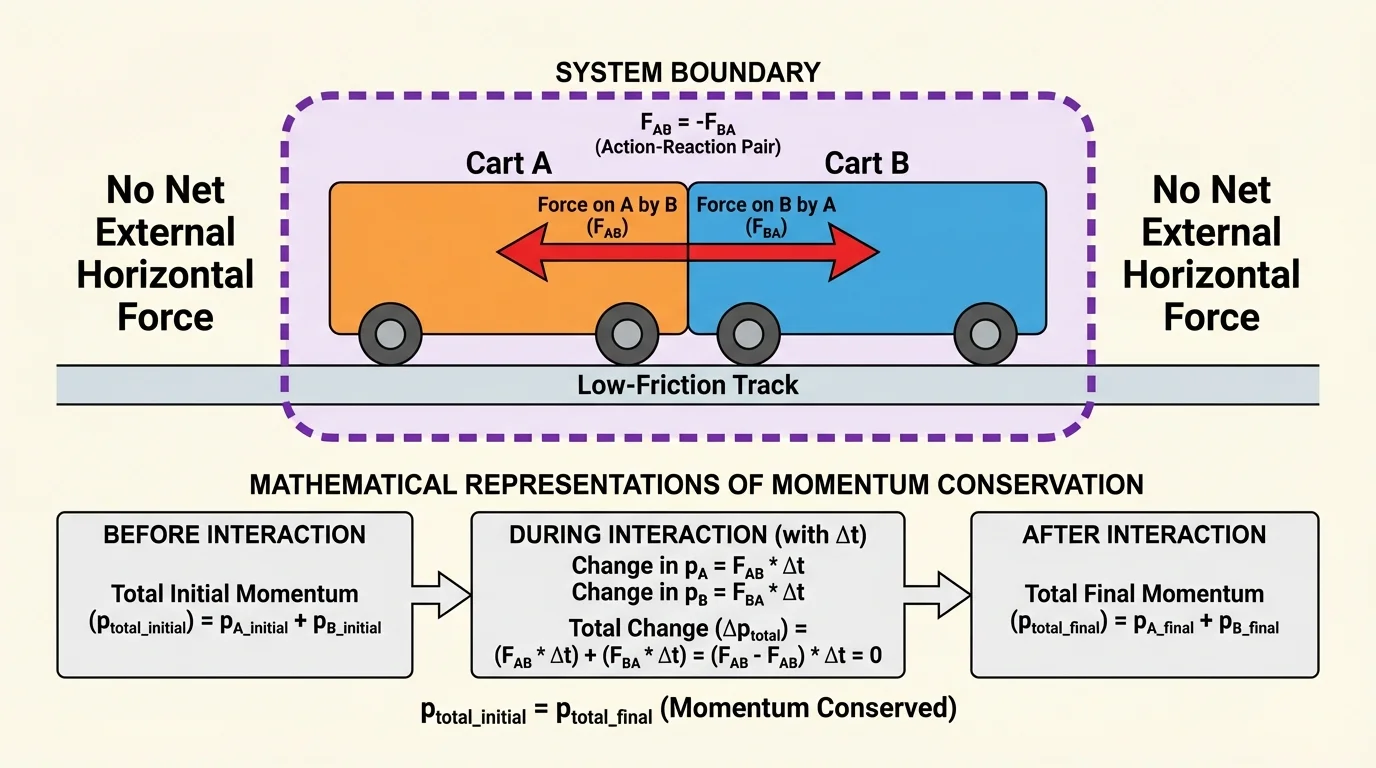
This idea can feel surprising at first. During a collision, the force on each cart can be large, but those forces are internal to the system if both carts are included. One cart pushes on the other, and the other pushes back with equal magnitude in the opposite direction. These forces change the momenta of the individual carts, but they do not change the total momentum of the two-cart system.
Why internal forces do not change total momentum
If object \(1\) pushes on object \(2\), then object \(2\) pushes back on object \(1\) with an equal and opposite force. Over the same interaction time, the momentum gained by one object is balanced by the momentum lost by the other. The system redistributes momentum internally, but the total stays the same as long as no net external force acts on the system.
The phrase "no net force on the system" does not mean no forces exist. It means the external forces cancel or are negligible in the direction being studied. That distinction matters. Two objects can exert very strong forces on each other and still conserve total momentum.
Newton's second law connects force to changes in motion. For momentum, a useful form is that net force equals the rate of change of momentum. In a one-dimensional situation, this idea can be written as \(F_{net} = \dfrac{\Delta p}{\Delta t}\). If the net external force on a system is zero, then \(\dfrac{\Delta p_{total}}{\Delta t} = 0\). That means \(\Delta p_{total} = 0\), so total momentum does not change.
Mathematically, for two objects in one dimension, the conservation statement is
\[p_{1,i} + p_{2,i} = p_{1,f} + p_{2,f}\]
Here, the subscripts \(i\) and \(f\) mean initial and final. Replacing each momentum with \(mv\) gives
\[m_1v_{1,i} + m_2v_{2,i} = m_1v_{1,f} + m_2v_{2,f}\]
This equation is a mathematical representation of the claim. If there is no net external force on the system, then the total momentum before the interaction equals the total momentum after the interaction. This is true whether the objects stick together, bounce apart, or simply push away from each other.
A system can have total momentum equal to zero even when both objects are moving. If one object has momentum \(+8 \, \textrm{kg} \cdot \textrm{m/s}\) and the other has momentum \(-8 \, \textrm{kg} \cdot \textrm{m/s}\), the total is zero because the momenta cancel.
Notice what this equation does and does not say. It does not say the velocities remain the same. It says the sum of the momenta remains the same. Velocities can change a lot, especially if the masses are different.
[Figure 3] One strong way to support a scientific claim is to represent the same idea in more than one mathematical form. For momentum conservation, we can use equations, signed-number calculations, and tables. A before-and-after picture makes it easier to track how one object loses momentum while the other gains it.
Suppose right is positive. Then a useful structure for any two-object, one-dimensional problem is:
\[p_{total,i} = m_1v_{1,i} + m_2v_{2,i}\]
\[p_{total,f} = m_1v_{1,f} + m_2v_{2,f}\]
If there is no net external force, then \(p_{total,i} = p_{total,f}\).
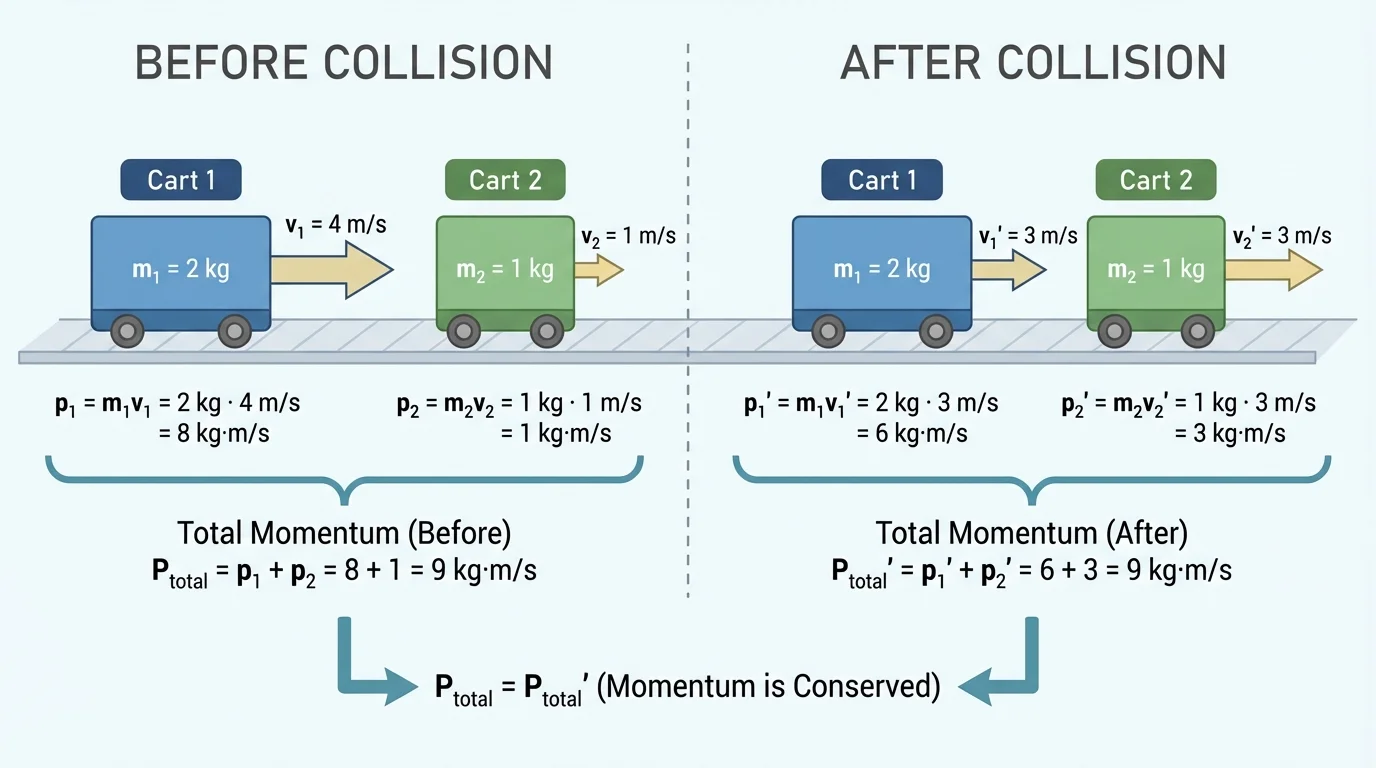
Students often find tables helpful because they separate each object's momentum from the system total. For example:
| Object | Mass | Velocity before | Momentum before | Velocity after | Momentum after |
|---|---|---|---|---|---|
| Object 1 | \(m_1\) | \(v_{1,i}\) | \(m_1v_{1,i}\) | \(v_{1,f}\) | \(m_1v_{1,f}\) |
| Object 2 | \(m_2\) | \(v_{2,i}\) | \(m_2v_{2,i}\) | \(v_{2,f}\) | \(m_2v_{2,f}\) |
| Total | — | — | \(p_{total,i}\) | — | \(p_{total,f}\) |
Table 1. General structure for comparing initial and final momentum in a two-object one-dimensional system.
As in [Figure 1], signs matter in every column involving velocity or momentum. A leftward motion is represented by a negative velocity, which gives a negative momentum if the mass is positive.
The claim of momentum conservation becomes convincing when the numbers work out. Each example below uses two macroscopic objects moving in one dimension and assumes the net external force on the system is zero.
Example 1: A moving cart hits a stationary cart and they stick together
A \(2 \, \textrm{kg}\) cart moves right at \(4 \, \textrm{m/s}\). It collides with a stationary \(3 \, \textrm{kg}\) cart. After the collision, the carts stick together. Find their final velocity.
Step 1: Write the conservation equation
Because momentum is conserved, \(m_1v_{1,i} + m_2v_{2,i} = (m_1 + m_2)v_f\).
Step 2: Substitute known values
Here, \(m_1 = 2\), \(v_{1,i} = 4\), \(m_2 = 3\), and \(v_{2,i} = 0\). So \((2)(4) + (3)(0) = (2 + 3)v_f\).
Step 3: Solve
The left side is \(8\), so \(8 = 5v_f\). Then \(v_f = \dfrac{8}{5} = 1.6 \, \textrm{m/s}\).
The combined carts move at \(1.6 \, \textrm{m/s}\) to the right. The initial total momentum is \(8 \, \textrm{kg} \cdot \textrm{m/s}\), and the final total momentum is \((5)(1.6) = 8 \, \textrm{kg} \cdot \textrm{m/s}\), so the total is conserved.
This example shows an important pattern: when objects stick together, their shared final speed is usually less than the original speed of the faster object because the total mass is larger.
Example 2: Two carts push apart from rest
Two carts are initially at rest on a low-friction track. Cart A has mass \(1 \, \textrm{kg}\), and cart B has mass \(2 \, \textrm{kg}\). A spring between them pushes them apart. After release, cart A moves left at \(6 \, \textrm{m/s}\). Find the velocity of cart B.
Step 1: Identify the initial total momentum
Both carts start at rest, so \(p_{total,i} = 0\).
Step 2: Set final total momentum equal to zero
Let right be positive. Then cart A has velocity \(-6 \, \textrm{m/s}\). The conservation equation is \((1)(-6) + (2)v_{B,f} = 0\).
Step 3: Solve
Adding \(6\) to both sides gives \(2v_{B,f} = 6\). Therefore, \(v_{B,f} = 3 \, \textrm{m/s}\).
Cart B moves at \(3 \, \textrm{m/s}\) to the right. The lighter cart moves faster, but the total momentum remains zero because \((-6) + (2)(3) = 0\).
This is the same idea shown earlier with internal forces in [Figure 2]. The spring force is internal to the two-cart system, so it redistributes momentum without changing the total.
Example 3: Head-on motion with opposite directions
A \(1.5 \, \textrm{kg}\) cart moves right at \(4 \, \textrm{m/s}\). A \(0.5 \, \textrm{kg}\) cart moves left at \(2 \, \textrm{m/s}\). After they collide, the \(0.5 \, \textrm{kg}\) cart moves right at \(6 \, \textrm{m/s}\). Find the final velocity of the \(1.5 \, \textrm{kg}\) cart.
Step 1: Compute initial total momentum
Using right as positive, \(p_{total,i} = (1.5)(4) + (0.5)(-2) = 6 - 1 = 5 \, \textrm{kg} \cdot \textrm{m/s}\).
Step 2: Write the final momentum equation
Let the final velocity of the \(1.5 \, \textrm{kg}\) cart be \(v\). Then \(p_{total,f} = (1.5)v + (0.5)(6) = 1.5v + 3\).
Step 3: Set initial and final totals equal
Since momentum is conserved, \(5 = 1.5v + 3\). Subtracting \(3\) gives \(2 = 1.5v\).
Step 4: Solve
\(v = \dfrac{2}{1.5} = 1.33\overline{3} \, \textrm{m/s}\).
The final velocity of the \(1.5 \, \textrm{kg}\) cart is \(1.33\overline{3} \, \textrm{m/s}\) to the right. The total momentum before and after is \(5 \, \textrm{kg} \cdot \textrm{m/s}\).
This example shows why signs are essential. If the leftward velocity had been treated as positive instead of negative, the result would have been incorrect. The before-and-after accounting method in [Figure 3] helps prevent that error.
A mathematical result should match physical reasoning. If the total initial momentum is positive, then the total final momentum must also be positive if momentum is conserved. If the total initial momentum is zero, then the final momenta must cancel.
Negative final velocity does not mean a mistake. It means the object moves in the direction opposite the chosen positive direction. For example, if a calculation gives \(v = -2 \, \textrm{m/s}\), the object moves left at \(2 \, \textrm{m/s}\) when right is positive.
It is also possible for one object to gain speed while the other loses speed and for total momentum still to stay constant. Conservation does not require equal speeds or equal momentum values for each object. It requires the signed sum to remain constant.
Momentum conservation is used in crash analysis, transportation safety, and engineering design. Investigators examining a two-vehicle collision can measure masses and post-collision velocities, then use conservation equations to estimate pre-collision motion. This does not remove the need for careful evidence, but it gives a quantitative tool grounded in physics.
Safety systems such as seat belts and airbags relate to momentum too. If a passenger's momentum must change from some moving value to zero, a force is required. Increasing the time over which that momentum changes reduces the average force on the person. While that idea involves impulse in a fuller treatment, it still connects to the fact that changes in momentum are central to understanding collisions.
Another example appears in laboratory carts on low-friction tracks. When two carts push apart from rest, the lighter cart usually moves away faster. That often surprises students, but the math explains it immediately: equal and opposite momentum changes do not require equal velocities because the masses are different.
"When no net external force acts on a system, the system's total momentum remains constant."
— Core principle of momentum conservation
Even in sports, the idea appears clearly. Two players pushing off each other on wheeled platforms move in opposite directions. The one with less mass tends to move faster, but the total momentum of the two-player system remains the same as it was before the push, often zero.
A simple experiment can test the claim directly. Place two carts on a low-friction track. Measure each cart's mass. Use motion sensors or video analysis to find velocities before and after a collision or push-off. Then calculate each cart's momentum with \(p = mv\) and add them to get the system total.
For example, suppose a \(1 \, \textrm{kg}\) cart moves right at \(2 \, \textrm{m/s}\) toward a stationary \(1 \, \textrm{kg}\) cart. If after collision the first cart stops and the second cart moves right at \(2 \, \textrm{m/s}\), then the initial total momentum is \((1)(2) + (1)(0) = 2 \, \textrm{kg} \cdot \textrm{m/s}\). The final total momentum is \((1)(0) + (1)(2) = 2 \, \textrm{kg} \cdot \textrm{m/s}\). The totals match.
Example 4: Using a table to support the claim
Consider two gliders on a track. Glider 1 has mass \(0.8 \, \textrm{kg}\) and moves right at \(5 \, \textrm{m/s}\). Glider 2 has mass \(1.2 \, \textrm{kg}\) and moves right at \(1 \, \textrm{m/s}\). After interaction, glider 1 moves right at \(2 \, \textrm{m/s}\). Find glider 2's final velocity and compare totals.
Step 1: Calculate initial total momentum
\(p_{total,i} = (0.8)(5) + (1.2)(1) = 4 + 1.2 = 5.2 \, \textrm{kg} \cdot \textrm{m/s}\).
Step 2: Write the final momentum expression
\(p_{total,f} = (0.8)(2) + (1.2)v = 1.6 + 1.2v\).
Step 3: Set totals equal and solve
\(5.2 = 1.6 + 1.2v\). Then \(3.6 = 1.2v\), so \(v = 3 \, \textrm{m/s}\).
Step 4: Verify
The final total momentum is \((0.8)(2) + (1.2)(3) = 1.6 + 3.6 = 5.2 \, \textrm{kg} \cdot \textrm{m/s}\).
The totals are equal, so the calculation supports the claim that momentum is conserved.
Real experiments usually show small differences because friction, measurement uncertainty, and imperfect alignment introduce external effects. Even so, the totals are often close enough to strongly support the conservation law.
One common mistake is forgetting to treat velocity as signed. In one dimension, direction must be included. Another mistake is analyzing only one object and then claiming momentum is conserved for that object alone. Conservation applies to the entire system, not generally to each object separately.
A third mistake is confusing momentum with force. Force causes momentum to change, but they are not the same quantity. A collision can involve large forces while still conserving total momentum if those forces are internal to the system.
Finally, do not assume total momentum must be a positive number. It can be positive, negative, or zero depending on the chosen coordinate direction and the motions of the objects.
