Every year, engineers launch satellites that must arrive in exactly the right place above Earth, and astronomers track asteroids that may pass millions of kilometers from our planet. Those predictions work because orbital motion is not random. The paths of planets, moons, comets, asteroids, and spacecraft follow clear patterns that were first described by Johannes Kepler in the early seventeenth century. What makes the story even more interesting is that these paths are both orderly and changeable: the same gravity that creates orbits can also reshape them.
Kepler's laws describe common features of orbiting objects, especially their paths around the Sun. These laws do not just apply to planets. They also help explain the motion of moons around planets, artificial satellites around Earth, and many small bodies in the solar system. To understand Earth's place in the universe, it is essential to understand that the solar system is dynamic. Objects move in regular ways, but interactions with other objects can shift those motions over time.
An orbit is the path one object follows around another object because of gravity. Earth orbits the Sun, the Moon orbits Earth, and many human-made satellites orbit Earth as well. Although we often picture orbits as neat circles, nature is usually more complicated. Most orbits are not perfect circles, and they are not isolated from the pull of other bodies.
This matters because orbital motion affects seasons, eclipses, tides, the length of a year, and even the possibility of impacts from asteroids or comets. When scientists predict the return of a comet or guide a probe to Mars, they rely on the same basic ideas that explain why Earth stays in motion around the Sun instead of flying away into space.
Gravity is the force of attraction between masses. A larger mass produces a stronger gravitational pull, and the force weakens with distance. An orbit happens when an object is moving forward while gravity continually pulls it inward, causing curved motion instead of straight-line motion.
Kepler discovered his laws by analyzing detailed observations of planetary positions, especially data collected by Tycho Brahe. Kepler did not know the full physical cause of orbital motion. Later, Isaac Newton showed that Kepler's patterns could be explained by gravity. Kepler's laws are therefore best understood as descriptions of orbital behavior, while Newton's work explains why that behavior happens.
A key idea in orbital motion is the ellipse, which [Figure 1] shows as an oval-shaped curve with two special points called foci. A circle is actually a special kind of ellipse in which the two foci are at the same point. In many planetary orbits, the Sun is located at one focus, not at the center of the ellipse.
Two important locations on an orbit are perihelion, the point where an object is closest to the Sun, and aphelion, the point where it is farthest from the Sun. Earth reaches perihelion in early January and aphelion in early July. This surprises many people because seasons are not caused mainly by Earth being nearer to or farther from the Sun; they are caused by Earth's axial tilt.
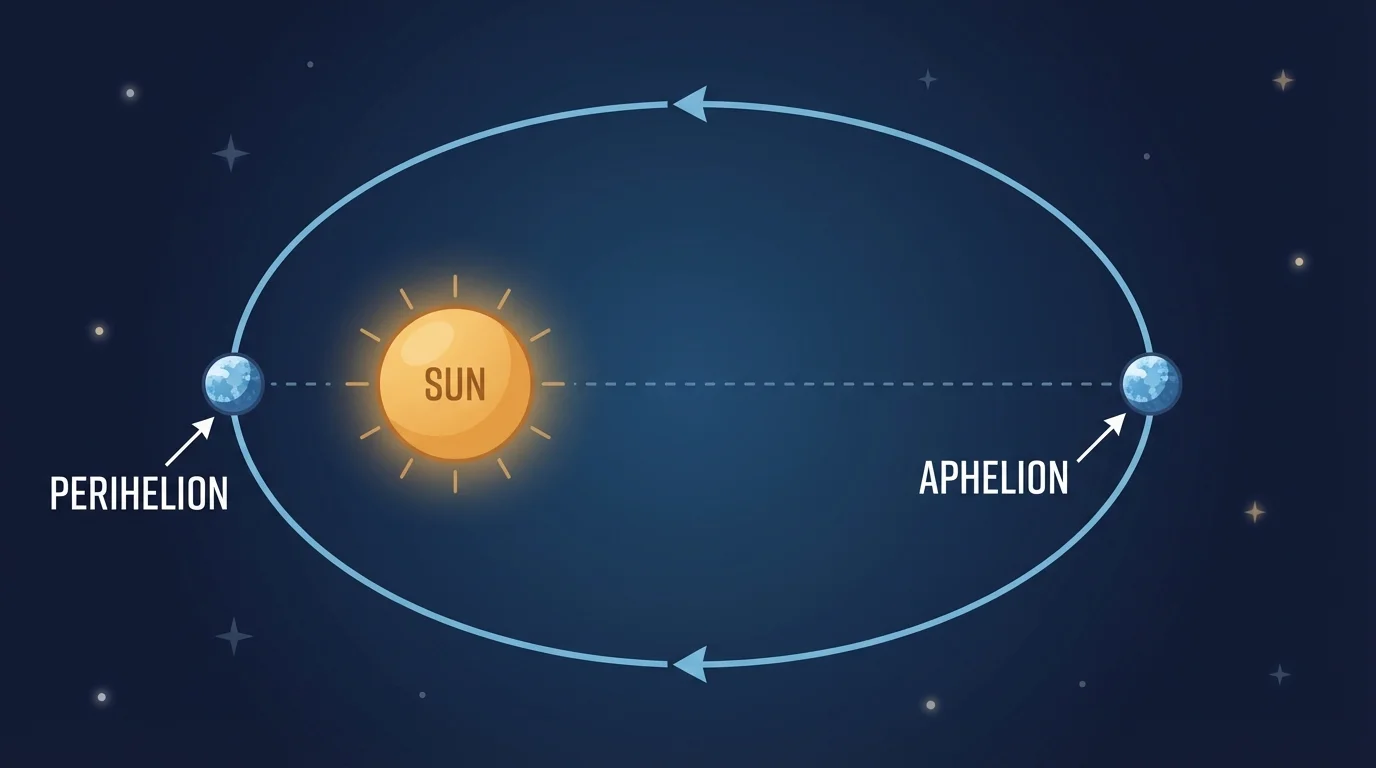
The amount by which an orbit differs from a circle is described by its eccentricity. An orbit with eccentricity close to zero is nearly circular. A more stretched ellipse has a larger eccentricity. Earth's orbit has low eccentricity, so it is close to circular, while many comets have much more elongated orbits.
Ellipse is a closed curve shaped like a stretched circle, with two foci.
Perihelion is the point in an object's orbit where it is closest to the Sun.
Aphelion is the point in an object's orbit where it is farthest from the Sun.
Eccentricity is a measure of how stretched an orbit is.
Because so many textbook drawings exaggerate the stretching, students often imagine all planetary orbits as highly elongated. In reality, most of the major planets have only mildly elliptical paths. The difference still matters, however, because even a small change in distance affects orbital speed and gravitational pull.
Kepler's First Law states that planets move in elliptical orbits with the Sun at one focus. This was a major breakthrough because earlier models often assumed circular motion. The first law replaced the idea that circles were the natural shape of planetary paths.
Mars provided especially important evidence. Its observed motion did not match a simple circle well enough, but an ellipse fit the data. This helped establish that the solar system follows mathematical patterns that can be tested against observation. As seen earlier in [Figure 1], placing the Sun at one focus correctly describes how the distance between a planet and the Sun changes during the orbit.
The first law applies beyond planets. Many asteroids follow elliptical paths around the Sun. Some comets travel on very elongated ellipses, spending most of their time far from the Sun and then swinging inward quickly. Earth satellites can also be placed in elliptical orbits for communication, observation, or scientific missions.
Kepler's Second Law says that a line joining a planet and the Sun sweeps out equal areas in equal times. [Figure 2] This means a planet does not move at a constant speed along its orbit. It travels faster when it is closer to the Sun and slower when it is farther away.
This rule makes sense when we connect it to gravity. When a planet is closer to the Sun, the gravitational attraction is stronger, so the planet speeds up. When it is farther away, the pull is weaker, so the planet slows down. The path remains continuous, but the speed changes throughout the orbit.
For example, a comet approaching the Sun can become dramatically faster near perihelion. This is one reason comets develop visible tails near the Sun: not only does solar heating increase, but the comet is also moving rapidly through the inner solar system.
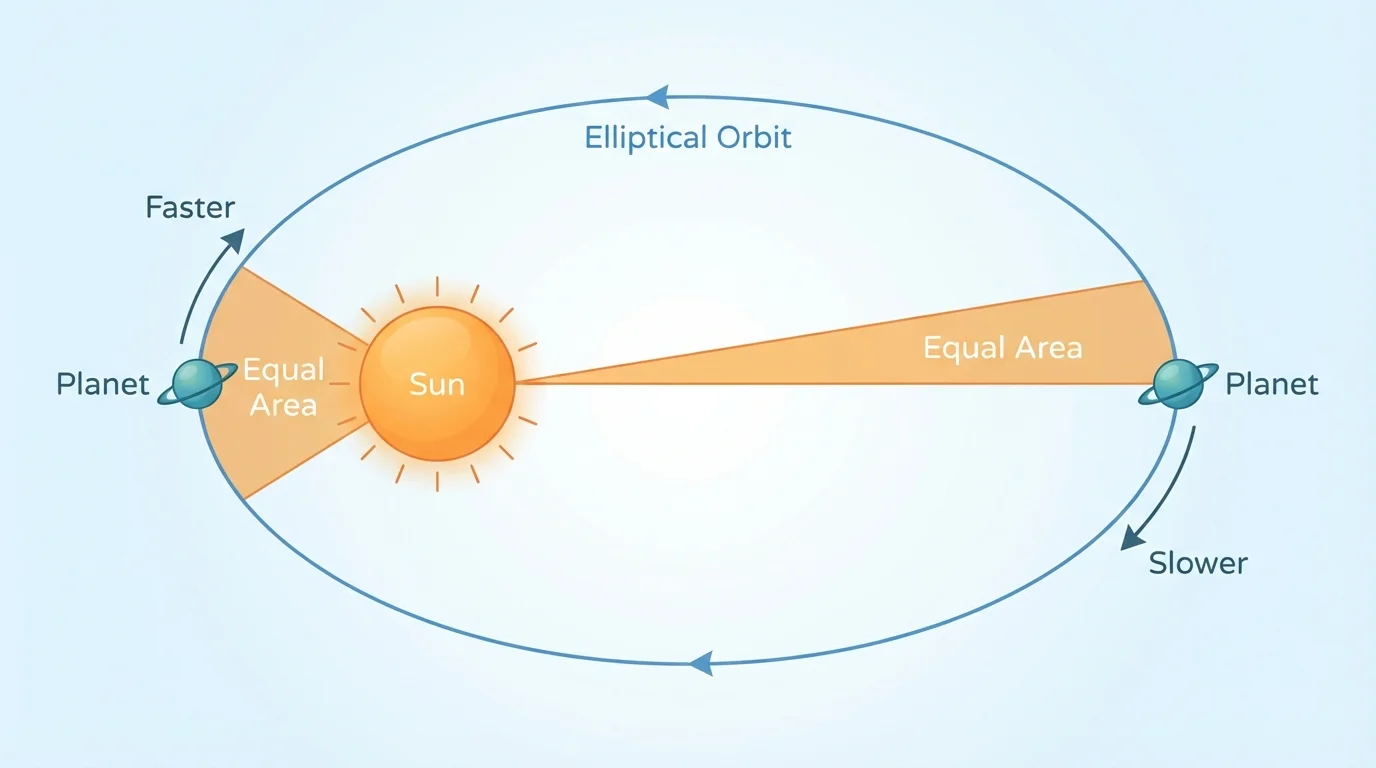
Earth follows this law too. Because Earth is slightly closer to the Sun in January, it moves a little faster then than it does in July. The effect is real but not large enough to control the seasons. The second law helps explain why orbital motion is a balance between changing gravitational force and forward motion.
Equal areas, different distances
If a planet sweeps out equal areas in the same amount of time, it must cover a longer stretch of its orbit when it is close to the Sun and a shorter stretch when it is farther away. The shape of the area changes, but the area itself stays the same for equal time intervals.
A useful way to think about the second law is to compare it to a skater spinning with arms pulled in and then extended outward. The details are not identical, but the comparison helps show why motion can become faster when distance from the center becomes smaller. In orbital motion, gravity continuously reshapes the path and speed.
Kepler's Third Law connects the size of an orbit to the time needed to complete it. In simple form for planets orbiting the Sun, the square of the orbital period is proportional to the cube of the average orbital distance:
\[T^2 \propto a^3\]
Here, orbital period means the time required to complete one orbit, and semi-major axis is half the longest diameter of the ellipse. The third law explains why planets with larger semi-major axes take much longer to go around the Sun than planets with smaller semi-major axes.
If we compare two planets orbiting the same star, we can write the law as
\[\frac{T_1^2}{T_2^2} = \frac{a_1^3}{a_2^3}\]
Numeric example: comparing Earth and Mars
Suppose Earth has an orbital period of \(1\) year and a semi-major axis of \(1\) astronomical unit. Mars has a semi-major axis of about \(1.52\) astronomical units. Find the orbital period of Mars.
Step 1: Set up the ratio
Using Earth as object \(2\), we have \(T_2 = 1\) and \(a_2 = 1\). Then \(T_1^2 = a_1^3\) for Mars in these units.
Step 2: Substitute the distance
\(T_1^2 = (1.52)^3 = 3.511808\)
Step 3: Take the square root
\(T_1 = \sqrt{3.511808} \approx 1.87\)
Mars takes about \(1.87\) years to orbit the Sun, which matches observations closely.
This law is powerful because it lets astronomers estimate orbital times from distances, and distances from orbital times. It is also used beyond our solar system. When astronomers observe an exoplanet repeatedly passing in front of its star, they can use the planet's orbital period to infer how far it is from that star.
The relationship is not just a pattern for planets around the Sun. With the proper form of the equation, it also applies to moons orbiting planets and satellites orbiting Earth. A low Earth satellite has a much shorter orbital period than the Moon because it is much closer to the object it orbits.
Kepler discovered the rules, but Newton later showed that gravity explains them. The gravitational force between two masses is given by
\[F = G\frac{m_1m_2}{r^2}\]
In this equation, \(F\) is gravitational force, \(G\) is the gravitational constant, \(m_1\) and \(m_2\) are the masses, and \(r\) is the distance between their centers. As \(r\) decreases, the force grows stronger. That is why objects move faster near perihelion and why distant planets orbit more slowly.
Numeric example: how force changes with distance
If the distance between the Sun and an object doubles, what happens to the gravitational force?
Step 1: Focus on the distance term
The force depends on \(\dfrac{1}{r^2}\).
Step 2: Replace \(r\) with \(2r\)
The new force is proportional to \(\dfrac{1}{(2r)^2} = \dfrac{1}{4r^2}\).
Step 3: Compare old and new values
The new force is \(\dfrac{1}{4}\) of the original force.
So doubling the distance makes the gravitational attraction four times weaker.
Orbital motion can also be understood as continuous falling. A planet is always being pulled toward the Sun, but it also has sideways motion. Instead of crashing straight inward, it keeps missing the Sun and following a curved path. The same idea explains why the Moon remains in orbit around Earth and why satellites can stay above our planet for long periods.
Strictly speaking, both bodies orbit a shared center of mass called a barycenter. In the Sun-planet system, that point is usually inside the Sun because the Sun is so massive. In other systems, such as some star-star pairs, the barycenter can be located in empty space between the two stars.
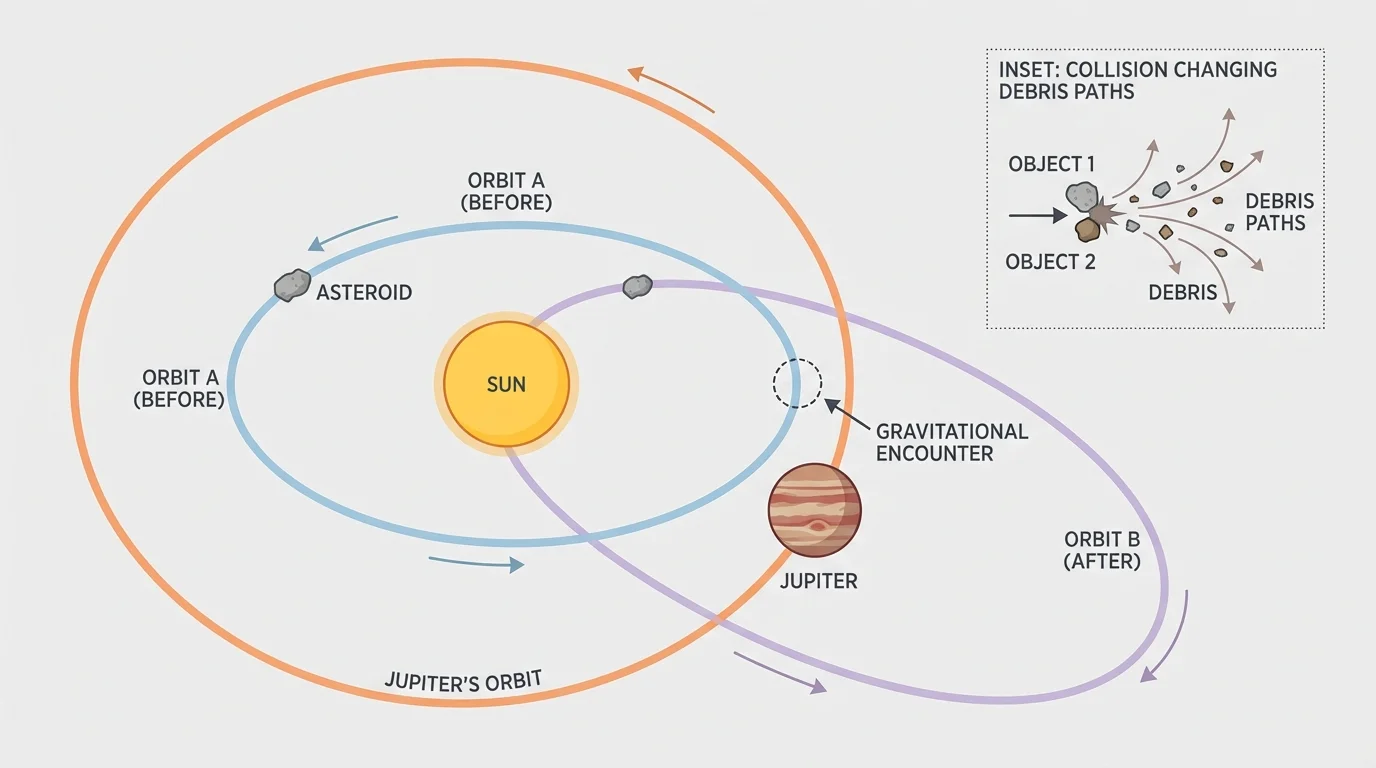
Although Kepler's laws describe the main patterns well, real solar-system motion is affected by more than one object at a time. A perturbation is a small change in an orbit caused by the gravitational pull of another body. [Figure 3] Over time, many small perturbations can noticeably alter the shape, orientation, or tilt of an orbit.
Jupiter has a particularly strong influence because it is so massive. Many asteroids have orbits that are shaped by repeated interactions with Jupiter. Some are nudged into new paths; others are kept out of certain orbital zones. These long-term gravitational effects help organize the structure of the asteroid belt.
In some cases, objects enter resonance, which happens when orbital periods form simple ratios such as \(2:1\) or \(3:2\). Repeated gravitational tugs then occur at regular intervals. Resonance can stabilize an orbit, but it can also make an orbit more extreme. Pluto, for example, is in resonance with Neptune, which helps prevent collisions even though their paths seem to overlap when viewed from above.
Collisions can also change orbits dramatically. When asteroids collide, fragments can be sent into new paths. A collision can alter speed, direction, spin, and shape. If a large enough impact occurs, debris may spread out into a family of related objects. Some meteoroid streams that create meteor showers on Earth come from debris left behind by comets or collisions involving small bodies.
Comets are especially sensitive to change. When a comet passes near a planet, gravity can bend its orbit. In some cases, the comet may be thrown into a shorter-period orbit; in others, it may be pushed outward or even ejected from the solar system. Long-period comets from the distant outer regions can therefore become short-period comets after repeated gravitational encounters.
Scientists also study tiny non-collision effects. For some small bodies, radiation from the Sun can gradually alter motion over very long times. These effects are usually much weaker than direct gravity, but across millions of years they can matter. Real orbital evolution is therefore a combination of major forces and subtle influences.
The earlier geometry becomes important again here: an orbit is not a permanent track painted into space. The ellipse itself can rotate, stretch, shrink, or tilt. What [Figure 1] presents as a single stable ellipse is often only a snapshot of a changing system when other gravitational influences are included.
Kepler's laws are not just historical ideas. Space agencies use them whenever they plan missions. A spacecraft sent from Earth to another planet follows an orbit around the Sun, and mission planners calculate where both planets will be months later, not where they are at launch. This requires precise understanding of orbital period, orbital shape, and changing speed.
Mercury orbits the Sun in only about \(88\) days, while Neptune takes about \(165\) Earth years to orbit the Sun. The enormous difference follows naturally from Kepler's third law because Neptune's orbit is far larger.
Earth satellites provide another practical example. A satellite in low Earth orbit moves quickly and circles Earth in a few hours, while a geostationary satellite takes \(24\) hours and stays above nearly the same point on Earth's equator. Different orbital distances produce different periods, just as Kepler's third law predicts.
Planetary defense depends on these ideas too. To determine whether an asteroid could threaten Earth, astronomers measure its position repeatedly and calculate its orbit. Then they account for perturbations from planets, especially Jupiter, and for possible long-term changes. The effect of gravitational encounters, as shown earlier in [Figure 3], can be crucial in predicting future risk.
Eclipses can also be predicted because the motions of Earth and the Moon are regular. Although the Moon's orbit is around Earth rather than the Sun, the same orbital principles apply: elliptical paths, changing speed, and repeating periods make future alignments calculable.
Kepler's laws work best in a simplified two-body system, where one object orbits another and outside influences are ignored. The real solar system contains many bodies interacting at once. Because of that, no orbit is perfectly fixed forever.
Some orbits slowly rotate in space, a process called precession. Others become more or less eccentric over long intervals. Even Earth's orbit changes slightly over time, contributing to long-term climate cycles when combined with changes in axial tilt and precession. These changes are gradual, but they show that orbital systems evolve.
Still, the overall picture remains one of remarkable order. The planets do not wander randomly. Their paths follow laws that can be measured, compared, and used to predict future positions. Kepler's insight turned the sky from a mystery into a system governed by patterns that still guide modern astronomy.
"The motions of the heavens are not chaotic accidents but lawful patterns that can be discovered."
— Idea inspired by the scientific revolution
Understanding these laws deepens our view of Earth's place in the universe. Earth is one orbiting world among many, shaped by the same gravity that governs moons, planets, asteroids, comets, and spacecraft. At the same time, Earth exists in a solar system where interactions continue to reshape motion. Stability and change are both part of the story.
