A pilot flying through a strong crosswind does not simply care about how fast the plane moves. The pilot also needs to know which way the plane is moving. That difference is the doorway into one of the most useful ideas in mathematics and science: some quantities are completely described by a number, while others need both a number and a direction. Those direction-based quantities are essential in physics, engineering, navigation, computer graphics, and even sports analysis.
A scalar quantity has magnitude only. In other words, it tells how much of something there is, but not which way it points. Examples include temperature, mass, time, distance, and speed. If a car travels at speed \(60 \textrm{ km/h}\), the number tells how fast it is going, but not whether it is moving north, south, or in any other direction.
A vector quantity has both magnitude and direction. Examples include displacement, velocity, force, and acceleration. If a car has velocity \(60 \textrm{ km/h}\) east, that description is more complete than speed alone because it includes both size and direction.
Scalar quantity means a quantity described by magnitude only.
Vector quantity means a quantity described by both magnitude and direction.
This distinction matters because two objects can have the same magnitude but represent very different situations if their directions differ. A force of \(10 \textrm{ N}\) upward is not the same as a force of \(10 \textrm{ N}\) downward. The magnitudes match, but the vectors are different.
The magnitude of a vector is its size or length. Depending on the context, magnitude might measure distance, speed, force, or another quantity. The direction tells where the vector points. A vector is incomplete without both parts.
For example, suppose one person walks \(5 \textrm{ m}\) north and another walks \(5 \textrm{ m}\) south. Each person has traveled the same magnitude, \(5 \textrm{ m}\), but their displacements are different because the directions are opposite.
In many situations, changing either the magnitude or the direction creates a different vector. Compare these three examples:
The first and second vectors have the same magnitude but opposite directions. The first and third have the same direction but different magnitudes. Since a vector needs both pieces of information, all three are different.
Why direction changes the quantity
Vectors model change in position or influence in space. If you push a box with a force of \(20 \textrm{ N}\), the box responds differently depending on whether you push left, right, upward, or at an angle. The number alone cannot describe the full effect. Direction is part of the quantity itself, not an extra detail.
One useful way to think about vectors is that they answer two questions at once: How much? and Which way? Scalars answer only the first question.
[Figure 1] A vector can be represented by a directed line segment. This is a line segment with an arrowhead on one end. The length of the segment represents the magnitude, and the arrowhead shows the direction.
The starting point is often called the tail, and the endpoint with the arrowhead is called the head. If the segment starts at point \(A\) and ends at point \(B\), the vector points from \(A\) to \(B\). If you reverse the arrow, you get a different vector.
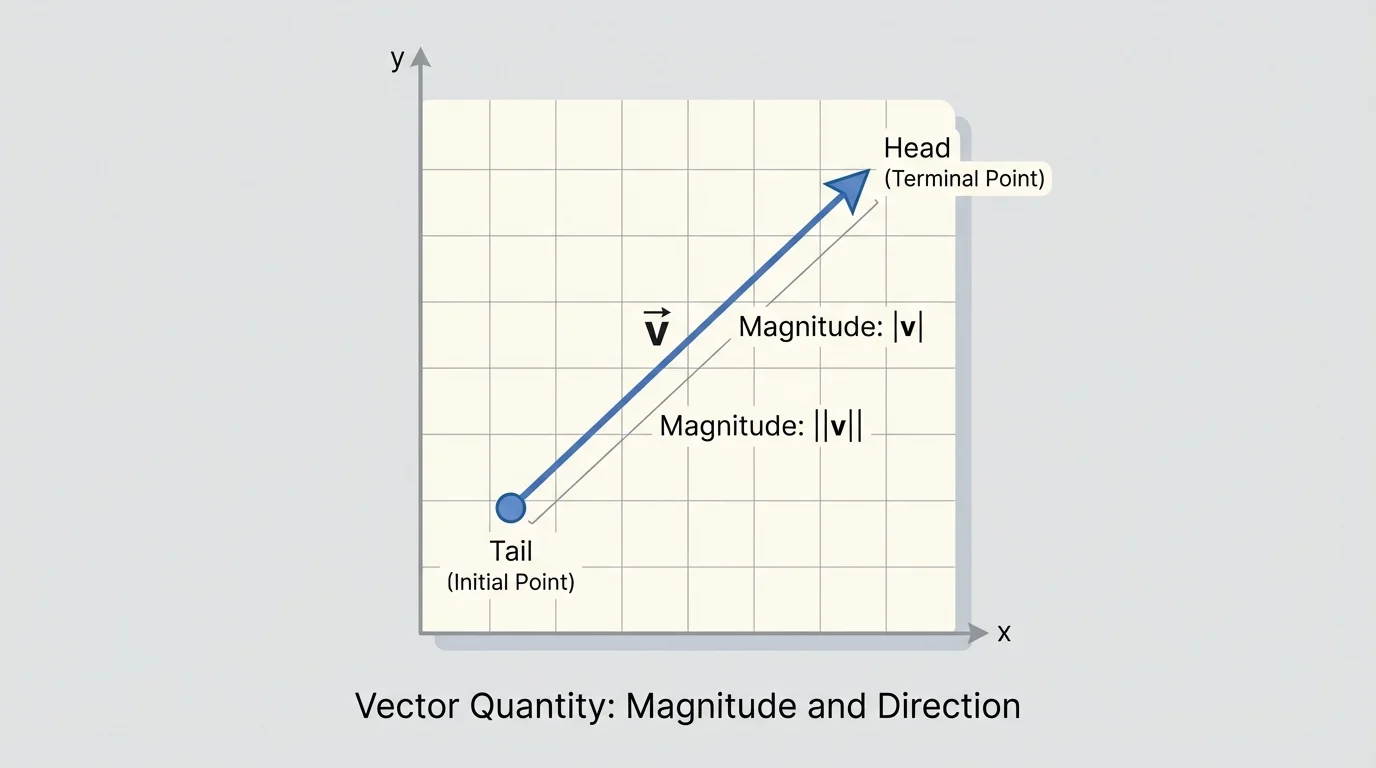
A directed line segment does not have to stay in one exact location to represent the same vector. If two arrows have the same length and point in the same direction, they represent the same vector even if they are drawn in different places. This idea is important because vectors describe movement or effect, not just location.
Suppose one arrow shows a displacement of \(4\) units right and \(3\) units up. Another arrow elsewhere on the page also shows \(4\) units right and \(3\) units up. These are equivalent vectors because they have the same magnitude and the same direction.
Later, when you work with components, the picture in [Figure 1] remains useful because it reminds you that a vector is not just a pair of numbers. It is a directed quantity represented visually by an arrow.
[Figure 2] Mathematicians use special notation to distinguish a vector from its magnitude. A vector may be written with an arrow over the letter, such as \(\vec{v}\), or in boldface, such as \(\mathbf{v}\). Both notations mean the vector itself.
The magnitude of a vector is written using absolute value bars or double bars. For example, the magnitude of \(\vec{v}\) may be written as \(|\vec{v}|\), and the magnitude of \(\mathbf{v}\) may be written as \(\|\mathbf{v}\|\). These symbols refer only to the size of the vector, not its direction.
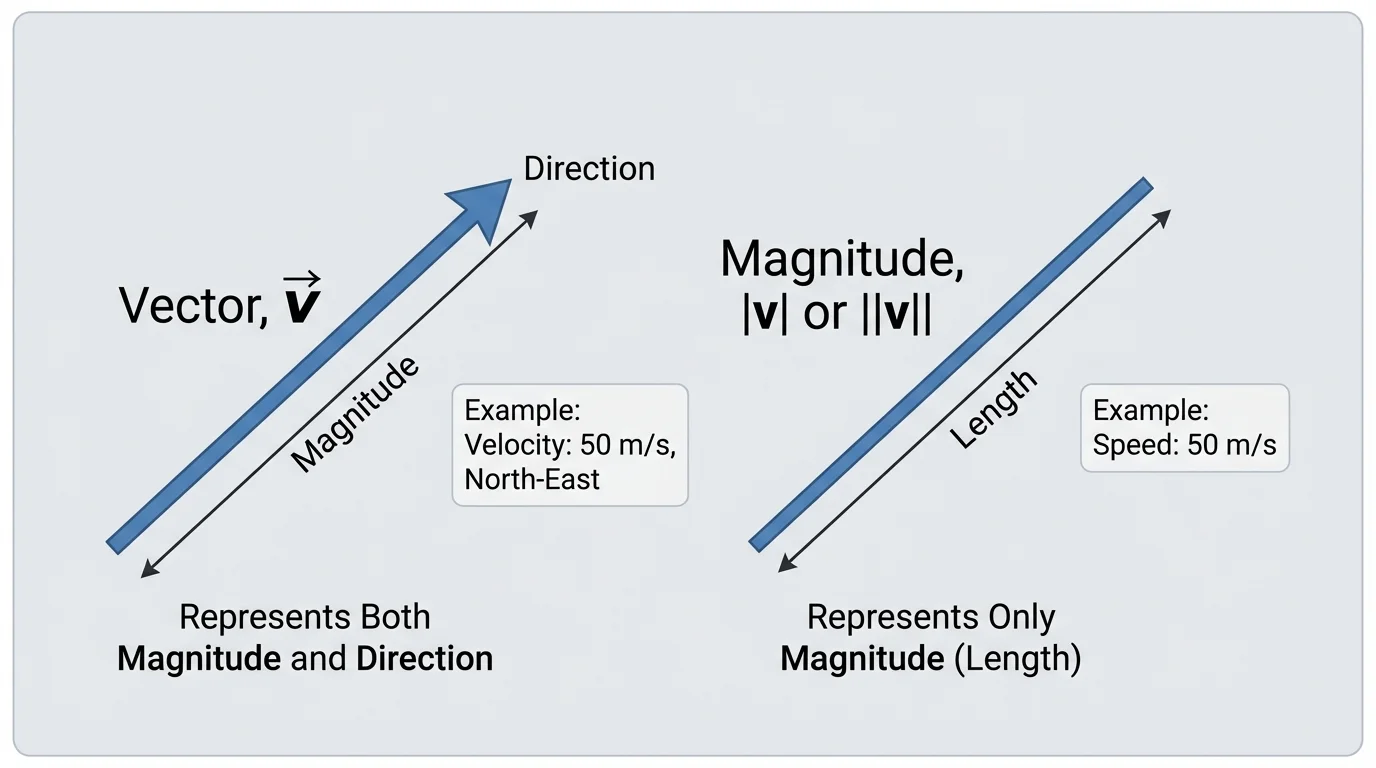
This distinction is extremely important. The notation \(\vec{v}\) means the full vector, including direction. The notation \(|\vec{v}|\) means only how long the vector is. If \(\vec{v}\) points west, \(|\vec{v}|\) does not include the word west. It is just a nonnegative number.
For instance, if \(\vec{v}\) represents a displacement of \(7 \textrm{ m}\) north, then \(|\vec{v}| = 7\). The vector and its magnitude are related, but they are not the same object. One is directional; the other is scalar.
| Notation | Meaning | Type |
|---|---|---|
| \(\vec{v}\) | The vector \(v\) | Vector |
| \(\mathbf{v}\) | The vector \(v\) written in bold | Vector |
| \(|\vec{v}|\) | Magnitude of \(\vec{v}\) | Scalar |
| \(\|\mathbf{v}\|\) | Magnitude of \(\mathbf{v}\) | Scalar |
Table 1. Common notation used to distinguish vectors from their magnitudes.
When you look back at [Figure 2], notice that the arrow symbol and the magnitude notation serve different jobs. Good notation prevents mistakes, especially in physics and coordinate geometry.
Absolute value bars in earlier algebra measured distance from zero on a number line. Magnitude notation uses a similar idea: it measures size. For vectors, that size is the vector's length.
Equivalent vectors are vectors with the same magnitude and the same direction. They do not need to begin at the same point. If one arrow is translated without being rotated or stretched, the new arrow represents an equivalent vector.
This is one reason vectors are so powerful in modeling. A wind vector, for example, can be moved on a weather map while still representing the same wind speed and direction. The position of the drawing is often less important than the vector itself.
There is also a special vector called the zero vector. Its magnitude is \(0\), so it has no length. Because it has no length, its direction is not usually considered meaningful in the same way as nonzero vectors. It can represent no movement, no force, or no change.
Computer animation and video games use vectors constantly. Motion on the screen, camera direction, lighting, and even the orientation of surfaces are often controlled by vectors behind the scenes.
If a person starts at one point and ends at the same point, the displacement vector is the zero vector. The person may have walked around a track, but the displacement from start to finish is still \(0\).
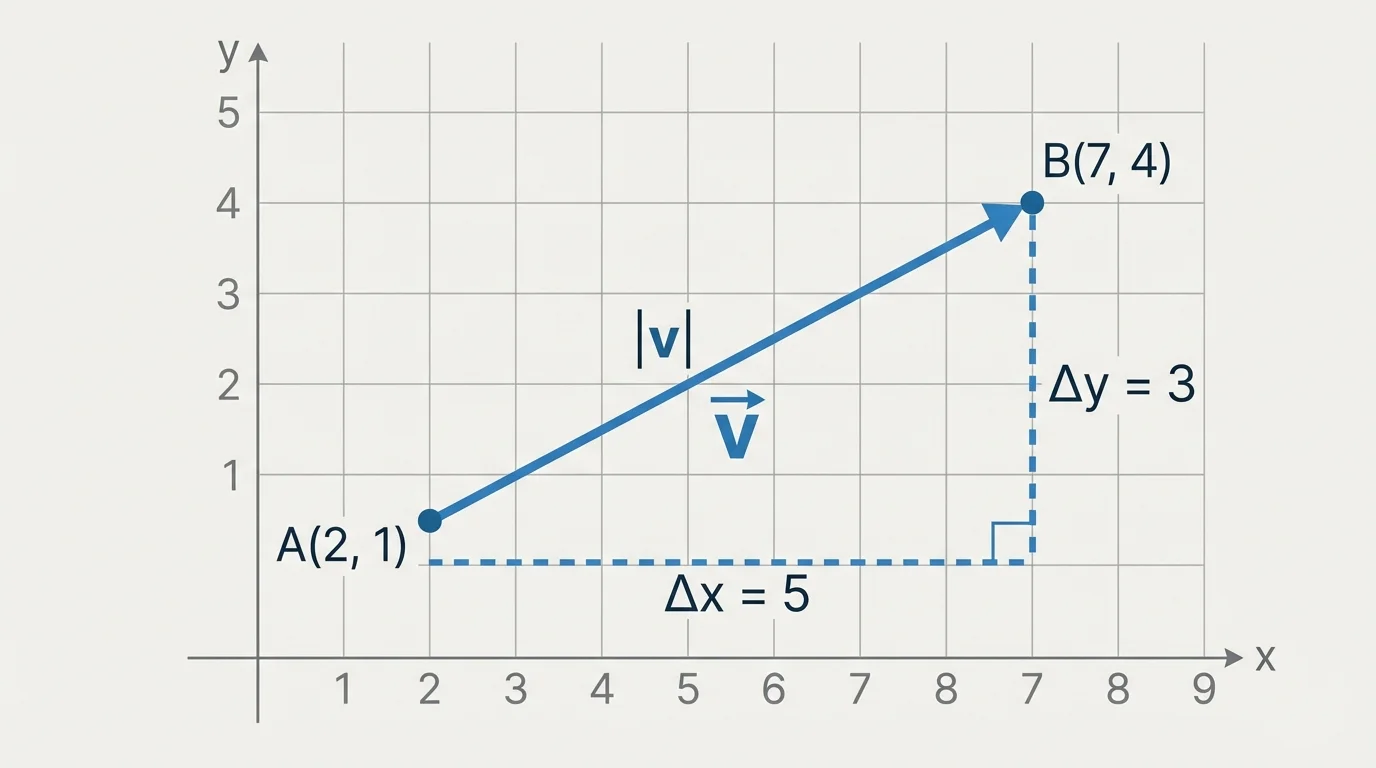
[Figure 3] Vectors are often written using component form, especially on a coordinate plane. In component form, a vector is described by its horizontal and vertical change. A vector that moves \(a\) units right and \(b\) units up may be written as \(\langle a, b \rangle\).
If a vector starts at \((x_1, y_1)\) and ends at \((x_2, y_2)\), then its components are found by subtracting coordinates: horizontal change \(x_2 - x_1\), vertical change \(y_2 - y_1\). So the vector can be written as \(\langle x_2 - x_1, y_2 - y_1 \rangle\).
For example, from \((2,1)\) to \((7,4)\), the horizontal change is \(7 - 2 = 5\) and the vertical change is \(4 - 1 = 3\). So the vector is \(\langle 5, 3 \rangle\).
Component form makes it easier to compare vectors and compute magnitudes. For a vector \(\langle a, b \rangle\), the magnitude is found using the Pythagorean Theorem:
\[|\langle a,b \rangle| = \sqrt{a^2 + b^2}\]
If \(\vec{u} = \langle 5, 3 \rangle\), then \(|\vec{u}| = \sqrt{5^2 + 3^2} = \sqrt{25 + 9} = \sqrt{34}\). This number gives the length of the directed segment. The picture in [Figure 3] helps explain why the Pythagorean Theorem applies: the horizontal and vertical components form the legs of a right triangle.
Position versus displacement
A point such as \((4,2)\) gives a location. A vector such as \(\langle 4,2 \rangle\) gives a change in position. These ideas are related but not identical. A point tells where something is; a vector tells how far and in what direction it moves.
Worked examples make the notation and ideas more concrete. Pay attention to whether the final answer should be a vector or a scalar magnitude.
Example 1: Identify scalar and vector quantities
Classify each quantity as a scalar or a vector: \(12 \textrm{ s}\), \(35 \textrm{ m/s}\) north, \(8 \textrm{ kg}\), and \(20 \textrm{ N}\) downward.
Step 1: Check whether each quantity has direction.
Time \(12 \textrm{ s}\) has magnitude only, so it is a scalar.
Velocity \(35 \textrm{ m/s}\) north has magnitude and direction, so it is a vector.
Step 2: Continue with the remaining quantities.
Mass \(8 \textrm{ kg}\) has magnitude only, so it is a scalar.
Force \(20 \textrm{ N}\) downward has magnitude and direction, so it is a vector.
The scalar quantities are \(12 \textrm{ s}\) and \(8 \textrm{ kg}\). The vector quantities are \(35 \textrm{ m/s}\) north and \(20 \textrm{ N}\) downward.
Notice that units alone do not determine whether something is a vector. Direction is the key test.
Example 2: Find a vector in component form
Find the vector from point \((1,2)\) to point \((6,8)\).
Step 1: Subtract the x-coordinates.
The horizontal change is \(6 - 1 = 5\).
Step 2: Subtract the y-coordinates.
The vertical change is \(8 - 2 = 6\).
Step 3: Write the vector.
The vector is \(\langle 5, 6 \rangle\).
The directed line segment goes \(5\) units right and \(6\) units up, so the vector is \(\langle 5,6 \rangle\).
If the order of the points were reversed, the vector would be \(\langle -5,-6 \rangle\), which points in the opposite direction.
Example 3: Find the magnitude of a vector
Let \(\vec{w} = \langle 3,4 \rangle\). Find \(|\vec{w}|\).
Step 1: Use the magnitude formula.
For \(\langle a,b \rangle\), magnitude is \(\sqrt{a^2 + b^2}\).
Step 2: Substitute the values.
\(|\vec{w}| = \sqrt{3^2 + 4^2} = \sqrt{9 + 16}\).
Step 3: Simplify.
\(|\vec{w}| = \sqrt{25} = 5\).
\[|\vec{w}| = 5\]
This result is a scalar, not a vector. The answer is just \(5\), not \(\langle 3,4 \rangle\).
Example 4: Distinguish a vector from its magnitude
A boat's velocity is represented by \(\vec{v} = \langle -2, 5 \rangle\). State what \(\vec{v}\) and \(|\vec{v}|\) mean.
Step 1: Interpret the vector itself.
\(\vec{v} = \langle -2,5 \rangle\) means the motion has a horizontal component of \(-2\) and a vertical component of \(5\). It describes both size and direction.
Step 2: Find the magnitude.
\(|\vec{v}| = \sqrt{(-2)^2 + 5^2} = \sqrt{4 + 25} = \sqrt{29}\).
Step 3: Interpret the result.
\(|\vec{v}|\) is the speed. It does not include direction.
So \(\vec{v}\) is the full vector, while \(|\vec{v}| = \sqrt{29}\) is only its magnitude.
Vectors are not just abstract arrows on paper. They are the language of motion and force in the real world.
In physics, forces are vectors. If two people push a cart from different directions, the overall effect depends on both how hard they push and in which directions they push. The vector description captures that situation accurately.
In navigation, pilots and ship captains use vectors to track motion through air or water. A plane may aim one direction while the wind pushes another. The actual path depends on the combination of those vectors.
In sports, the path of a soccer ball or basketball depends on the velocity vector at launch. A stronger kick changes magnitude; aiming differently changes direction. Both matter.
In computer graphics, vectors control movement, lighting, and orientation. When a video game character turns or a camera pans across a digital world, vectors help the system calculate position and direction efficiently.
"Mathematics reveals its power when it describes the world with precision."
Even weather forecasts use vectors. Wind maps use arrows to show both speed and direction, which is exactly what a vector represents. This is the same idea you have already seen in directed line segments and component form.
One common mistake is confusing a vector with its magnitude. Remember that \(\vec{a}\) and \(|\vec{a}|\) are not interchangeable. The first is directional; the second is scalar.
Another mistake is reversing the order of points when finding a vector from coordinates. The vector from \((x_1,y_1)\) to \((x_2,y_2)\) is \(\langle x_2-x_1, y_2-y_1 \rangle\), not \(\langle x_1-x_2, y_1-y_2 \rangle\).
Students also sometimes think two vectors drawn in different places must be different. That is false if the arrows have the same length and direction. Equivalent vectors can be translated without changing their identity.
Finally, do not ignore direction words like north, south, left, or upward. In vector work, those words are part of the quantity itself.
