Have you ever counted a big pile of things and wished there were a faster way? Mathematicians do that too. Instead of counting one by one all the way to \(100\), we can make smart groups. When we group \(10\) tens together, we get something new and important: \(1\) hundred.
We start with ones. One block, one bead, or one cube means \(1\) one. If we put \(10\) ones together, we can make one ten. As shown in [Figure 1], if we keep going and make \(10\) tens, we have a much bigger group. That bigger group is \(100\).
So we can say this important idea in two ways: \(100\) is \(100\) ones, and \(100\) is also \(10\) tens. A bundle of \(10\) tens is called a hundred.
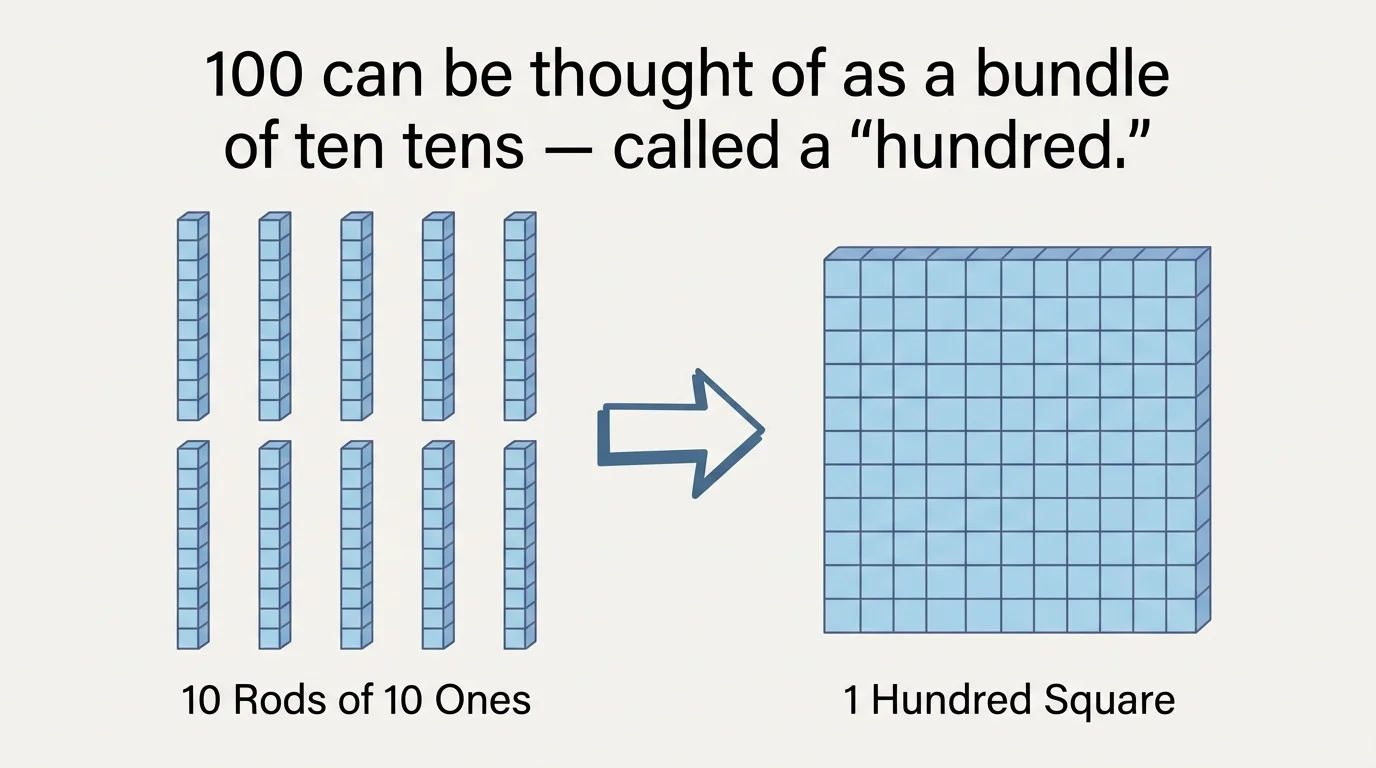
Here is the relationship:
\[10 \textrm{ ones} = 1 \textrm{ ten}\]
\[10 \textrm{ tens} = 1 \textrm{ hundred}\]
This is called our place value system. The value of a digit depends on where it is. A \(1\) in the ones place means \(1\). A \(1\) in the tens place means \(10\). A \(1\) in the hundreds place means \(100\).
Hundred means one bundle of \(10\) tens. Since each ten is \(10\), one hundred is \(10 \times 10 = 100\).
Tens are groups of \(10\) ones, and ones are single units.
Thinking in bundles helps us count faster and understand larger numbers more easily. Instead of saying "\(10\) tens" every time, we use the shorter name "\(1\) hundred."
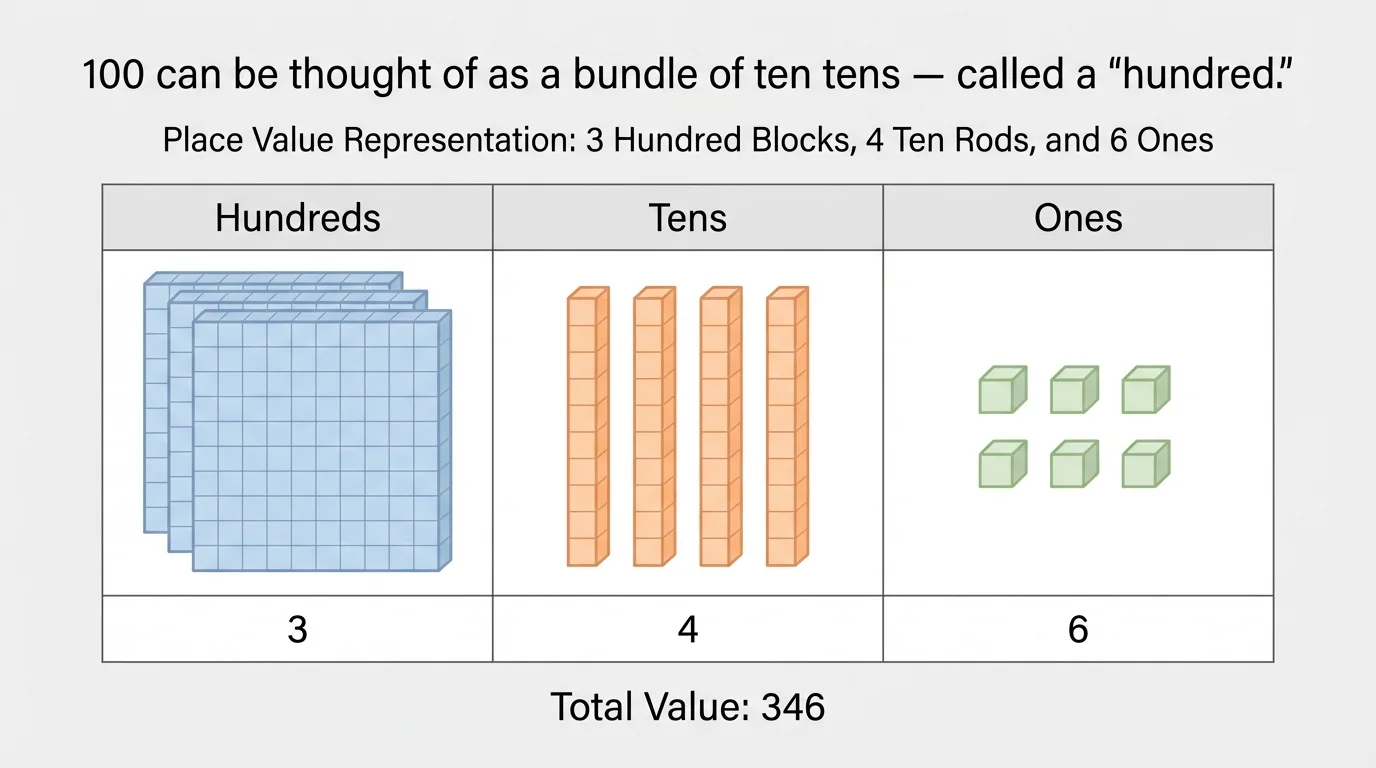
Three-digit numbers are made of hundreds, tens, and ones. A digit in each place tells how many groups there are. A place value chart, as shown in [Figure 2], helps us see the number clearly.
For example, the number \(346\) means \(3\) hundreds, \(4\) tens, and \(6\) ones. That means:
\[346 = 300 + 40 + 6\]
The \(3\) does not mean just \(3\). It means \(3\) hundreds, which is \(300\). The \(4\) means \(4\) tens, which is \(40\). The \(6\) means \(6\) ones.
This idea helps us understand special numbers too. The number \(100\) has \(1\) hundred, \(0\) tens, and \(0\) ones. We can write:
\[100 = 1 \textrm{ hundred} + 0 \textrm{ tens} + 0 \textrm{ ones}\]
That is why \(100\) is the first number with a digit in the hundreds place.
Why ten tens becomes one hundred
Our number system is based on groups of \(10\). Every time we collect \(10\) of one unit, we trade them for \(1\) of the next larger unit. So \(10\) ones become \(1\) ten, and \(10\) tens become \(1\) hundred.
This trading idea is very important in math. It is the same idea we use later when we add, subtract, and regroup numbers.
Let's read some numbers by saying how many hundreds, tens, and ones they have.
The number \(120\) means \(1\) hundred, \(2\) tens, and \(0\) ones.
\[120 = 100 + 20 + 0\]
The number \(305\) means \(3\) hundreds, \(0\) tens, and \(5\) ones.
\[305 = 300 + 0 + 5\]
The number \(706\) means \(7\) hundreds, \(0\) tens, and \(6\) ones.
\[706 = 700 + 0 + 6\]
Notice how the digits tell the story of the number. Even when a place has no tens or no ones, we still show that place with \(0\). That keeps every digit in the correct spot.
You already know that \(10\) ones make \(1\) ten. Now you are building on that idea: \(10\) tens make \(1\) hundred.
We can also build numbers in words. If a number has \(2\) hundreds, \(5\) tens, and \(3\) ones, then it is \(253\).
\[253 = 200 + 50 + 3\]
Worked example 1
How many tens are in \(100\)?
Step 1: Start with what one ten means.
One ten is \(10\).
Step 2: Count by tens until you reach \(100\).
\(10, 20, 30, 40, 50, 60, 70, 80, 90, 100\)
Step 3: Count the tens.
There are \(10\) tens.
So, \(100 = 10 \textrm{ tens}\).
This example shows why \(100\) is called one hundred. It is one big bundle made from \(10\) tens.
Worked example 2
What does the number \(148\) mean in hundreds, tens, and ones?
Step 1: Look at each digit and its place.
In \(148\), the digits are \(1\), \(4\), and \(8\).
Step 2: Match each digit to its place value.
The \(1\) is in the hundreds place, so it means \(1\) hundred.
The \(4\) is in the tens place, so it means \(4\) tens.
The \(8\) is in the ones place, so it means \(8\) ones.
Step 3: Write the number in expanded form.
\[148 = 100 + 40 + 8\]
The number \(148\) is \(1\) hundred, \(4\) tens, and \(8\) ones.
Reading numbers this way helps you understand what each digit is really worth.
Worked example 3
A number has \(3\) hundreds, \(0\) tens, and \(7\) ones. What is the number?
Step 1: Write the hundreds digit.
\(3\) hundreds means the hundreds digit is \(3\).
Step 2: Write the tens digit.
\(0\) tens means the tens digit is \(0\).
Step 3: Write the ones digit.
\(7\) ones means the ones digit is \(7\).
Step 4: Put the digits together.
\(307\)
The number is \(307\).
Notice that the zero is important. Without it, \(37\) would mean \(3\) tens and \(7\) ones, which is a very different number.
Worked example 4
How many ones are in \(1\) hundred?
Step 1: Recall that \(1\) ten is \(10\) ones.
Step 2: Recall that \(1\) hundred is \(10\) tens.
Step 3: Multiply the number of tens by the ones in each ten.
\(10 \times 10 = 100\)
So \(1\) hundred is \(100\) ones.
Sometimes students think a \(0\) means "nothing important." But in place value, \(0\) has a very important job. It holds a place when there are no groups there.
In \(100\), the \(0\) in the tens place means there are no tens left after making \(1\) hundred. The \(0\) in the ones place means there are no extra ones. In \(706\), the \(0\) means there are no tens, just \(7\) hundreds and \(6\) ones.
As we saw earlier with \(346\) in [Figure 2], each digit must stay in its own place. Zero helps keep the number's meaning correct.
The number \(100\) is often used as a special milestone. People talk about \(100\) days of school, \(100\) points in a game, or a race that is \(100\) meters long because \(100\) is a strong, complete bundle in our base-ten system.
Zero is like an empty seat label. Even when no one is sitting there, the seat still matters because it tells everyone else where to go.
Bundling tens into hundreds is not just a school idea. People use it in real life all the time. A store may put straws into packs of \(10\), then pack \(10\) of those bundles into a box of \(100\). A teacher may count \(100\) stickers by making groups of \(10\).
Money gives another useful example. If you have \(10\) dimes, and each dime is worth \(10\) cents, then the total is \(100\) cents. And \(100\) cents is \(\$1.00\). The same grouping idea appears again: \(10\) groups of \(10\) make \(100\).
When people count large collections, grouping saves time and reduces mistakes. Instead of counting \(1, 2, 3, 4, ...\) all the way to \(100\), they can count \(10, 20, 30, ...\) by tens.
When we count by tens, we see a pattern on the number line, as shown in [Figure 3]. The ones digit stays \(0\), and the tens digit grows: \(10, 20, 30, 40, 50, 60, 70, 80, 90\).
Then an important change happens. After \(90\), adding one more ten gives \(100\). The tens have bundled into a hundred.
\[90 + 10 = 100\]
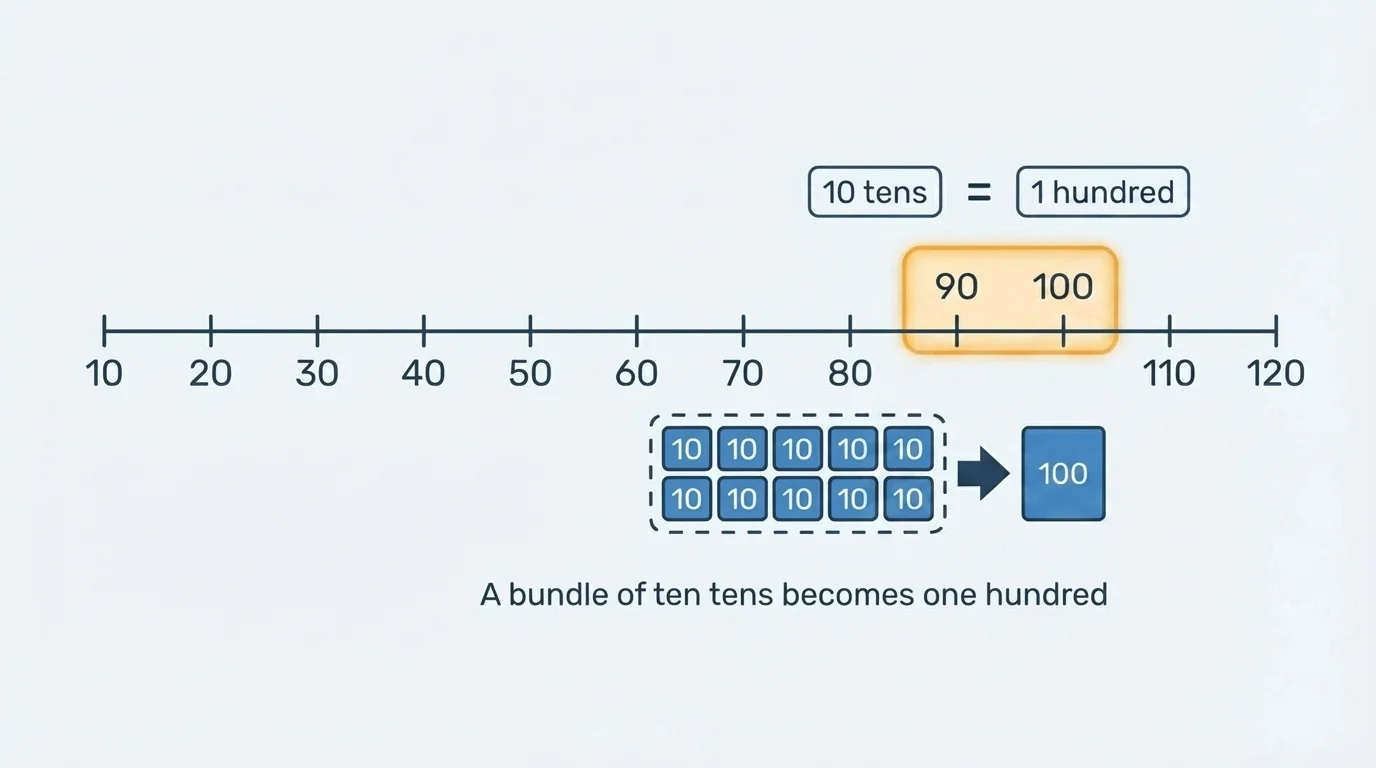
Now the number has \(1\) in the hundreds place and \(0\) in the tens place. That is because all \(10\) tens have been traded for \(1\) hundred.
We can keep counting by tens after \(100\): \(100, 110, 120, 130\), and so on. In \(110\), there are \(1\) hundred and \(1\) ten. In \(120\), there are \(1\) hundred and \(2\) tens.
| Number | Hundreds | Tens | Ones |
|---|---|---|---|
| \(100\) | \(1\) | \(0\) | \(0\) |
| \(110\) | \(1\) | \(1\) | \(0\) |
| \(120\) | \(1\) | \(2\) | \(0\) |
| \(130\) | \(1\) | \(3\) | \(0\) |
Table 1. Numbers counted by tens after \(100\), showing hundreds, tens, and ones.
The jump from \(90\) to \(100\) is an important place value change. On the number line in [Figure 3], that step shows ten tens becoming one hundred.
"Small groups can build big numbers."
— A place value idea
Once you understand \(100\) as a bundle of \(10\) tens, three-digit numbers make much more sense. You can look at a number and know how many hundreds, tens, and ones it contains.
