Suppose \(5\) friends each get \(4\) stickers. You could count one by one, but that would take a while. A faster way is to think, "There are \(5\) groups of \(4\)." That is multiplication. Now suppose there are \(20\) stickers and you want to share them equally among \(5\) friends. That is division. Multiplication and division are like teammates: each one helps you understand the other.
We use multiplication and division all the time. A baker puts \(6\) muffins in each box. A coach forms \(4\) teams with the same number of players. A teacher puts \(8\) crayons on each table. These situations are about putting things into equal groups or sharing them fairly.
When you become fluent with facts within \(100\), your brain can solve problems faster and with more confidence. Fluency means you can choose a strategy when you need one, and over time many facts become quick to remember.
You already know how to count, add, and subtract. Multiplication builds on repeated addition, and division connects to subtraction and equal sharing.
That is why learning facts such as \(7 \times 4 = 28\) and \(28 \div 7 = 4\) is so important. These facts help in math now and in later grades too.
Array models help us see multiplication clearly. [Figure 1] An array is a set of objects arranged in rows and columns. If there are \(4\) rows with \(6\) stars in each row, then there are \(4 \times 6 = 24\) stars altogether.
Multiplication means combining equal groups. For example, \(3 \times 5\) means \(3\) groups of \(5\). You can also think of it as repeated addition: \(5 + 5 + 5 = 15\). So \(3 \times 5 = 15\).
Division means splitting into equal groups or finding how many equal groups there are. If \(15\) cookies are shared equally among \(3\) children, each child gets \(15 \div 3 = 5\) cookies. If you make groups of \(5\) from \(15\) cookies, you can make \(15 \div 5 = 3\) groups.
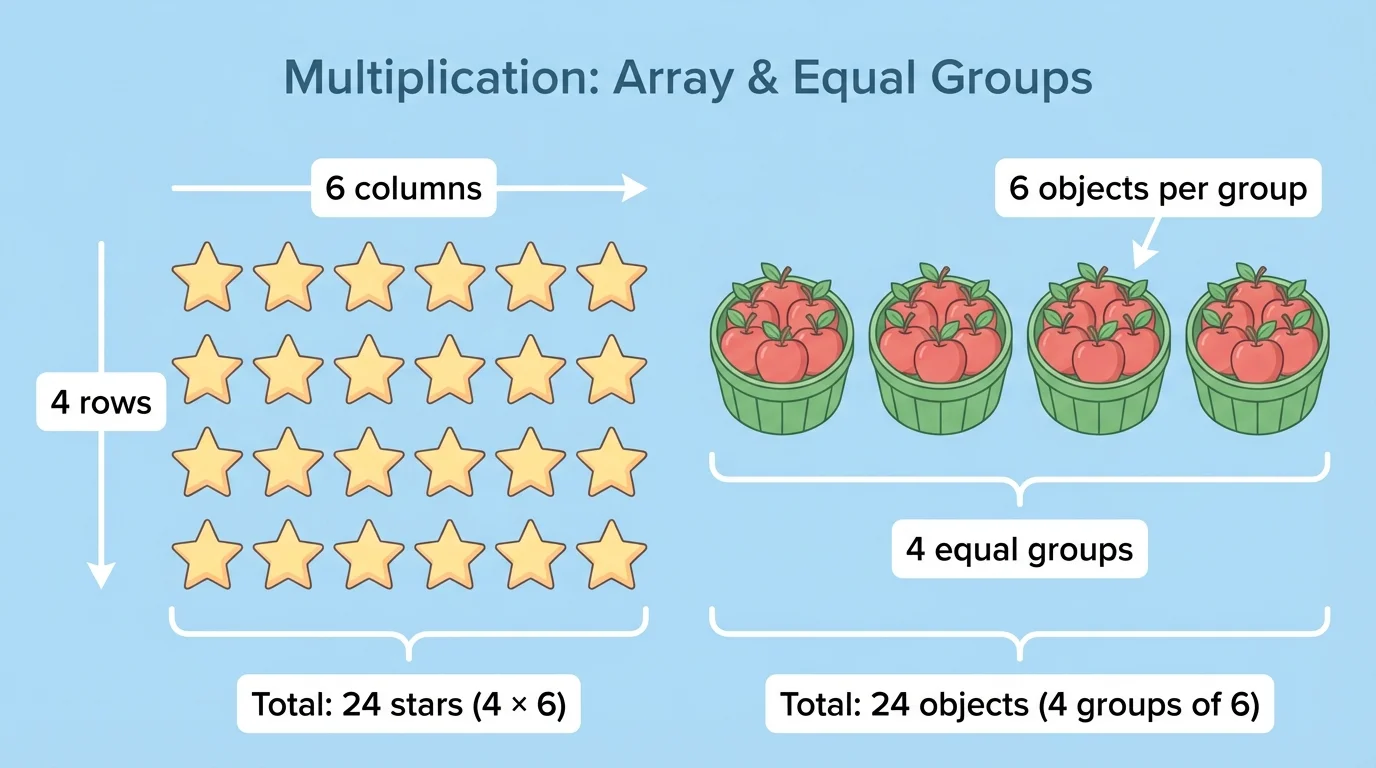
Multiplication and division are connected to the same numbers. When you understand equal groups, you can move back and forth between the two operations.
Multiplication is a way to find the total in equal groups.
Division is a way to share equally or find how many equal groups can be made.
Arrays also help you see that turning rows into columns does not change the total. For example, \(3\) rows of \(4\) and \(4\) rows of \(3\) both make \(12\). This idea will help with a very useful property later.
[Figure 2] The same three numbers can make a fact family, and this shows how it works. If you know one multiplication fact, you can use it to find related division facts. For example, if \(8 \times 5 = 40\), then \(5 \times 8 = 40\), \(40 \div 5 = 8\), and \(40 \div 8 = 5\).
These four facts belong together because they use the same numbers: \(8\), \(5\), and \(40\). Learning one fact helps you learn the others.
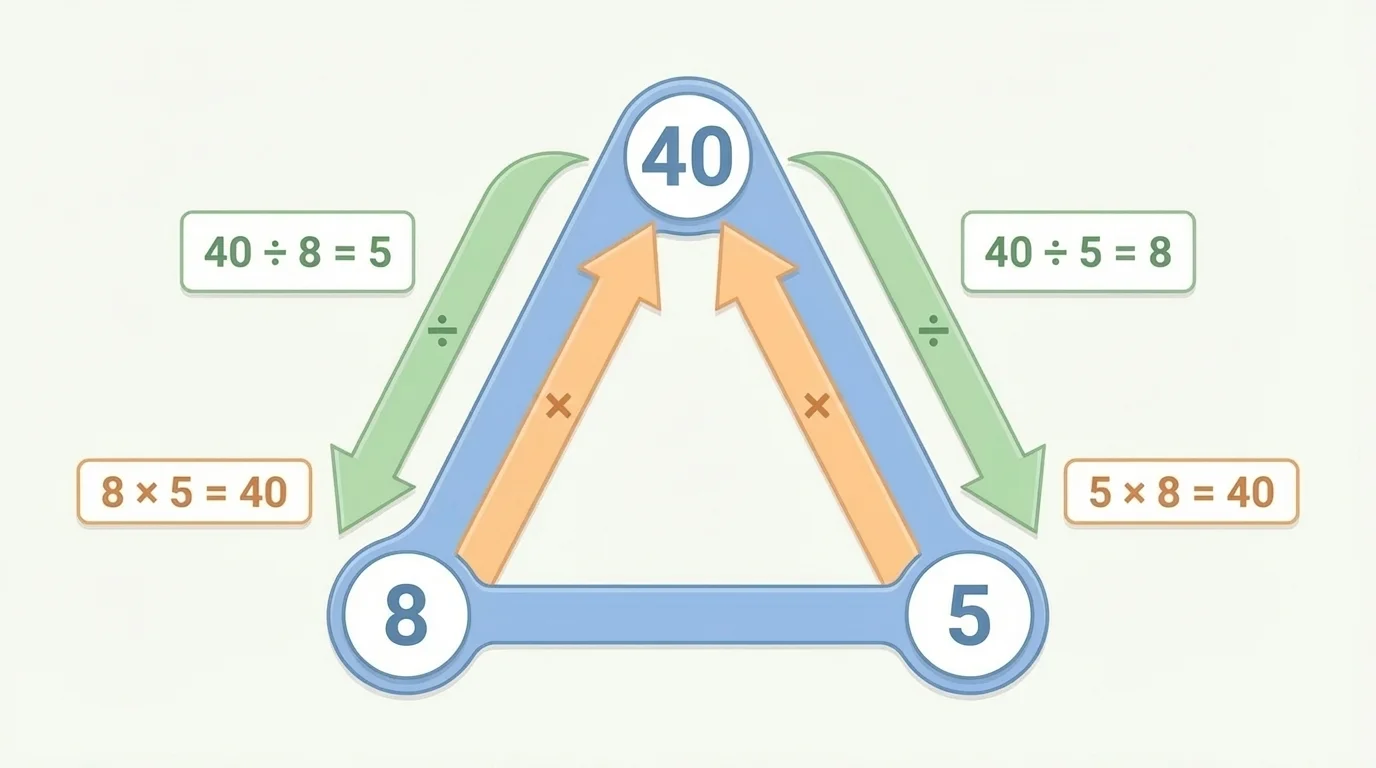
This is one of the best tools for division. If you forget a division fact, think of the multiplication fact that matches it. To solve \(42 \div 6\), ask, "What number times \(6\) equals \(42\)?" Since \(7 \times 6 = 42\), the answer is \(42 \div 6 = 7\).
Later, when facts become more automatic, you may answer right away. But using the relationship first is smart math thinking, not a shortcut to avoid.
Knowing just one fact can unlock several others. When you learn \(9 \times 3 = 27\), you also gain \(3 \times 9 = 27\), \(27 \div 9 = 3\), and \(27 \div 3 = 9\).
Multiplication and division facts fit together like puzzle pieces.
You do not have to memorize every fact all at once. Strong strategies help you find answers and build memory over time.
One useful strategy is the commutative property. This means you can switch the order of factors and keep the same product. For example, \(3 \times 7 = 21\) and \(7 \times 3 = 21\). If you know one, you know the other.
Another helpful idea is using doubles. If you know \(4 \times 6 = 24\), then \(8 \times 6\) is double that, which is \(48\). If you know \(2 \times 9 = 18\), then \(4 \times 9 = 36\).
[Figure 3] You can also break apart a fact into easier parts using the distributive property. For example, to solve \(7 \times 6\), think of \(7\) as \(5 + 2\). Then \(7 \times 6 = (5 \times 6) + (2 \times 6) = 30 + 12 = 42\).
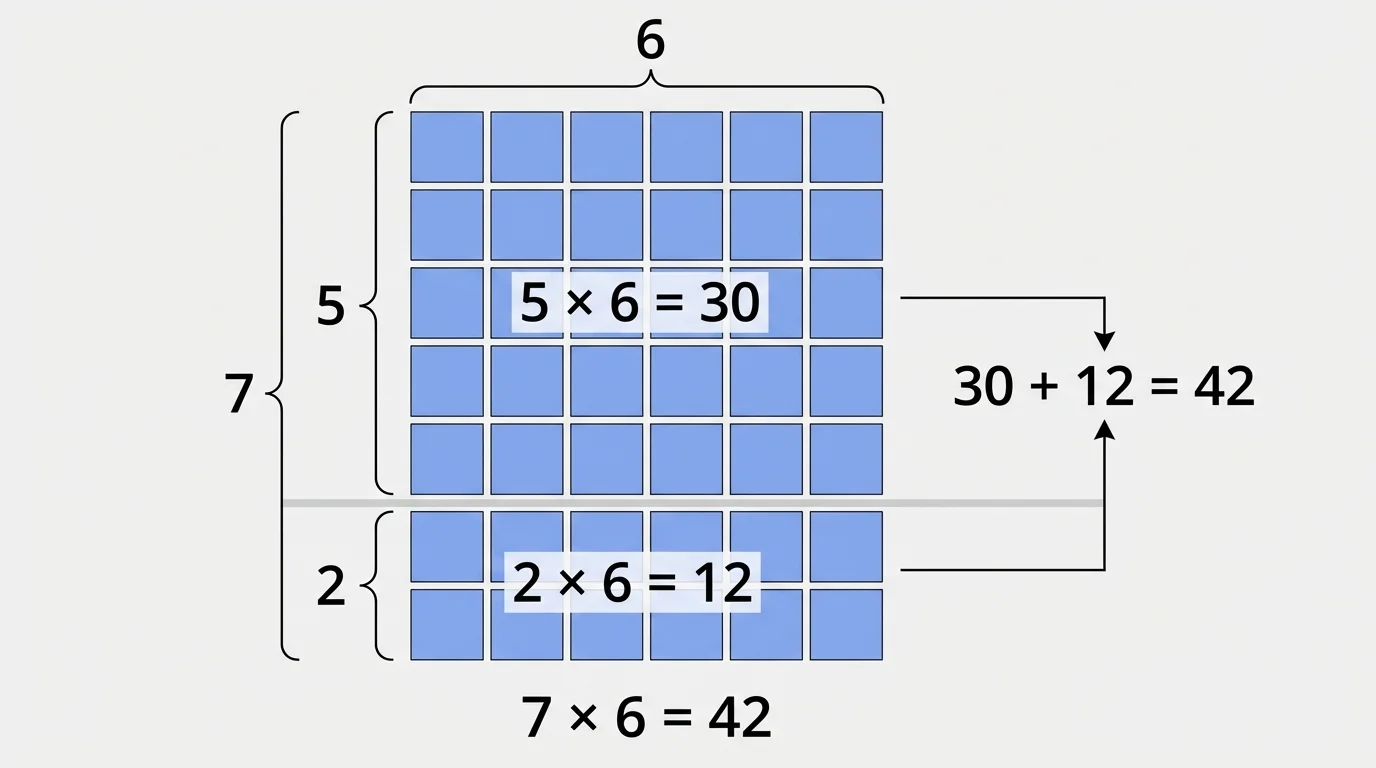
Facts with \(5\) and \(10\) are often easy to spot. For example, \(5 \times 8 = 40\) and \(10 \times 8 = 80\). Facts with \(2\) connect to doubles: \(2 \times 7 = 14\). Facts with \(1\) stay the same number: \(1 \times 9 = 9\). Facts with \(0\) are always \(0\): \(0 \times 6 = 0\).
These patterns help build memory. Instead of starting from nothing, you can use facts you already know.
Division facts become easier when you think of multiplication. Division asks for a missing factor. In \(24 \div 6 = ?\), you are really asking, "What number times \(6\) equals \(24\)?" The answer is \(4\), because \(4 \times 6 = 24\).
Division can mean two things. It can mean sharing equally, or it can mean making groups. If \(18\) apples are shared among \(3\) baskets, each basket gets \(6\) apples. If you make groups of \(3\) apples from \(18\) apples, you can make \(6\) groups. Both ideas use the equation \(18 \div 3 = 6\).
Missing-factor thinking is one of the strongest ways to divide. Instead of repeated subtraction every time, ask which multiplication fact matches the division problem. This is faster and helps facts stay in memory.
When you know your multiplication facts well, division gets much easier. That is why these two operations are taught together.
Let's work through some examples step by step.
Worked example 1
Find \(6 \times 4\).
Step 1: Think of equal groups.
\(6 \times 4\) means \(6\) groups of \(4\).
Step 2: Use repeated addition.
\(4 + 4 + 4 + 4 + 4 + 4 = 24\).
Step 3: State the product.
\[6 \times 4 = 24\]
The product is \(24\).
This multiplication fact also gives related division facts: \(24 \div 6 = 4\) and \(24 \div 4 = 6\).
Worked example 2
Find \(35 \div 5\).
Step 1: Rewrite it as a missing-factor question.
Ask: \(5 \times ? = 35\).
Step 2: Use a known multiplication fact.
Since \(5 \times 7 = 35\), the missing factor is \(7\).
Step 3: Write the division fact.
\[35 \div 5 = 7\]
The quotient is \(7\).
Notice how multiplication helped solve division quickly.
Worked example 3
Find \(7 \times 8\) by breaking apart a fact.
Step 1: Break \(7\) into easier parts.
Think of \(7\) as \(5 + 2\).
Step 2: Multiply each part by \(8\).
\(5 \times 8 = 40\) and \(2 \times 8 = 16\).
Step 3: Add the partial products.
\(40 + 16 = 56\).
Step 4: State the product.
\[7 \times 8 = 56\]
The product is \(56\).
This is the same break-apart idea shown earlier. A hard fact can become two easier facts.
Worked example 4
Find \(54 \div 9\).
Step 1: Ask the related multiplication question.
\(9 \times ? = 54\)
Step 2: Use a known fact.
\(9 \times 6 = 54\).
Step 3: Write the answer.
\[54 \div 9 = 6\]
The quotient is \(6\).
Some multiplication facts are especially important because they help with many others.
Facts with \(0\): Any number multiplied by \(0\) equals \(0\). For example, \(9 \times 0 = 0\).
Facts with \(1\): Any number multiplied by \(1\) stays the same. For example, \(1 \times 7 = 7\).
Facts with \(2\): These are doubles. For example, \(2 \times 8 = 16\).
Facts with \(5\): Products end in \(0\) or \(5\). For example, \(5 \times 7 = 35\).
Facts with \(10\): Multiplying by \(10\) gives the number of tens. For example, \(10 \times 6 = 60\).
The product is the answer to a multiplication problem, and the quotient is the answer to a division problem. Knowing these words helps you talk about your work clearly.
| Known fact | How it helps | New fact |
|---|---|---|
| \(3 \times 4 = 12\) | Switch order | \(4 \times 3 = 12\) |
| \(5 \times 6 = 30\) | Add \(2 \times 6\) | \(7 \times 6 = 42\) |
| \(8 \times 5 = 40\) | Use fact family | \(40 \div 5 = 8\) |
| \(6 \times 6 = 36\) | Use fact family | \(36 \div 6 = 6\) |
Table 1. Examples of how known multiplication facts help solve new multiplication and division facts.
Patterns are helpful, but practice with understanding is what leads to memory. You want facts to make sense, not just sound familiar.
Division helps in everyday life through sharing and grouping. If \(24\) markers are shared equally among \(6\) students, each student gets \(24 \div 6 = 4\) markers. If markers are packed in groups of \(6\), then \(24 \div 6 = 4\) tells how many packs can be made.
Multiplication helps with totals. If a concert row has \(9\) seats and there are \(7\) rows, then there are \(7 \times 9 = 63\) seats. If a soccer team has \(3\) water bottles for each of \(8\) players, that is \(3 \times 8 = 24\) bottles.
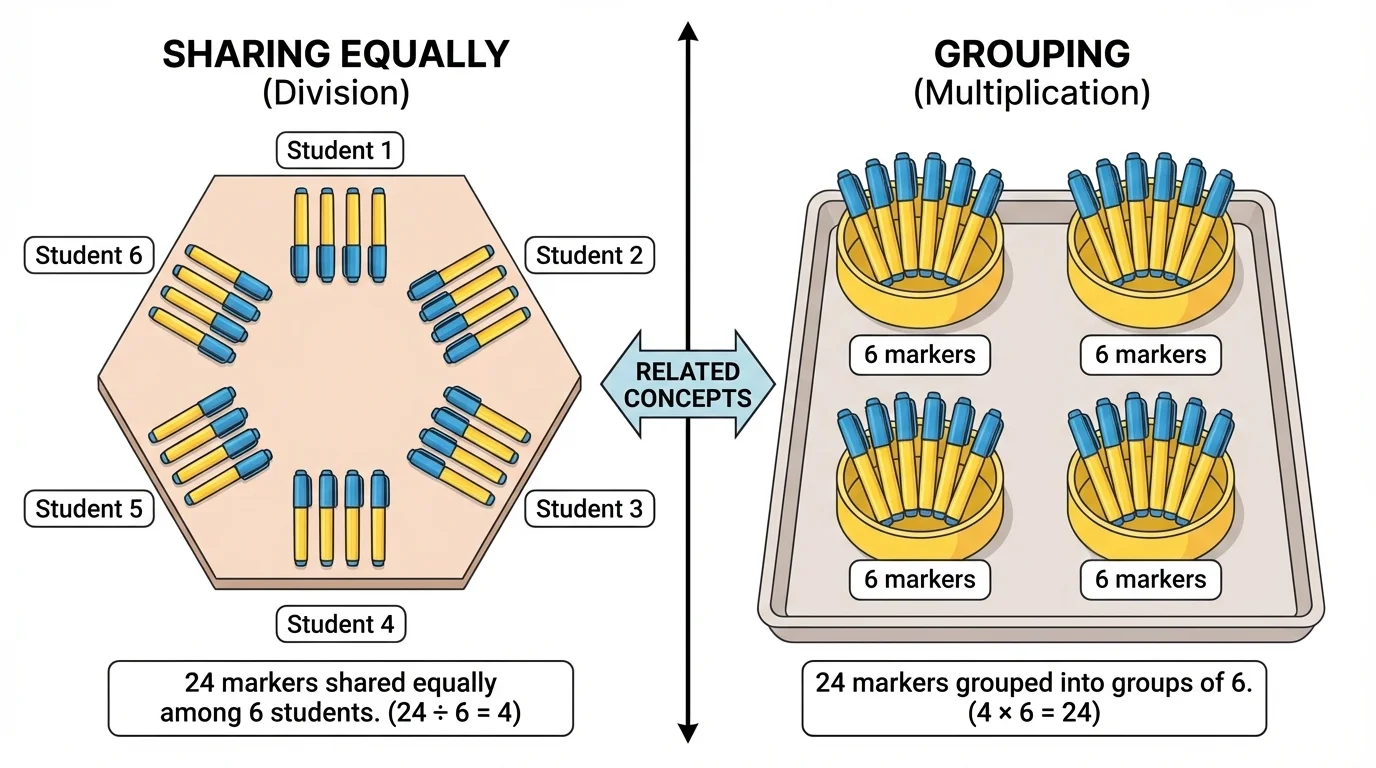
Arrays are useful in real life too. Gardeners plant flowers in rows. Builders place tiles in rows and columns. Store shelves often organize items in equal groups. Multiplication helps count quickly, and division helps organize fairly.
Later, when you estimate, measure, and solve bigger problems, these facts continue to help. Quick recall of facts gives you more mental energy for more challenging problem-solving.
"If one fact is clear, many facts become easier."
Sharing and grouping show why division is more than just an answer rule. It describes real situations.
At first, it is fine to use drawings, arrays, skip counting, repeated addition, or fact families. These strategies are tools. As you use them again and again, many facts become automatic.
Fluency means more than being fast. It means being accurate, flexible, and able to choose a good strategy. For one problem, you might use a fact family. For another, you might break apart a number. For an easy fact like \(10 \times 4\), you may know it right away.
By the end of Grade \(3\), an important goal is to know from memory all products of two one-digit numbers. That means facts such as \(2 \times 3\), \(7 \times 8\), and \(9 \times 9\) should become familiar and quick to recall.
When facts are remembered, division facts become faster too, because you can think of the matching multiplication fact. If \(8 \times 7 = 56\), then \(56 \div 8 = 7\) and \(56 \div 7 = 8\).
