A single digit can be a tiny amount or a huge amount depending on where it stands. The digit \(7\) can mean \(7\), \(70\), \(700\), or even \(7{,}000\). That is one of the most powerful ideas in our number system: position matters. When you understand place value, big numbers stop feeling mysterious and start making sense.
In our base-ten number system, every place has a value. A digit in the ones place tells how many ones there are. A digit in the tens place tells how many tens there are. A digit in the hundreds place tells how many hundreds there are. This idea is called place value.
Look at the digit \(4\) in these numbers: \(4\), \(40\), \(400\), and \(4{,}000\). The digit is the same each time, but its value changes because its place changes. In \(4\), it means \(4\) ones. In \(40\), it means \(4\) tens, which is \(40\). In \(400\), it means \(4\) hundreds, which is \(400\).
Place value means the value of a digit based on where it is in a number. In a whole number, each place to the left is worth \(10\) times as much as the place to its right.
This is why the number \(444\) does not mean the same thing three times. The first \(4\) from the left means \(400\), the middle \(4\) means \(40\), and the last \(4\) means \(4\). Even though the digits look the same, their values are different.
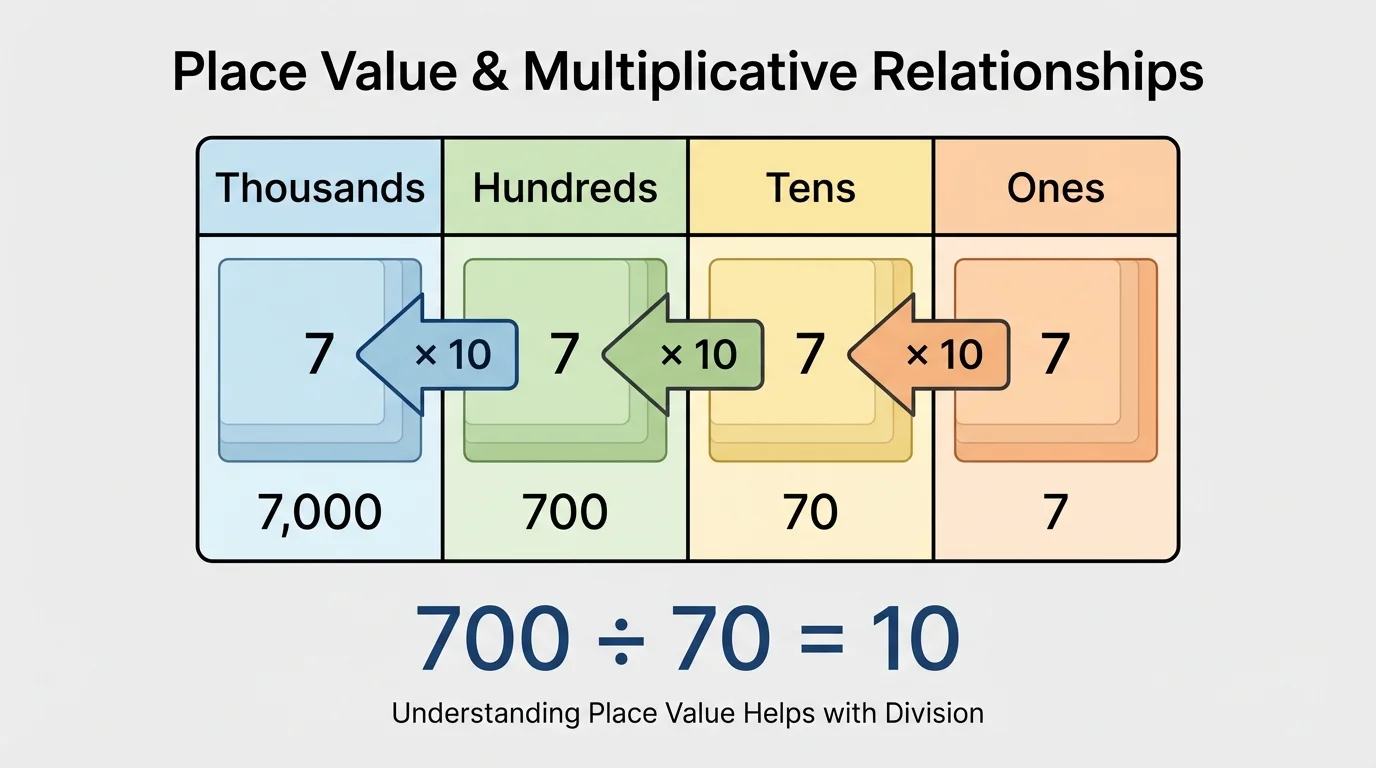
[Figure 1] A place value chart helps organize digits by place and shows clearly that each place is \(10\) times the place to its right. Starting from the right, the places are ones, tens, hundreds, thousands, and so on.
Here is a simple way to think about it: \(10\) ones make \(1\) ten, \(10\) tens make \(1\) hundred, and \(10\) hundreds make \(1\) thousand. Every time you move one place left, the value becomes \(10\) times greater, as shown in [Figure 1].
We can write these relationships like this:
\[10 \textrm{ ones} = 1 \textrm{ ten}\]
\[10 \textrm{ tens} = 1 \textrm{ hundred}\]
\[10 \textrm{ hundreds} = 1 \textrm{ thousand}\]
If you move one place to the left, you multiply by \(10\). If you move one place to the right, you divide by \(10\). That pattern continues for larger whole numbers too.
| Place | Value of \(1\) |
|---|---|
| Ones | \(1\) |
| Tens | \(10\) |
| Hundreds | \(100\) |
| Thousands | \(1{,}000\) |
Table 1. A basic place value chart showing how the value of \(1\) changes by place.
This pattern is what makes our number system efficient. We do not need a new symbol for every large amount. We use the same digits \(0\) through \(9\), and their positions do the work.
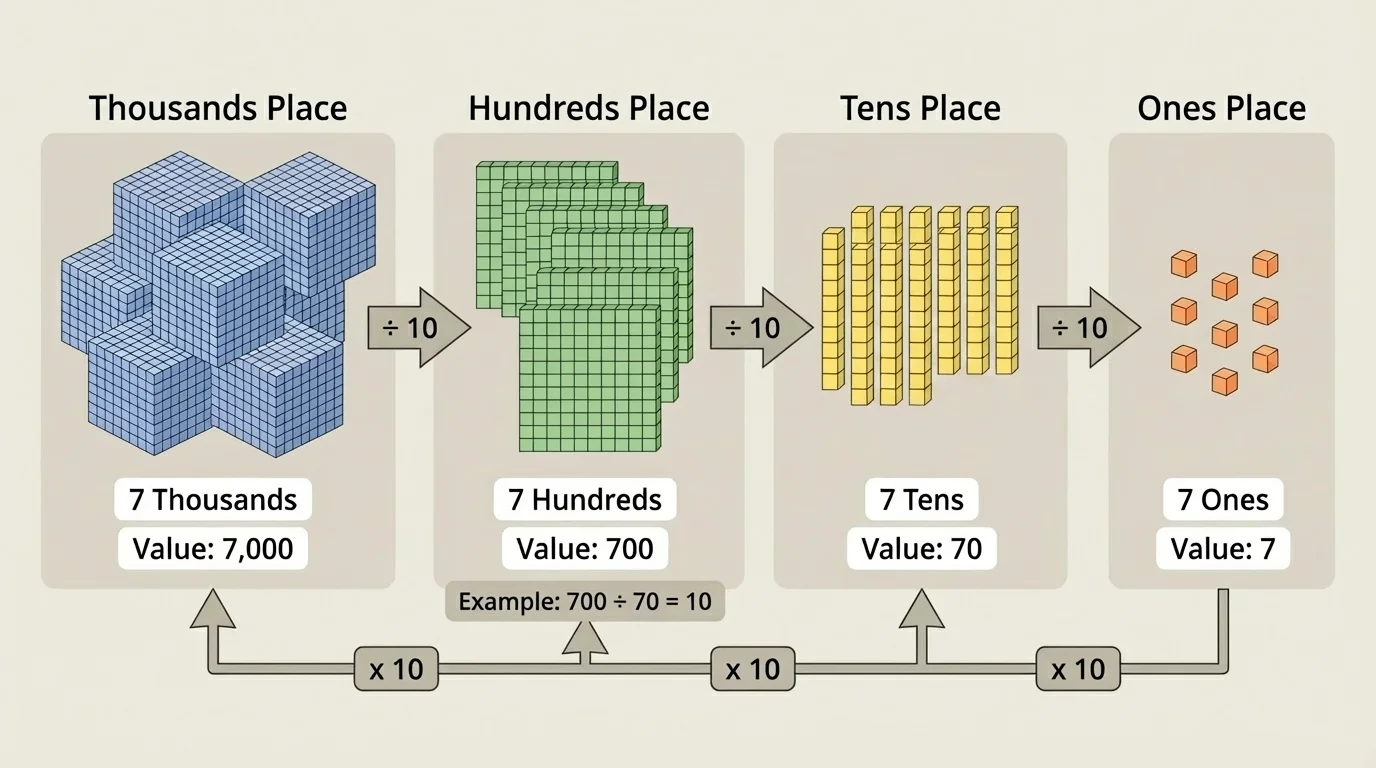
[Figure 2] The same digit can represent very different amounts. In \(7\), the digit \(7\) means \(7\) ones. In \(70\), it means \(7\) tens. In \(700\), it means \(7\) hundreds. In \(7{,}000\), it means \(7\) thousands.
We can describe these values in words and numbers:
In \(70\), the \(7\) is worth \(70\).
In \(700\), the \(7\) is worth \(700\).
Since \(700 = 10 \times 70\), the \(7\) in \(700\) is worth ten times as much as the \(7\) in \(70\).
This works with any digit. Compare the digit \(3\) in \(3\), \(30\), and \(300\). The \(3\) in \(30\) is ten times the value of the \(3\) in \(3\). The \(3\) in \(300\) is ten times the value of the \(3\) in \(30\).
We can also compare places using division. Since \(300 \div 30 = 10\), the value of the \(3\) in \(300\) is \(10\) times the value of the \(3\) in \(30\). Division helps us measure how many times greater one value is than another.
Ten Times as Much
When a digit moves one place to the left in a whole number, its value becomes \(10\) times greater. When it moves one place to the right, its value becomes \(\dfrac{1}{10}\) as much, which means you divide by \(10\).
Think of climbing stairs. Each step left on the place value chart is a big jump: \(1\), \(10\), \(100\), \(1{,}000\). Each step right makes the value smaller by a factor of \(10\). As we saw earlier in [Figure 1], the pattern is regular and predictable.
Place value is closely connected to multiply and divide. If a digit moves one place left, multiply its value by \(10\). If a digit moves one place right, divide its value by \(10\).
For example, compare \(70\) and \(700\).
\[70 \times 10 = 700\]
This means \(700\) is ten times \(70\).
Now look at the same relationship using division:
\[700 \div 70 = 10\]
This equation tells us that \(700\) contains \(10\) groups of \(70\). It also tells us that the value of the \(7\) in \(700\) is \(10\) times the value of the \(7\) in \(70\).
Here are more examples:
In each pair, the number on the left has the same leading digit, but that digit is one place farther left. That makes its value \(10\) times greater.
Zeros are important in whole numbers because they hold places. In \(507\), the \(0\) shows that there are no tens, but it still keeps the \(5\) in the hundreds place and the \(7\) in the ones place.
Compare \(57\), \(507\), and \(5{,}070\). The digit \(5\) has different values in each number:
The zeros do not have value by themselves here, but they help show the place of the other digits. That is why zeros matter so much in writing numbers correctly.
Remember that a digit is one symbol such as \(0\), \(1\), \(2\), or \(7\), while a number can be made of one digit or many digits. Also remember that multiplication can show "how many times as much," and division can compare one amount to another.
A common mistake is to think that more zeros always mean a number is just "a little bigger." Actually, each zero can change the place and make a value much larger. For example, \(60\) is not just a little bigger than \(6\); it is \(10\) times as large.
Let's work through some examples step by step.
Worked Example 1
Compare the value of the digit \(5\) in \(50\) and \(500\).
Step 1: Identify each value.
In \(50\), the digit \(5\) is in the tens place, so its value is \(50\).
In \(500\), the digit \(5\) is in the hundreds place, so its value is \(500\).
Step 2: Compare the values.
Compute \(500 \div 50 = 10\).
Step 3: State the relationship.
The \(5\) in \(500\) is \(10\) times the value of the \(5\) in \(50\).
Answer: \(500\) is \(10\) times \(50\).
Notice that the digit stayed the same, but moving one place left changed its value by a factor of \(10\).
Worked Example 2
Explain why \(700 \div 70 = 10\) using place value.
Step 1: Name the place values.
In \(70\), the digit \(7\) is in the tens place, so it means \(70\).
In \(700\), the digit \(7\) is in the hundreds place, so it means \(700\).
Step 2: Compare the values.
The digit \(7\) in \(700\) is one place to the left of the digit \(7\) in \(70\).
One place left means the value is multiplied by \(10\).
Step 3: Use division.
Since \(700\) is \(10\) times \(70\), dividing \(700\) by \(70\) gives \(10\).
Answer: \[700 \div 70 = 10\]
This example is important because it shows that division can prove a place value relationship.
Worked Example 3
In the number \(3{,}482\), how much is the \(8\) worth, and how does it compare to the \(8\) in \(348\)?
Step 1: Find the value of \(8\) in \(3{,}482\).
The \(8\) is in the tens place, so its value is \(80\).
Step 2: Find the value of \(8\) in \(348\).
The \(8\) is in the ones place, so its value is \(8\).
Step 3: Compare the two values.
Compute \(80 \div 8 = 10\).
Answer: The \(8\) in \(3{,}482\) is worth \(80\), and it is \(10\) times the value of the \(8\) in \(348\).
Here the digit \(8\) moved from the ones place to the tens place, so its value became \(10\) times greater.
Worked Example 4
Which statement is true: the \(6\) in \(6{,}000\) is \(10\) times or \(100\) times the value of the \(6\) in \(60\)?
Step 1: Find the values.
In \(6{,}000\), the digit \(6\) is worth \(6{,}000\).
In \(60\), the digit \(6\) is worth \(60\).
Step 2: Divide to compare.
Compute \(6{,}000 \div 60 = 100\).
Step 3: Decide.
The \(6\) in \(6{,}000\) is \(100\) times the value of the \(6\) in \(60\).
Answer: The correct statement is \(100\) times.
This happens because the \(6\) moved two places to the left: from tens to hundreds to thousands. Each move left multiplies by \(10\), so two moves give \(10 \times 10 = 100\).
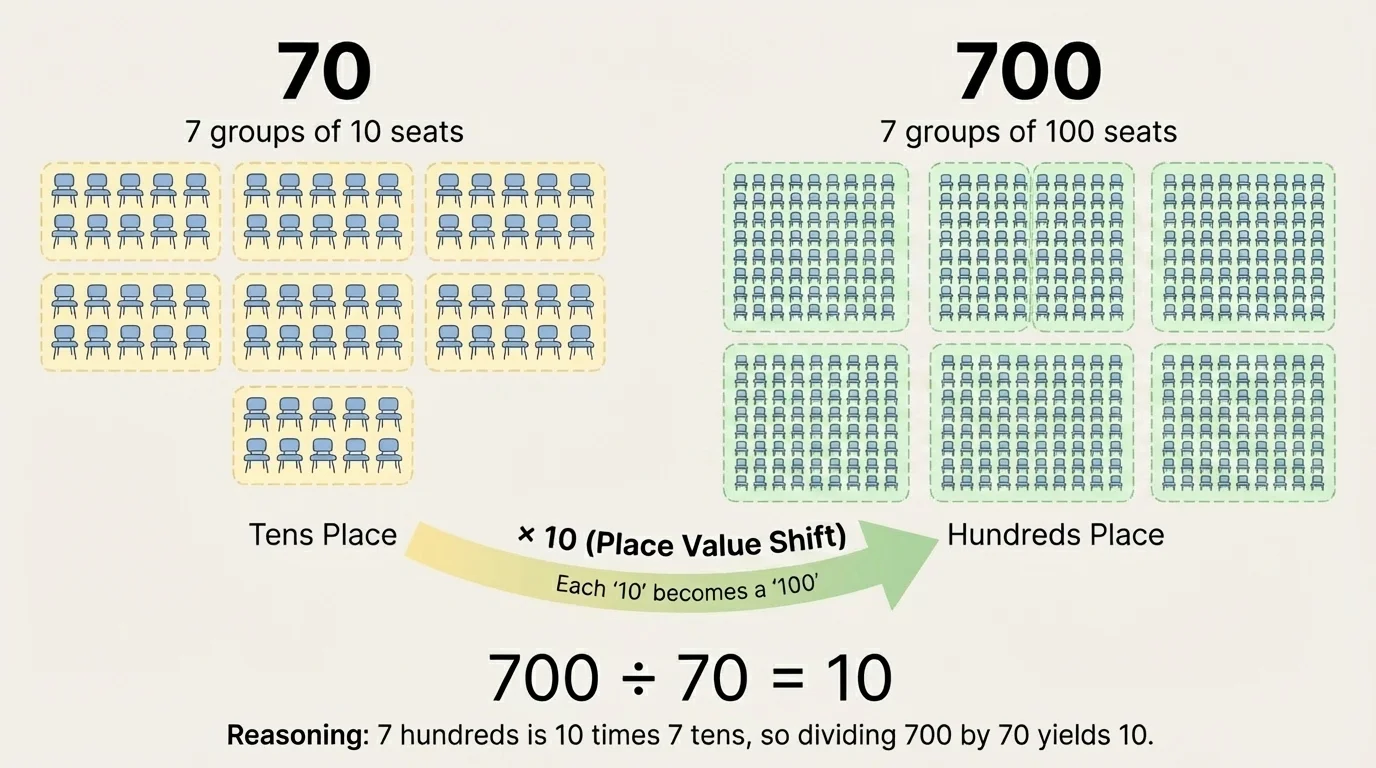
[Figure 3] Place value is not just for math class. It helps us understand real groups and amounts. Suppose a school auditorium has \(70\) seats in one section and \(700\) seats in a larger section. The larger section has \(10\) times as many seats.
If a toy store packs stickers in groups of \(10\), then \(70\) stickers means \(7\) groups of \(10\). But \(700\) stickers means \(70\) groups of \(10\), or \(7\) groups of \(100\). The amount grows fast because each new place is ten times greater, as shown in [Figure 3].
Money gives another example. Think about \(7\) dollars, \(70\) dollars, and \(700\) dollars. The digit \(7\) stays the same, but its value changes based on place. A person saving \(\$700\) has ten times as much money as a person saving \(\$70\).
Sports statistics also use place value. A player who scores \(80\) points over some games has a total that is \(10\) times a score of \(8\) points. This relationship is easy to see when we understand that the \(8\) in \(80\) is in the tens place, not the ones place.
Later, when you study larger numbers like populations, distances, or data counts, the same place-value pattern continues. The structure we saw in [Figure 2] still works even for very large whole numbers.
Our number system is called a base-ten system because it is built on groups of \(10\). This is probably connected to the fact that humans usually count with ten fingers.
Understanding this idea now will help with multiplication, division, comparing numbers, rounding, and reading large numbers later.
One common mistake is confusing a digit with its value. In \(246\), the digit \(4\) is not worth just \(4\). It is in the tens place, so it is worth \(40\).
Another mistake is forgetting how many places a digit moved. If a digit moves one place left, its value becomes \(10\) times greater. If it moves two places left, its value becomes \(100\) times greater. For example, from \(6\) to \(600\), the value changes by \(100\), not just \(10\).
A third mistake is using the number of digits only. For example, \(105\) and \(15\) both contain the digit \(1\), but in \(105\) the \(1\) means \(100\), while in \(15\) it means \(10\). Always look at the place, not just the digit.
When you are unsure, ask yourself two questions: What place is the digit in? and How many times greater is that place than the place to its right? Those questions usually lead to the answer.
