A school can have hundreds of students, and a stadium can have thousands of seats. How do people quickly find totals like the number of stickers in several packs or the number of chairs arranged in equal rows? They use multiplication. When numbers get larger, multiplication still works the same way, but we need efficient strategies. The good news is that large multiplication problems become much easier when we use place value and the properties of operations.
Multiplication means combining equal groups. For small facts, you may know that \(4 \times 6 = 24\). But what about \(4 \times 36\)? Instead of trying to think of \(36\) all at once, we can break it into tens and ones.
The place value of a digit tells how much the digit is worth. In \(36\), the \(3\) means \(3\) tens, or \(30\), and the \(6\) means \(6\) ones. So we can write
\(36 = 30 + 6\)
Then we multiply each part:
\[4 \times 36 = 4 \times (30 + 6) = (4 \times 30) + (4 \times 6) = 120 + 24 = 144\]
This works because of the distributive property. It lets us multiply one factor by each part of the other factor, then add the partial products.
Place value means the value of a digit based on its position in a number. A digit in the tens place is worth ten times as much as the same digit in the ones place.
Distributive property means a number multiplied by a sum can be multiplied by each addend and then added. For example, \(3 \times (20 + 4) = (3 \times 20) + (3 \times 4)\).
Breaking apart numbers does not change their value. It simply makes the multiplication easier to see and easier to solve.
Now let's multiply larger numbers by one digit. Suppose we want to find \(3 \times 2{,}345\). We can use expanded form:
\[2{,}345 = 2{,}000 + 300 + 40 + 5\]
Then multiply each part by \(3\):
\[3 \times 2{,}345 = 3 \times (2{,}000 + 300 + 40 + 5)\]
\[= (3 \times 2{,}000) + (3 \times 300) + (3 \times 40) + (3 \times 5)\]
\[= 6{,}000 + 900 + 120 + 15 = 7{,}035\]
Each smaller multiplication is easier because we understand what each digit is worth. We are not just multiplying digits. We are multiplying thousands, hundreds, tens, and ones.
You already know basic multiplication facts such as \(6 \times 7 = 42\). Multi-digit multiplication uses those same facts again and again, but with place value attached. For example, if \(6 \times 7 = 42\), then \(6 \times 70 = 420\) and \(6 \times 700 = 4{,}200\).
Sometimes we regroup when adding the partial products. For example, in \(4 \times 1{,}286\), we can write
\[1{,}286 = 1{,}000 + 200 + 80 + 6\]
Then:
\[4 \times 1{,}286 = 4{,}000 + 800 + 320 + 24 = 5{,}144\]
The regrouping happens when we combine values like \(320 + 24 = 344\), and then add that to the thousands and hundreds.
Solved example 1
Find \(5 \times 3{,}204\).
Step 1: Write the number in expanded form.
\[3{,}204 = 3{,}000 + 200 + 4\]
Step 2: Multiply each part by \(5\).
\[5 \times 3{,}000 = 15{,}000\]
\[5 \times 200 = 1{,}000\]
\[5 \times 4 = 20\]
Step 3: Add the partial products.
\[15{,}000 + 1{,}000 + 20 = 16{,}020\]
So, \(5 \times 3{,}204 = 16{,}020\).
Notice that the zero in the tens place of \(3{,}204\) does not create a problem. It simply means there are no tens to multiply.
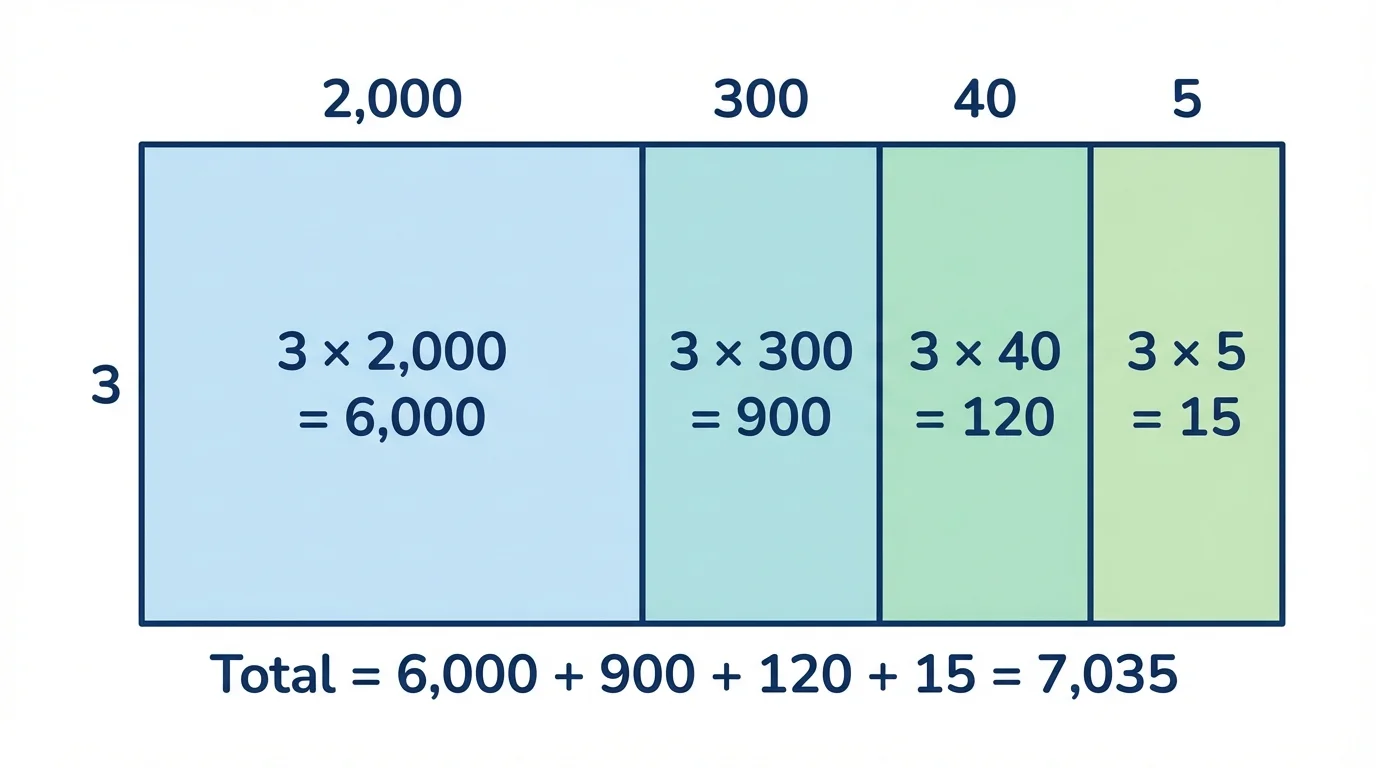
An area model helps you see multiplication. It uses a rectangle split into smaller rectangles. Each smaller rectangle shows one partial product. The model in [Figure 1] shows how a large number can be broken into place-value parts and multiplied one part at a time.
For \(3 \times 2{,}345\), think of one side of a rectangle as \(3\), and the other side as \(2{,}000 + 300 + 40 + 5\). The whole area is the total product, and each smaller area is a partial product.
The smaller parts are \(3 \times 2{,}000\), \(3 \times 300\), \(3 \times 40\), and \(3 \times 5\). When we add those areas, we get the full product.
A rectangular array is similar. It arranges objects in rows and columns. If there are \(3\) rows and \(24\) columns, the total is \(3 \times 24\). If we split \(24\) into \(20\) and \(4\), then the array is also split into \(3 \times 20\) and \(3 \times 4\).
Arrays and area models help explain why multiplication works. They are especially useful when numbers are too large to picture as single groups.
Partial products are the smaller multiplication results you get when you break numbers apart by place value. In \(3 \times 2{,}345\), the partial products are \(6{,}000\), \(900\), \(120\), and \(15\). Adding the partial products gives the total product.
When you look back at [Figure 1], you can see that the big product is not one mystery number. It is the sum of several smaller, understandable products.
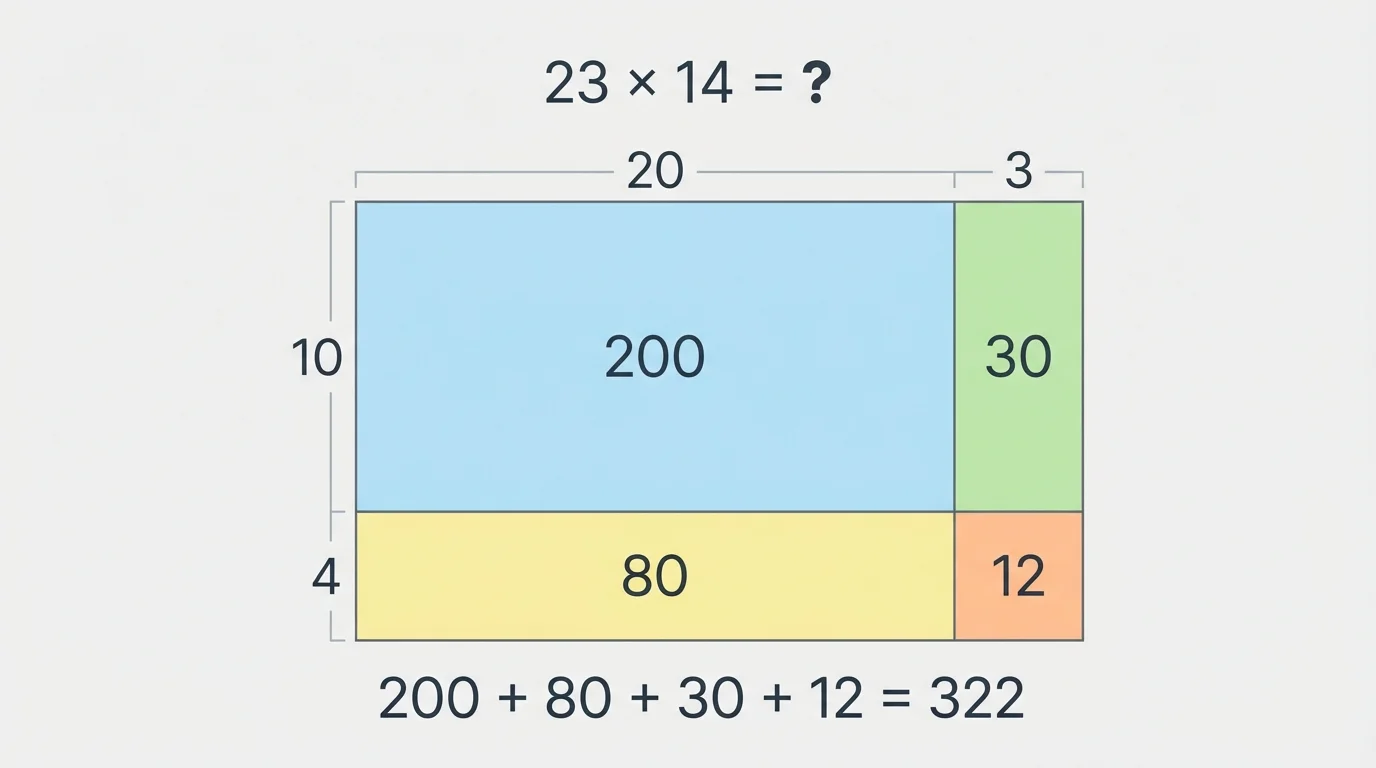
[Figure 2] shows how multiplying two two-digit numbers creates four smaller products, not just one. Now let's multiply numbers like \(23 \times 14\). This time, both factors can be broken apart.
Write each number in expanded form:
\(23 = 20 + 3\)
\(14 = 10 + 4\)
Now multiply each part by each part:
\[(20 + 3)(10 + 4)\]
That gives four products:
\[20 \times 10 = 200\]
\[20 \times 4 = 80\]
\[3 \times 10 = 30\]
\[3 \times 4 = 12\]
Add them:
\[200 + 80 + 30 + 12 = 322\]
So, \(23 \times 14 = 322\).
Solved example 2
Find \(27 \times 35\) using place value.
Step 1: Break apart both factors.
\(27 = 20 + 7\)
\(35 = 30 + 5\)
Step 2: Multiply each part.
\[20 \times 30 = 600\]
\[20 \times 5 = 100\]
\[7 \times 30 = 210\]
\[7 \times 5 = 35\]
Step 3: Add the partial products.
\[600 + 100 + 210 + 35 = 945\]
So, \(27 \times 35 = 945\).
This method works because each factor is made of tens and ones. Every part of one factor must be multiplied by every part of the other factor.
If one factor has a zero in the ones or tens place, one partial product may be zero. For example, in \(40 \times 26\), we can write \(40 = 40 + 0\), so one part adds nothing. The product is still correct.
Rectangles are a powerful way to think about multiplication because area grows in pieces. Builders, gardeners, and designers often break large rectangles into smaller ones for quick calculations.
Looking again at [Figure 2], notice that the four smaller rectangles exactly fill the larger one. That is a picture of the distributive property in action.
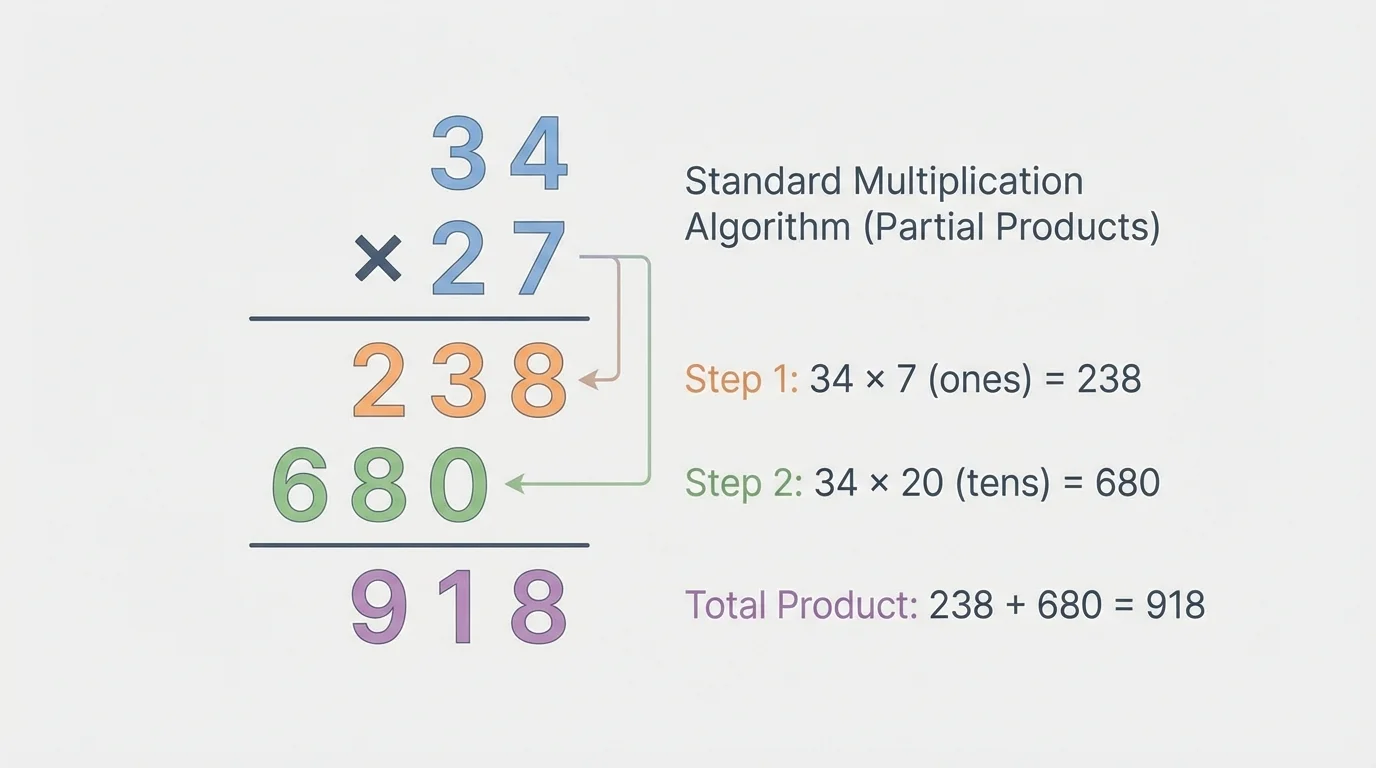
Another method is the written standard algorithm. It is more efficient once you understand the place value behind it. The setup in [Figure 3] illustrates why the second row starts one place to the left: it represents tens, not ones.
Suppose we want to find \(34 \times 27\). First multiply by the ones digit, \(7\). Then multiply by the tens digit, \(2\), which really means \(20\).
Here is the calculation:
\[\begin{array}{r} 34 \\ \times\;27 \\ \hline 238 \\ 680 \\ \hline 918 \end{array}\]
The first row, \(238\), comes from \(34 \times 7\). The second row, \(680\), comes from \(34 \times 20\). Then we add the two partial products.
You may also see a zero used as a placeholder in the tens row, or you may leave the ones place blank and shift left. Both show the same place-value idea.
Solved example 3
Find \(46 \times 12\) using the standard algorithm and connect it to place value.
Step 1: Multiply by the ones digit.
\(46 \times 2 = 92\)
Step 2: Multiply by the tens digit.
\(46 \times 10 = 460\)
Step 3: Add the partial products.
\[\begin{array}{r} 92 \\ +\;460 \\ \hline 552 \end{array}\]
So, \(46 \times 12 = 552\).
The standard algorithm is not a different kind of math. It is a shorter way to write the same partial products you would find in an area model.
As [Figure 3] shows, place value matters in every row. If a row is not aligned correctly, the final answer will be wrong even if the multiplication facts are correct.
After multiplying, it is smart to estimate. An estimate helps you decide if your answer makes sense.
For \(23 \times 14\), round to nearby multiples of ten:
\[23 \approx 20\]
\[14 \approx 10\]
Then:
\[20 \times 10 = 200\]
The exact answer, \(322\), is bigger than \(200\), but still in the same general size range. That is reasonable because \(23\) and \(14\) were both rounded down.
For \(5 \times 3{,}204\), we might estimate with \(5 \times 3{,}200 = 16{,}000\). The exact answer, \(16{,}020\), is very close.
| Exact problem | Estimate | Exact product | Does it make sense? |
|---|---|---|---|
| \(23 \times 14\) | \(20 \times 10 = 200\) | \(322\) | Yes, the exact answer is a little larger. |
| \(27 \times 35\) | \(30 \times 40 = 1{,}200\) | \(945\) | Yes, the estimate rounded both factors up. |
| \(3 \times 2{,}345\) | \(3 \times 2{,}300 = 6{,}900\) | \(7{,}035\) | Yes, the exact answer is close. |
Table 1. Estimates compared with exact products to check whether answers are reasonable.
Estimation does not replace exact multiplication. It gives you a quick check so you can catch mistakes.
Multiplication is useful in many everyday situations. If a concert hall has \(24\) rows with \(18\) seats in each row, the total number of seats is
\[24 \times 18 = 432\]
If a store puts \(6\) markers in each pack and receives \(1{,}250\) packs, the total number of markers is
\[6 \times 1{,}250 = 7{,}500\]
If a classroom has \(16\) tables and each table holds \(4\) students, then there are seats for
\[16 \times 4 = 64\]
These problems all use the same idea: equal groups. The numbers may describe seats, boxes, books, stickers, or tiles, but the math structure stays the same.
Solved example 4
A fruit stand packs \(28\) apples in each crate and loads \(14\) crates onto a truck. How many apples are loaded?
Step 1: Write the multiplication expression.
\[28 \times 14\]
Step 2: Break apart the factors.
\(28 = 20 + 8\)
\(14 = 10 + 4\)
Step 3: Find the partial products.
\[20 \times 10 = 200\]
\[20 \times 4 = 80\]
\[8 \times 10 = 80\]
\[8 \times 4 = 32\]
Step 4: Add the partial products.
\[200 + 80 + 80 + 32 = 392\]
So, the truck is loaded with \(392\) apples.
When people organize events, build arrays of seats, pack supplies, or count items in rows and columns, these multiplication methods help them work efficiently and accurately.
One common mistake is forgetting place value. For example, if you multiply \(23 \times 14\) and only compute \(20 \times 10\) and \(3 \times 4\), you miss the other two products, \(20 \times 4\) and \(3 \times 10\).
Another mistake is misaligning numbers in the standard algorithm. The row for tens must be shifted because it represents tens. If it is written in the ones place, the answer will be too small.
A third mistake is adding partial products incorrectly. Even if each product is right, the final sum must also be correct.
It helps to ask yourself three questions: Did I multiply every part? Did I keep place values in the right columns? Does my answer seem reasonable compared with my estimate?
"Big multiplication problems become small ones when you use place value."
That idea is the heart of multi-digit multiplication. A large product is built from smaller products you already know how to find.
