Have you ever followed a recipe that used amounts like \(1\dfrac{1}{2}\) cups of flour and \(2\dfrac{3}{4}\) cups of milk? Those numbers are called mixed numbers, and they show up in real life all the time. When you know how to add and subtract them, you can solve problems about food, distance, time, and measurement with confidence.
A fraction describes equal parts of a whole. The fraction \(\dfrac{1}{b}\) means one part when a whole is split into \(b\) equal parts. For example, \(\dfrac{1}{4}\) means one fourth, and \(\dfrac{1}{8}\) means one eighth.
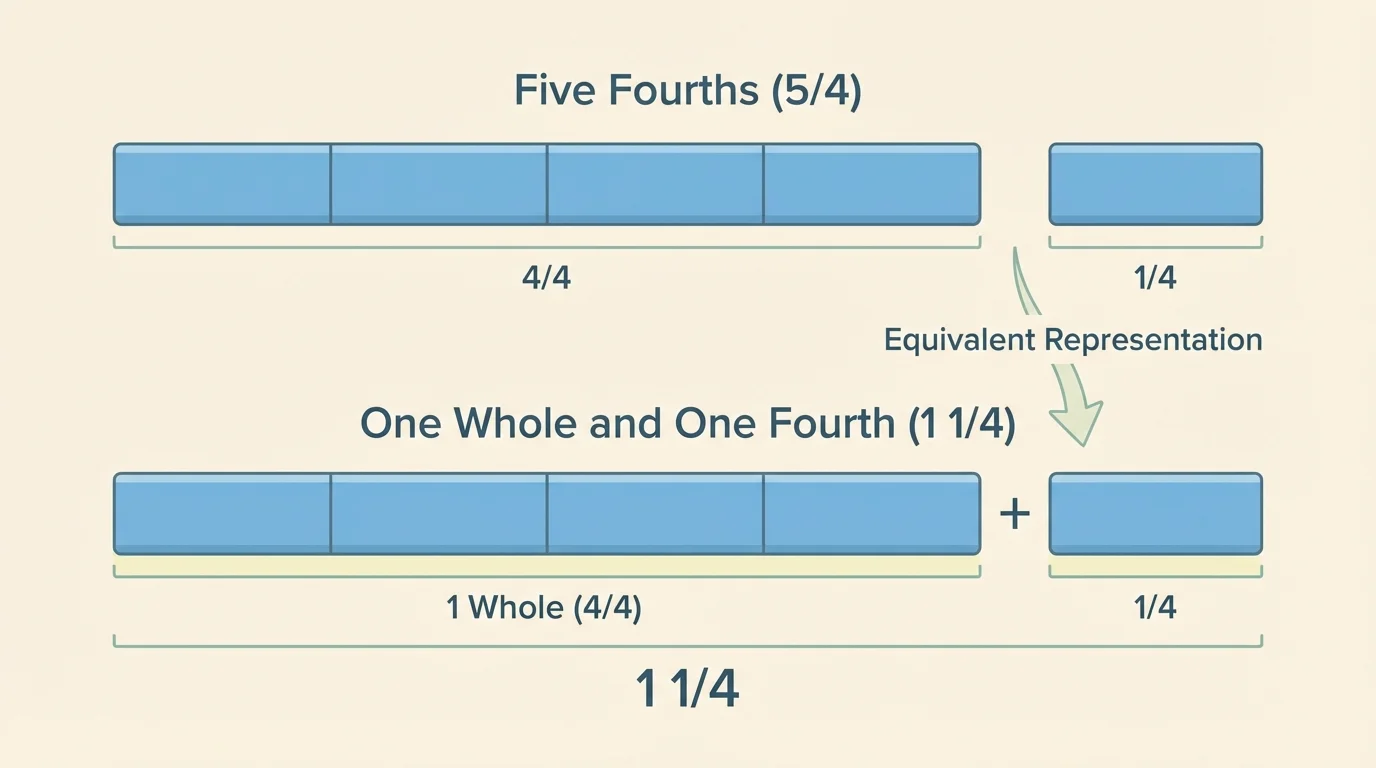
Fractions with a numerator greater than \(1\) are built from unit fractions. For example, \(\dfrac{3}{4}\) means \(\dfrac{1}{4} + \dfrac{1}{4} + \dfrac{1}{4}\). In the same way, \(\dfrac{5}{4}\) means \(\dfrac{1}{4} + \dfrac{1}{4} + \dfrac{1}{4} + \dfrac{1}{4} + \dfrac{1}{4}\). As [Figure 1] shows, four fourths make one whole, so \(\dfrac{5}{4} = 1\dfrac{1}{4}\).
This idea is important because mixed numbers are really just another way to write fractions greater than \(1\). A whole number like \(2\) can also be written as a fraction using equal parts, such as \(\dfrac{8}{4}\) or \(\dfrac{16}{8}\). That helps us combine whole numbers and fractions more easily.
When fractions have like denominators, they are divided into the same-size parts. That means you can combine or compare the numerators while keeping the denominator the same.
For example, \(\dfrac{2}{7} + \dfrac{3}{7} = \dfrac{5}{7}\) because both fractions are made of sevenths. Also, \(\dfrac{6}{9} - \dfrac{2}{9} = \dfrac{4}{9}\) because both are made of ninths.
A mixed number has a whole number and a fraction together, such as \(2\dfrac{3}{5}\) or \(4\dfrac{1}{8}\). It tells how many whole units there are and how much of one more unit there is.
An improper fraction is a fraction in which the numerator is greater than or equal to the denominator, such as \(\dfrac{7}{4}\) or \(\dfrac{9}{9}\). Improper fractions and mixed numbers can name the same amount. For example, \(1\dfrac{3}{4} = \dfrac{7}{4}\).
An equivalent fraction is a fraction that has the same value as another fraction, even though it looks different. For instance, \(\dfrac{2}{4} = \dfrac{1}{2}\). Equivalent fractions help when we rewrite mixed numbers in different forms.
Mixed number: a number with a whole-number part and a fraction part, such as \(3\dfrac{2}{6}\).
Improper fraction: a fraction that is equal to or greater than one whole, such as \(\dfrac{11}{6}\).
Equivalent fractions: fractions that name the same amount, such as \(\dfrac{4}{6}\) and \(\dfrac{2}{3}\).
You can change a mixed number to an improper fraction by multiplying the whole number by the denominator, adding the numerator, and keeping the same denominator. For example, for \(2\dfrac{3}{4}\), compute \(2 \times 4 = 8\), then \(8 + 3 = 11\), so \(2\dfrac{3}{4} = \dfrac{11}{4}\).
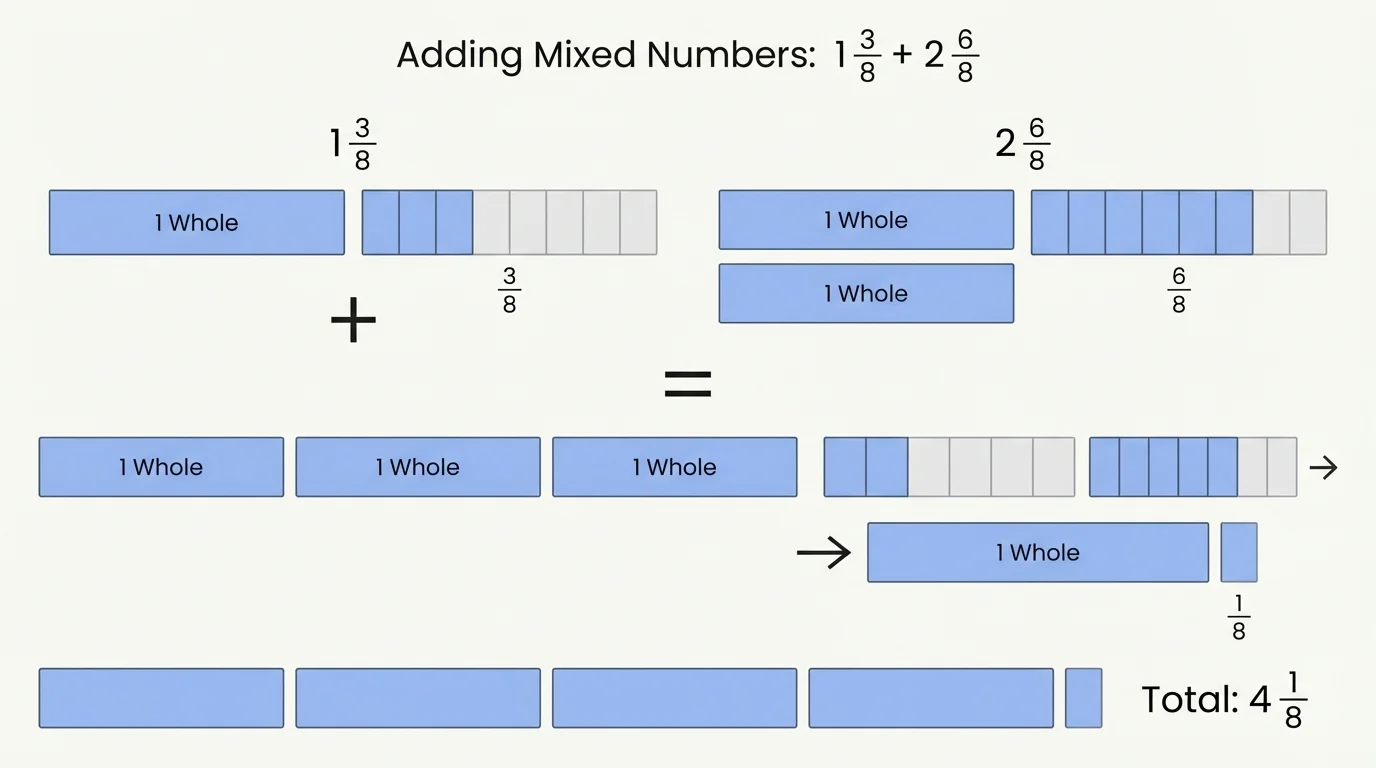
When you add mixed numbers with like denominators, you can often add the whole numbers and the fractions separately. This works because the fractional parts are made of the same-size pieces. Sometimes, as [Figure 2] illustrates, the fractions combine to make another whole.
Start by adding the whole numbers. Then add the fractions. If the fractional sum is less than \(1\), you are done. If the fractional sum is \(1\) or more, regroup by making one or more whole numbers.
For example, \(1\dfrac{2}{5} + 3\dfrac{1}{5}\) can be found by adding \(1 + 3 = 4\) and \(\dfrac{2}{5} + \dfrac{1}{5} = \dfrac{3}{5}\). The sum is \(4\dfrac{3}{5}\).
Now look at \(2\dfrac{3}{8} + 1\dfrac{6}{8}\). Add the whole numbers: \(2 + 1 = 3\). Add the fractions: \(\dfrac{3}{8} + \dfrac{6}{8} = \dfrac{9}{8}\). Since \(\dfrac{9}{8} = 1\dfrac{1}{8}\), regroup and get \(3 + 1\dfrac{1}{8} = 4\dfrac{1}{8}\).
Why regrouping works
If the fraction part adds up to a value greater than or equal to \(1\), it means the small equal pieces have filled one whole and maybe more. Since \(\dfrac{8}{8} = 1\), \(\dfrac{9}{8}\) is really \(1\dfrac{1}{8}\). Regrouping just rewrites the same amount in a simpler mixed-number form.
You can also write the calculation in vertical form if that helps you keep track of the parts:
\[\begin{array}{r} 2\frac{3}{8} \\ +\;1\frac{6}{8} \\ \hline 3\frac{9}{8} = 4\frac{1}{8} \end{array}\]
As [Figure 3] shows, subtracting mixed numbers also begins by looking at the whole numbers and the fractions. If the fractional part of the first mixed number is large enough, you can subtract the fractions directly. If it is not large enough, you need to rename one whole as a fraction with the same denominator. One whole can be renamed as \(\dfrac{b}{b}\).
For example, \(5\dfrac{4}{7} - 2\dfrac{1}{7}\) is simple. Subtract the whole numbers: \(5 - 2 = 3\). Subtract the fractions: \(\dfrac{4}{7} - \dfrac{1}{7} = \dfrac{3}{7}\). The answer is \(3\dfrac{3}{7}\).
Now look at \(3\dfrac{2}{8} - 1\dfrac{5}{8}\). You cannot subtract \(\dfrac{5}{8}\) from \(\dfrac{2}{8}\), so rename \(3\dfrac{2}{8}\) as \(2\dfrac{10}{8}\). This works because one whole is \(\dfrac{8}{8}\), and \(\dfrac{8}{8} + \dfrac{2}{8} = \dfrac{10}{8}\). Then subtract: \(2\dfrac{10}{8} - 1\dfrac{5}{8} = 1\dfrac{5}{8}\).
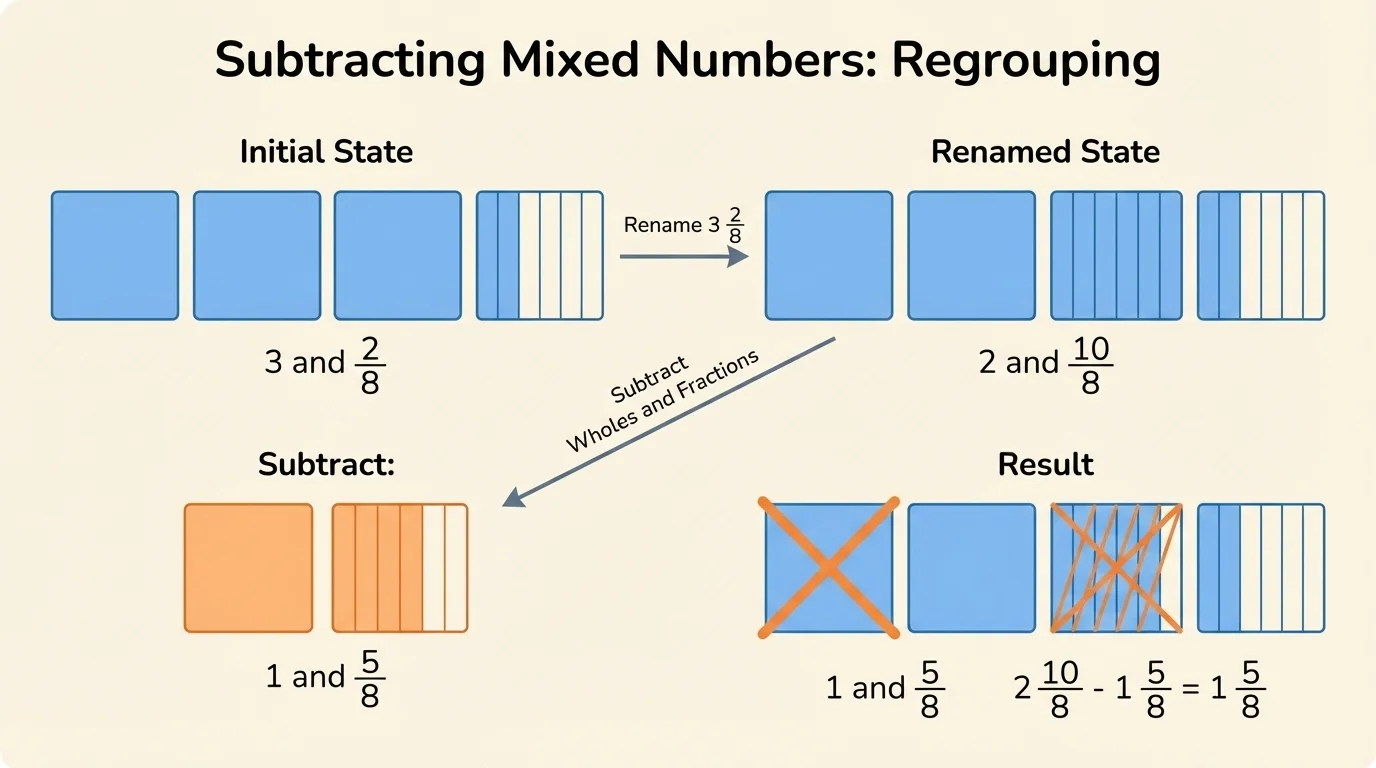
This renaming is a lot like regrouping in whole-number subtraction. You are not changing the value. You are just rewriting the number so the subtraction is easier.
Bakers, carpenters, and builders often work with measurements such as \(2\dfrac{1}{2}\) inches or \(4\dfrac{3}{4}\) cups. Quick mixed-number math helps them measure accurately.
Later, when you check your work, it helps to remember that renaming one whole into equal fractional parts does not change the total amount.
Sometimes it is easier to change each mixed number into an improper fraction first. This method works for both addition and subtraction, especially when regrouping or renaming feels tricky.
To add \(1\dfrac{3}{4} + 2\dfrac{1}{4}\), rewrite the numbers as improper fractions: \(1\dfrac{3}{4} = \dfrac{7}{4}\) and \(2\dfrac{1}{4} = \dfrac{9}{4}\). Then add: \(\dfrac{7}{4} + \dfrac{9}{4} = \dfrac{16}{4} = 4\).
To subtract \(4\dfrac{2}{3} - 1\dfrac{1}{3}\), rewrite them: \(4\dfrac{2}{3} = \dfrac{14}{3}\) and \(1\dfrac{1}{3} = \dfrac{4}{3}\). Then subtract: \(\dfrac{14}{3} - \dfrac{4}{3} = \dfrac{10}{3} = 3\dfrac{1}{3}\).
This method gives the same answers as adding or subtracting whole numbers and fractions separately. The best method is the one you understand well and can use accurately.
The best way to see these ideas clearly is to work through examples step by step.
Worked example 1
Find \(2\dfrac{1}{6} + 3\dfrac{4}{6}\).
Step 1: Add the whole numbers.
\(2 + 3 = 5\)
Step 2: Add the fractions.
\(\dfrac{1}{6} + \dfrac{4}{6} = \dfrac{5}{6}\)
Step 3: Combine the results.
\(5 + \dfrac{5}{6} = 5\dfrac{5}{6}\)
The sum is \[5\frac{5}{6}\]
In that example, the fraction part stayed less than one whole, so no regrouping was needed.
Worked example 2
Find \(4\dfrac{5}{9} + 2\dfrac{7}{9}\).
Step 1: Add the whole numbers.
\(4 + 2 = 6\)
Step 2: Add the fractions.
\(\dfrac{5}{9} + \dfrac{7}{9} = \dfrac{12}{9}\)
Step 3: Regroup the fraction.
\(\dfrac{12}{9} = 1\dfrac{3}{9} = 1\dfrac{1}{3}\)
Step 4: Add the extra whole.
\(6 + 1\dfrac{1}{3} = 7\dfrac{1}{3}\)
The sum is \[7\frac{1}{3}\]
Notice how the denominator stayed \(9\) while adding the fractions because the pieces were all ninths.
Worked example 3
Find \(6\dfrac{3}{10} - 2\dfrac{1}{10}\).
Step 1: Subtract the whole numbers.
\(6 - 2 = 4\)
Step 2: Subtract the fractions.
\(\dfrac{3}{10} - \dfrac{1}{10} = \dfrac{2}{10}\)
Step 3: Combine the results.
\(4\dfrac{2}{10} = 4\dfrac{1}{5}\)
The difference is \[4\frac{1}{5}\]
After subtracting, it is a good idea to simplify if the fraction can be written in a smaller form.
Worked example 4
Find \(5\dfrac{2}{7} - 3\dfrac{6}{7}\).
Step 1: Rename the first mixed number because \(\dfrac{2}{7}\) is smaller than \(\dfrac{6}{7}\).
\(5\dfrac{2}{7} = 4\dfrac{9}{7}\)
Step 2: Subtract the whole numbers and fractions.
\(4 - 3 = 1\) and \(\dfrac{9}{7} - \dfrac{6}{7} = \dfrac{3}{7}\)
Step 3: Write the final answer.
\(1\dfrac{3}{7}\)
The difference is \[1\frac{3}{7}\]
That example shows the usefulness of renaming. One whole became \(\dfrac{7}{7}\), and then the fractional subtraction worked smoothly.
Worked example 5
Find \(2\dfrac{5}{8} + 1\dfrac{7}{8}\) by changing to improper fractions.
Step 1: Rewrite each mixed number.
\(2\dfrac{5}{8} = \dfrac{21}{8}\) and \(1\dfrac{7}{8} = \dfrac{15}{8}\)
Step 2: Add the fractions.
\(\dfrac{21}{8} + \dfrac{15}{8} = \dfrac{36}{8}\)
Step 3: Change back to a mixed number.
\(\dfrac{36}{8} = 4\dfrac{4}{8} = 4\dfrac{1}{2}\)
The sum is \[4\frac{1}{2}\]
As we saw earlier with regrouping in [Figure 2], the improper-fraction method still finds the extra whole. It just shows that extra whole in a different way.
Mixed-number addition and subtraction are useful whenever people measure things in parts of a whole.
In cooking, a recipe might need \(1\dfrac{1}{4}\) cups of juice and then another \(2\dfrac{2}{4}\) cups of water. The total is \(3\dfrac{3}{4}\) cups. A cook needs that answer to measure the correct amount.
In building, a board might be \(8\dfrac{1}{2}\) feet long, and a piece \(3\dfrac{1}{2}\) feet long might be cut from it. You would subtract to find what remains. The same rules still apply because the denominators match.
In sports, a runner might complete \(2\dfrac{3}{5}\) miles in the morning and \(1\dfrac{1}{5}\) miles later. The runner covered \(3\dfrac{4}{5}\) miles total.
| Situation | Operation | Example | Result |
|---|---|---|---|
| Cooking | Add | \(1\dfrac{1}{4} + 2\dfrac{2}{4}\) | \(3\dfrac{3}{4}\) |
| Ribbon | Subtract | \(6\dfrac{5}{6} - 2\dfrac{1}{6}\) | \(4\dfrac{4}{6} = 4\dfrac{2}{3}\) |
| Running | Add | \(2\dfrac{3}{5} + 1\dfrac{1}{5}\) | \(3\dfrac{4}{5}\) |
| Wood length | Subtract | \(5\dfrac{4}{8} - 1\dfrac{7}{8}\) | \(3\dfrac{5}{8}\) |
Table 1. Real-world examples of adding and subtracting mixed numbers with like denominators.
One common mistake is adding or subtracting the denominators. When denominators are already the same, they stay the same. For example, \(\dfrac{2}{7} + \dfrac{3}{7} = \dfrac{5}{7}\), not \(\dfrac{5}{14}\).
Another mistake is forgetting to regroup after addition. If you get something like \(3\dfrac{10}{8}\), that is not in simplest mixed-number form. Regroup it: \(\dfrac{10}{8} = 1\dfrac{2}{8} = 1\dfrac{1}{4}\), so \(3\dfrac{10}{8} = 4\dfrac{1}{4}\).
A third mistake is forgetting to rename during subtraction. If you try to do \(2\dfrac{1}{6} - 1\dfrac{5}{6}\) without renaming, the fraction part does not work. Rename \(2\dfrac{1}{6}\) as \(1\dfrac{7}{6}\), then subtract to get \(\dfrac{2}{6} = \dfrac{1}{3}\), so the answer is \(\dfrac{1}{3}\).
"Keep the denominator when the parts are the same size."
— A smart fraction rule
You can also estimate to check your answer. For example, \(2\dfrac{7}{8} + 3\dfrac{1}{8}\) is close to \(3 + 3 = 6\), so an answer near \(6\) makes sense. The exact answer is \(6\), which matches the estimate very well.
Estimation also helps with subtraction. If \(7\dfrac{1}{6} - 2\dfrac{5}{6}\) is close to \(7 - 3 = 4\), then an answer around \(4\) is reasonable. The exact answer is \(4\dfrac{1}{3}\), so that checks out.
