Have you ever shared a snack so that everyone gets equal pieces, and then noticed that the whole snack is really just many tiny equal parts put together? Fractions work the same way. A fraction is not an unfamiliar new kind of number. It is a number built from equal pieces. Once you understand the small piece, you can build the larger fraction from it. That is why learning about fractions as groups of unit fractions is such an important idea.
In this topic, the big idea is that a fraction like \(\dfrac{5}{4}\) means five copies of \(\dfrac{1}{4}\). So instead of thinking of \(\dfrac{5}{4}\) as a difficult number to memorize, you can think, "That is \(\dfrac{1}{4}\) taken \(5\) times." Written as multiplication, that is
\[\frac{5}{4} = 5 \times \frac{1}{4}\]
This idea works for many fractions, not just \(\dfrac{5}{4}\). It helps you understand what a fraction means, how to draw it, and how multiplication with fractions begins.
Suppose a whole sandwich is cut into \(4\) equal parts. Each part is one of those \(4\) equal pieces, so each part is \(\dfrac{1}{4}\) of the whole sandwich. If you take \(1\) piece, you have \(\dfrac{1}{4}\). If you take \(2\) pieces, you have \(\dfrac{2}{4}\). If you take \(3\) pieces, you have \(\dfrac{3}{4}\). If you take all \(4\) pieces, you have \(\dfrac{4}{4}\), which is exactly one whole.
What if you take \(5\) pieces of size \(\dfrac{1}{4}\)? Then you have one whole made of \(4\) fourths, plus one more fourth. That total is \(\dfrac{5}{4}\). So even when the numerator is greater than the denominator, the fraction still means a certain number of equal pieces.
This is why the numerator and denominator have different jobs. The denominator tells the size of each piece. The numerator tells how many of those pieces you have.
From earlier fraction work, you already know that fractions come from dividing a whole into equal parts. Equal parts are very important. If the parts are not equal, the pieces do not represent a fraction correctly.
When we build fractions piece by piece, we are really using repeated unit fractions. This makes fractions more like counting. Instead of counting whole objects like \(1, 2, 3\), we count equal fractional parts like \(\dfrac{1}{4}, \dfrac{2}{4}, \dfrac{3}{4}, \dfrac{4}{4}, \dfrac{5}{4}\).
Unit fraction means a fraction with a numerator of \(1\), such as \(\dfrac{1}{2}\), \(\dfrac{1}{3}\), or \(\dfrac{1}{8}\).
Numerator is the top number in a fraction. It tells how many parts are being counted.
Denominator is the bottom number in a fraction. It tells how many equal parts make one whole.
A unit fraction is the building block of other fractions. For example, if the denominator is \(6\), then the basic piece is \(\dfrac{1}{6}\). Using that one piece, you can build many fractions: \(\dfrac{2}{6}\), \(\dfrac{3}{6}\), \(\dfrac{4}{6}\), and so on.
In general, the fraction \(\dfrac{a}{b}\) means \(a\) copies of \(\dfrac{1}{b}\). This can be written as
\[\frac{a}{b} = a \times \frac{1}{b}\]
This equation is a very important idea. It says that if you know the unit fraction \(\dfrac{1}{b}\), then you can build \(\dfrac{a}{b}\) by multiplying that unit fraction by the whole number \(a\).
For example, \(\dfrac{3}{8}\) means \(3\) copies of \(\dfrac{1}{8}\). So
\[\frac{3}{8} = 3 \times \frac{1}{8}\]
And \(\dfrac{7}{3}\) means \(7\) copies of \(\dfrac{1}{3}\). So
\[\frac{7}{3} = 7 \times \frac{1}{3}\]
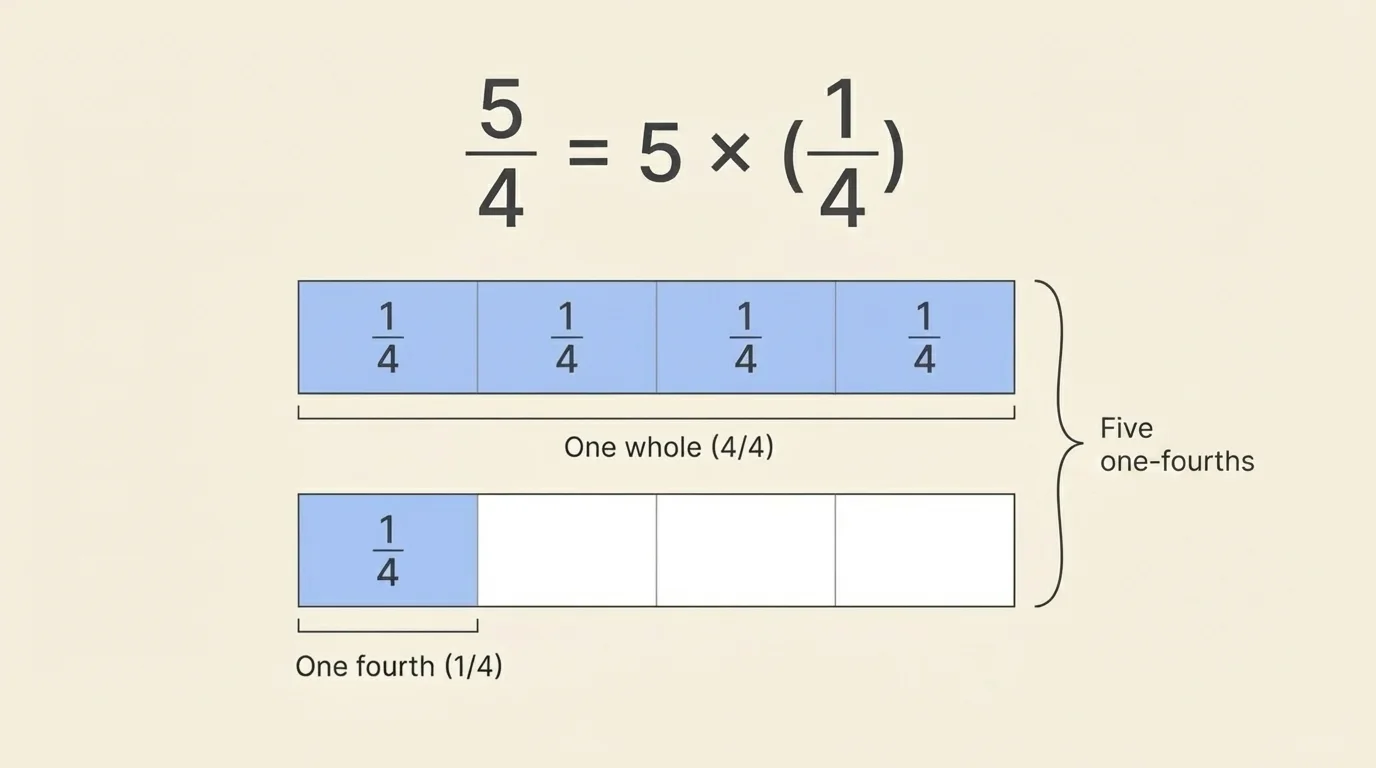
Visual models help make this idea clear, and [Figure 1] shows one of the most important examples: \(\dfrac{5}{4}\) as five copies of \(\dfrac{1}{4}\). A fraction strip or bar model is especially useful because it shows equal parts in a straight row.
Picture one bar divided into \(4\) equal parts. Each part is \(\dfrac{1}{4}\). If all \(4\) parts are shaded, that bar shows \(\dfrac{4}{4}\), or \(1\) whole. Then picture one more bar, also divided into \(4\) equal parts, but with only \(1\) part shaded. That extra shaded part is another \(\dfrac{1}{4}\).
So together, the shaded parts are \(\dfrac{4}{4} + \dfrac{1}{4} = \dfrac{5}{4}\). You can also count the pieces one by one: \(\dfrac{1}{4}, \dfrac{2}{4}, \dfrac{3}{4}, \dfrac{4}{4}, \dfrac{5}{4}\). That is why \(\dfrac{5}{4}\) means five one-fourths.
This same kind of model works for many fractions. For \(\dfrac{2}{3}\), draw a whole divided into \(3\) equal parts and shade \(2\) of them. For \(\dfrac{6}{5}\), you need more than one whole because \(5\) fifths make one whole, and one more fifth makes \(\dfrac{6}{5}\).
Notice something important: the denominator decides how many equal parts each whole is cut into. The numerator tells how many of those parts to count. If the denominator is \(4\), every piece must be a fourth. If the denominator is \(5\), every piece must be a fifth.
Fractions greater than \(1\) are sometimes called improper fractions, but there is nothing "wrong" with them. They are perfectly good numbers and are very useful in measurement and problem solving.
The model makes another fact easy to see: \(\dfrac{5}{4}\) is larger than \(1\), because \(\dfrac{4}{4} = 1\) and there is one extra fourth.
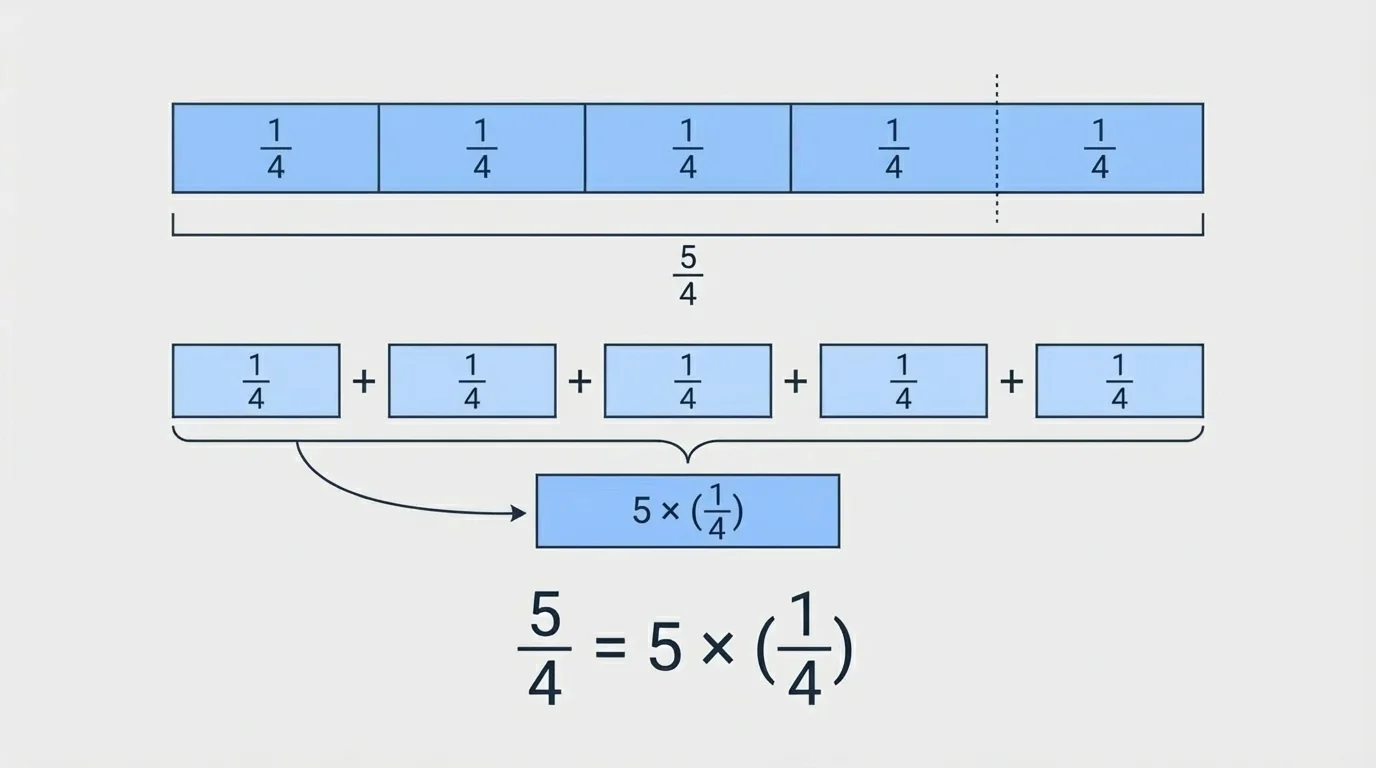
The jump from addition to multiplication is easier than it may seem, and [Figure 2] illustrates this connection by showing equal fractional parts counted again and again. When the same fraction is added repeatedly, multiplication gives a shorter way to write it.
For example, if you add \(\dfrac{1}{5}\) three times, you get
\[\frac{1}{5} + \frac{1}{5} + \frac{1}{5} = \frac{3}{5}\]
Because there are \(3\) copies of \(\dfrac{1}{5}\), you can also write this as
\[3 \times \frac{1}{5} = \frac{3}{5}\]
So repeated addition and multiplication are connected. Multiplication tells how many copies of the unit fraction you have.
Here are more examples:
\[2 \times \frac{1}{6} = \frac{2}{6}\]
\[4 \times \frac{1}{7} = \frac{4}{7}\]
\[8 \times \frac{1}{3} = \frac{8}{3}\]
Each equation says the same thing in a new way: a fraction is a whole number multiplied by a unit fraction.
How multiplication helps with fractions
When you write \(\dfrac{a}{b} = a \times \dfrac{1}{b}\), you are saying, "Take the unit fraction \(\dfrac{1}{b}\) and use it \(a\) times." This connects fractions to multiplication, skip-counting, and repeated addition. It also prepares you for later fraction multiplication.
You can think of this as a special kind of counting. Instead of counting by ones, you are counting by unit fractions. Counting by fourths might go \(\dfrac{1}{4}, \dfrac{2}{4}, \dfrac{3}{4}, \dfrac{4}{4}, \dfrac{5}{4}\). Counting by sixths might go \(\dfrac{1}{6}, \dfrac{2}{6}, \dfrac{3}{6}, \dfrac{4}{6}\), and so on.
Worked examples help show exactly how to think about fractions as multiples of unit fractions. In each example, start by finding the unit fraction from the denominator. Then count how many copies are needed from the numerator.
Worked Example 1
Write \(\dfrac{3}{4}\) as a multiple of a unit fraction.
Step 1: Identify the unit fraction.
The denominator is \(4\), so the unit fraction is \(\dfrac{1}{4}\).
Step 2: Use the numerator to count how many copies.
The numerator is \(3\), so we need \(3\) copies of \(\dfrac{1}{4}\).
Step 3: Write the multiplication equation.
\[\frac{3}{4} = 3 \times \frac{1}{4}\]
So \(\dfrac{3}{4}\) means three one-fourths.
This example is a proper fraction because it is less than \(1\). Even so, the idea is exactly the same as with larger fractions.
Worked Example 2
Use a visual idea to explain \(\dfrac{5}{4}\).
Step 1: Find the unit fraction.
The denominator is \(4\), so each piece is \(\dfrac{1}{4}\).
Step 2: Count \(5\) pieces of size \(\dfrac{1}{4}\).
Four fourths make one whole: \(\dfrac{4}{4} = 1\). One more fourth gives \(\dfrac{5}{4}\).
Step 3: Write the multiplication equation.
\[\frac{5}{4} = 5 \times \frac{1}{4}\]
So \(\dfrac{5}{4}\) means five one-fourths.
This is the same model you saw earlier, and [Figure 1] keeps that idea visible: the fraction is built by repeating one-fourth five times.
Worked Example 3
Write \(\dfrac{7}{3}\) as a multiple of a unit fraction.
Step 1: Identify the unit fraction.
The denominator is \(3\), so the unit fraction is \(\dfrac{1}{3}\).
Step 2: Count the number of copies.
The numerator is \(7\), so there are \(7\) copies of \(\dfrac{1}{3}\).
Step 3: Write the equation.
\[\frac{7}{3} = 7 \times \frac{1}{3}\]
So \(\dfrac{7}{3}\) means seven one-thirds.
Notice that this fraction is greater than \(2\), because \(\dfrac{6}{3} = 2\), and then one more third makes \(\dfrac{7}{3}\).
Worked Example 4
Show that \(4 \times \dfrac{1}{8}\) equals \(\dfrac{4}{8}\).
Step 1: Read the multiplication.
\(4 \times \dfrac{1}{8}\) means \(4\) copies of \(\dfrac{1}{8}\).
Step 2: Write it as repeated addition.
\(\dfrac{1}{8} + \dfrac{1}{8} + \dfrac{1}{8} + \dfrac{1}{8} = \dfrac{4}{8}\)
Step 3: State the result.
\[4 \times \frac{1}{8} = \frac{4}{8}\]
This shows that multiplication and repeated addition tell the same story.
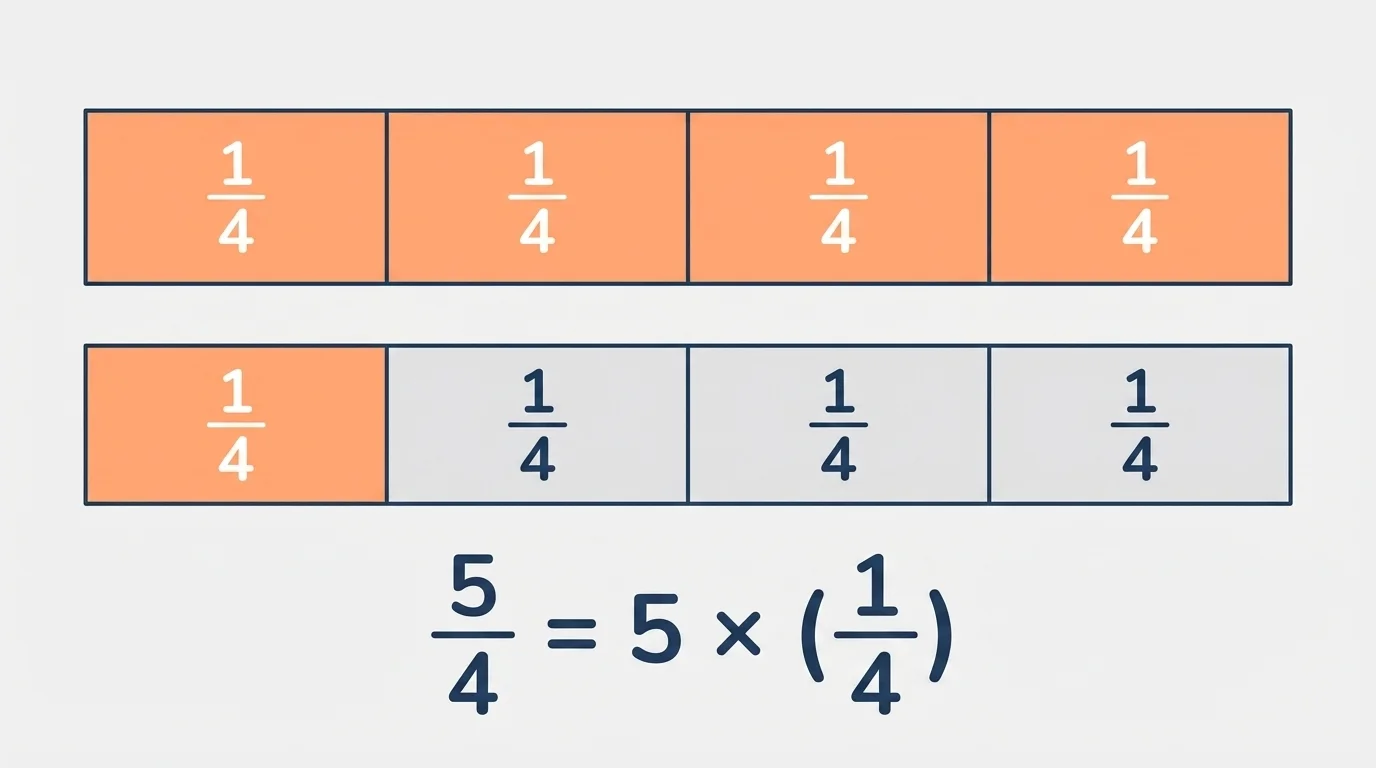
Some fractions are greater than \(1\), and [Figure 3] makes it easy to see how they can be named in two ways. A fraction such as \(\dfrac{5}{4}\) is an improper fraction because the numerator is greater than the denominator. But it can also be written as a mixed number.
Since \(\dfrac{4}{4} = 1\), we can split \(\dfrac{5}{4}\) into \(\dfrac{4}{4} + \dfrac{1}{4}\). Therefore,
\[\frac{5}{4} = 1 \frac{1}{4}\]
Even when we write it as \(1 \dfrac{1}{4}\), it still means five copies of \(\dfrac{1}{4}\). The mixed number and the improper fraction are two names for the same amount.
Here is another example. \(\dfrac{9}{4}\) means nine one-fourths:
\[\frac{9}{4} = 9 \times \frac{1}{4}\]
Because \(\dfrac{8}{4} = 2\), we know \(\dfrac{9}{4} = 2 \dfrac{1}{4}\).
You can see why this works: full groups of \(4\) fourths make whole numbers, and any extra fourths remain as fractional parts.
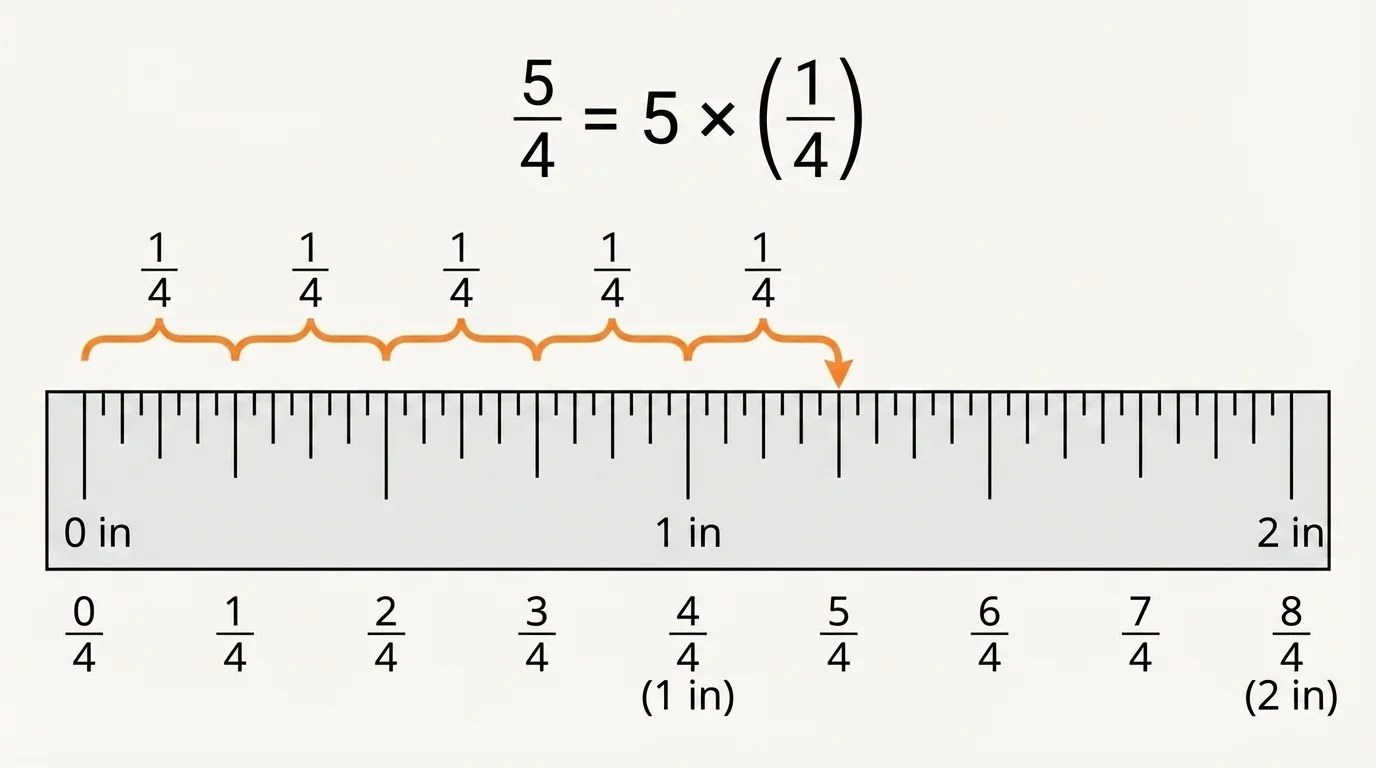
Fractions built from unit fractions appear in everyday measurement, and [Figure 4] shows a ruler marked in fourths, which is a perfect real-life example. If a piece of ribbon is \(\dfrac{5}{4}\) inches long, that means it is made of five pieces of length \(\dfrac{1}{4}\) inch.
You can think of that length as \(1\) whole inch plus \(\dfrac{1}{4}\) inch more. So \(\dfrac{5}{4}\) inch and \(1 \dfrac{1}{4}\) inches name the same length.
Cooking is another place where this matters. Suppose a recipe uses \(\dfrac{3}{4}\) cup of milk. That amount means three copies of \(\dfrac{1}{4}\) cup:
\[\frac{3}{4} = 3 \times \frac{1}{4}\]
If you only have a \(\dfrac{1}{4}\)-cup measuring cup, you can still measure \(\dfrac{3}{4}\) cup by filling it \(3\) times.
Music also uses fractions in timing. A measure may be divided into equal beats, and parts of the beat can be counted in equal pieces. The idea of building a total amount from equal smaller parts appears again and again in math and life.
One common mistake is to think that \(\dfrac{5}{4}\) means \(\dfrac{1}{20}\) because someone multiplies \(5\) and \(4\). But that is not what the fraction means. The denominator tells the size of each part, and the numerator tells the number of parts. So \(\dfrac{5}{4}\) means five one-fourths, not one-twentieth.
Another mistake is drawing unequal parts in a visual model. If a whole is divided into \(4\) parts, all \(4\) parts must be equal in size. Otherwise, the picture does not correctly show fourths.
A third mistake is forgetting that \(\dfrac{4}{4} = 1\). This is important because it helps you understand why \(\dfrac{5}{4}\) is greater than \(1\), why \(\dfrac{8}{4} = 2\), and why improper fractions can be rewritten as mixed numbers.
"A fraction is not just one number written with two numbers. It is a count of equal pieces of the same size."
That idea helps keep the meaning clear. Always ask yourself two questions: What size is each piece? How many of those pieces are there?
Patterns make the idea even stronger. Suppose the denominator stays \(6\). Then every fraction is built from the same unit fraction, \(\dfrac{1}{6}\).
| Fraction | As repeated unit fractions | As multiplication |
|---|---|---|
| \(\dfrac{2}{6}\) | \(\dfrac{1}{6} + \dfrac{1}{6}\) | \(2 \times \dfrac{1}{6}\) |
| \(\dfrac{5}{6}\) | \(\dfrac{1}{6} + \dfrac{1}{6} + \dfrac{1}{6} + \dfrac{1}{6} + \dfrac{1}{6}\) | \(5 \times \dfrac{1}{6}\) |
| \(\dfrac{8}{6}\) | eight copies of \(\dfrac{1}{6}\) | \(8 \times \dfrac{1}{6}\) |
Table 1. Fractions with denominator \(6\) shown as repeated unit fractions and as multiplication.
When the denominator stays the same, the piece size stays the same. Only the number of pieces changes. That is why \(\dfrac{2}{6}\), \(\dfrac{5}{6}\), and \(\dfrac{8}{6}\) are all built from sixths.
You can make the same pattern with any denominator:
\[\frac{a}{b} = a \times \frac{1}{b}\]
This equation is the general rule. It works whether the fraction is less than \(1\), equal to \(1\), or greater than \(1\).
