You may have heard that multiplication makes numbers bigger. That sounds true at first, but it is not always true. For example, \(6 \times 2 = 12\), which is bigger than \(6\). But \(6 \times \dfrac{1}{2} = 3\), which is smaller than \(6\). So what is really happening? Multiplication is not just repeated addition. It is also a way to resize a number.
When we think about multiplication as resizing, we ask, "How much of the original amount do we want?" If the factor is more than \(1\), we stretch the original amount. If the factor is less than \(1\), we shrink it. This idea helps us understand whole numbers and fractions in one simple way.
A useful way to think about multiplication is scaling. Scaling means changing the size of something while comparing it to the original. If you enlarge a photo, the photo gets bigger. If you shrink a drawing, it gets smaller. Multiplication works in a similar way with numbers.
Scaling means resizing a quantity by multiplying. A factor greater than \(1\) enlarges the quantity, a factor less than \(1\) reduces it, and a factor equal to \(1\) keeps it the same.
Suppose the original number is \(10\). If we multiply by \(2\), we get \(20\). If we multiply by \(\dfrac{1}{2}\), we get \(5\). If we multiply by \(1\), we still have \(10\). The factor tells us what kind of resizing happens, as [Figure 1] helps show.
So instead of memorizing separate rules, we can use one idea: compare the factor to \(1\).
Whole-number multiplication is the familiar case of scaling up. When you multiply by a whole number greater than \(1\), you are taking several copies of the original amount.
For example, \(4 \times 3 = 12\). This means \(3 + 3 + 3 + 3 = 12\), but it also means that \(3\) has been scaled by a factor of \(4\). The new amount is \(4\) times as large as the original.
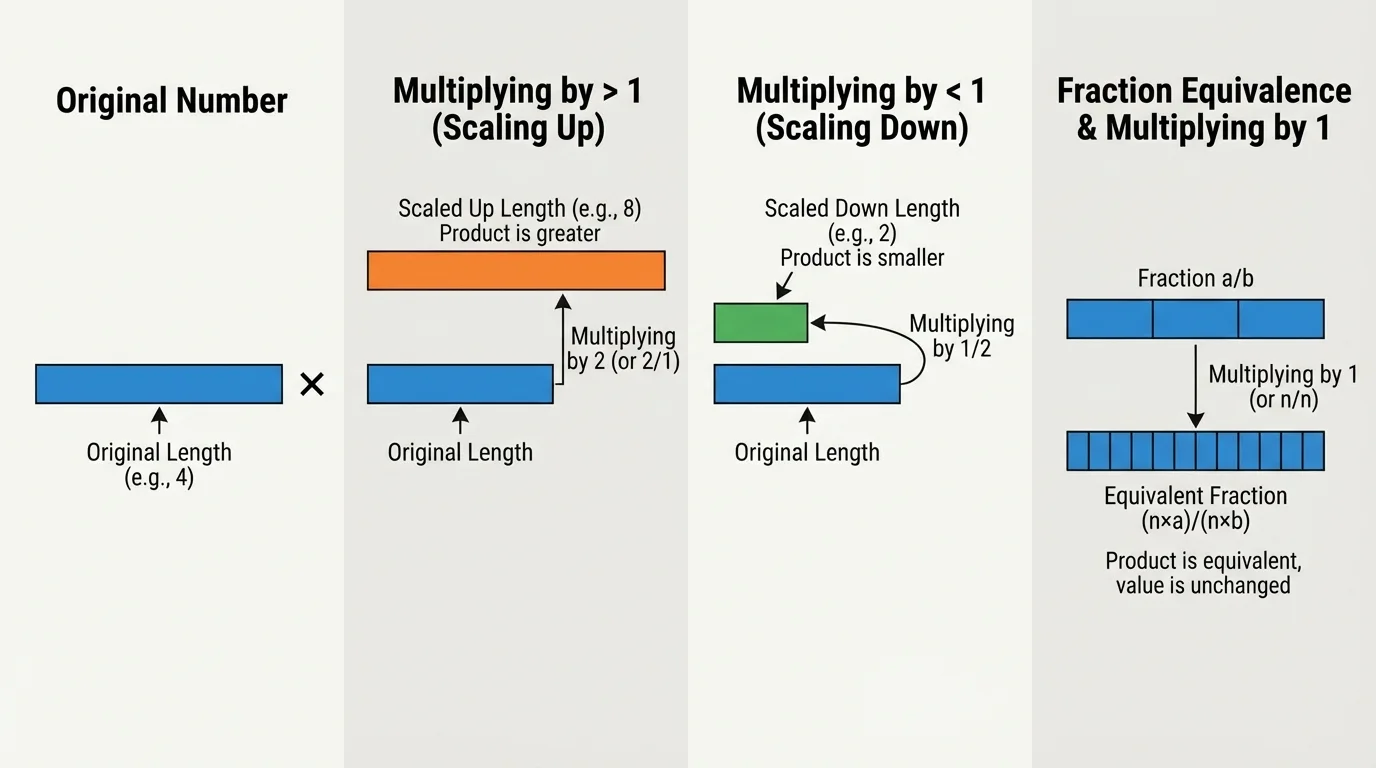
If the factor is \(2\), the product is twice as large. If the factor is \(5\), the product is five times as large. Since every whole number greater than \(1\) is larger than \(1\), multiplying by it makes the product larger than the original number.
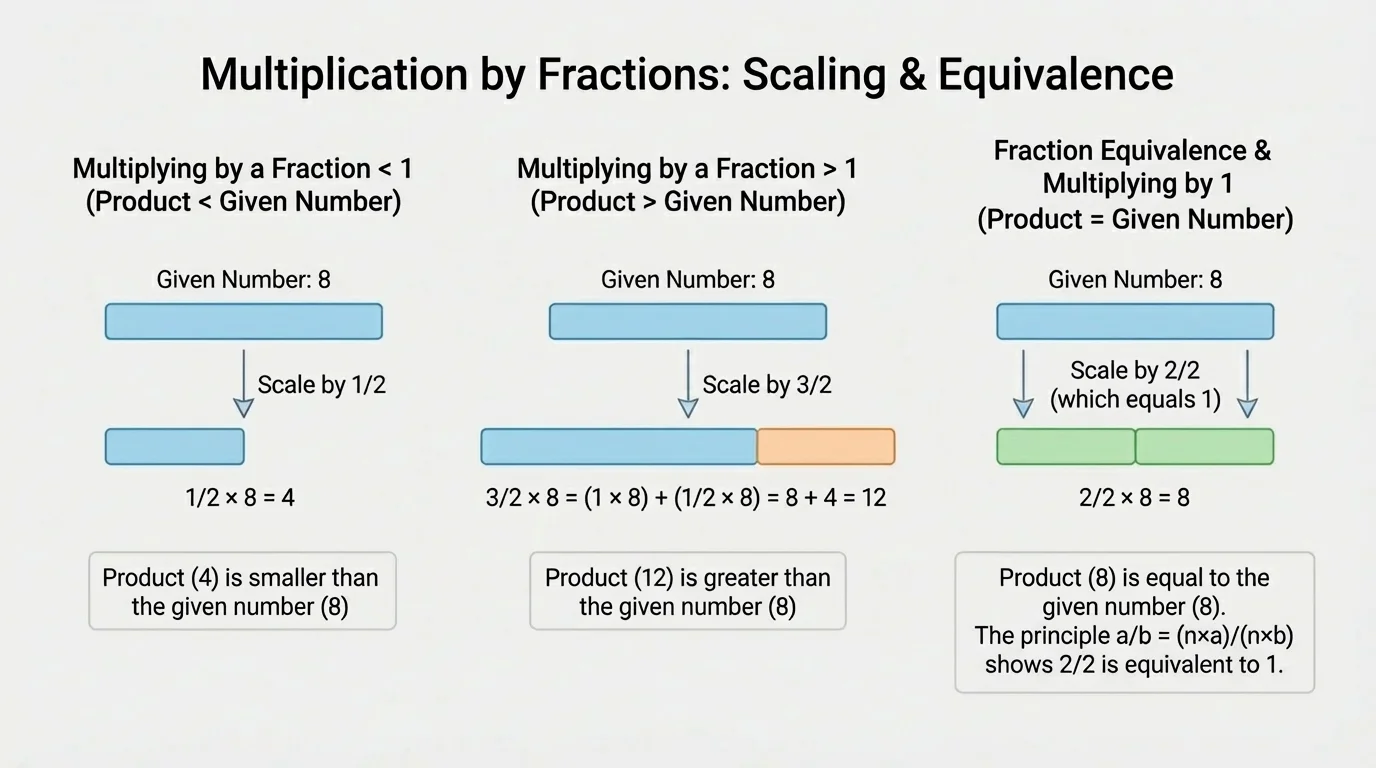
This is why multiplying by whole numbers greater than \(1\) feels familiar: we already know it enlarges. Fractions greater than \(1\) do the same thing, even though the enlargement may be less dramatic than multiplying by \(2\) or \(3\), as [Figure 2] helps illustrate.
A fraction greater than 1 is a fraction whose numerator is greater than its denominator, such as \(\dfrac{3}{2}\), \(\dfrac{5}{4}\), or \(\dfrac{7}{3}\). Because these fractions are greater than \(1\), they enlarge the original amount.
Consider \(8 \times \dfrac{3}{2}\). The fraction \(\dfrac{3}{2}\) means "one and one-half." So multiplying by \(\dfrac{3}{2}\) means taking \(8\) and then half of \(8\) more.
Half of \(8\) is \(4\). So:
\[8 \times \frac{3}{2} = 8 + 4 = 12\]
The product \(12\) is greater than \(8\), because the factor \(\dfrac{3}{2}\) is greater than \(1\).
We can also see this with another example: \(10 \times \dfrac{6}{5}\). Since \(\dfrac{6}{5} = 1 + \dfrac{1}{5}\), we are taking all of \(10\) and adding one-fifth more. One-fifth of \(10\) is \(2\), so the product is \(12\).
Whenever the factor is greater than \(1\), the product must be greater than the original number, provided the original number is positive. This is the same scaling idea we saw with whole numbers in [Figure 1]. Whole numbers like \(2\) and \(3\) are just familiar examples of factors greater than \(1\).
Why a factor greater than \(1\) enlarges
If a factor is greater than \(1\), it means "at least the whole amount, and then some more." That extra part makes the product larger than the original quantity.
You can even compare factors. Multiplying by \(\dfrac{5}{4}\) enlarges a number, but not as much as multiplying by \(2\). Both are greater than \(1\), yet \(2\) is a bigger scale factor than \(\dfrac{5}{4}\).
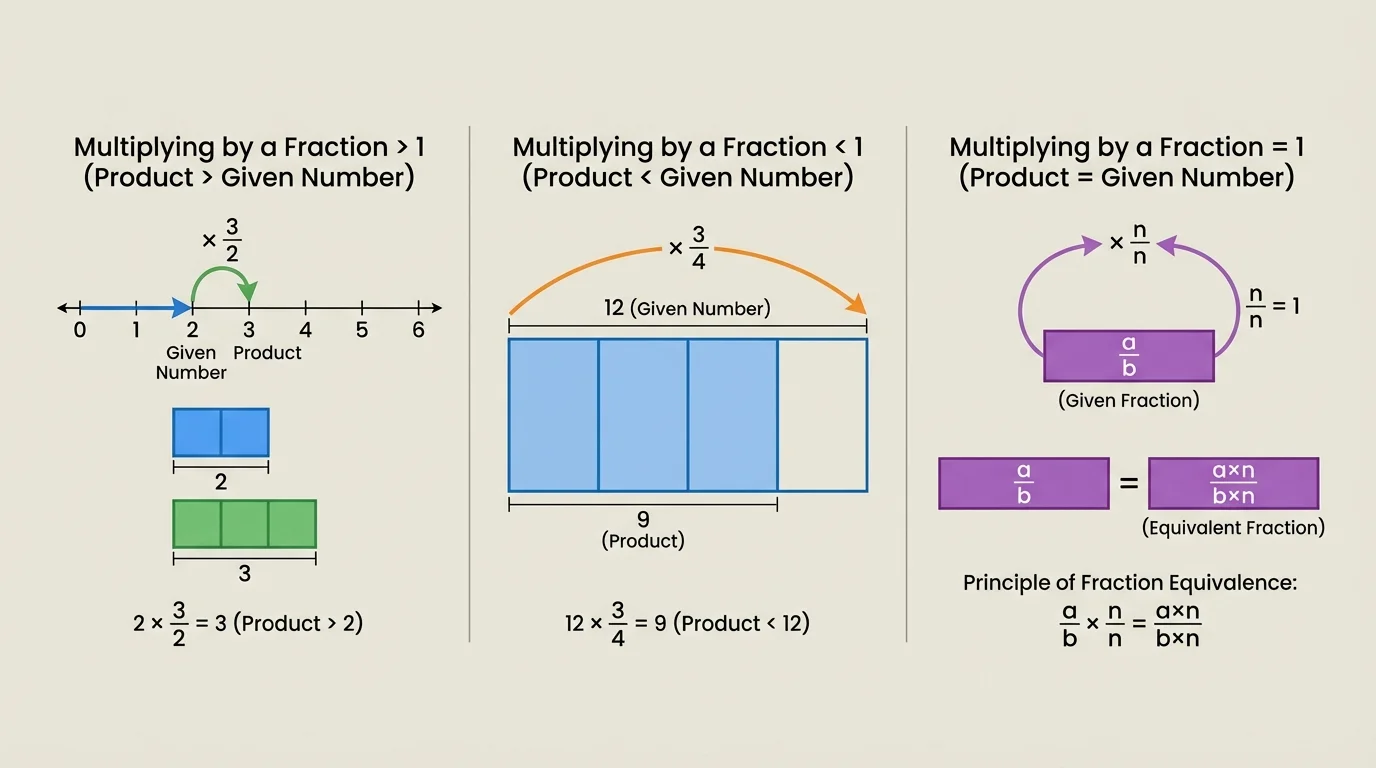
A fraction less than 1 has a numerator smaller than its denominator, such as \(\dfrac{1}{2}\), \(\dfrac{3}{4}\), or \(\dfrac{2}{5}\). These fractions shrink the original amount, as [Figure 3] shows by taking only part of a whole.
For example, \(12 \times \dfrac{3}{4}\) means taking three-fourths of \(12\). First divide \(12\) into \(4\) equal parts. Each part is \(3\). Then take \(3\) of those parts: \(3 + 3 + 3 = 9\).
\[12 \times \frac{3}{4} = 9\]
Because \(\dfrac{3}{4}\) is less than \(1\), the product \(9\) is smaller than \(12\).
Here is another example: \(7 \times \dfrac{1}{2} = 3.5\). Taking half of \(7\) gives a smaller amount than the original. We are not making copies of \(7\); we are taking only part of it.
This is why the old rule "multiplication makes numbers bigger" is not complete. A better rule is: if you multiply by a factor less than \(1\), you get a smaller product. The picture in [Figure 3] makes that shrinking idea easier to see.
Remember that a fraction like \(\dfrac{3}{4}\) means \(3\) parts out of \(4\) equal parts. Multiplying by \(\dfrac{3}{4}\) means taking \(\dfrac{3}{4}\) of a quantity.
So the key question is always: is the factor less than \(1\), equal to \(1\), or greater than \(1\)? That comparison tells whether the product shrinks, stays the same, or grows.
The number \(1\) is special because multiplying by \(1\) does not change a number. For any number \(n\),
\[n \times 1 = n\]
This makes sense in scaling. A factor of \(1\) means "keep the original size." There is no enlargement and no shrinkage.
Examples include \(9 \times 1 = 9\), \(\dfrac{2}{3} \times 1 = \dfrac{2}{3}\), and \(15.4 \times 1 = 15.4\). Multiplying by \(1\) leaves the value unchanged.
[Figure 4] Equivalent fractions are fractions that name the same amount, even though they look different. This happens because multiplying by \(1\) does not change value.
Suppose we start with \(\dfrac{a}{b}\). If we multiply it by \(1\), the value stays the same. But we can write \(1\) as \(\dfrac{n}{n}\), as long as \(n \neq 0\). Then:
\[\frac{a}{b} \times \frac{n}{n} = \frac{n \times a}{n \times b}\]
Since \(\dfrac{n}{n} = 1\), this means:
\[\frac{a}{b} = \frac{n \times a}{n \times b}\]
This is the rule for making equivalent fractions.
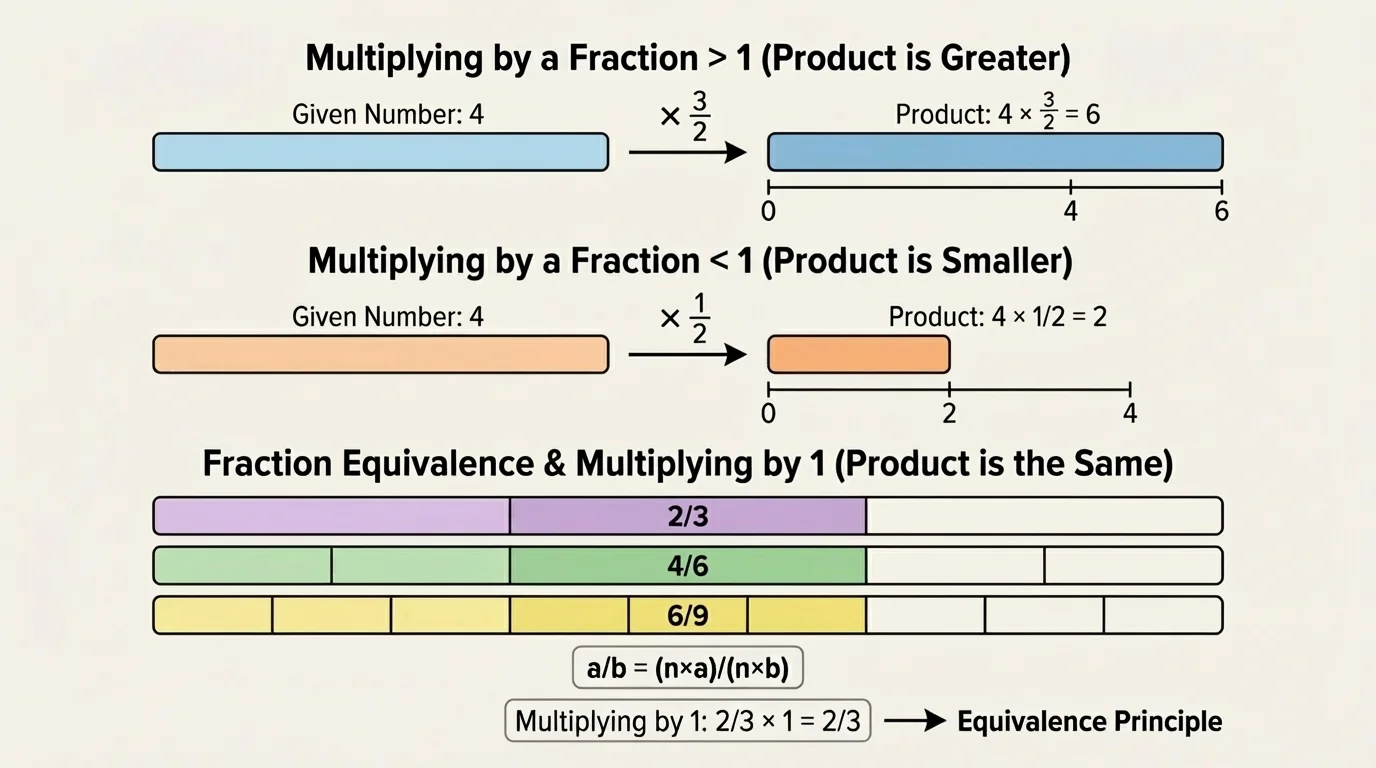
For example, start with \(\dfrac{2}{3}\). Multiply by \(\dfrac{2}{2}\):
\[\frac{2}{3} \times \frac{2}{2} = \frac{4}{6}\]
Because \(\dfrac{2}{2} = 1\), the fractions \(\dfrac{2}{3}\) and \(\dfrac{4}{6}\) are equal in value. They are just different names for the same amount.
We can do it again with \(\dfrac{3}{3}\):
\[\frac{2}{3} \times \frac{3}{3} = \frac{6}{9}\]
So \(\dfrac{2}{3} = \dfrac{4}{6} = \dfrac{6}{9}\). The strips all cover the same length, which is why the fractions are equivalent.
A fraction can have infinitely many equivalent forms. For example, \(\dfrac{1}{2} = \dfrac{2}{4} = \dfrac{3}{6} = \dfrac{4}{8}\), and the pattern can continue forever.
This idea connects perfectly to multiplication as scaling. Multiplying by \(\dfrac{n}{n}\) means multiplying by \(1\), so there is no resizing at all. The fraction looks different, but its value stays the same.
Now let's work through several examples step by step.
Worked example 1
Explain why \(5 \times \dfrac{7}{5}\) is greater than \(5\).
Step 1: Compare the factor to \(1\).
The fraction \(\dfrac{7}{5}\) is greater than \(1\) because the numerator is greater than the denominator.
Step 2: Interpret the factor.
Since \(\dfrac{7}{5} = 1 + \dfrac{2}{5}\), multiplying by \(\dfrac{7}{5}\) means taking all of \(5\) and then adding \(\dfrac{2}{5}\) of \(5\).
Step 3: Compute the extra part.
\(\dfrac{2}{5}\) of \(5\) is \(2\).
Step 4: Find the product.
\(5 + 2 = 7\), so \(5 \times \dfrac{7}{5} = 7\).
The product is greater than \(5\) because the factor is greater than \(1\).
The important idea is not just the answer. It is the reason: the factor includes the whole original amount and something extra.
Worked example 2
Explain why \(16 \times \dfrac{3}{8}\) is smaller than \(16\).
Step 1: Compare the factor to \(1\).
The fraction \(\dfrac{3}{8}\) is less than \(1\).
Step 2: Interpret the multiplication.
Multiplying by \(\dfrac{3}{8}\) means taking only three out of eight equal parts of \(16\).
Step 3: Divide into eighths.
\(16 \div 8 = 2\), so each eighth is \(2\).
Step 4: Take three parts.
\(2 + 2 + 2 = 6\), so \(16 \times \dfrac{3}{8} = 6\).
The product is smaller than \(16\) because the factor is less than \(1\).
Notice how the factor tells the story before we even calculate. A factor less than \(1\) means the result will shrink.
Worked example 3
Use multiplying by \(1\) to show that \(\dfrac{3}{4}\) and \(\dfrac{9}{12}\) are equivalent.
Step 1: Write \(1\) as a fraction.
We can write \(1\) as \(\dfrac{3}{3}\).
Step 2: Multiply the fraction by \(1\).
\(\dfrac{3}{4} \times \dfrac{3}{3} = \dfrac{9}{12}\).
Step 3: Explain why the value stays the same.
Because \(\dfrac{3}{3} = 1\), multiplying by it does not change the amount.
So \(\dfrac{3}{4} = \dfrac{9}{12}\).
This shows that equivalent fractions are not "almost equal." They are exactly equal.
Worked example 4
Decide whether the product is greater than, less than, or equal to the given number: \(24 \times \dfrac{11}{10}\).
Step 1: Compare the factor to \(1\).
\(\dfrac{11}{10} > 1\).
Step 2: Predict the result.
Since the factor is greater than \(1\), the product will be greater than \(24\).
Step 3: Compute to confirm.
\(24 \times \dfrac{11}{10} = \dfrac{264}{10} = 26.4\).
The product \(26.4\) is greater than \(24\).
Scaling happens all the time in real life. In cooking, a recipe might be increased by a factor greater than \(1\). If a recipe uses \(2\) cups of flour and you make \(\dfrac{3}{2}\) times the recipe, you need \(2 \times \dfrac{3}{2} = 3\) cups. The amount grows because the factor is greater than \(1\).
In art or printing, a picture may be reduced to \(\dfrac{1}{2}\) of its original size. If a poster is \(24\) inches wide, then the reduced width is \(24 \times \dfrac{1}{2} = 12\) inches. The new width is smaller because the factor is less than \(1\).
In shopping, a discount means multiplying by a number less than \(1\). If an item costs \(\$20\) and is sold for \(\dfrac{3}{4}\) of the original price, then the sale price is \(\$20 \times \dfrac{3}{4} = \$15\). The price shrinks because only part of the original remains.
In maps and models, scaling can make objects smaller or larger while keeping the same shape. That same idea of resizing is what multiplication expresses in math.
One common mistake is believing that multiplication always increases a number. That is only true when the factor is greater than \(1\). If the factor is less than \(1\), multiplication decreases the number instead.
Another mistake is thinking that equivalent fractions change the amount because both numbers change. But if both numerator and denominator are multiplied by the same nonzero number, the fraction is really being multiplied by \(1\), so the value stays the same.
The clearest strategy is to compare the factor to \(1\):
| Factor | Effect on the Original Number | Example |
|---|---|---|
| Greater than \(1\) | Product is greater | \(6 \times \dfrac{4}{3} = 8\) |
| Equal to \(1\) | Product stays the same | \(6 \times 1 = 6\) |
| Less than \(1\) | Product is smaller | \(6 \times \dfrac{1}{3} = 2\) |
Table 1. How comparing the factor to \(1\) predicts whether multiplication enlarges, keeps, or shrinks a quantity.
That simple comparison helps you predict what multiplication will do before you even find the exact answer.
