If a recipe uses only half of three-fourths of a cup of juice, how much juice is that? Questions like this come up more often than you might think. Fraction multiplication helps in cooking, building, sports, and even figuring out how much time or distance is part of a larger amount. Once you understand what the numbers mean, these problems become much easier.
When whole numbers are multiplied, the product is often larger. For example, multiplying by \(3\) makes something three times as large. But with fractions, multiplication can shrink an amount. If you find \(\dfrac{1}{2}\) of \(8\), you get \(4\). If you find \(\dfrac{1}{2}\) of \(\dfrac{3}{4}\), you get an even smaller amount. That is why fraction multiplication is so useful in real life: it helps describe parts of amounts very precisely.
In word problems, the word of usually signals multiplication. For example, \(\dfrac{2}{3}\) of \(\dfrac{3}{5}\) means multiply \(\dfrac{2}{3} \times \dfrac{3}{5}\). The situation tells you what the fractions represent, and multiplication tells you how to combine them.
You already know how to find equal parts of a whole and how to write equivalent fractions. You also know that equivalent fractions name the same amount, such as \(\dfrac{1}{2} = \dfrac{2}{4}\). These ideas help when you draw models and simplify products.
Before solving real-world problems, it helps to understand exactly what fraction multiplication means.
A fraction multiplication problem often means finding one part of another part. For example, \(\dfrac{1}{2} \times \dfrac{3}{4}\) means one-half of three-fourths. Start with \(\dfrac{3}{4}\), then take half of that amount.
This is sometimes called scaling. If you multiply by a fraction less than \(1\), the amount gets smaller. If you multiply by \(1\), it stays the same. If you multiply by a number greater than \(1\), such as a mixed number like \(1\dfrac{1}{2}\), the amount gets larger.
Fraction multiplication means finding a part of a part or changing an amount by a scale factor.
Mixed number means a number with a whole-number part and a fraction part, such as \(2\dfrac{1}{3}\).
Improper fraction means a fraction whose numerator is greater than or equal to its denominator, such as \(\dfrac{7}{3}\).
Thinking about size is important. For example, \(\dfrac{3}{4} \times \dfrac{2}{3}\) should be less than \(\dfrac{3}{4}\) because you are taking only two-thirds of it. This simple idea helps you check your work later.
An area model, as [Figure 1] shows, helps you see fraction multiplication as an overlap of parts. Draw one rectangle to represent one whole. Divide it into equal parts in one direction for the first fraction and in the other direction for the second fraction. The overlapping shaded part shows the product.
Suppose you want to find \(\dfrac{1}{3} \times \dfrac{1}{4}\). Divide a rectangle into \(3\) equal columns and shade \(1\) column. Then divide the same rectangle into \(4\) equal rows and shade \(1\) row in another direction. The overlap is \(1\) small part out of \(12\) equal parts, so the product is \(\dfrac{1}{12}\).
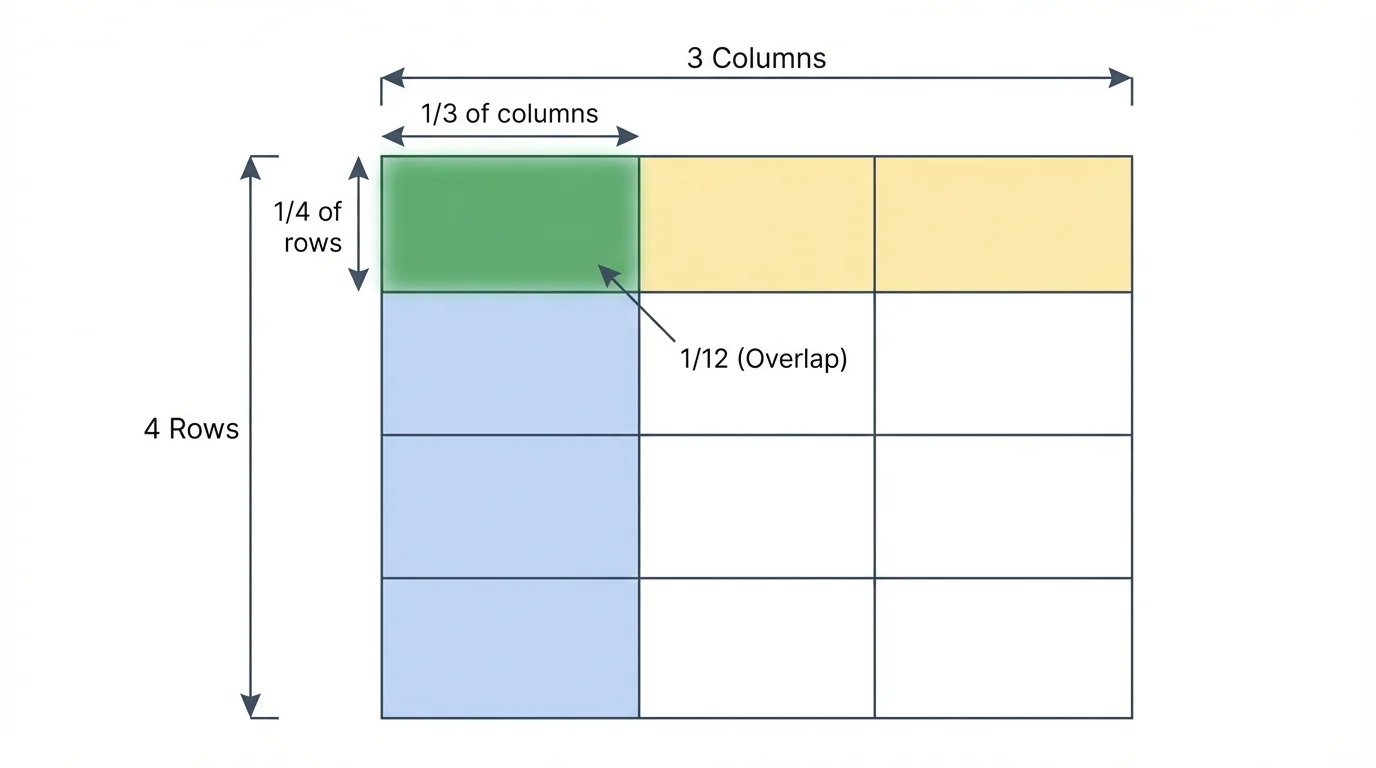
You can also use a model for \(\dfrac{2}{3} \times \dfrac{3}{4}\). Divide the whole into \(3\) columns and shade \(2\). Then divide into \(4\) rows and shade \(3\) in the other direction. The overlap covers \(6\) out of \(12\) parts, which is \(\dfrac{6}{12} = \dfrac{1}{2}\).
Visual models are helpful because they show why the rule works. The total number of small pieces is found by multiplying the denominators, and the number of overlapping shaded pieces is found by multiplying the numerators. Later, when you use only an equation, the picture still helps explain the meaning.
Recipes are one of the most common places where people multiply fractions. Professional cooks often scale recipes up or down by multiplying every ingredient amount by the same fraction.
Sometimes a fraction model is enough by itself, and sometimes it helps you set up the equation that matches the picture.
Once you understand the model, you can use the multiplication rule directly:
\[\frac{a}{b} \times \frac{c}{d} = \frac{ac}{bd}\]
This means multiply the numerators and multiply the denominators. Then simplify if possible.
For example, \(\dfrac{2}{5} \times \dfrac{3}{4} = \dfrac{6}{20}\). Since \(\dfrac{6}{20}\) can be simplified by dividing top and bottom by \(2\), the answer is \(\dfrac{3}{10}\).
Another example is \(\dfrac{4}{7} \times \dfrac{1}{2} = \dfrac{4}{14} = \dfrac{2}{7}\). The product is smaller than \(\dfrac{4}{7}\), which makes sense because multiplying by \(\dfrac{1}{2}\) takes only half of the original amount.
Why the product can be smaller
When you multiply by a fraction less than \(1\), you are taking only part of the amount. That is why \(\dfrac{3}{4} \times \dfrac{1}{2}\) is smaller than \(\dfrac{3}{4}\). In real-world problems, this often means you are finding part of an ingredient, part of a distance, part of a set, or part of a length.
Equations are especially useful in word problems because they let you represent the situation clearly and solve it efficiently.
Some real-world problems use a mixed number instead of a simple fraction. As [Figure 2] shows, a mixed number such as \(1\dfrac{1}{2}\) means one whole and one-half more.
It is often easier to convert mixed numbers to improper fractions before multiplying.
To multiply mixed numbers, first convert each mixed number to an improper fraction. Then multiply the fractions. Finally, simplify and, if needed, write the result as a mixed number.
For example, to multiply \(1\dfrac{1}{2} \times \dfrac{3}{5}\), convert \(1\dfrac{1}{2}\) to \(\dfrac{3}{2}\). Then multiply:
\[\frac{3}{2} \times \frac{3}{5} = \frac{9}{10}\]
Notice that the answer is less than \(1\dfrac{1}{2}\), which makes sense because \(\dfrac{3}{5}\) is less than \(1\).
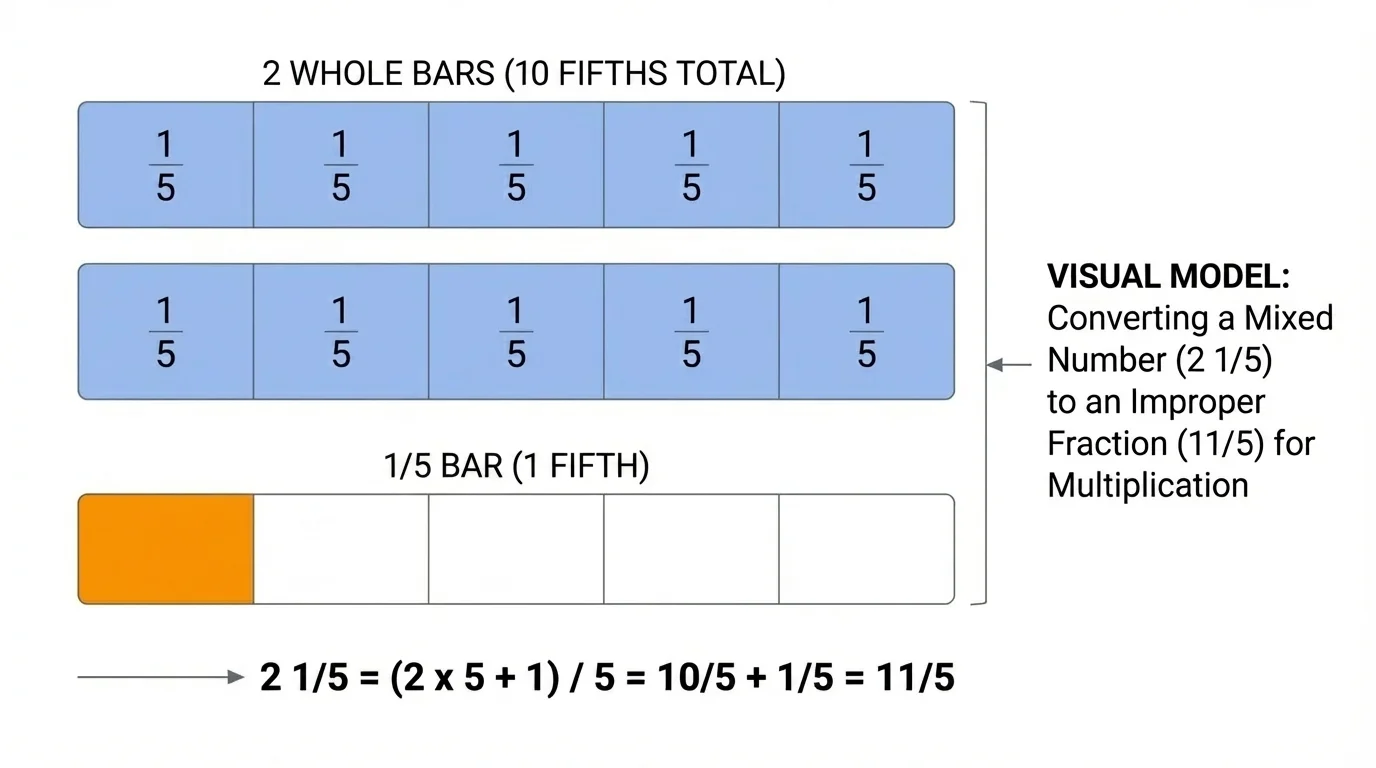
Here is another example: \(2\dfrac{1}{4} \times 3\). First write \(2\dfrac{1}{4} = \dfrac{9}{4}\), and write \(3\) as \(\dfrac{3}{1}\). Then multiply: \(\dfrac{9}{4} \times \dfrac{3}{1} = \dfrac{27}{4} = 6\dfrac{3}{4}\). This makes sense because multiplying by \(3\) makes the amount larger.
When a mixed number appears in a real-world problem, the story tells you whether the answer should be more than one whole, less than one whole, or several wholes. That is another useful way to check reasonableness because the numbers should connect to actual amounts.
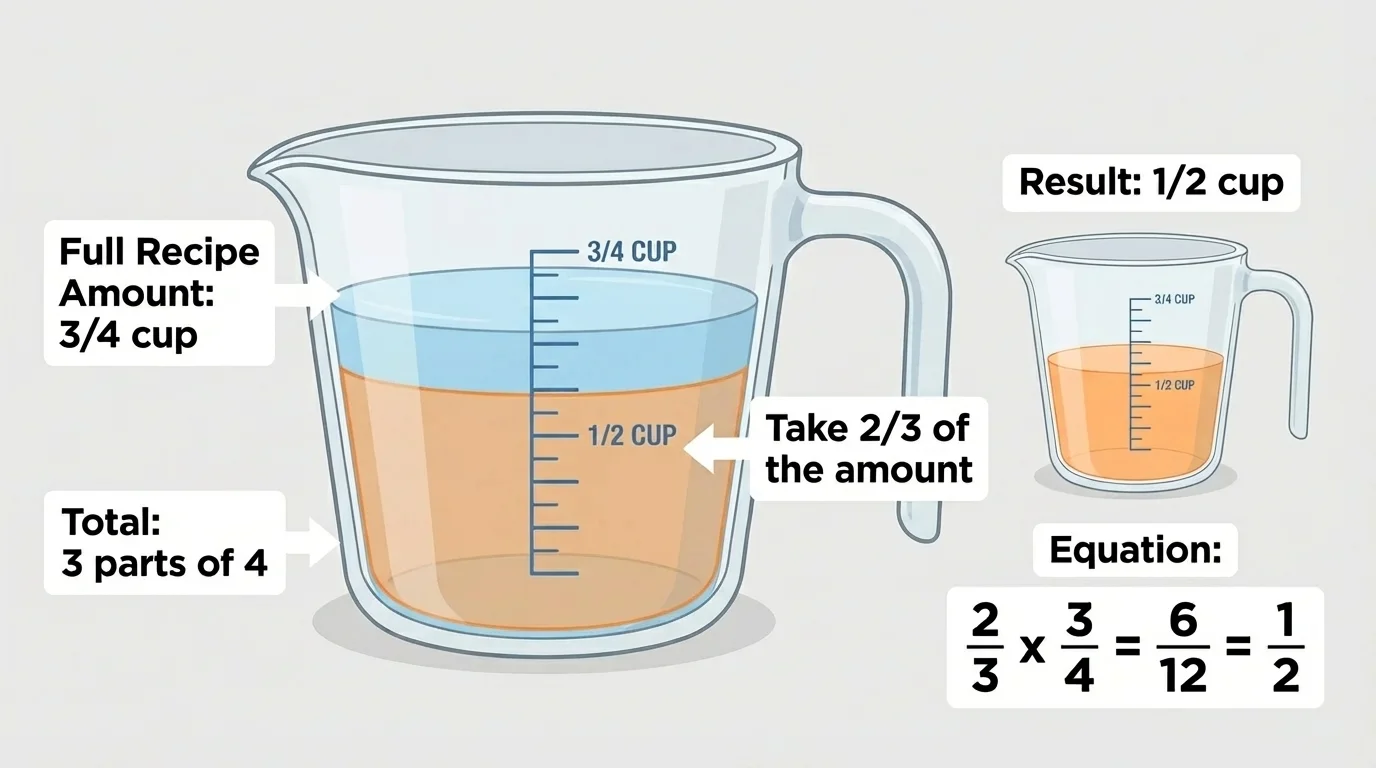
[Figure 3] shows how a real-world situation connects the words to the math.
Stories and equations work together in fraction multiplication. Each problem below shows how to decide what to multiply and how to interpret the answer.
Worked example 1
A recipe needs \(\dfrac{3}{4}\) cup of milk, but Maya is making only \(\dfrac{2}{3}\) of the recipe. How much milk does she need?
Step 1: Write an equation for the situation.
Maya needs \(\dfrac{2}{3}\) of \(\dfrac{3}{4}\) cup, so multiply: \(\dfrac{2}{3} \times \dfrac{3}{4}\).
Step 2: Multiply numerators and denominators.
\(\dfrac{2}{3} \times \dfrac{3}{4} = \dfrac{6}{12}\).
Step 3: Simplify.
\(\dfrac{6}{12} = \dfrac{1}{2}\).
Maya needs \(\dfrac{1}{2}\) cup of milk.
This answer makes sense because making only \(\dfrac{2}{3}\) of the recipe should use less than \(\dfrac{3}{4}\) cup.
Worked example 2
A garden bed is \(2\dfrac{1}{2}\) meters long. Flowers will be planted in \(\dfrac{3}{5}\) of the bed. How many meters of the bed will have flowers?
Step 1: Convert the mixed number.
\(2\dfrac{1}{2} = \dfrac{5}{2}\).
Step 2: Multiply.
\(\dfrac{5}{2} \times \dfrac{3}{5} = \dfrac{15}{10}\).
Step 3: Simplify and write the answer as a mixed number.
\(\dfrac{15}{10} = \dfrac{3}{2} = 1\dfrac{1}{2}\).
The flowers cover \(1\dfrac{1}{2}\) meters of the bed.
The answer is reasonable because \(\dfrac{3}{5}\) of \(2\dfrac{1}{2}\) should be less than the full \(2\dfrac{1}{2}\) meters.
Worked example 3
Lena has a \(1\dfrac{3}{4}\)-mile practice route. If she rides only \(\dfrac{4}{7}\) of the route, how far does she ride?
Step 1: Convert the mixed number.
\(1\dfrac{3}{4} = \dfrac{7}{4}\).
Step 2: Multiply.
\(\dfrac{4}{7} \times \dfrac{7}{4} = \dfrac{28}{28}\).
Step 3: Simplify.
\(\dfrac{28}{28} = 1\).
She rides \(1\) mile.
This example is interesting because the numbers cancel to make a whole number. Even so, it still follows the same fraction multiplication process. Real-world stories often mean "find part of an amount."
Worked example 4
A ribbon is \(3\dfrac{1}{3}\) feet long. One decoration uses \(\dfrac{3}{4}\) of the ribbon. How much ribbon is used?
Step 1: Convert the mixed number.
\(3\dfrac{1}{3} = \dfrac{10}{3}\).
Step 2: Multiply.
\(\dfrac{10}{3} \times \dfrac{3}{4} = \dfrac{30}{12}\).
Step 3: Simplify.
\(\dfrac{30}{12} = \dfrac{5}{2} = 2\dfrac{1}{2}\).
The decoration uses \(2\dfrac{1}{2}\) feet of ribbon.
Since \(\dfrac{3}{4}\) is less than \(1\), the answer should be less than \(3\dfrac{1}{3}\), and it is.
Good problem solvers do not just calculate. They also choose a strategy and ask whether the answer makes sense.
Use a visual model when you want to see what "part of a part" means. Use an equation when the numbers are easy to work with and you want to solve efficiently. Many students like to sketch first and then write the equation.
Estimation is also helpful. If you are finding \(\dfrac{1}{2} \times \dfrac{3}{4}\), you know the answer should be less than \(\dfrac{3}{4}\) and close to \(\dfrac{1}{2}\) of that amount, so \(\dfrac{3}{8}\) is reasonable. If you are finding \(1\dfrac{1}{2} \times \dfrac{2}{3}\), the answer should be less than \(1\dfrac{1}{2}\) because you are taking only two-thirds of it.
| Type of factor | What happens to the amount | Example |
|---|---|---|
| Less than \(1\) | The product gets smaller | \(\dfrac{3}{4} \times \dfrac{1}{2} = \dfrac{3}{8}\) |
| Equal to \(1\) | The amount stays the same | \(\dfrac{5}{6} \times 1 = \dfrac{5}{6}\) |
| Greater than \(1\) | The product gets larger | \(\dfrac{2}{3} \times 2 = \dfrac{4}{3}\) |
Table 1. How the size of a factor affects the size of the product.
This table shows why understanding the meaning of multiplication matters. The numbers are not just symbols; they describe how much of an amount you are taking.
One common mistake is adding instead of multiplying. If a problem says \(\dfrac{2}{3}\) of \(\dfrac{3}{4}\), do not compute \(\dfrac{2}{3} + \dfrac{3}{4}\). The word of means multiply.
Another mistake is forgetting to convert mixed numbers. For example, in \(1\dfrac{1}{2} \times \dfrac{2}{5}\), you should first write \(1\dfrac{1}{2} = \dfrac{3}{2}\). Then multiply \(\dfrac{3}{2} \times \dfrac{2}{5} = \dfrac{6}{10} = \dfrac{3}{5}\).
A third mistake is not simplifying. A product such as \(\dfrac{4}{8}\) is correct, but \(\dfrac{1}{2}\) is simpler and easier to understand.
"When a problem says part of a part, multiplication helps you find it."
Being careful with these details makes your work more accurate and your answers easier to explain.
Fraction multiplication appears in many everyday situations. In cooking, you may make half or two-thirds of a recipe. In gardening, you might plant flowers in only a fraction of a rectangular bed. In sports, you may run only part of a practice distance. In art, you may use a fraction of a ribbon or a board. In construction, workers often cut boards to fractional lengths and then use only part of those pieces.
For example, if a painter has \(\dfrac{5}{6}\) liter of paint and uses \(\dfrac{2}{3}\) of it on one wall, the amount used is \(\dfrac{2}{3} \times \dfrac{5}{6} = \dfrac{10}{18} = \dfrac{5}{9}\) liter. If a hiker walks \(\dfrac{3}{4}\) of a \(4\dfrac{1}{2}\)-mile trail, the distance is \(\dfrac{3}{4} \times \dfrac{9}{2} = \dfrac{27}{8} = 3\dfrac{3}{8}\) miles.
These problems are not all exactly the same, but they use the same ideas: understand the story, decide what amount is being multiplied, write an equation, solve carefully, and check whether the answer fits the situation.
