Why can one hamburger cost $5, while another meal deal seems cheaper until you look closely? Why can two cars both travel for \(2\) hours, but one goes much farther? The secret idea behind both questions is the same: unit rate. A unit rate helps us compare fairly by asking, "How much for \(1\)?" Once you understand that question, shopping, cooking, travel, and even sports statistics become much clearer.
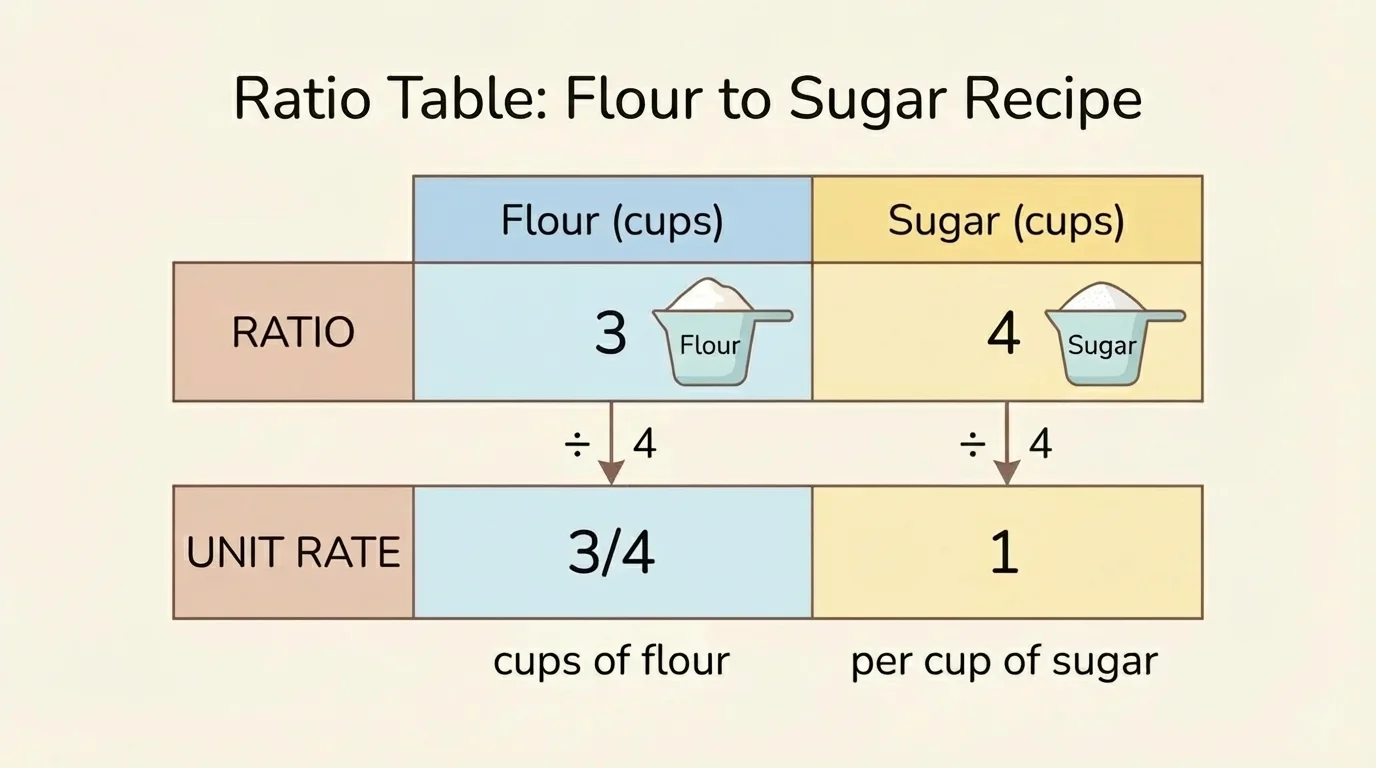
A ratio compares two quantities. If a recipe uses \(3\) cups of flour and \(4\) cups of sugar, we can write the ratio as \(3:4\). We can also connect that ratio to the fraction \(\dfrac{3}{4}\). This means there are \(3\) cups of flour for every \(4\) cups of sugar.
When we use words like for every, for each, or per, we are using rate language. A rate is a kind of ratio that compares quantities with different units. For example, $75 for \(15\) hamburgers compares dollars and hamburgers. Distance in \(60\) miles for \(1\) hour compares miles and hours.
Ratios do not always compare different units. For example, \(2\) red marbles to \(5\) blue marbles is a ratio. But when the two quantities have different units, such as dollars and ounces or miles and hours, the ratio is also called a rate.
Ratio, rate, and unit rate are closely connected ideas. A ratio compares two quantities. A rate is a ratio that compares quantities with different units. A unit rate is a rate written so that the second quantity is \(1\).
If you hear "$3 per notebook," the word per means "for each \(1\)." So "$3 per notebook" means $3 for \(1\) notebook. If you hear "\(65\) miles per hour," it means \(65\) miles for each \(1\) hour.
A unit rate is a rate written with a denominator of \(1\). If a ratio is \(a:b\), we can connect it to the fraction \(\dfrac{a}{b}\), as long as \(b \ne 0\). The condition \(b \ne 0\) matters because division by zero is not possible.
To turn a rate into a unit rate, we find how much of the first quantity matches exactly \(1\) of the second quantity, as [Figure 1] shows. In other words, we are looking for \(\dfrac{a}{b}\) "per \(1\)." For the recipe ratio \(3:4\), the unit rate is \(\dfrac{3}{4}\) cup of flour for each \(1\) cup of sugar.
Here are some examples of rates and unit rates:
| Rate | Unit Rate | Meaning |
|---|---|---|
| $75 for \(15\) hamburgers | $5 per hamburger | Each hamburger costs $5. |
| \(120\) miles in \(2\) hours | \(60\) miles per hour | The object travels \(60\) miles each hour. |
| \(3\) cups flour to \(4\) cups sugar | \(\dfrac{3}{4}\) cup flour per cup sugar | Each cup of sugar matches \(\dfrac{3}{4}\) cup of flour. |
Table 1. Examples showing how a rate can be rewritten as a unit rate.
Notice that the second quantity becomes \(1\). That is the key feature of a unit rate. Sometimes the unit rate is a whole number, like \(5\). Sometimes it is a fraction, like \(\dfrac{3}{4}\). Sometimes it is a decimal, like \(2.5\).
Equivalent fractions can help you understand unit rates. For example, \(\dfrac{6}{8} = \dfrac{3}{4}\). If two ratios are equivalent, they describe the same relationship in different forms.
Another important idea is order. The ratio \(3:4\) is not the same as \(4:3\). "\(3\) cups of flour for \(4\) cups of sugar" means something different from "\(4\) cups of flour for \(3\) cups of sugar." When finding a unit rate, keep the quantities in the same order.
There are two common ways to find a unit rate. One way is to divide the first quantity by the second quantity. The other way is to use equivalent ratios until the second quantity becomes \(1\). Both methods give the same answer.
If a rate is \(\dfrac{a}{b}\), then the unit rate is found by calculating \(a \div b\), as long as \(b \ne 0\). Written as a fraction, the unit rate is
\[\frac{a}{b}\]
This tells how much of the first quantity goes with exactly \(1\) of the second quantity.
Why division works
Suppose \(15\) hamburgers cost $75. To find the cost of \(1\) hamburger, split the total cost equally among the \(15\) hamburgers: \(75 \div 15 = 5\). Division answers the question, "How much for one?"
When you find a unit rate, always include units in words. A number by itself is not enough. The answer should sound like "miles per hour," "dollars per hamburger," or "cups of flour per cup of sugar." The units tell what the number means.
Unit pricing is one of the most useful real-world uses of rates. Stores often sell items in different sizes or packs, and a unit rate helps you compare them fairly.
Worked example 1
A customer pays $75 for \(15\) hamburgers. What is the unit rate in dollars per hamburger?
Step 1: Write the rate as a fraction.
The rate is \(\dfrac{75}{15}\) dollars per hamburger.
Step 2: Divide.
\(75 \div 15 = 5\).
Step 3: Write the answer with units.
The unit rate is $5 per hamburger.
So each hamburger costs $5.
This example shows why the word per is so helpful. "$5 per hamburger" means $5 for each \(1\) hamburger. If someone buys \(2\) hamburgers at the same rate, the cost would be \(2 \times 5 = 10\), so the total would be $10.
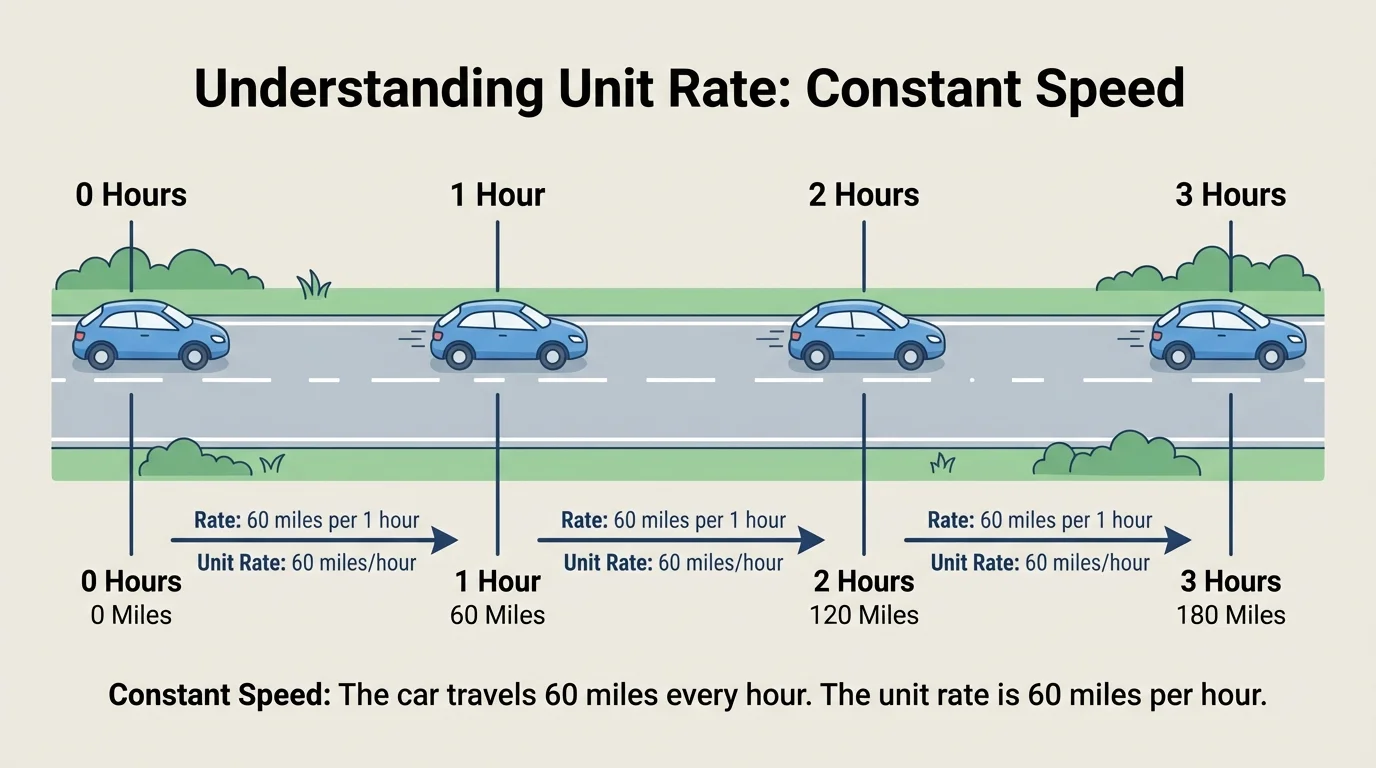
In travel, a constant speed means an object covers the same distance in each equal amount of time, as [Figure 2] illustrates. That makes unit rates very useful, because we can ask how far the object goes in \(1\) hour.
If a car travels \(180\) miles in \(3\) hours at a constant speed, the unit rate tells the speed in miles per hour.
Worked example 2
A car travels \(180\) miles in \(3\) hours at a constant speed. What is the unit rate in miles per hour?
Step 1: Write the rate as distance divided by time.
\(\dfrac{180}{3}\) miles per hour.
Step 2: Divide.
\(180 \div 3 = 60\).
Step 3: Write the answer with units.
The unit rate is \(60\) miles per hour.
The car travels \(60\) miles per hour.
This means that in every \(1\) hour, the car travels \(60\) miles. In \(2\) hours, it would travel \(2 \times 60 = 120\) miles. In \(4\) hours, it would travel \(4 \times 60 = 240\) miles. Because the speed is constant, the same rate keeps working.
Rates in travel can also be smaller. A walker who goes \(6\) miles in \(2\) hours has a unit rate of \(3\) miles per hour because \(6 \div 2 = 3\). The method stays the same whether the object is fast or slow.
Some speed limits are really unit rates in disguise. A sign that says \(55\) miles per hour tells the allowed distance for each \(1\) hour of travel.
Later, when you compare two travelers, this idea remains useful because it shows that constant speed means equal jumps in distance during equal time intervals.
Rates are not only about money and travel. They also appear in cooking. A recipe can compare ingredients, and a unit rate can tell how much of one ingredient goes with \(1\) unit of another ingredient.
Worked example 3
A recipe has a ratio of \(3\) cups of flour to \(4\) cups of sugar. How much flour is there for each \(1\) cup of sugar?
Step 1: Write the ratio as a fraction.
\(\dfrac{3}{4}\) cup of flour per cup of sugar.
Step 2: Notice that the second quantity is already understood as \(1\) cup when we say "per cup of sugar."
So the unit rate is \(\dfrac{3}{4}\).
Step 3: State the answer clearly.
There is \(\dfrac{3}{4}\) cup of flour for each \(1\) cup of sugar.
The unit rate is \(\dfrac{3}{4}\) cup of flour per cup of sugar.
This example is interesting because the answer is a fraction, not a whole number. Unit rates do not have to be whole numbers. A unit rate can be any number that correctly describes the amount for \(1\).
We can also reverse the question. If we ask for sugar per cup of flour, then we must switch the order and use \(\dfrac{4}{3}\) cups of sugar per cup of flour. That is a different unit rate because it answers a different question.
A unit rate can appear in several forms:
All of these are valid unit rates because each one tells how much of one quantity goes with \(1\) of another quantity.
Fractions and decimals in unit rates
Sometimes a fraction is easiest to understand, especially in recipes. Sometimes a decimal is easier, especially with money. For example, \(\dfrac{5}{2}\) dollars per notebook and $2.50 per notebook describe the same unit rate.
If the number does not divide evenly, the answer may be a decimal or a fraction. For example, \(7\) meters in \(2\) seconds gives \(\dfrac{7}{2} = 3.5\) meters per second. The relationship is still clear: each \(1\) second matches \(3.5\) meters.
Unit rates appear in many everyday situations:
Suppose one bag of apples costs $6 for \(3\) pounds. The unit price is $2 per pound because \(6 \div 3 = 2\). That helps you compare it with another bag that costs $7.50 for \(5\) pounds, which is $1.50 per pound because \(7.50 \div 5 = 1.5\). The second bag is the better buy.
Suppose a student reads \(90\) pages in \(3\) days. The unit rate is \(30\) pages per day. That rate can help estimate future reading. In \(5\) days at the same rate, the student would read \(5 \times 30 = 150\) pages.
Suppose a dog walker earns $36 for \(4\) hours of work. The unit rate is $9 per hour because \(36 \div 4 = 9\). This tells the pay for each \(1\) hour of work.
One common mistake is reversing the order of the quantities. If the problem asks for dollars per notebook, you should divide dollars by notebooks, not notebooks by dollars. The order changes the meaning.
Another common mistake is forgetting units. If you only write \(5\), your answer is incomplete. Is it \(5\) dollars per item? \(5\) miles per hour? \(5\) cups per batch? Units are part of the answer.
A third mistake is trying to divide by zero. If a rate is written as \(\dfrac{a}{b}\), then the denominator \(b\) cannot be \(0\). There is no unit rate for "\(10\) dollars for \(0\) hamburgers" because dividing by \(0\) is undefined.
"A unit rate answers the question: how much for one?"
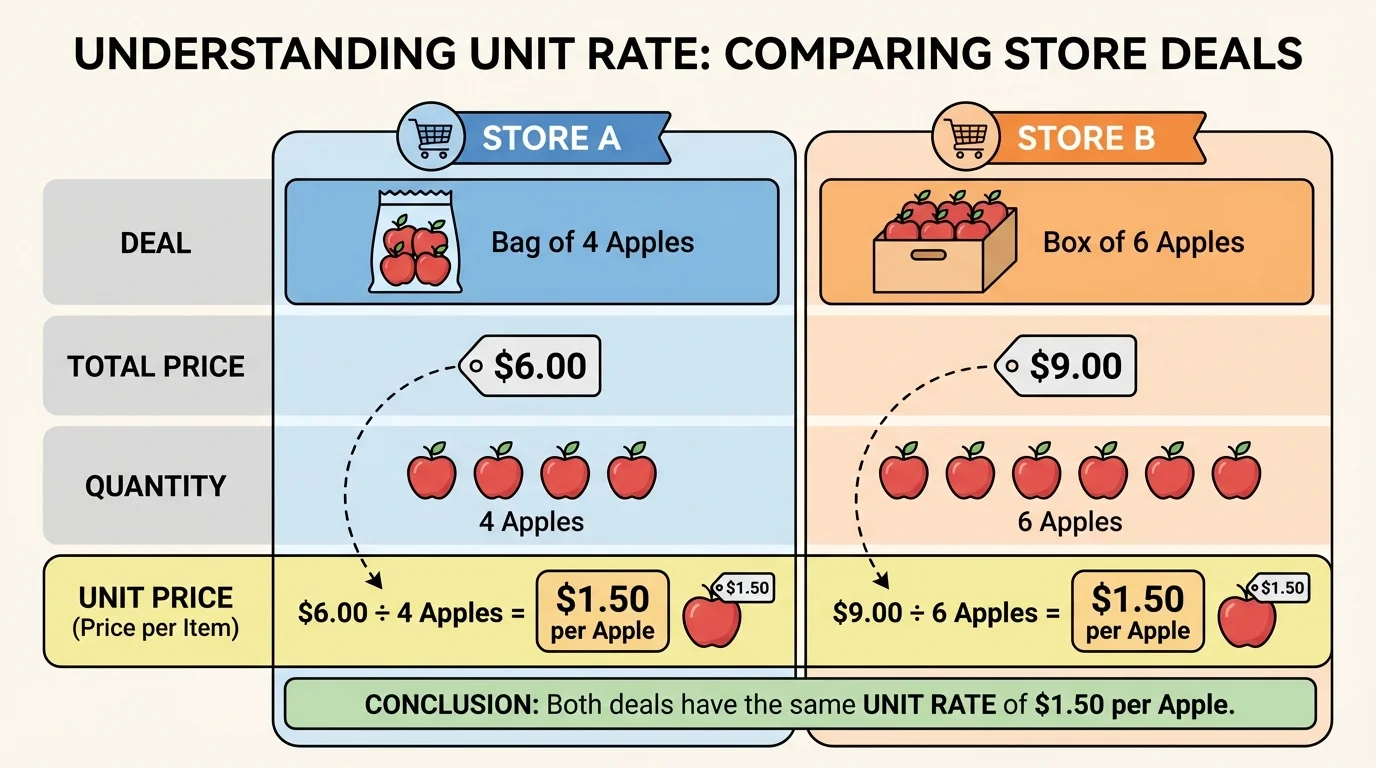
Also be careful when comparing rates from different-sized groups. Looking only at total price can be misleading, as [Figure 3] shows. A larger package may cost more overall but still have a smaller cost for each item.
Unit rates help you compare choices fairly. When two deals involve different numbers of items, the total prices alone do not tell the whole story. The unit rate lets you compare item by item.
Suppose Store A sells \(8\) juice boxes for $4.80. The unit price is $0.60 per juice box because \(4.80 \div 8 = 0.60\). Suppose Store B sells \(6\) juice boxes for $3.90. The unit price is $0.65 per juice box because \(3.90 \div 6 = 0.65\). Store A is the better buy because $0.60 per juice box is less than $0.65 per juice box.
You can use the same thinking with speed. If one cyclist rides \(24\) miles in \(2\) hours, the speed is \(12\) miles per hour. If another cyclist rides \(39\) miles in \(3\) hours, the speed is \(13\) miles per hour. The second cyclist is faster.
Notice how the calculations focus on the amount for \(1\). That is why unit rates are so powerful. They turn unequal groups into equal comparisons.
Earlier, [Figure 1] showed that a unit rate can come from shrinking or enlarging equivalent ratios until the second quantity becomes \(1\). The same idea works in shopping and travel: keep the relationship, but rewrite it in a form that is easy to compare.
