Have you ever noticed that stores do not just want you to see a price, but to feel like you found a deal? A giant cereal box might cost more, but is it actually cheaper for each ounce? A car might travel far, but how fast is it going each hour? Questions like these are all about rates. When we shrink a rate down to a comparison with one unit, we get a powerful tool for solving real-world problems quickly and clearly.
People use rates every day. Athletes look at distance per minute. Drivers look at miles per hour. Shoppers compare dollars per ounce or dollars per item. If a machine makes \(120\) bottles in \(4\) minutes, you may want to know how many bottles it makes in \(1\) minute. That single-unit comparison helps you understand the situation and make predictions.
In grade \(6\), an important goal is to use ratio reasoning to solve problems. That means understanding how two quantities are connected and using that relationship in tables, diagrams, and equations.
A ratio compares two quantities, such as \(4:7\) or \(\dfrac{4}{7}\). When the quantities have different units, like miles and hours, the comparison is called a rate.
Once you know the rate, you can answer many questions: How much in one hour? How much in one pound? How much in one item? Then you can scale up to any amount you need.
A rate is a comparison of two quantities with different units. For example, \(60\) miles in \(2\) hours is a rate. The units are miles and hours.
A unit rate is a rate for \(1\) unit of the second quantity. For example, if a car travels \(60\) miles in \(2\) hours, then the unit rate is \(30\) miles per hour because \(60 \div 2 = 30\).
Rate compares two quantities with different units.
Unit rate compares a quantity to exactly \(1\) unit of another quantity.
Constant speed means moving at the same rate the whole time, so equal amounts of time match equal amounts of distance.
Unit rates are often written with the word per. For example, \(12\) cookies per bag, \(55\) miles per hour, or $0.75 per pound. The word per is a clue that you are working with a unit rate.
You can find a unit rate by dividing. If \(18\) oranges cost $6, then the cost per orange is found by \(6 \div 18 = \dfrac{1}{3}\). So the unit price is $0.33 per orange, or about \(33\) cents each.
To find a unit rate, divide so that one of the quantities becomes \(1\). There are two common questions:
Question type \(1\): "How much for \(1\)?"
Question type \(2\): "At that rate, how much in a different amount of time, distance, money, or items?"
For example, if \(24\) pages are read in \(3\) hours, the unit rate is \(24 \div 3 = 8\) pages per hour. Then in \(5\) hours, the number of pages is \(8 \times 5 = 40\) pages.
One relationship, many equivalent rates
If a situation has a constant rate, then all matching pairs of numbers are equivalent ratios. That means you can multiply or divide both parts by the same number and the relationship stays true. If \(4\) lawns are mowed in \(7\) hours, then \(8\) lawns in \(14\) hours and \(20\) lawns in \(35\) hours are equivalent rates.
Sometimes the unit rate is a whole number, and sometimes it is a fraction or decimal. All of these are valid. For example, \(4\) lawns in \(7\) hours gives \(\dfrac{4}{7}\) lawn per hour. That is a perfectly valid unit rate.
Equivalent ratios can be shown in a table or on a double number line, as [Figure 1] illustrates for hours and lawns. A visual model helps you see that both quantities are multiplied by the same number.
Suppose \(4\) lawns are mowed in \(7\) hours. If the time becomes \(35\) hours, notice that \(35 = 7 \times 5\). So the number of lawns must also be multiplied by \(5\). That gives \(4 \times 5 = 20\) lawns.
| Hours | Lawns |
|---|---|
| \(7\) | \(4\) |
| \(14\) | \(8\) |
| \(21\) | \(12\) |
| \(28\) | \(16\) |
| \(35\) | \(20\) |
You can also use an equation. Let \(r\) stand for the number of lawns mowed per hour. Then \(r = \dfrac{4}{7}\). In \(35\) hours, the total lawns mowed would be \(L = r \cdot 35 = \dfrac{4}{7} \cdot 35 = 20\).
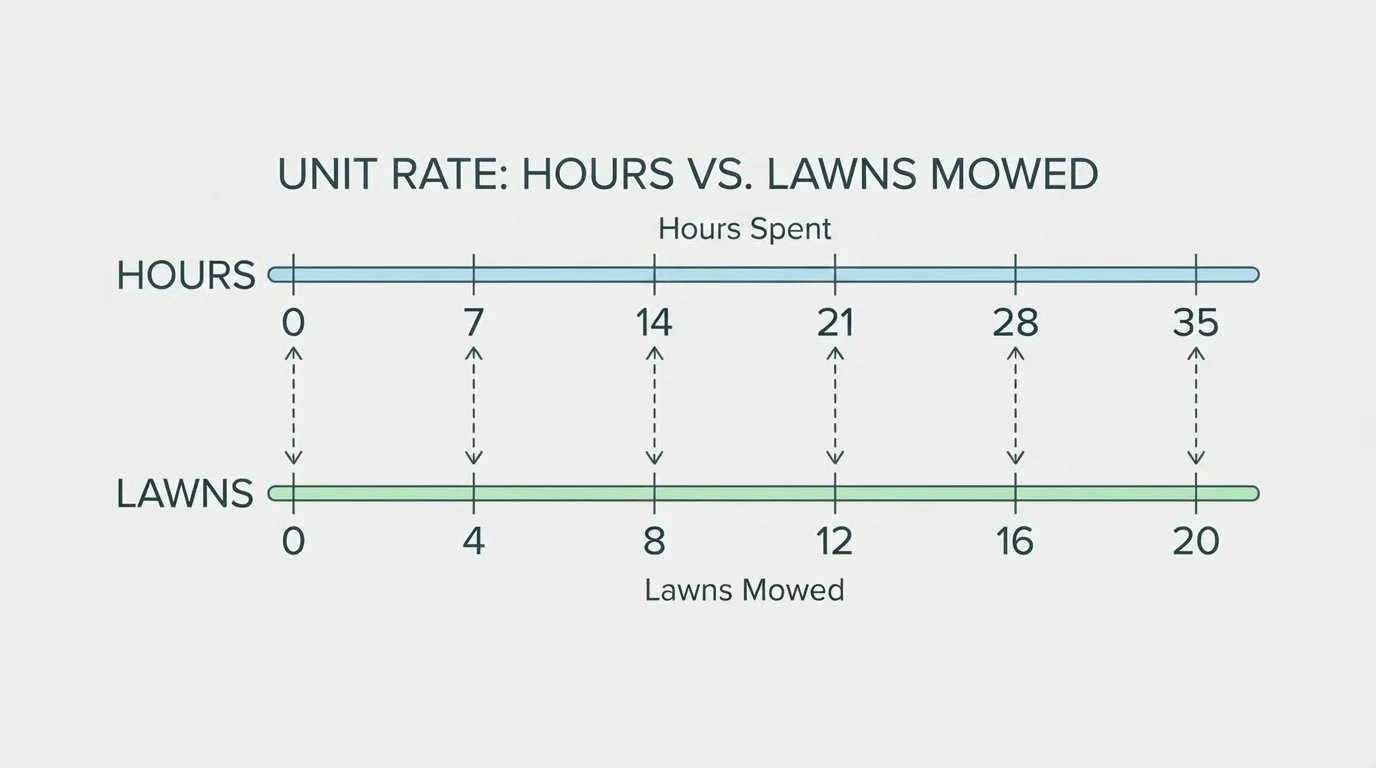
Whether you use a table, a diagram, or an equation, the important idea is the same: a constant rate creates equivalent ratios.
This example shows both parts of a typical rate problem: finding the amount in a new time and finding the mowing rate itself.
Worked example \(1\): Lawns and hours
If it took \(7\) hours to mow \(4\) lawns, then at that rate, how many lawns could be mowed in \(35\) hours? At what rate were lawns being mowed?
Step 1: Write the starting rate.
The situation gives \(4\) lawns in \(7\) hours.
Step 2: Find the unit rate.
Divide lawns by hours: \(\dfrac{4}{7}\) lawn per hour.
\[r = \frac{4}{7}\]
So the mowing rate is \(\dfrac{4}{7}\) lawn per hour.
Step 3: Find how many lawns in \(35\) hours.
Multiply the unit rate by \(35\) hours: \(\dfrac{4}{7} \times 35 = 20\).
The number of lawns that could be mowed in \(35\) hours is \(20\) lawns, and the mowing rate is \(\dfrac{4}{7}\) lawns per hour.
The number of lawns that could be mowed in \(35\) hours is \(20\) lawns, and the mowing rate is \(\dfrac{4}{7}\) lawns per hour.
You can also solve it by scaling. Since \(35\) is \(5\) times \(7\), multiply \(4\) lawns by \(5\). This gives the same answer, \(20\) lawns. That matches the equivalent-ratio idea shown earlier in [Figure 1].
When comparing prices, it is often unfair to look only at the total cost. A package that costs more may actually be cheaper per ounce or per item. A side-by-side comparison, as shown in [Figure 2], helps organize the information clearly.
Suppose one bag of raisins costs $3.60 for \(12\) ounces, and another bag costs $5.20 for \(20\) ounces. To decide which is the better buy, find the unit price for each bag.
Worked example \(2\): Comparing unit prices
Which is the better buy: $3.60 for \(12\) ounces or $5.20 for \(20\) ounces?
Step 1: Find the price per ounce for the first bag.
\(3.60 \div 12 = 0.30\), so the unit price is $0.30 per ounce.
Step 2: Find the price per ounce for the second bag.
\(5.20 \div 20 = 0.26\), so the unit price is $0.26 per ounce.
Step 3: Compare the unit prices.
Since \(0.26 < 0.30\), the second bag costs less per ounce.
The better buy is the \(20\)-ounce bag for $5.20.
Notice that the second bag has the higher total price, but the lower unit price. That is why unit pricing is so useful in real life.
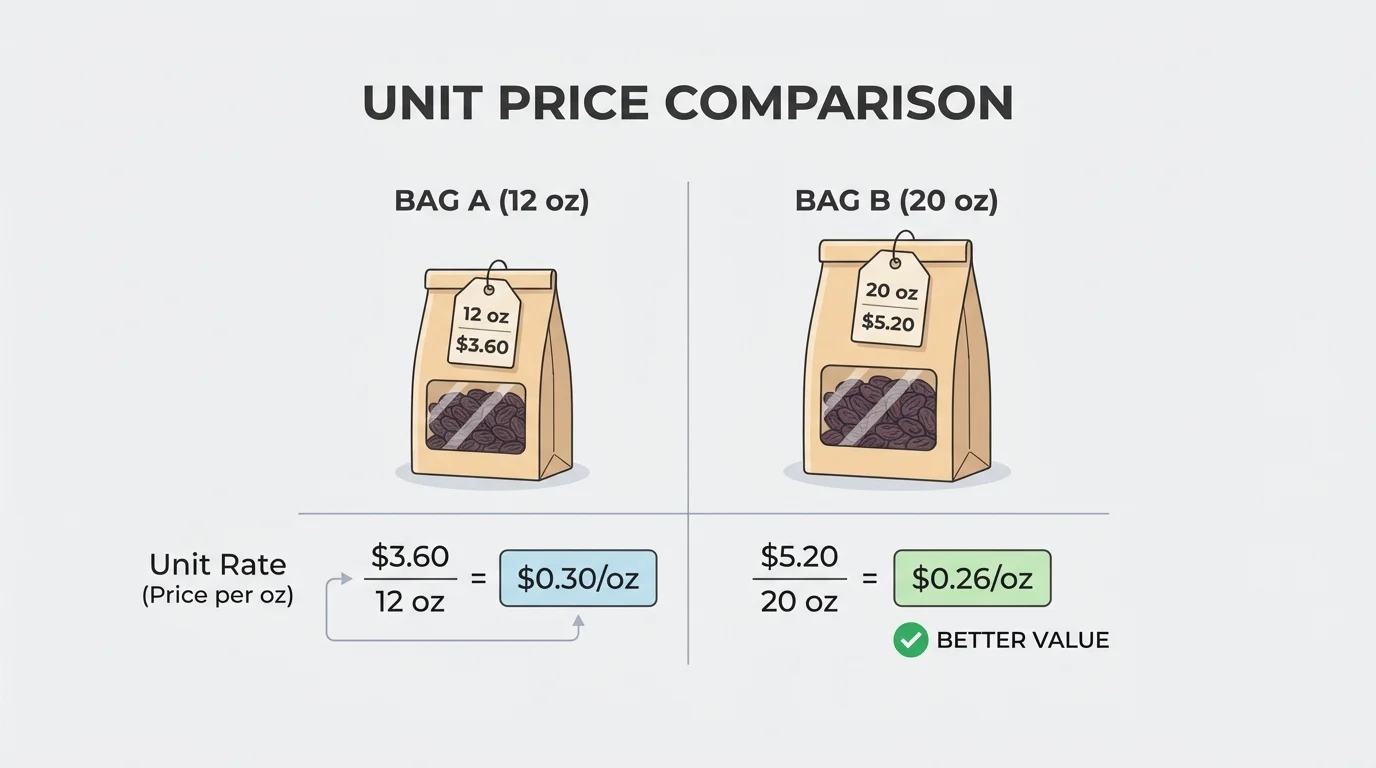
Stores often place a small shelf label with the price per ounce, pound, or liter. If you know how unit price works, you can check whether the better deal really is the one you think it is.
Some grocery shoppers save a lot of money over time by comparing unit prices instead of just buying the biggest package. Bigger is not always cheaper per unit.
Unit pricing works for many situations: cost per notebook, cost per pound of apples, cost per ounce of shampoo, or cost per ticket.
Travel problems use rates too. When an object moves at a constant speed, it travels the same distance in each equal unit of time. On a graph, [Figure 3] shows this as a straight line because distance increases evenly over time.
Suppose a bike travels \(28\) miles in \(2\) hours. The speed is the distance divided by the time: \(28 \div 2 = 14\) miles per hour.
Worked example \(3\): Constant speed
A bike travels \(28\) miles in \(2\) hours at a constant speed. How fast is the bike traveling? How far will it go in \(5\) hours?
Step 1: Find the unit rate.
\(28 \div 2 = 14\), so the speed is \(14\) miles per hour.
\(v = 14\)
So the speed is \(14\) miles per hour.
Step 2: Use the unit rate to find the new distance.
In \(5\) hours, the bike travels \(14 \times 5 = 70\) miles.
The bike is traveling \(14\) miles per hour and goes \(70\) miles in \(5\) hours.
You can write constant-speed situations with an equation. If \(d\) is distance, \(r\) is rate, and \(t\) is time, then
\(d = rt\)
For the bike example, \(d = 14t\). If \(t = 5\), then \(d = 14 \cdot 5 = 70\) miles.
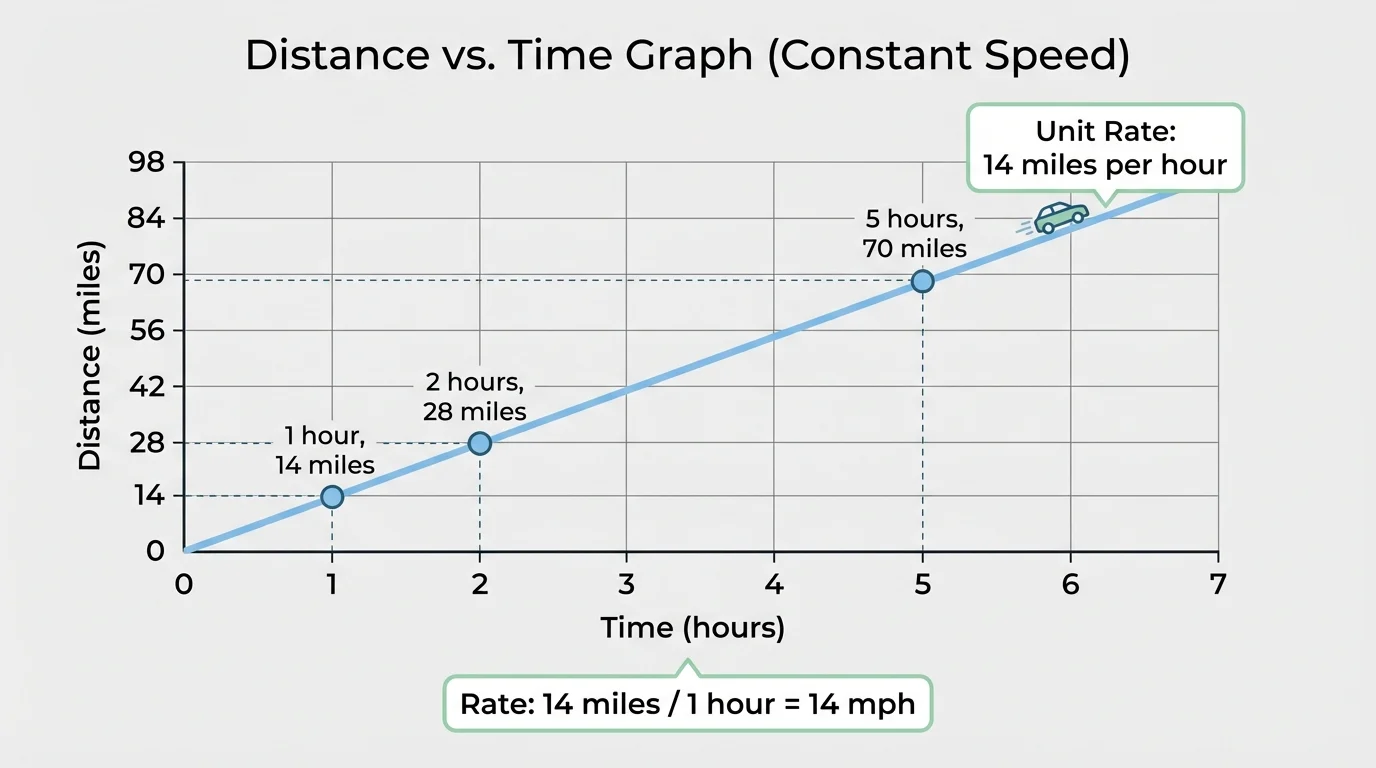
A straight-line graph helps show why the speed is constant. For every extra hour, the same number of miles is added. That even increase is the same pattern we use in ratio tables.
Some problems are easiest to solve by dividing first to get the unit rate. Others are easier to solve by scaling equivalent ratios. Here are two useful questions to ask yourself:
\(1\). Can I make one quantity equal to \(1\) by dividing?
\(2\). Can I get from one amount to another by multiplying by a simple number?
For example, from \(7\) hours to \(35\) hours, scaling is easy because \(35 = 7 \times 5\). But if the question asked about \(10\) hours instead, using the unit rate \(\dfrac{4}{7}\) lawn per hour would be more direct: \(\dfrac{4}{7} \times 10 = \dfrac{40}{7}\) lawns.
That answer, \(\dfrac{40}{7}\), is about \(5.7\) lawns. In a real-life situation, you would think carefully about what that means. A person cannot finish \(0.71\) of a lawn and call it complete, so context matters.
One common mistake is reversing the units. If \(4\) lawns are mowed in \(7\) hours, then lawns per hour is \(\dfrac{4}{7}\), not \(\dfrac{7}{4}\). The fraction must match the words you are saying.
Another mistake is multiplying when you should divide. To get a unit rate, you usually divide to find the amount for \(1\) unit.
A third mistake is comparing total prices instead of unit prices. In shopping, the better buy is not always the package with the smaller price tag. It is the package with the smaller price per unit, as we saw in the raisin comparison in [Figure 2].
Units tell the story
If your answer is \(14\), that number alone is not enough. You must know whether it means \(14\) miles per hour, \(14\) ounces, or \(14\) cents per item. Correct units make an answer meaningful.
You should also watch for whether the situation is truly constant. If a car stops for lunch, its speed is not constant over the whole trip. But if a problem says at a constant speed, then ratio reasoning works directly.
Unit price helps families compare groceries, school supplies, and household products. If one notebook pack costs $4.50 for \(5\) notebooks, then the cost is \(4.50 \div 5 = 0.90\), or $0.90 per notebook.
Sports use rates too. If a runner completes \(3\) miles in \(24\) minutes, the pace is \(24 \div 3 = 8\) minutes per mile. That unit rate helps predict how long \(5\) miles would take: \(8 \times 5 = 40\) minutes.
Travel depends on constant speed ideas. Pilots, train systems, and delivery companies use rates to plan arrival times. The graph in [Figure 3] connects to this idea by showing steady motion as a straight line.
Even in technology, rates matter. Internet downloads are measured in data per second. Factory machines are measured in products per minute. In each case, a unit rate helps people compare performance and make decisions.
Good problem solvers do not stop after getting a number. They ask whether the answer is reasonable.
If \(4\) lawns take \(7\) hours, then in much more time, like \(35\) hours, the number of lawns should be much more than \(4\). So \(20\) lawns makes sense. But \(2.8\) lawns would not make sense because the time increased, so the output should increase too.
You can estimate too. Since \(\dfrac{4}{7}\) is a little more than \(\dfrac{1}{2}\), in \(35\) hours you would expect a little more than half of \(35\) lawns, which is a little more than \(17.5\) lawns. The answer \(20\) is reasonable.
Finally, always check the units. If the question asks, "At what rate were lawns being mowed?" then the answer should be in lawns per hour. If the question asks, "How many lawns in \(35\) hours?" then the answer should be in lawns.
"A unit rate turns a comparison into a clear decision."
Once you can find and use unit rates, you can solve many practical problems with confidence. The key is to understand what is being compared, keep the units straight, and use the constant relationship between the quantities.
