A juice box, a fish tank, a gift box, and a brick all have something in common: they hold or take up space. That space is called volume. Sometimes the side lengths are whole numbers, which feels straightforward. But what if a prism is \(\dfrac{3}{2}\) units long, \(\dfrac{1}{2}\) unit wide, and \(1\) unit high? It may look trickier, but the same idea still works. You can count how many small cubes fit inside, and you can also multiply the side lengths. Both methods lead to the same answer.
A right rectangular prism is a box-shaped solid with rectangular faces and straight edges that meet at right angles. Volume tells how much space is inside it. If you are filling a tank with water, packing a crate, or designing a storage bin, volume helps you know how much the object can hold.
For prisms, the most important idea is that the inside space can be filled with cubes and counted. When the side lengths are whole numbers, we often use cubes with edge length \(1\) unit. Each of those cubes has volume \(1\) cubic unit. When side lengths are fractions, we use smaller cubes that match the fractional measurements.
You already know that area measures a flat surface in square units. Volume measures space in cubic units. A square unit covers a surface, but a cubic unit fills space.
That difference matters. If a rectangle is \(\dfrac{1}{2}\) unit by \(\dfrac{1}{3}\) unit, its area is measured in square units. But if a prism has those dimensions and also has height, then its volume is measured in cubic units.
Suppose a prism has side lengths \(\dfrac{3}{2}\) units, \(1\) unit, and \(\dfrac{1}{2}\) unit. To find its volume by packing, we use a unit-fraction cube whose edges match the smallest fractional part needed. In this case, edges of length \(\dfrac{1}{2}\) unit work well. Packing with these cubes shows exactly how many fractional cubes fill the prism, as shown in [Figure 1].
Along the length \(\dfrac{3}{2}\), there are \(3\) cubes of side \(\dfrac{1}{2}\) unit. Along the width \(1\), there are \(2\) cubes of side \(\dfrac{1}{2}\) unit. Along the height \(\dfrac{1}{2}\), there is \(1\) cube. So the total number of small cubes is \(3 \times 2 \times 1 = 6\).
Each small cube has volume
\[\left(\frac{1}{2}\right)^3 = \frac{1}{8}\]
So the whole prism has volume \(6 \times \dfrac{1}{8} = \dfrac{6}{8} = \dfrac{3}{4}\) cubic unit.
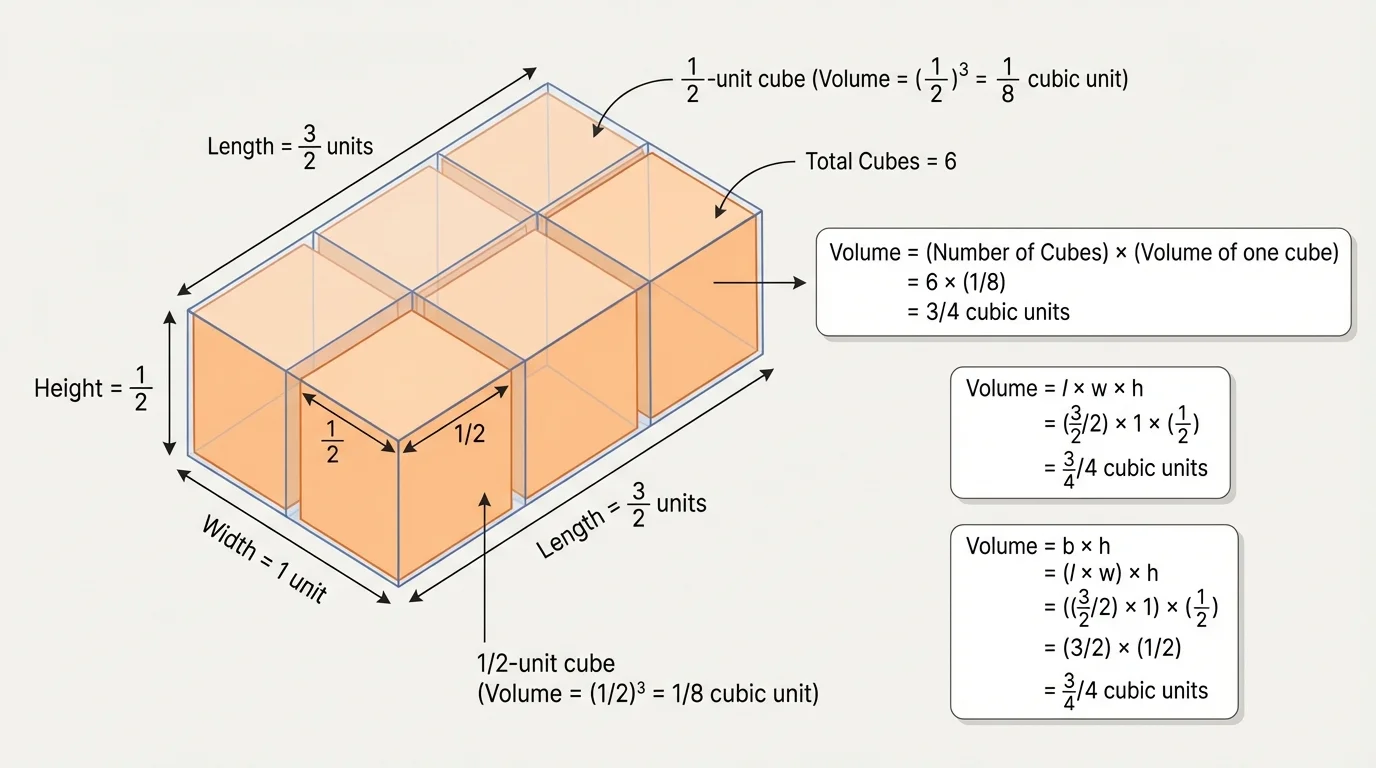
This method is powerful because it turns a fraction problem into careful counting. Instead of guessing, we divide the prism into equal small cubes, count how many cubes fit in each direction, and multiply the count by the volume of one small cube.
Volume is the amount of space inside a three-dimensional figure.
Cubic unit is the volume of a cube with edge length \(1\) unit.
Base is one face of a prism chosen to be the bottom layer.
We can also use other unit-fraction cubes. If side lengths involve thirds, then cubes with edge length \(\dfrac{1}{3}\) unit may be the best choice. If side lengths involve fourths, cubes with edge length \(\dfrac{1}{4}\) unit are useful. The main idea is to choose cube edges that fit evenly along each dimension.
The formula for the volume of a rectangular prism is
\(V = lwh\)
where \(l\) is length, \(w\) is width, and \(h\) is height. This is not a magic rule to memorize without meaning. It comes from counting rows, columns, and layers. The row-column-layer structure in [Figure 2] explains why multiplication finds volume.
First, look at the base. If the base has \(a\) rows and \(b\) columns of equal small squares, then one layer contains \(a \times b\) small cubes. If the prism is \(c\) layers high, then the whole prism contains \(a \times b \times c\) cubes.
That is exactly what happens with fractional edge lengths too. The only difference is that the cubes are smaller. Their count changes, and the size of each cube changes, but the total volume still comes from multiplying the three edge lengths together.
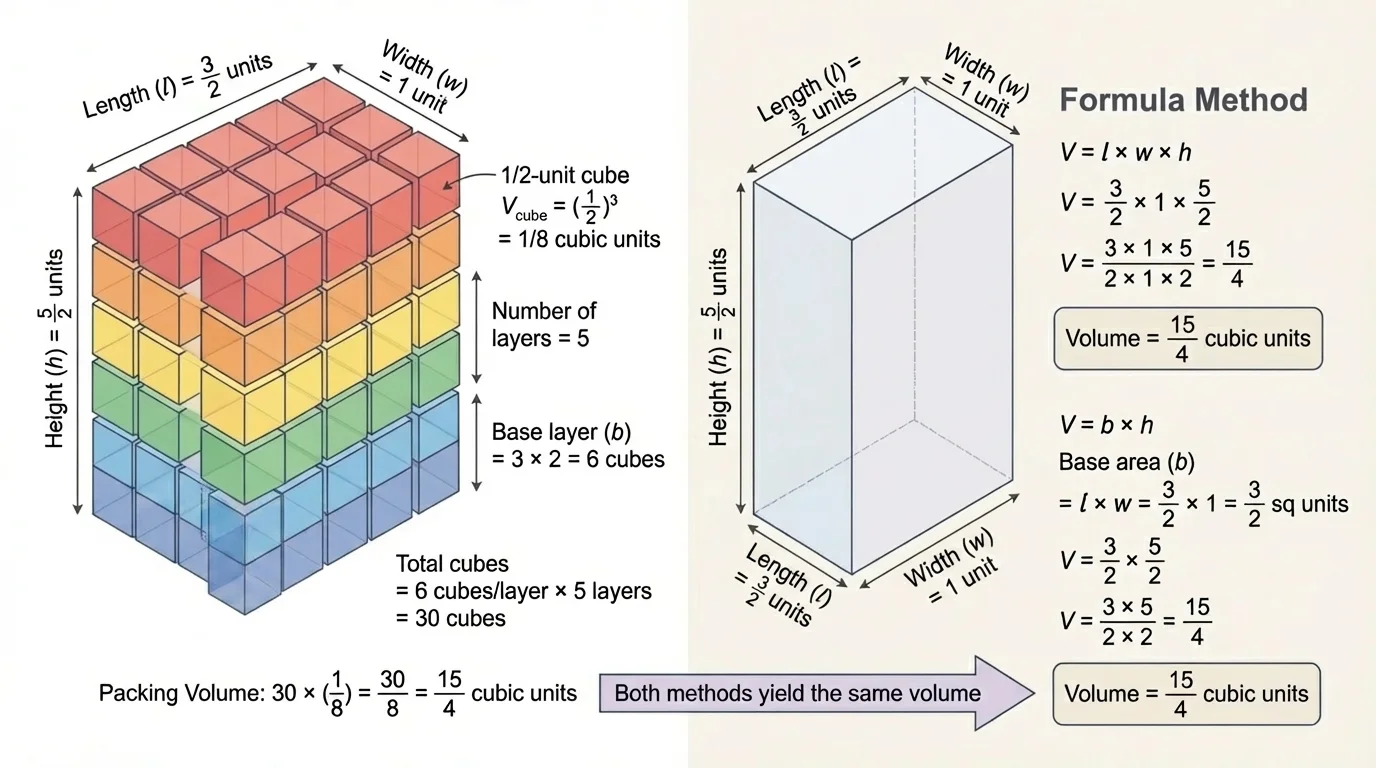
For example, let the prism measure \(\dfrac{3}{2}\), \(1\), and \(\dfrac{1}{2}\) units. Multiplying gives
\[V = \frac{3}{2} \cdot 1 \cdot \frac{1}{2} = \frac{3}{4}\]
This matches the packing result of \(\dfrac{3}{4}\) cubic unit. Earlier, [Figure 1] showed \(6\) cubes of volume \(\dfrac{1}{8}\) each. Counting and multiplying agree because both describe the same space.
Why the formula still works with fractions
Fractions do not change what volume means. A prism with fractional edges can still be split into equal layers, and each layer can still be split into rows and columns. The product \(lwh\) counts how much space fills the prism, whether the edges are whole numbers, fractions, or mixed numbers.
Another way to think about it is this: if one dimension gets cut in half, the volume gets cut in half. If two dimensions get cut in half, the volume becomes one fourth as large. Multiplication captures these size changes exactly.
When you use \(V = lwh\), multiply the three side lengths carefully. The answer tells how many cubic units are inside the prism. If the dimensions are fractions, the volume may also be a fraction.
Suppose \(l = \dfrac{2}{3}\), \(w = \dfrac{3}{4}\), and \(h = 2\). Then
\[V = \frac{2}{3} \cdot \frac{3}{4} \cdot 2\]
You can simplify while multiplying. Since \(\dfrac{2}{3} \cdot \dfrac{3}{4} = \dfrac{1}{2}\), the volume becomes \(\dfrac{1}{2} \cdot 2 = 1\). So the prism has volume \(1\) cubic unit.
Be careful with mixed numbers. Change them to improper fractions before multiplying. For example, \(1\dfrac{1}{2} = \dfrac{3}{2}\) and \(2\dfrac{1}{4} = \dfrac{9}{4}\).
A prism can have edge lengths less than \(1\) unit and still have a perfectly reasonable volume. Small dimensions do not make the problem harder in meaning; they only make careful fraction work more important.
Sometimes it helps to estimate first. If all three side lengths are less than \(1\), then the volume should also be less than \(1\) cubic unit. If one side is close to \(2\) and the others are about \(1\), then the volume might be near \(2\) cubic units. Estimation helps you catch mistakes.
Another formula for prism volume is
\(V = bh\)
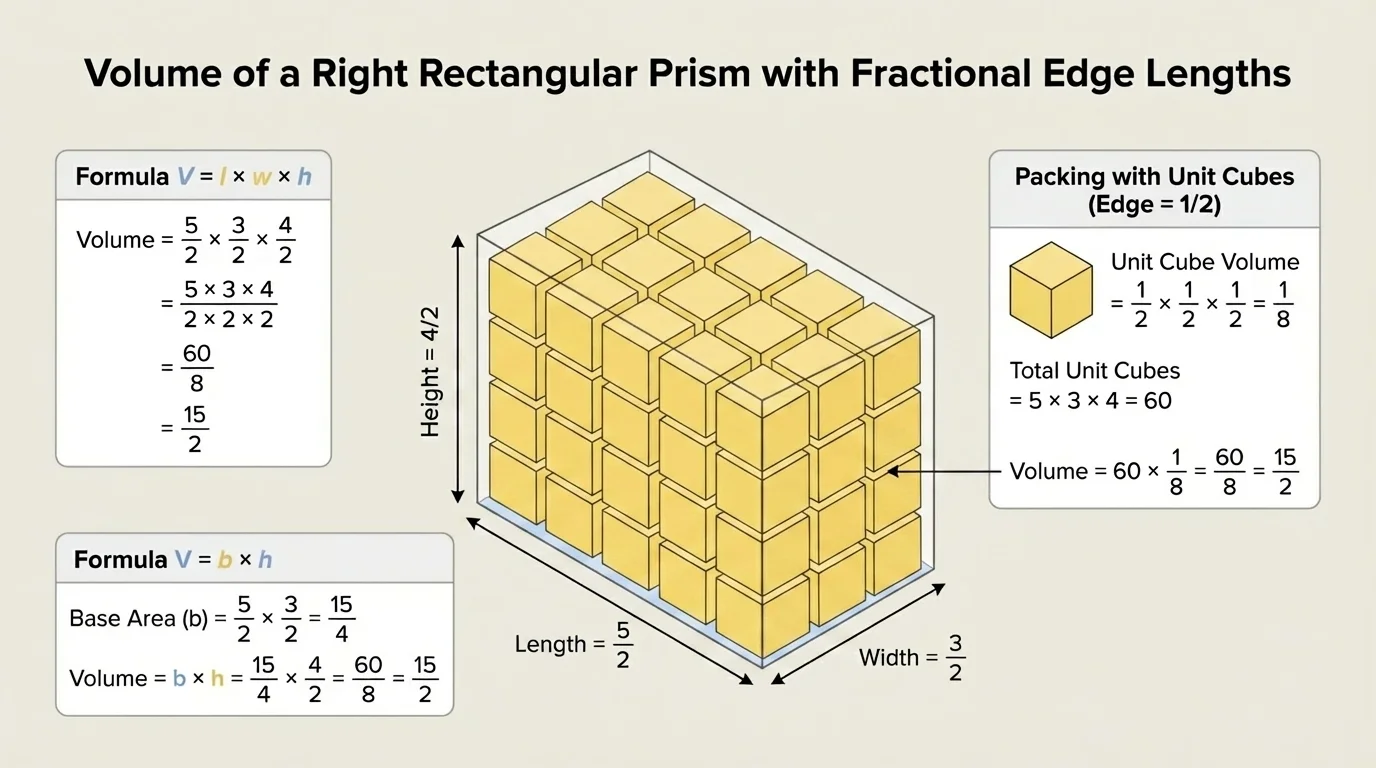
Here \(b\) means the area of the base, and \(h\) means the height of the prism. This works because a prism is made of equal layers stacked on top of the base. [Figure 3] separates the base from the height so you can see that first you find the area of one layer, and then you count how many layers there are.
If the base is a rectangle, then \(b = lw\). That means \(V = bh\) and \(V = lwh\) are really connected. They are two ways to describe the same volume.
For example, suppose the base measures \(\dfrac{5}{6}\) unit by \(\dfrac{2}{3}\) unit, and the height is \(\dfrac{3}{2}\) units. First find the base area:
\[b = \frac{5}{6} \cdot \frac{2}{3} = \frac{10}{18} = \frac{5}{9}\]
Now multiply by the height:
\[V = bh = \frac{5}{9} \cdot \frac{3}{2} = \frac{15}{18} = \frac{5}{6}\]
The volume is \(\dfrac{5}{6}\) cubic unit. If you used \(V = lwh\), you would get the same result.
Later, when prisms have more complicated bases, the idea of base area times height becomes even more useful. For rectangular prisms, both formulas are easy to use, so choose the one that makes the problem simplest.
Now let's work through several examples carefully.
Example 1
Find the volume of a right rectangular prism with dimensions \(\dfrac{3}{4}\) unit, \(\dfrac{2}{3}\) unit, and \(\dfrac{1}{2}\) unit.
Step 1: Write the formula.
Use \(V = lwh\).
Step 2: Substitute the values.
\(V = \dfrac{3}{4} \cdot \dfrac{2}{3} \cdot \dfrac{1}{2}\)
Step 3: Multiply and simplify.
First, \(\dfrac{3}{4} \cdot \dfrac{2}{3} = \dfrac{1}{2}\).
Then, \(\dfrac{1}{2} \cdot \dfrac{1}{2} = \dfrac{1}{4}\).
\[V = \frac{1}{4}\]
The prism has volume \(\dfrac{1}{4}\) cubic units.
This answer makes sense because all three dimensions are less than \(1\), so the volume should be fairly small.
Example 2
A box is \(1\dfrac{1}{2}\) feet long, \(\dfrac{2}{3}\) foot wide, and \(\dfrac{3}{4}\) foot high. Find its volume.
Step 1: Change the mixed number to an improper fraction.
\(1\dfrac{1}{2} = \dfrac{3}{2}\)
Step 2: Use the formula.
\(V = \dfrac{3}{2} \cdot \dfrac{2}{3} \cdot \dfrac{3}{4}\)
Step 3: Simplify while multiplying.
\(\dfrac{3}{2} \cdot \dfrac{2}{3} = 1\)
So \(V = 1 \cdot \dfrac{3}{4} = \dfrac{3}{4}\).
\[V = \frac{3}{4}\]
The volume is \(\dfrac{3}{4}\) cubic feet.
Changing mixed numbers first helps avoid confusion and makes the multiplication cleaner.
Example 3
The base of a prism is a rectangle measuring \(\dfrac{4}{5}\) meter by \(\dfrac{3}{4}\) meter. The height is \(\dfrac{5}{2}\) meters. Find the volume using \(V = bh\).
Step 1: Find the base area.
\(b = \dfrac{4}{5} \cdot \dfrac{3}{4} = \dfrac{3}{5}\)
Step 2: Multiply the base area by the height.
\(V = bh = \dfrac{3}{5} \cdot \dfrac{5}{2}\)
Step 3: Simplify.
\(\dfrac{3}{5} \cdot \dfrac{5}{2} = \dfrac{3}{2}\)
\[V = \frac{3}{2}\]
The prism has volume \(\dfrac{3}{2}\) cubic meters.
This is the same as \(1\dfrac{1}{2}\) cubic meters.
Example 4
A small aquarium is \(\dfrac{5}{4}\) feet long, \(\dfrac{1}{2}\) foot wide, and \(\dfrac{3}{4}\) foot high. How much space is inside the aquarium?
Step 1: Use \(V = lwh\).
\(V = \dfrac{5}{4} \cdot \dfrac{1}{2} \cdot \dfrac{3}{4}\)
Step 2: Multiply the numerators and denominators.
\(V = \dfrac{15}{32}\)
Step 3: State the unit.
The measurements are in feet, so the volume is in cubic feet.
\[V = \frac{15}{32}\]
The aquarium holds \(\dfrac{15}{32}\) cubic feet of space.
Word problems often ask what an object can hold, how much space is inside, or how much material can fit. Those are all clues that you need volume.
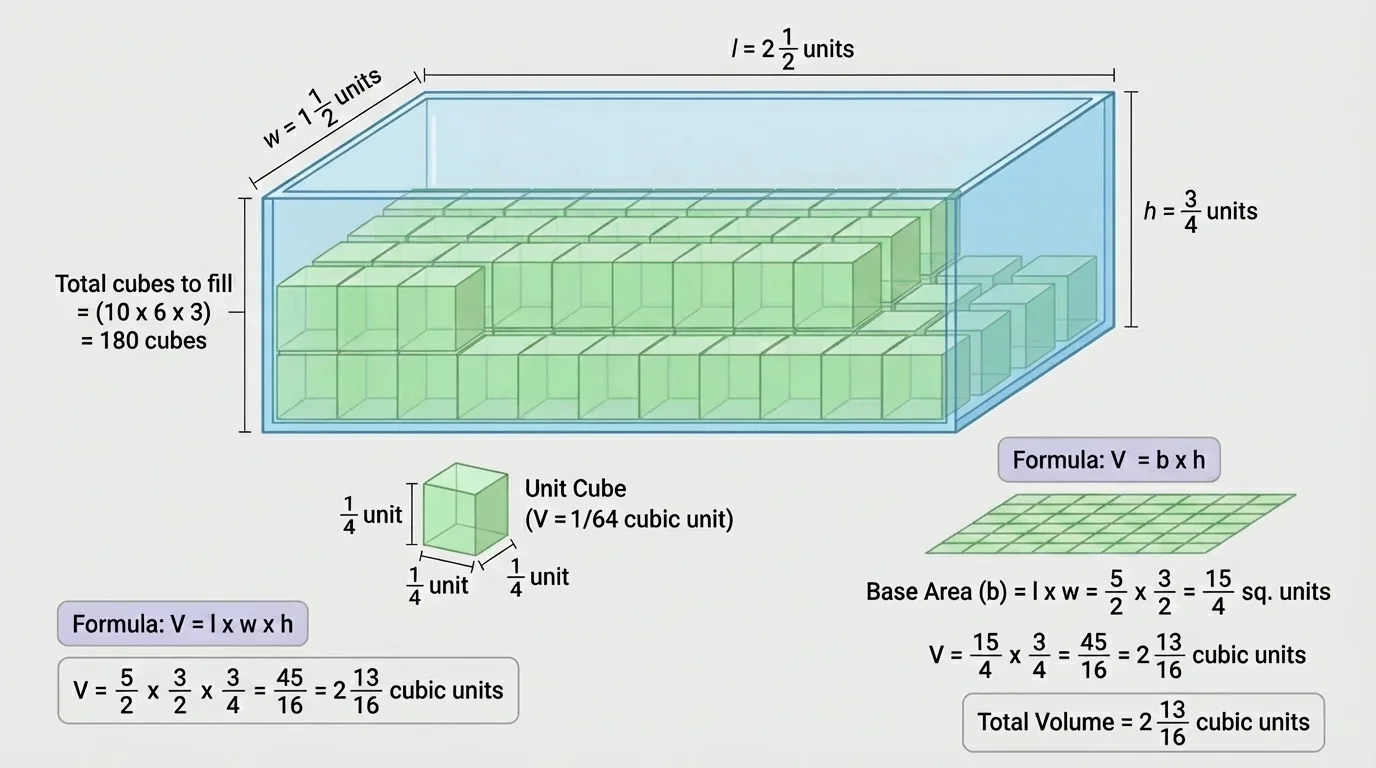
Volume with fractional side lengths appears in real life more often than you might expect. Measuring containers, shelving, tanks, and packages rarely gives only whole numbers. Everyday objects often have dimensions like \(\dfrac{1}{2}\) inch, \(\dfrac{3}{4}\) foot, or \(1\dfrac{1}{4}\) meters. Measuring the space inside these objects works exactly like the prisms in class. The aquarium in [Figure 4] is a good example of a rectangular prism whose dimensions can be fractional.
If you are building a drawer organizer, you might need to know how much space one section has. If you are shipping a product, you may need to know the volume of the box. If a recipe uses a rectangular pan with fractional dimensions, the pan's capacity depends on volume.
Suppose a storage container is \(\dfrac{7}{8}\) yard long, \(\dfrac{2}{3}\) yard wide, and \(\dfrac{1}{2}\) yard high. Its volume is
\[V = \frac{7}{8} \cdot \frac{2}{3} \cdot \frac{1}{2} = \frac{14}{48} = \frac{7}{24}\]
So the container holds \(\dfrac{7}{24}\) cubic yards. If you were comparing two containers, volume would tell which one holds more.
Earlier, [Figure 2] showed that volume can be thought of as layers. That same idea helps when stacking trays, boxes, or bins in a storeroom. Each layer has the same base area, and the total space depends on how many layers fit in the height.
One common mistake is adding the side lengths instead of multiplying them. Volume is not found by \(l + w + h\). It is found by \(lwh\) or \(bh\).
Another mistake is forgetting to use cubic units. If the dimensions are in inches, the answer is in cubic inches. If the dimensions are in meters, the answer is in cubic meters.
A third mistake is not changing mixed numbers into improper fractions before multiplying. For example, you should rewrite \(2\dfrac{1}{3}\) as \(\dfrac{7}{3}\).
Some students also forget to simplify. For example, \(\dfrac{12}{16}\) should be simplified to \(\dfrac{3}{4}\). A simplified answer is easier to understand and compare.
You can also check whether an answer is reasonable. If each side length is less than \(1\), then the volume should be less than \(1\) cubic unit. If one side is large and the others are moderate, the volume should reflect that size.
| Situation | Best formula | Why |
|---|---|---|
| All three edge lengths are given | \(V = lwh\) | Direct multiplication of the dimensions |
| Base area is known already | \(V = bh\) | Use the area of one layer times the height |
| Base dimensions and height are given | Either formula | Since \(b = lw\), both formulas match |
Table 1. A comparison of when to use each prism volume formula.
As we saw with [Figure 3], separating the base from the height can make the structure of the prism clearer. That is especially useful when you want to think of the solid as many identical layers stacked up.
"Volume is the space a solid figure holds, and multiplication helps us count that space efficiently."
Whether you picture tiny fractional cubes filling a prism or use a formula, you are describing the same amount of space. Packing explains why the formulas work, and the formulas help you solve problems quickly and accurately.
