A circle is one of the most familiar shapes in the world, but it hides a surprising idea: the distance around every circle is always related to the distance across it in exactly the same way. Whether you look at a coin, a bicycle wheel, or a stadium track, the same number appears again and again: \(\pi\). That single number helps us find both the circumference of a circle and its area.
Circles appear in engineering, sports, design, and nature. Wheels roll because of their shape, pipes have circular openings, and many machines use rotating parts. To measure these objects correctly, we need two important ideas: circumference and area. One measures the boundary, and the other measures the inside region.
If you are putting a border around a circular garden, you need the distance around it. If you are covering the garden with grass seed, you need the amount of surface inside it. Those are two different measurements, and mixing them up leads to wrong answers. Learning which formula to use is just as important as doing the calculation correctly.
Circle formulas are also a great example of how geometry connects shapes, measurement, and patterns. A circle looks very different from a rectangle, but with a clever rearrangement, we can understand its area using ideas we already know.
You already know that perimeter measures the distance around a shape and area measures the amount of surface it covers. A circle does not have straight sides, but the same ideas still apply.
[Figure 1] Before using formulas, we need to know the main parts of a circle.
The key parts of a circle are easy to identify. The center is the point exactly in the middle. A radius is a segment from the center to the circle. A diameter is a segment that goes all the way across the circle through the center. The diameter is always twice the radius.
If the radius is \(r\), then the diameter is \(d = 2r\). If the diameter is known, then the radius is \(r = \dfrac{d}{2}\). This relationship is simple, but it matters a lot because some circle formulas use radius and others can use diameter.
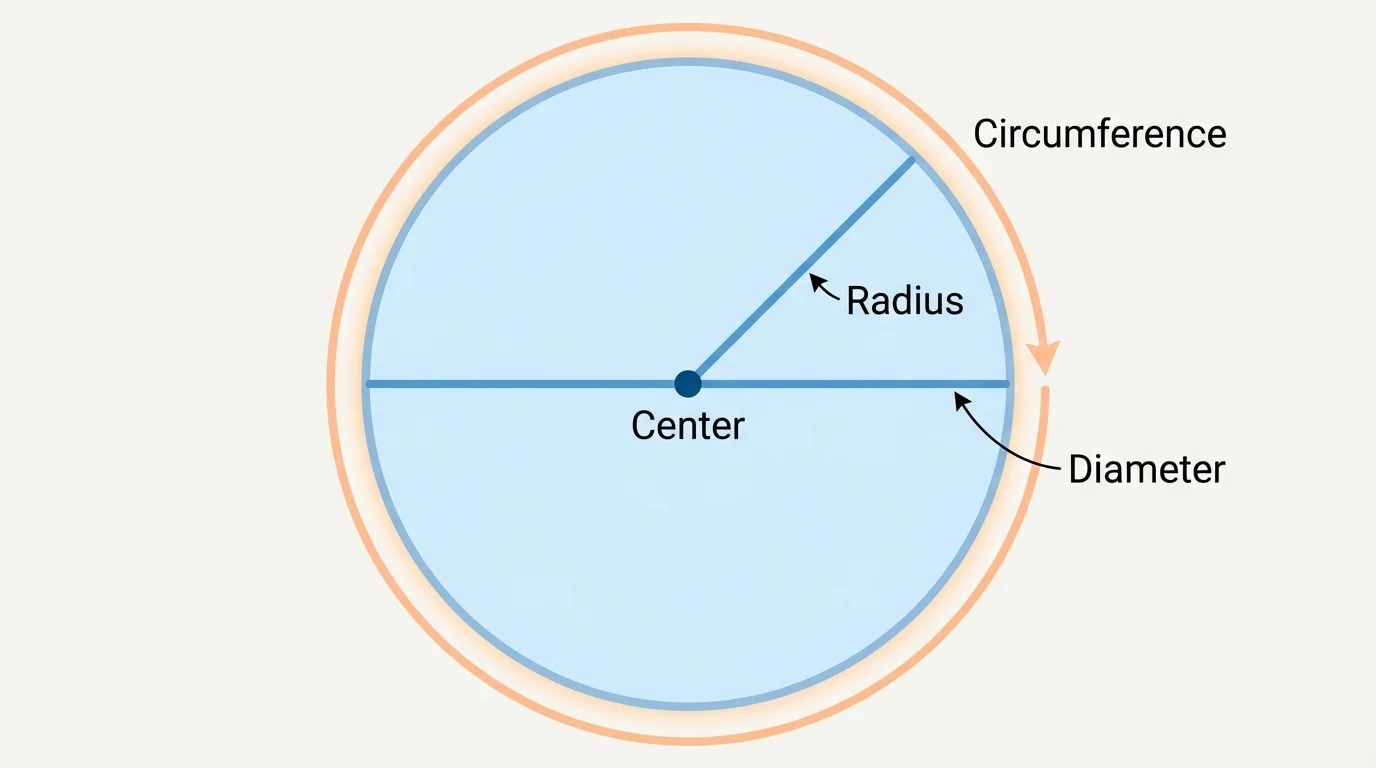
The distance around the circle is called the circumference. The amount of space inside the circle is called the area. The special number pi, written as \(\pi\), is approximately \(3.14\). It is the ratio of the circumference of any circle to its diameter.
Radius is the distance from the center of a circle to any point on the circle.
Diameter is the distance across a circle through the center, and it equals twice the radius.
Circumference is the distance around a circle.
Area is the amount of space inside a circle.
Pi, written \(\pi\), is the constant ratio of circumference to diameter, approximately \(3.14\).
Because \(\pi\) is an irrational number, its decimal form goes on forever without repeating. In grade 7, we usually use \(\pi\) as an exact value or approximate it with \(3.14\), depending on the problem.
The formula for the circumference of a circle comes from the fact that every circle has a circumference equal to \(\pi\) times its diameter.
That gives the formula
\(C = \pi d\)
Since \(d = 2r\), we can also write the circumference formula as
\(C = 2\pi r\)
These two formulas mean exactly the same thing. Use \(C = \pi d\) when the diameter is given, and use \(C = 2\pi r\) when the radius is given.
The circumference is a linear measurement, so its units are regular units such as centimeters, meters, or feet. For example, a circumference might be \(31.4 \textrm{ cm}\), not square centimeters.
The area of a circle depends on the radius. The formula is
\(A = \pi r^2\)
This means you square the radius first and then multiply by \(\pi\). The exponent \(2\) is important. It tells us area grows with the square of the radius, not just the radius itself.
Area is measured in square units, such as square centimeters, square meters, or square feet. If a circle has area \(78.5 \textrm{ cm}^2\), that means it covers \(78.5\) square centimeters.
If the radius of a circle doubles, the circumference doubles, but the area becomes four times as large. That happens because circumference depends on \(r\), while area depends on \(r^2\).
[Figure 2] This difference is one reason circle formulas are powerful. A small change in radius can make a very large change in area.
A circle may look impossible to compare with straight-sided shapes, but the connection becomes visible if we cut a circle into many thin sectors, like pizza slices, and rearrange them in alternating directions. The shape starts to look like a parallelogram or a rectangle.
In that rearranged shape, the height is about the radius, \(r\). The base is about half the circumference, because half of the curved edges line up along the bottom and the other half line up along the top. Since the full circumference is \(C\), the base is about \(\dfrac{C}{2}\).
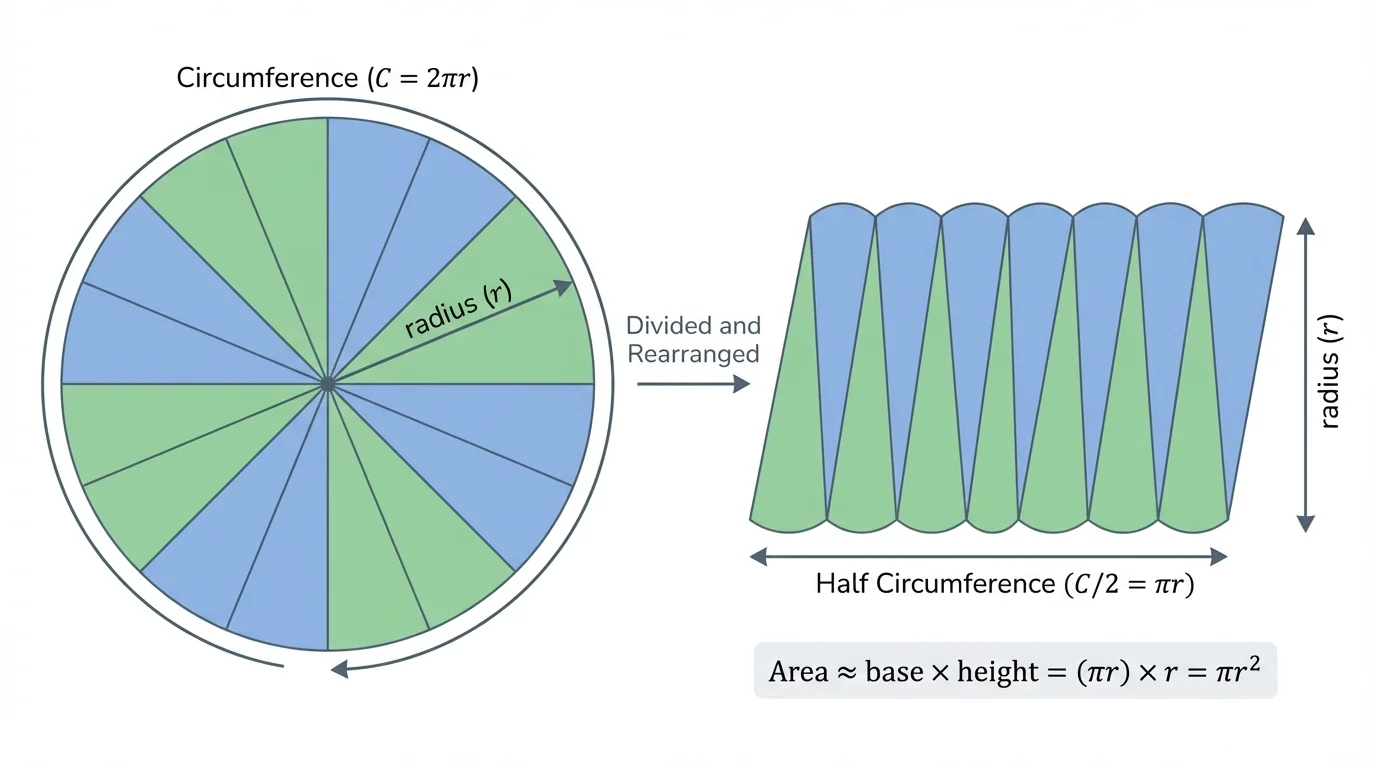
The area of this rearranged shape is approximately base times height:
\[A \approx \frac{C}{2} \cdot r\]
As the sectors get thinner and thinner, the approximation becomes more accurate. So we can think of the exact relationship as
\[A = \frac{1}{2}Cr\]
Now substitute the circumference formula \(C = 2\pi r\):
\[A = \frac{1}{2}(2\pi r)r = \pi r^2\]
This is an informal derivation, not a formal proof, but it explains why the area formula and the circumference formula are connected. The area depends on the radius and also on the distance around the circle. Later, when you use \(A = \pi r^2\), it should feel less like a magic rule and more like a result that makes sense.
We can also turn that relationship around. Since \(A = \dfrac{1}{2}Cr\), if you know the circumference and radius, you can find the area another way. That is not the main formula students usually memorize, but it shows again how closely the two ideas are linked.
Now let's use the formulas in different situations.
Worked example 1
A circular plate has radius \(6 \textrm{ cm}\). Find its circumference.
Step 1: Choose the correct formula.
The radius is given, so use \(C = 2\pi r\).
Step 2: Substitute \(r = 6\).
\(C = 2\pi(6) = 12\pi\).
Step 3: Approximate if needed.
\(C \approx 12(3.14) = 37.68\).
\[C = 12\pi \textrm{ cm} \approx 37.68 \textrm{ cm}\]
Notice that circumference is measured in centimeters, not square centimeters, because it is a distance around the edge.
Worked example 2
A circular fountain has diameter \(10 \textrm{ m}\). Find its area.
Step 1: Find the radius.
Since \(d = 10\), the radius is \(r = \dfrac{10}{2} = 5\).
Step 2: Use the area formula.
\(A = \pi r^2\)
Step 3: Substitute and simplify.
\(A = \pi(5^2) = 25\pi\).
Step 4: Approximate.
\(A \approx 25(3.14) = 78.5\).
\[A = 25\pi \textrm{ m}^2 \approx 78.5 \textrm{ m}^2\]
This example shows why it is important to check whether the problem gives radius or diameter.
Worked example 3
A bike wheel has circumference \(56.52 \textrm{ in}\). Find its diameter. Use \(\pi \approx 3.14\).
Step 1: Use the formula \(C = \pi d\).
We know \(C = 56.52\), so \(56.52 = 3.14d\).
Step 2: Solve for \(d\).
\(d = \dfrac{56.52}{3.14} = 18\).
Step 3: State the answer with units.
The diameter is \(18 \textrm{ in}\).
\[d = 18 \textrm{ in}\]
Here we worked backward from circumference to diameter. Circle formulas can be solved for missing measurements in different ways.
Worked example 4
A circular sandbox has area \(154 \textrm{ ft}^2\). Find the radius to the nearest tenth of a foot. Use \(\pi \approx 3.14\).
Step 1: Start with the area formula.
\(A = \pi r^2\)
Step 2: Substitute the known area.
\(154 = 3.14r^2\)
Step 3: Divide by \(3.14\).
\(r^2 = \dfrac{154}{3.14} \approx 49.04\)
Step 4: Take the square root.
\(r \approx \sqrt{49.04} \approx 7.0\)
\[r \approx 7.0 \textrm{ ft}\]
When solving from area to radius, remember that the radius was squared, so you must undo that by taking the square root.
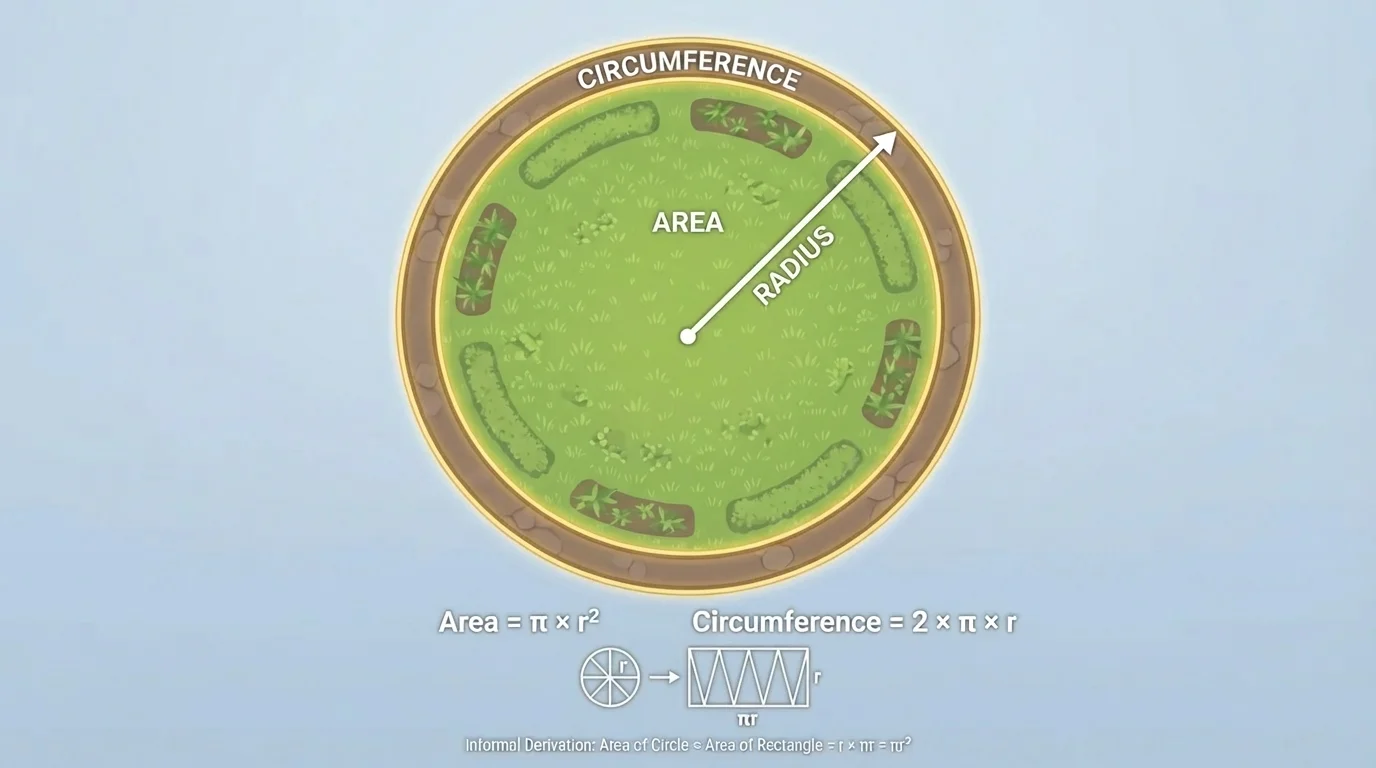
In real life, choosing between area and circumference depends on the question. In a circular garden, the outside border and the inside surface represent two different measurements. A border, fence, or trim uses circumference. Paint, grass, tile, or concrete uses area.
Suppose a circular flower bed has radius \(4 \textrm{ m}\). The edging needed is the circumference: \(C = 2\pi(4) = 8\pi \approx 25.12 \textrm{ m}\). The soil needed to cover the bed depends on the area: \(A = \pi(4^2) = 16\pi \approx 50.24 \textrm{ m}^2\).
Sports give another example. A runner going once around a circular track is covering a distance related to circumference. If workers need to resurface the entire circular practice area inside that track, they care about area instead.
Manufacturing uses the same ideas. If a company makes circular lids, the amount of metal in each lid depends on area, while the rubber seal around each lid depends on circumference. Engineers and designers constantly switch between these two measurements.
Earlier, [Figure 2] showed that area is related to half the circumference times the radius. That same idea helps explain why a larger wheel not only has a longer edge around it but also covers much more surface across its face.
One common mistake is using the diameter in the area formula without first dividing by \(2\). Since \(A = \pi r^2\), the formula needs the radius, not the diameter.
Another common mistake is forgetting units. Circumference uses units like \(\textrm{cm}\), while area uses square units like \(\textrm{cm}^2\). If your answer for area does not have square units, something is wrong.
A third mistake is entering the calculator steps in the wrong order. For area, square the radius first: \(r^2\), then multiply by \(\pi\). For example, if \(r = 3\), then \(A = \pi(3^2) = 9\pi\), not \((3\pi)^2\).
| Question asks for | Use this formula | Units |
|---|---|---|
| Distance around a circle | \(C = 2\pi r\) or \(C = \pi d\) | linear units |
| Space inside a circle | \(A = \pi r^2\) | square units |
Table 1. A comparison of when to use circumference and area formulas for circles.
You can also estimate to see whether an answer makes sense. If a circle has radius about \(5\), then the circumference should be a little more than \(2 \cdot 3 \cdot 5 = 30\), and the area should be a little more than \(3 \cdot 25 = 75\). Estimation helps you catch typing errors and unreasonable answers.
As we saw in [Figure 1], the radius and diameter are closely connected, so checking that relationship first often prevents mistakes before they start.
