A small change in how you write an expression can completely change how easy it is to understand. For example, the expression \(a + 0.05a\) may look like "an amount plus a little more," but when it is rewritten as \(1.05a\), it tells a clear story: the new amount is 105% of the original. That means increasing by \(5\%\) is the same as multiplying by \(1.05\). In algebra, rewriting is not just about making expressions look nicer. It helps you see what is happening in a problem.
When two expressions have the same value for every value of the variable, they are called equivalent expressions. They may look different, but they represent the same quantity. Different forms can highlight different ideas. One form may show the total parts being added. Another form may show a multiplication pattern or a common factor.
Equivalent expressions are expressions that have the same value for all values of the variable. Rewriting an expression means changing its form without changing its value.
Expanded form shows products written as sums, such as \(3(x+2) = 3x + 6\). Factored form shows a common factor pulled out, such as \(3x + 6 = 3(x+2)\).
To rewrite expressions correctly, you use properties of operations that you already know from arithmetic. These include the distributive property, combining like terms, and factoring out a common factor. These tools let you move between forms while keeping the meaning of the quantity the same.
Suppose a music app costs $8 per month, and you use it for \(m\) months. One way to write the total cost is \(8m\). That form quickly shows repeated addition: \(8 + 8 + 8 + \cdots\). But if a family plan covers \(m\) months for two people, the total could be written as \(8m + 8m\), which can be rewritten as \(16m\). Both forms describe the same total, but they emphasize different ideas. The first shows two separate equal charges. The second shows one combined rate.
Now think about a school event where each student ticket costs \(s\) dollars and each teacher ticket also costs \(s\) dollars. If \(4\) students and \(2\) teachers go, the total cost can be written as \(4s + 2s\), and this simplifies to \(6s\). The simplified form is easier to calculate with. The original form tells you where the costs came from.
This is why algebraic structure matters. One expression can show parts, while another shows a single combined relationship. Good algebra students learn to ask, "Which form helps me understand this situation best?"
You already know that arithmetic expressions can be rearranged using properties without changing their value. For example, \(3 + 5 = 5 + 3\), and \(2(4 + 1) = 2 \cdot 4 + 2 \cdot 1\). Algebra uses the same ideas, but now variables can represent unknown or changing amounts.
[Figure 1] When a variable stands for a quantity in a context, the way the expression is written can help you understand the relationship between that quantity and the result. That is the real power of rewriting.
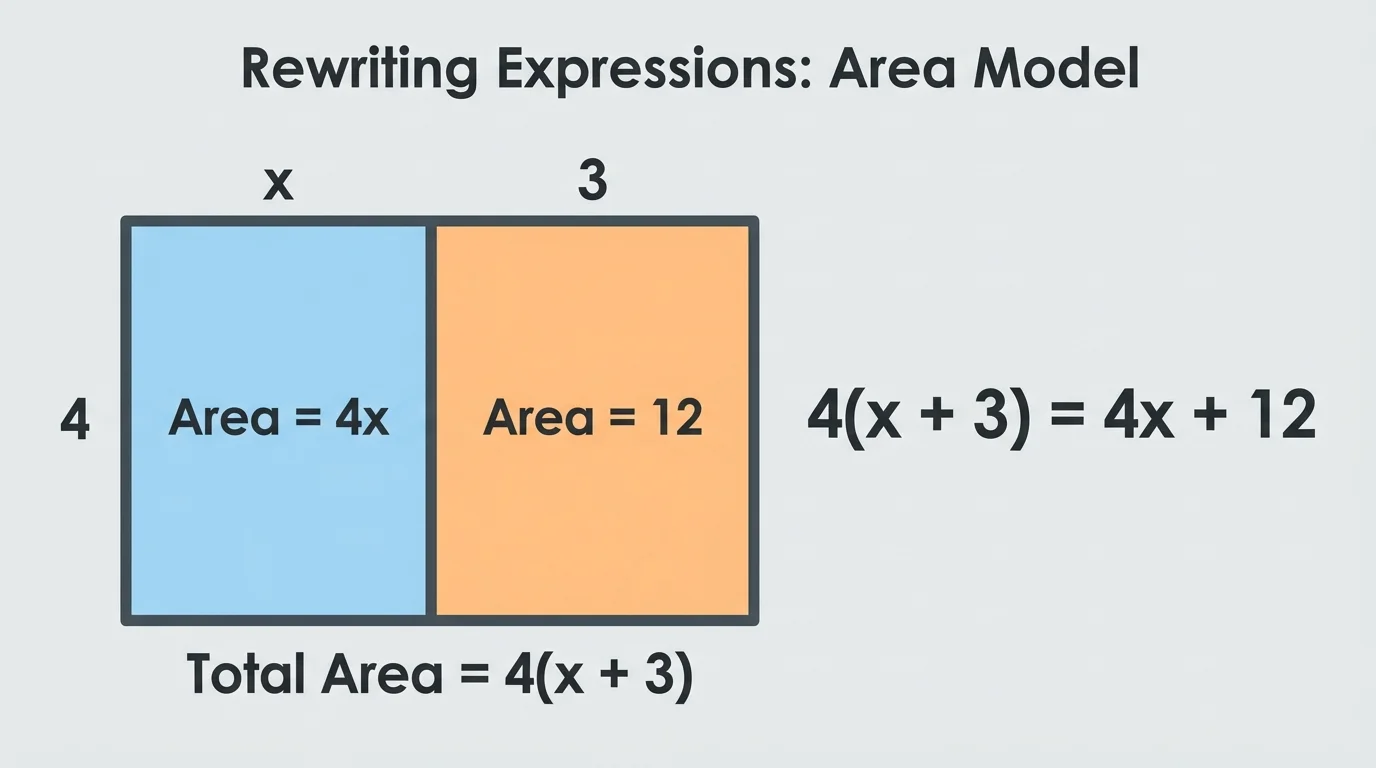
The idea of splitting a rectangle into smaller parts helps show why rewriting works. If a rectangle has side lengths \(x + 3\) and \(4\), its area can be seen as one large rectangle with area \(4(x+3)\), or as two smaller rectangles with areas \(4x\) and \(12\). So \(4(x+3) = 4x + 12\). This is the distributive property in action.
Rewriting also works in the other direction. If you start with \(4x + 12\), you can factor out the common factor \(4\) and write \(4(x+3)\). Expanded form often helps you see the separate parts. Factored form often helps you see what the parts have in common.
[Figure 2] Another important skill is combining like terms. Terms are like terms if they have the same variable part. For example, \(3x + 7x = 10x\), but \(3x + 7\) cannot be combined because one term has \(x\) and the other does not.
You can also rewrite expressions by grouping common patterns. For example, \(5n + 5\) can be written as \(5(n+1)\). In a context, the factored form may reveal repeated groups, while the expanded form shows separate pieces.
As seen earlier in [Figure 1], a visual model makes it clear that the total does not change when you rewrite. Algebra is not changing the quantity. It is changing the view of the quantity.
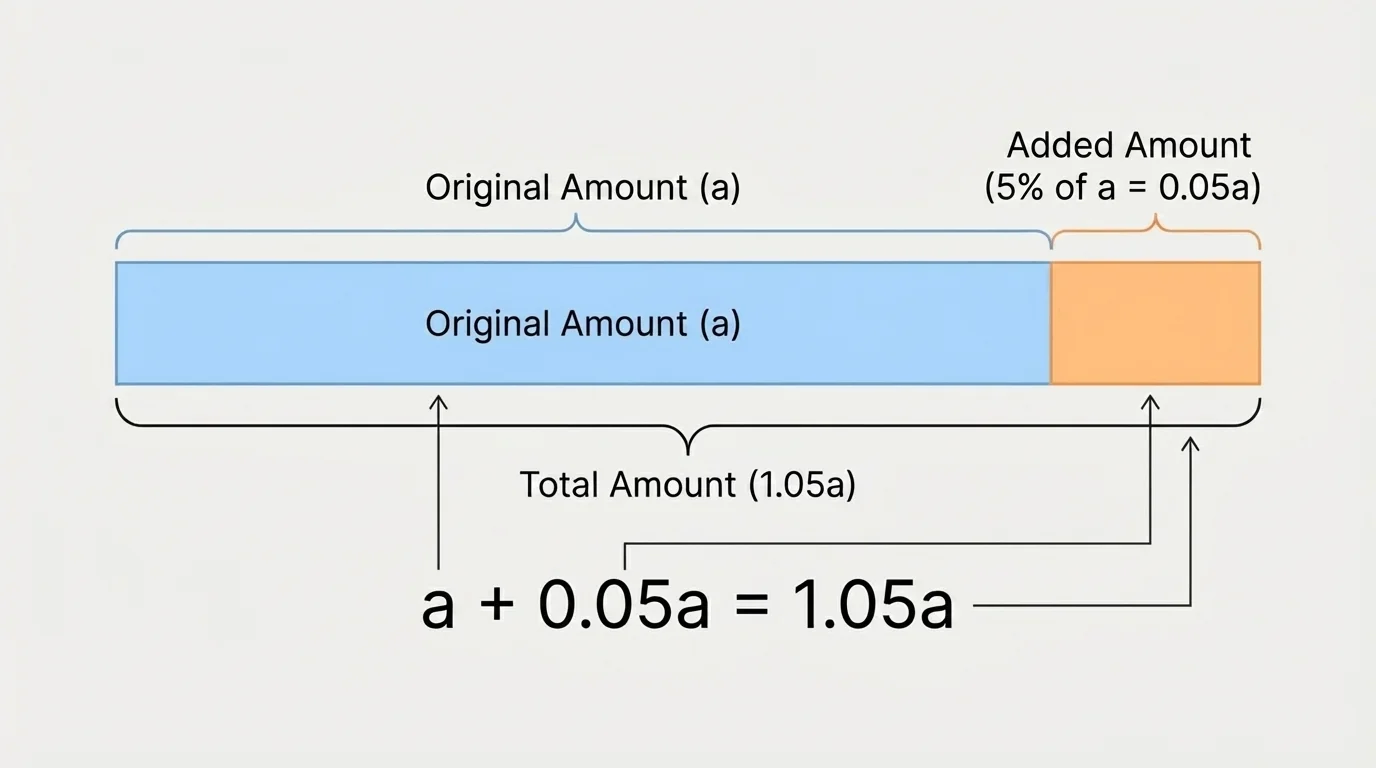
One of the most useful places to rewrite expressions is in percent problems. A percent is a part out of \(100\). So \(5\%\) means \(\dfrac{5}{100} = 0.05\). If an original amount is \(a\), then a \(5\%\) increase means adding \(0.05a\) to the original amount. That gives the expression \(a + 0.05a\).
Now combine like terms: \(a + 0.05a = 1.05a\). This rewritten form shows something important very quickly. Instead of thinking "original plus extra," you can think "multiply the original by \(1.05\)." Both forms are correct, but \(1.05a\) makes repeated calculations much easier.
This pattern works for any percent increase. If the increase is \(p\%\), then convert the percent to a decimal \(d\), and write
\[a + da = (1+d)a\]
For example:
Percent decrease works in a similar way, except you subtract. If an amount \(a\) decreases by \(5\%\), then
\[a - 0.05a = 0.95a\]
That means decreasing by \(5\%\) is the same as multiplying by \(0.95\). The multiplier is less than \(1\) because the amount gets smaller.
Additive form and multiplicative form
An expression like \(a + 0.05a\) is in an additive form because it shows the original amount and the added part. An expression like \(1.05a\) is in a multiplicative form because it shows one multiplication. In many real-world problems, the additive form explains where the change comes from, while the multiplicative form makes calculation faster and reveals the scale factor.
Later, when you study growth in science, business, and statistics, this idea becomes even more important. A growth factor such as \(1.05\) tells how much the quantity is being scaled.
Algebra is not just about rewriting symbols. It is about reading meaning from structure. The comparison in [Figure 3] shows that the same situation can be written in different ways, and each way can tell you something new.
Suppose one notebook costs \(x\) dollars. If you buy \(4\) notebooks and your friend also buys \(4\) notebooks, the total cost can be written as \(4x + 4x\). This form highlights two separate purchases. But if you combine like terms, you get \(8x\), which highlights the total number of notebooks.
Here is another example. A classroom has \(3\) rows of desks, and each row has \(n + 2\) desks. The total number of desks can be written as \(3(n+2)\). This form highlights the equal groups. If you distribute, you get \(3n + 6\), which shows how many desks come from the \(n\) part and how many come from the extra \(2\) desks in each row.
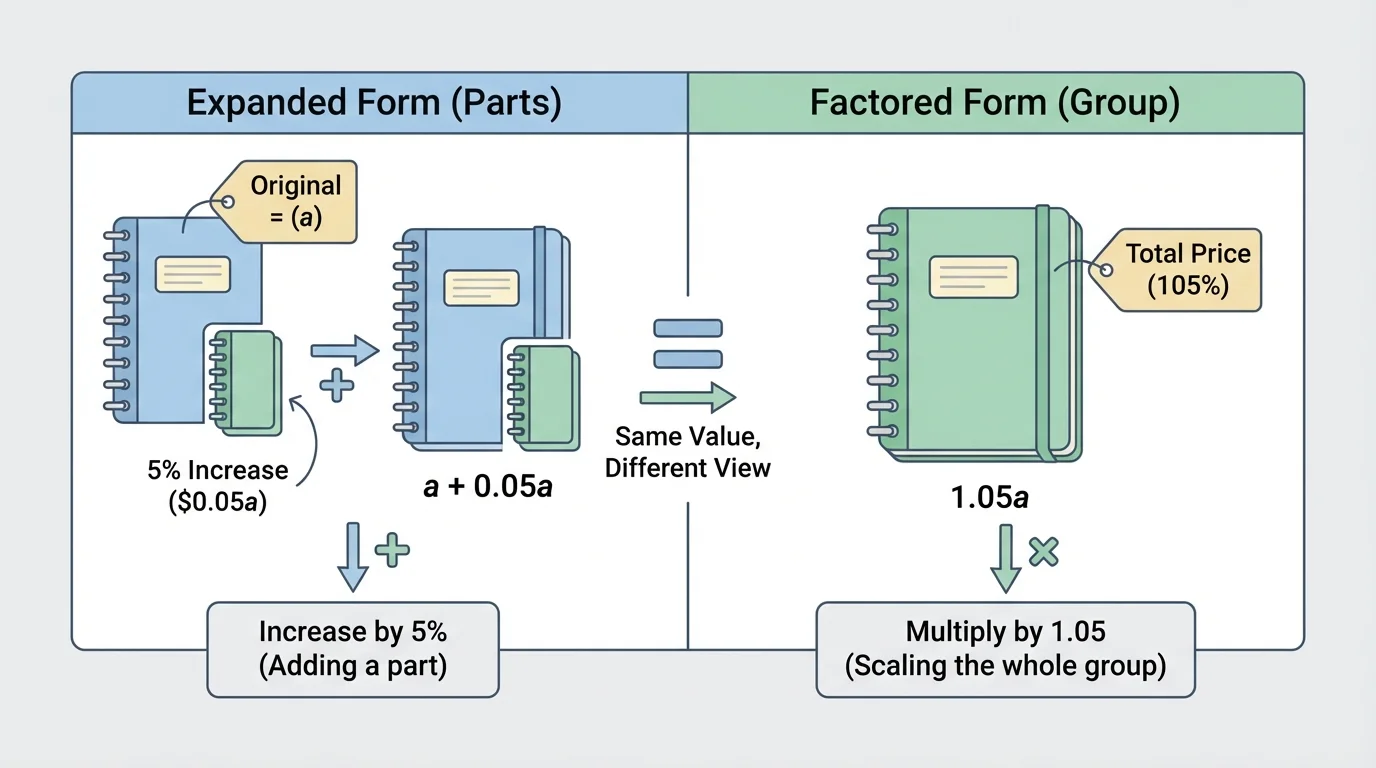
Both forms are useful. If you want to understand the setup, factored form may help more. If you want to add separate contributions, expanded form may help more. Neither is "more correct." The best form depends on what you are trying to notice.
We can compare these forms clearly:
| Expression form | Example | What it highlights |
|---|---|---|
| Expanded form | \(3n + 6\) | Separate parts being added |
| Factored form | \(3(n+2)\) | Equal groups or common factor |
| Combined like terms | \(8x\) | Total amount of one kind |
| Percent multiplier form | \(1.05a\) | Scale factor after a percent increase |
Table 1. Different algebraic forms and the relationships they make easier to see.
When you read a word problem, ask yourself: Does this expression show parts, groups, or a scale factor? Rewriting can help answer that question.
These examples show how rewriting expressions can uncover meaning in a problem situation and make calculations more efficient.
Worked Example 1: A \(5\%\) increase
A game console originally costs \(p\) dollars. The price increases by \(5\%\). Rewrite the new price in two equivalent forms and explain what each form means.
Step 1: Write the increase as a decimal part of the original amount.
A \(5\%\) increase is \(0.05p\).
Step 2: Add the increase to the original price.
The new price is \(p + 0.05p\).
Step 3: Combine like terms.
\(p + 0.05p = 1.05p\)
The two equivalent forms are \(p + 0.05p\) and \(1.05p\). The first shows the original price plus the increase. The second shows that the new price is \(105\%\) of the original.
This kind of rewriting is common in money situations because multiplying by a decimal is often faster than adding a percent part separately.
Worked Example 2: A \(20\%\) discount
A jacket has an original price of \(j\) dollars and is on sale for \(20\%\) off. Rewrite the sale price in two equivalent forms.
Step 1: Write the discount as a decimal part.
\(20\% = 0.20\), so the discount amount is \(0.20j\).
Step 2: Subtract the discount from the original price.
Sale price: \(j - 0.20j\)
Step 3: Combine like terms.
\(j - 0.20j = 0.80j\)
The forms \(j - 0.20j\) and \(0.80j\) are equivalent. The expression \(0.80j\) tells you immediately that the customer pays \(80\%\) of the original price.
Notice how the multiplier after a decrease is less than \(1\), while the multiplier after an increase is greater than \(1\).
Worked Example 3: Rewriting to show equal groups
A snack pack contains \(x\) crackers and \(3\) cheese cubes. There are \(5\) snack packs. Write and rewrite an expression for the total number of items.
Step 1: Write one pack.
One pack has \(x + 3\) items.
Step 2: Write five packs.
The total is \(5(x+3)\).
Step 3: Distribute to rewrite.
\(5(x+3) = 5x + 15\)
The form \(5(x+3)\) highlights that there are \(5\) equal packs. The form \(5x + 15\) highlights the total crackers and the total cheese cubes separately.
Different forms can answer different questions. If someone asks, "How many packs are there?" the factored form helps. If someone asks, "How many cheese cubes are there altogether?" the expanded form helps.
Worked Example 4: Factoring out a common factor
A school orders \(6m + 6n\) pencils, where \(m\) is the number of boxes of one type and \(n\) is the number of boxes of another type. Rewrite the expression to show the common factor.
Step 1: Identify the common factor.
Both terms \(6m\) and \(6n\) have a factor of \(6\).
Step 2: Factor out \(6\).
\(6m + 6n = 6(m+n)\)
The factored form \(6(m+n)\) shows that there are \(6\) pencils in each box, for a total of \(m+n\) boxes.
That is a good example of how factoring can reveal the real-world meaning hidden inside an expression.
[Figure 4] Rewriting expressions is useful far beyond classwork. In shopping, taxes, and subscriptions, one form may be easier to calculate, while another is easier to understand. The shopping illustration connects these rewrites to situations people actually see on receipts and price tags.
Suppose a phone plan costs $40 per month and sales tax adds \(8\%\). You could write the total monthly cost as \(40 + 0.08(40)\), which shows the base price and the tax part separately. Or you could rewrite it as \(1.08(40)\), which shows that the tax makes the total \(108\%\) of the original price.
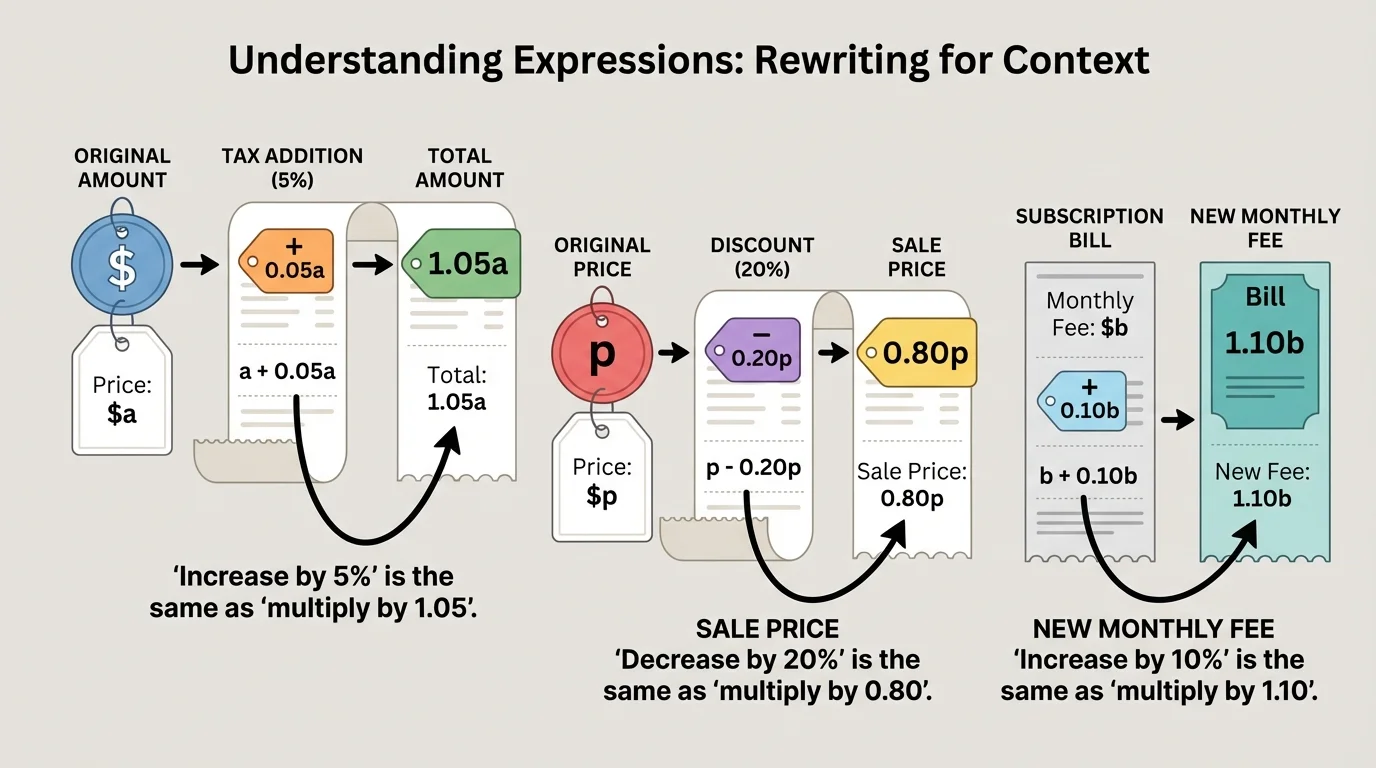
In sports, a player who improves a statistic by \(10\%\) has a new amount of \(1.10a\), where \(a\) is the original statistic. In science, if a population grows by \(3\%\), the next amount can be written as \(1.03p\). In business, a \(15\%\) discount changes a price from \(c\) to \(0.85c\).
These rewritten forms are especially helpful when changes happen more than once. If a quantity increases by \(5\%\) and then by another \(5\%\), it is natural to think in multipliers. The new amount becomes \(1.05(1.05a)\), which is \(1.1025a\). That shows the total increase is not exactly \(10\%\), because the second increase is applied to the already increased amount.
As with the receipt example in [Figure 4], multiplier form often makes repeated percent changes much easier to track.
A \(50\%\) decrease and a \(50\%\) increase do not cancel each other out. If you start with \(100\), then decrease to \(50\), and then increase by \(50\%\), you get \(75\), not \(100\). Rewriting with multipliers makes this easy to see: \(100 \cdot 0.5 \cdot 1.5 = 75\).
This is one reason algebraic rewriting matters in real life: it helps you avoid mistakes that seem reasonable at first glance.
One common mistake is combining terms that are not like terms. For example, \(3x + 4\) cannot be rewritten as \(7x\). Only terms with the same variable part can be combined.
Another common mistake is using the wrong decimal for a percent. Remember that \(5\% = 0.05\), not \(0.5\). So increasing by \(5\%\) means multiplying by \(1.05\), not \(1.5\).
Students also sometimes think that \(a + 0.05\) means a \(5\%\) increase. It does not. The expression \(a + 0.05\) adds a fixed amount of \(0.05\). A \(5\%\) increase must depend on the original amount, so it is \(a + 0.05a\).
Factoring can also be misunderstood. For example, \(4x + 12 = 4(x+3)\), not \(4(x+12)\). When you factor, each original term must still be represented correctly after distribution.
"A good algebra rewrite does not change the quantity. It changes what you can see."
That idea is worth remembering whenever you choose between expanded form, factored form, and multiplier form.
By now, you have seen that rewriting an expression can reveal parts, groups, or scale factors. The same quantity may be written in several equivalent ways, each useful for a different reason.
For example, \(2x + 6\) and \(2(x+3)\) are equivalent. The first emphasizes addition of two parts. The second emphasizes that everything comes in groups of \(2\). Likewise, \(a + 0.05a\) and \(1.05a\) are equivalent. The first emphasizes the original amount plus the increase. The second emphasizes multiplication by a growth factor.
When you rewrite expressions thoughtfully, you are doing more than simplifying. You are choosing the form that makes the situation easier to understand. That is a major goal of algebra.
