A steering wheel turning, a planet orbiting, a skateboard wheel rolling, a robot arm rotating: all of these involve angles, but in advanced mathematics and science, degrees are often not the most natural way to measure them. There is another angle measure, called a radian, that connects rotation directly to distance traveled along a circle. That connection makes radians far more than just "another unit." They reveal how angles and circles fit together.
Most students first meet angles in degrees. A full turn is \(360^\circ\), a straight angle is \(180^\circ\), and a right angle is \(90^\circ\). Degrees are convenient, but they are based on dividing a circle into \(360\) parts. Radians come from the geometry of the circle itself.
If an object moves along a circular path, we often care not only about how much it turned, but also about how far along the circle it traveled. Radian measure ties these ideas together. That is why radians are central in trigonometry, calculus, physics, and engineering.
A circle has a radius, a diameter, a circumference, and arcs. The circumference of a circle with radius \(r\) is \(2\pi r\). On the coordinate plane, the unit circle is the circle centered at \((0,0)\) with radius \(1\).
An angle formed at the center of a circle cuts off a curved part of the circle called an arc. The bigger the angle, the longer the arc it intercepts. Radians capture that idea directly.
[Figure 1] helps show why the unit circle is especially important: its radius is exactly \(1\). On this circle, the relationship between angle and arc becomes beautifully simple, because the angle at the center and the length of the intercepted arc have the same numerical value when the angle is measured in radians.
Suppose an angle starts on the positive \(x\)-axis and rotates counterclockwise until it reaches another point on the unit circle. The curved part between those two points is the arc subtended by the angle. Because the radius is \(1\), the arc length is exactly the radian measure of the angle.
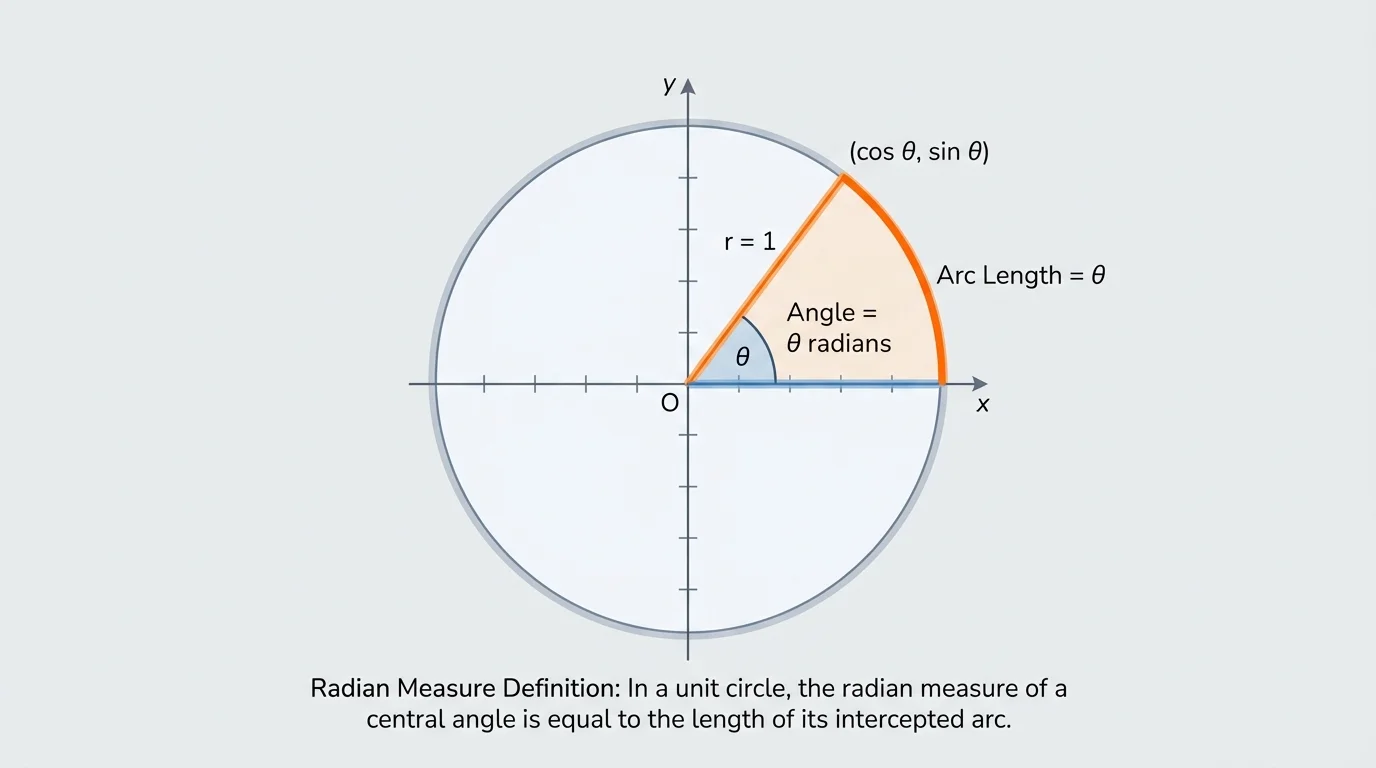
This is the key idea: on the unit circle, radian measure equals arc length. If the intercepted arc has length \(2\), then the angle measures \(2\) radians. If the arc has length \(\dfrac{\pi}{3}\), then the angle measures \(\dfrac{\pi}{3}\) radians.
Radian is the measure of a central angle that subtends an arc of the same length as the radius. On the unit circle, where the radius is \(1\), the radian measure of an angle is exactly the length of its intercepted arc.
Central angle is an angle whose vertex is at the center of a circle.
Because the unit circle has circumference \(2\pi\), one complete trip around it has length \(2\pi\). That means one full turn measures \(2\pi\) radians. A half-turn measures \(\pi\) radians, and a quarter-turn measures \(\dfrac{\pi}{2}\) radians.
To understand the radian precisely, begin with a circle of radius \(1\). A central angle of \(1\) radian intercepts an arc of length \(1\). A central angle of \(2\) radians intercepts an arc of length \(2\). So on the unit circle, angle measure is not based on an arbitrary division of the circle. It is based on actual distance along the circle.
This leads to an important scale of common angles:
Since the circumference of the unit circle is \(2\pi\), it makes sense that \(2\pi\) radians corresponds to \(360^\circ\). This is the bridge between radians and degrees.
The number \(\pi\) appears in radian measure because circles naturally involve circumference, and circumference is built from \(\pi\). Radians are not "using \(\pi\) because trigonometry likes it"; they use \(\pi\) because circles do.
Another way to think about it is that radians measure rotation by circle length. Degrees measure rotation by partition. Both measure the same turning, but radians connect more directly to the geometry.
[Figure 2] shows common positions on the unit circle with both degree and radian labels, making benchmark angles easier to compare. Since \(360^\circ = 2\pi\) radians, benchmark angles can be converted between the two systems.
The basic conversion relationships are:
From degrees to radians, multiply by \(\dfrac{\pi}{180}\).
From radians to degrees, multiply by \(\dfrac{180}{\pi}\).
Here are several important equivalents:
| Degrees | Radians |
|---|---|
| \(0^\circ\) | \(0\) |
| \(30^\circ\) | \(\dfrac{\pi}{6}\) |
| \(45^\circ\) | \(\dfrac{\pi}{4}\) |
| \(60^\circ\) | \(\dfrac{\pi}{3}\) |
| \(90^\circ\) | \(\dfrac{\pi}{2}\) |
| \(180^\circ\) | \(\pi\) |
| \(270^\circ\) | \(\dfrac{3\pi}{2}\) |
| \(360^\circ\) | \(2\pi\) |
Table 1. Common benchmark angles in degrees and radians.
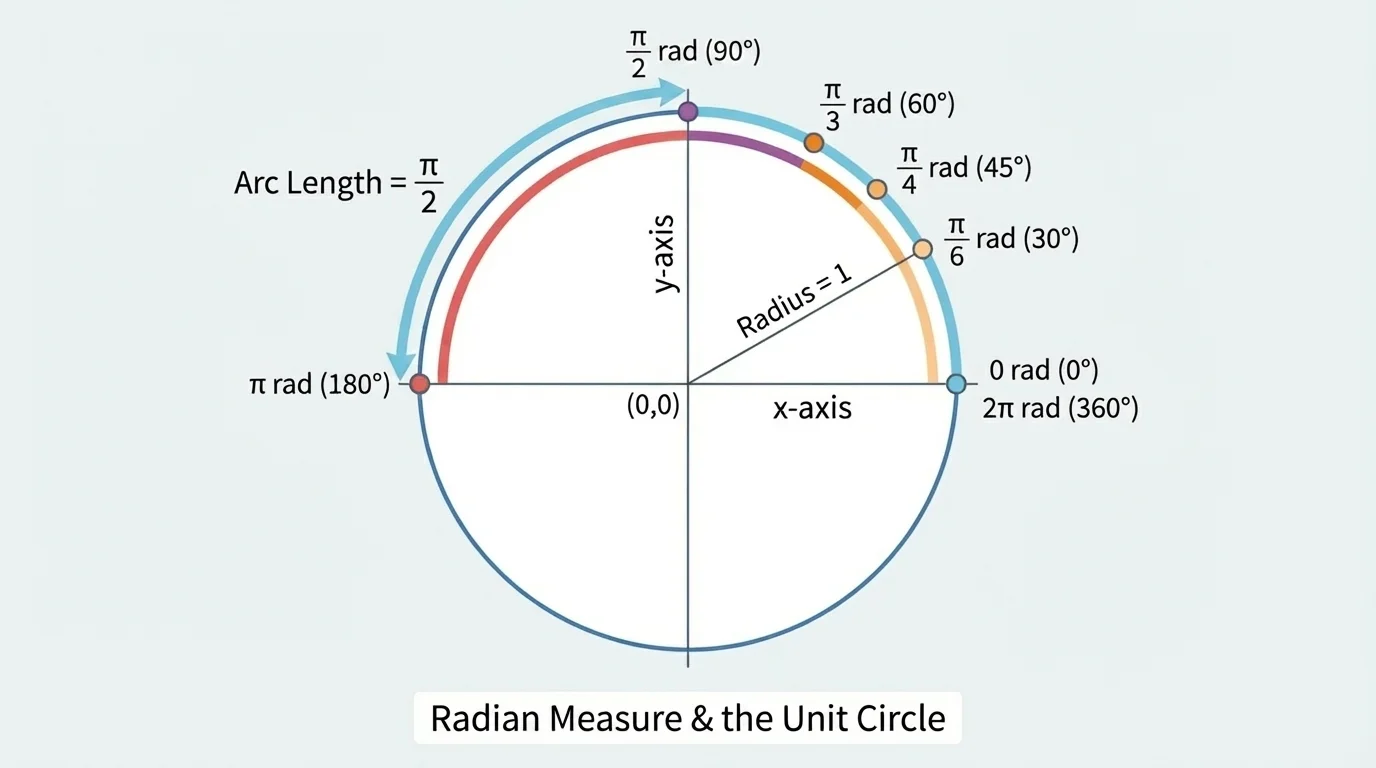
These values matter because trigonometric functions are built from points on the unit circle. Later, when you work with sine and cosine, these benchmark angles appear constantly.
Solved example 1: Convert \(135^\circ\) to radians
Step 1: Use the conversion factor from degrees to radians.
Multiply by \(\dfrac{\pi}{180}\).
Step 2: Substitute and simplify.
\(135^\circ \cdot \dfrac{\pi}{180} = \dfrac{135\pi}{180} = \dfrac{3\pi}{4}\).
The angle measures \(\dfrac{3\pi}{4}\) radians.
A helpful strategy is to simplify the fraction before worrying about decimals. In trigonometry, exact answers such as \(\dfrac{3\pi}{4}\) are usually preferred.
[Figure 3] shows that angle direction also matters. On the coordinate plane, positive angles rotate counterclockwise and negative angles rotate clockwise. This convention lets trigonometric functions extend beyond the first quadrant and even beyond one complete turn.
For example, \(\dfrac{\pi}{2}\) means a quarter-turn counterclockwise from the positive \(x\)-axis. But \(-\dfrac{\pi}{2}\) means a quarter-turn clockwise from the positive \(x\)-axis. Both land on the unit circle, but at different points.
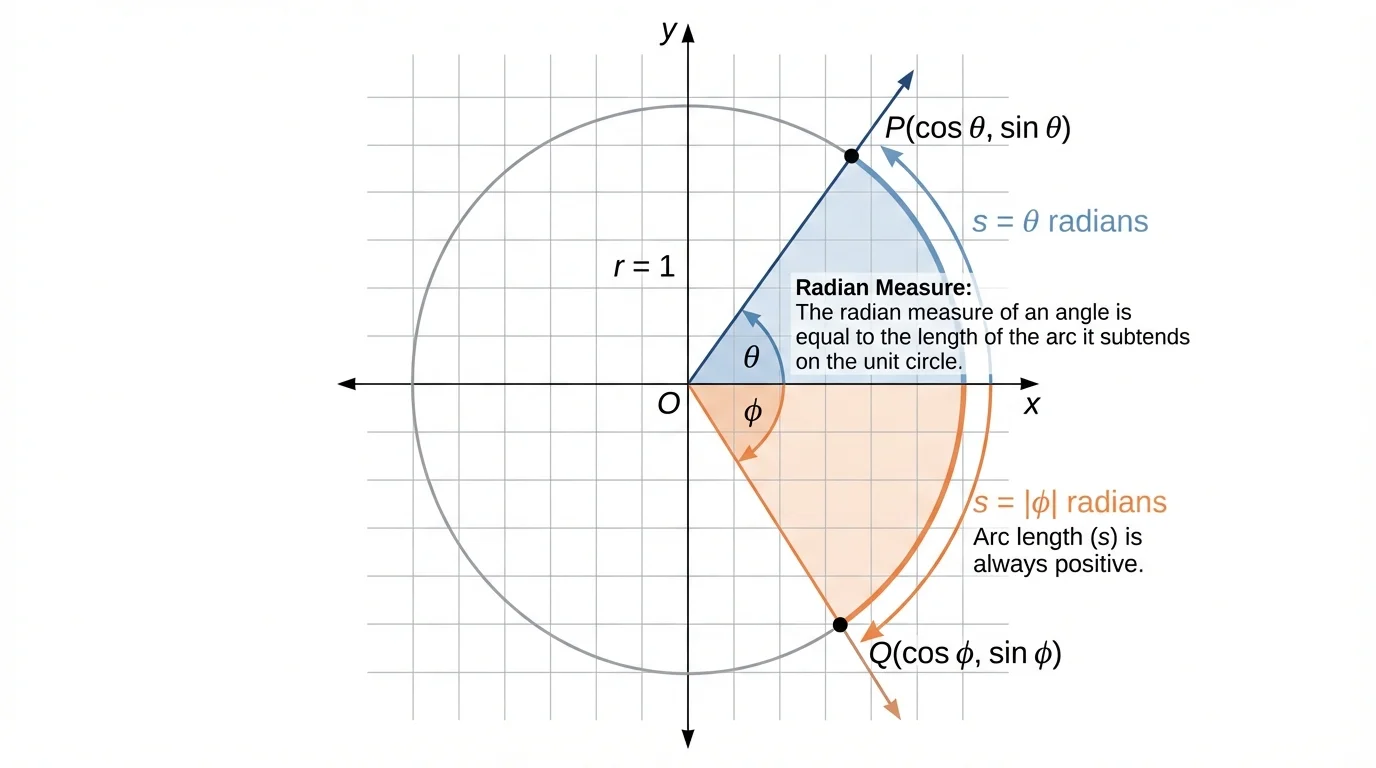
You can also have angles larger than \(2\pi\) or smaller than \(-2\pi\). For instance, \(\dfrac{5\pi}{2}\) represents one full turn plus another quarter-turn. It lands at the same terminal side as \(\dfrac{\pi}{2}\). Angles like these are called coterminal angles because they end at the same position.
In radians, coterminal angles differ by integer multiples of \(2\pi\):
\(\theta\) and \(\theta + 2\pi k\) are coterminal, where \(k\) is an integer.
This idea becomes very important in trigonometric functions, because sine and cosine repeat after a full turn of \(2\pi\).
[Figure 4] shows that the unit circle gives the definition, but the idea extends to every circle. If a circle has radius \(r\), then the relationship between an angle \(\theta\) in radians and the arc length \(s\) is geometric: the arc length is the radius times the angle measure.
The formula is
\(s = r\theta\)
This formula only works directly when \(\theta\) is measured in radians. That is one of the most practical reasons radians are so important.
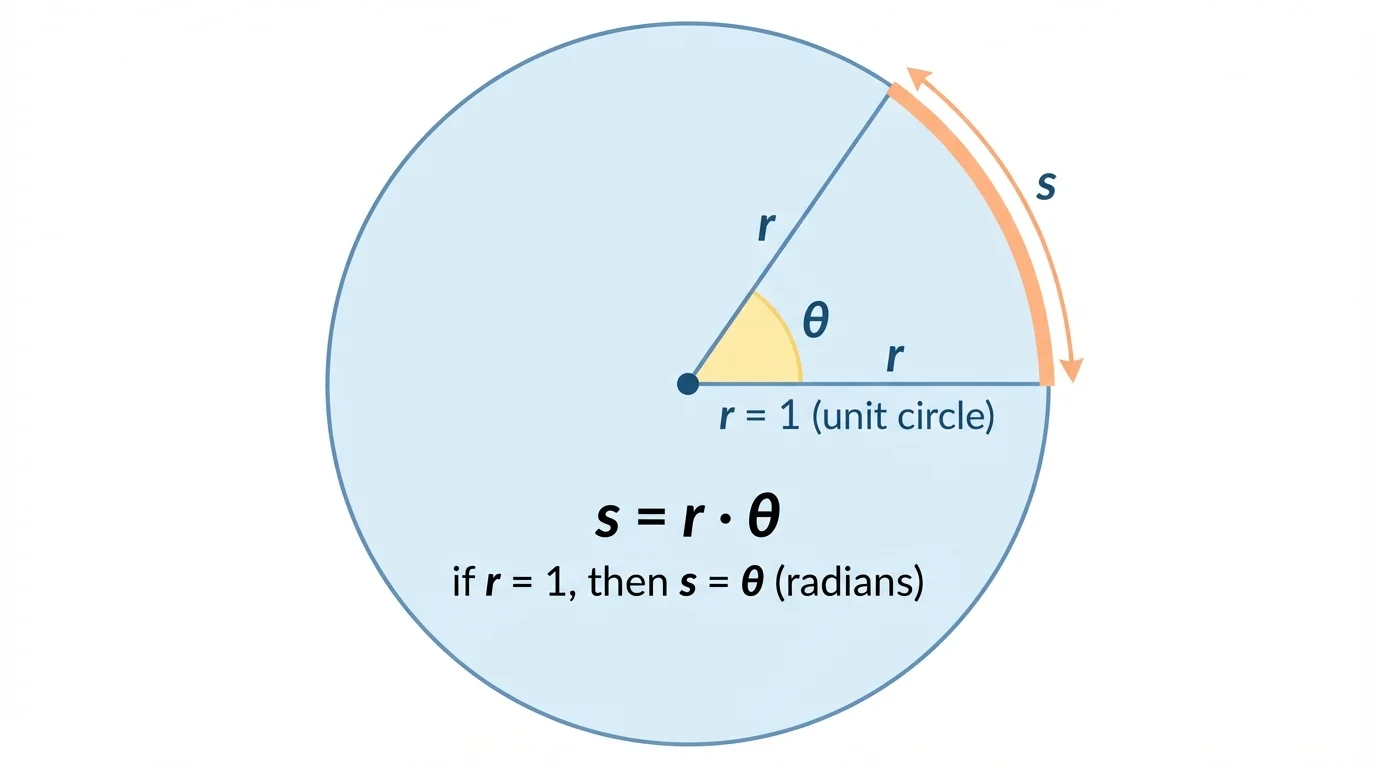
Notice how this general formula matches the unit circle definition. If \(r = 1\), then
\[s = 1\cdot \theta = \theta\]
So on the unit circle, arc length and radian measure are equal. That is exactly the definition we started with in [Figure 1].
Why radians make the formula simple
If you use degrees, arc length formulas need an extra conversion factor. With radians, the geometry of the circle is built directly into the angle measure, so the formula becomes the elegant relationship \(s = r\theta\).
This simplicity is not accidental. Radians are the angle unit that naturally fits circular motion, just as meters naturally fit length.
The best way to understand radians is to move between arc length, angle measure, and circle size.
Solved example 2: Find the radian measure of an angle on the unit circle if the intercepted arc has length \(\dfrac{5\pi}{6}\)
Step 1: Recall the unit circle relationship.
On the unit circle, radian measure equals arc length.
Step 2: Match the angle measure to the arc length.
Since the arc length is \(\dfrac{5\pi}{6}\), the angle measure is also \(\dfrac{5\pi}{6}\) radians.
The angle measures \(\dfrac{5\pi}{6}\) radians.
This is the purest use of the definition: no conversion is needed because the radius is \(1\).
Solved example 3: Convert \(\dfrac{7\pi}{6}\) radians to degrees
Step 1: Use the conversion factor from radians to degrees.
Multiply by \(\dfrac{180}{\pi}\).
Step 2: Substitute and simplify.
\(\dfrac{7\pi}{6} \cdot \dfrac{180}{\pi} = \dfrac{7\cdot 180}{6} = 7\cdot 30 = 210\).
The angle measures \(210^\circ\).
Because \(210^\circ\) is greater than \(180^\circ\), its terminal side lies in the third quadrant.
Solved example 4: Find the arc length of a circle with radius \(8\) intercepted by an angle of \(\dfrac{3\pi}{4}\) radians
Step 1: Use the arc length formula.
\(s = r\theta\)
Step 2: Substitute the known values.
\(s = 8\left(\dfrac{3\pi}{4}\right)\)
Step 3: Simplify.
\(s = \dfrac{24\pi}{4} = 6\pi\)
The arc length is \(6\pi\)
Here the angle had to be in radians. If the angle had been given in degrees, you would first need to convert it.
Consider one more example using negative rotation. If an angle is \(-\dfrac{\pi}{3}\), it means a clockwise rotation of \(\dfrac{\pi}{3}\). Its terminal side is coterminal with \(\dfrac{5\pi}{3}\). As with [Figure 3], the direction of motion changes the sign, but the circle still organizes the angle by where it ends.
Trigonometric functions on the unit circle are defined by points reached after rotating through an angle. If the angle is \(\theta\), the point on the unit circle has coordinates \((\cos \theta, \sin \theta)\). Because every real number can represent a radian measure, trigonometric functions can be extended from acute angles in triangles to all real numbers.
This is a major shift in mathematical thinking. In right-triangle trigonometry, angles are usually between \(0^\circ\) and \(90^\circ\). On the unit circle, angles can be larger than \(360^\circ\), negative, or fractional multiples of \(\pi\). Radians make that extension natural because they measure rotation continuously along the circle.
Benchmark angles from [Figure 2] are especially useful here. For example, \(\dfrac{\pi}{2}\), \(\pi\), and \(\dfrac{3\pi}{2}\) correspond to familiar quarter-turn, half-turn, and three-quarter-turn positions on the unit circle.
"Radians turn circle geometry into angle measurement."
That is why graphs of sine and cosine, periodic motion, and later calculus formulas are almost always written in radians.
Radians appear whenever something rotates or travels along a curved path. A wheel of radius \(r\) rolling through an angle \(\theta\) sweeps out an arc length of \(s = r\theta\). Engineers use this relationship when designing gears, tires, conveyor belts, and robotic joints.
In robotics, a rotating arm may need to move through an exact angle so that its end travels a precise distance along a circular path. In astronomy, the apparent angular size of an object in the sky is often studied using radian-based relationships. In physics, angular velocity is commonly measured in radians per second.
Even digital animation and game design use radians. When a character, camera, or object rotates around a point, software often calculates positions using sine and cosine with angles measured in radians.
Many programming languages expect angle input for trigonometric functions in radians, not degrees. If you enter \(90\) expecting \(\sin 90^\circ = 1\), the calculator or software may instead interpret \(90\) as \(90\) radians and give a very different result.
This is another sign that radians are the standard language of higher mathematics and technology.
One common mistake is thinking that radians and arc length are always the same. They are equal only on the unit circle. On a larger or smaller circle, the angle stays the same but the arc length changes with the radius, according to \(s = r\theta\), as shown earlier in [Figure 4].
Another mistake is treating radians as if they were unrelated to degrees. They measure the same type of quantity: angle. They are simply different units, just as centimeters and inches are different units for length.
A third mistake is using the arc length formula with degrees without conversion. For example, if \(\theta = 60^\circ\), you cannot directly compute \(s = r\theta\) using \(60\). First convert \(60^\circ\) to \(\dfrac{\pi}{3}\) radians.
Finally, remember that a radian is not usually written with a degree symbol. Writing \(\pi\) radians is correct. Writing \(\pi^\circ\) changes the meaning completely.
