For a long time, mathematicians faced a strange problem: some equations looked perfectly reasonable, yet they had no solutions on the real number line. For example, the equation \(x^2 + 1 = 0\) asks for a number whose square is \(-1\). No real number can do that. So does the equation simply fail to have a solution, or are we looking in too small a number system? That question leads to one of the most important ideas in algebra.
When you solve a linear equation, you expect one solution. When you solve a quadratic, you expect up to two solutions. More generally, a polynomial of degree \(n\) should somehow have \(n\) solutions. The surprising part is that this becomes fully true only when we allow solutions in the complex numbers.
The Fundamental Theorem of Algebra is the statement that guarantees this. It tells us that polynomial equations do not "run out" of solutions if we work in the complex number system. That makes the theorem a bridge between equations, factoring, and the structure of polynomials.
Recall that a polynomial in one variable has the form \(a_nx^n + a_{n-1}x^{n-1} + \cdots + a_1x + a_0\), where the exponents are whole numbers and \(a_n \ne 0\). The degree is the highest exponent, so a quadratic has degree \(2\).
If you have ever graphed quadratics, you may have noticed that some parabolas cross the \(x\)-axis twice, some touch it once, and some never touch it at all. Yet the theorem says every quadratic still has two roots in the complex number system, even when the graph does not cross the real axis.
The equation \(x^2 + 1 = 0\) becomes solvable once we define the imaginary unit \(i\) by \(i^2 = -1\). From there, numbers of the form \(a + bi\), where \(a\) and \(b\) are real, form the complex number system. This larger system includes all real numbers and also numbers that involve \(i\), as [Figure 1] illustrates through the complex plane.
A complex number has a real part and an imaginary part. For example, in \(3 - 2i\), the real part is \(3\) and the imaginary part is \(-2\). Real numbers are still part of this system; they are simply the complex numbers with imaginary part \(0\).
This matters because some polynomial equations have no real solutions but do have complex ones. For instance, \(x^2 + 1 = 0\) can be rewritten as \(x^2 = -1\), so the solutions are \(x = i\) and \(x = -i\).
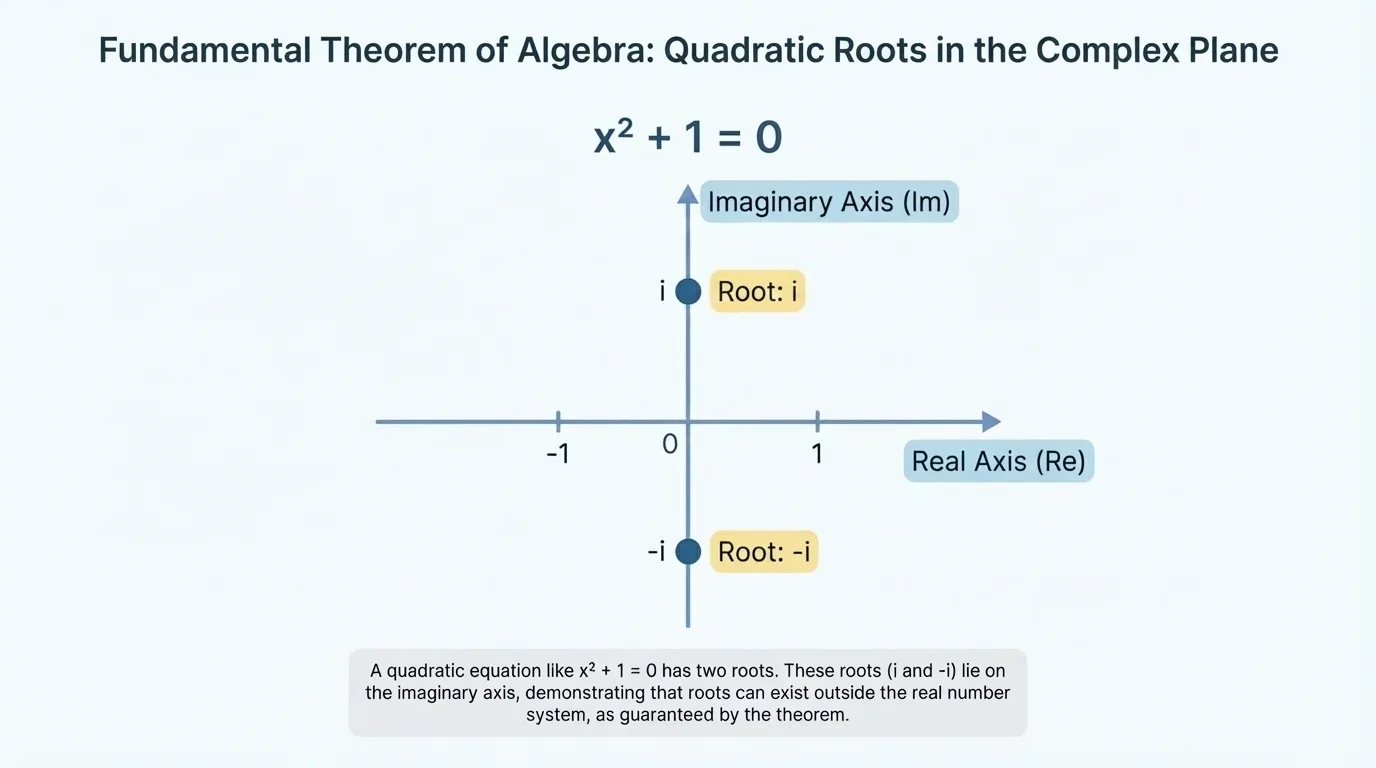
The complex number system is not just an extra trick for hard problems. It is the number system in which polynomial equations behave most completely. Later, when we discuss factoring, this becomes even more powerful: roots and factors line up neatly in the complex numbers.
Complex number: a number of the form \(a + bi\), where \(a\) and \(b\) are real numbers and \(i^2 = -1\).
Root or zero: a value of \(x\) that makes a polynomial equal to \(0\).
Multiplicity: the number of times a root is repeated as a factor.
Another important fact is that if a polynomial has real coefficients and one root is \(a + bi\), then \(a - bi\) is also a root. These are called conjugate pairs. This pattern appears often in quadratic equations with negative discriminant.
In standard form, the theorem says:
Every nonconstant polynomial with complex coefficients has at least one complex root.
An equivalent and very useful version says:
Every polynomial of degree \(n\) can be factored completely into \(n\) linear factors over the complex numbers, counting multiplicity.
So if \(P(x)\) has degree \(n\), then there exist complex numbers \(r_1, r_2, \dots, r_n\) such that
\[P(x) = a(x-r_1)(x-r_2)\cdots(x-r_n)\]
where \(a\) is the leading coefficient. Some of the roots may be equal, and some may be nonreal complex numbers.
This theorem does not say that every polynomial has all real roots. It says every nonconstant polynomial has roots in the complex numbers. That is a much stronger and more complete statement than "it has real solutions."
Why counting multiplicity matters
If \((x-2)^2\) is a factor, then \(x = 2\) is counted twice as a root. For the polynomial \((x-2)^2(x+1)\), the degree is \(3\), and the roots are \(2, 2, -1\). Even though there are only two distinct numbers, there are three roots counting multiplicity.
This way of counting is essential because the theorem matches the degree exactly. A quadratic has degree \(2\), so it has exactly two complex roots counting multiplicity. A cubic has degree \(3\), and so on.
Now let us prove the theorem for all quadratic polynomials. A general quadratic polynomial has the form, and [Figure 2] will help organize the cases that follow.
\[ax^2 + bx + c\]
where \(a \ne 0\). To find its roots, we use the quadratic formula:
\[x = \frac{-b \pm \sqrt{b^2 - 4ac}}{2a}\]
The expression \(b^2 - 4ac\) is called the discriminant. It determines the type of roots.
There are three possibilities:
In every case, the formula produces roots in the complex numbers. Therefore every quadratic polynomial has at least one complex root. In fact, it has exactly two complex roots counting multiplicity. That proves the Fundamental Theorem of Algebra for quadratic polynomials.
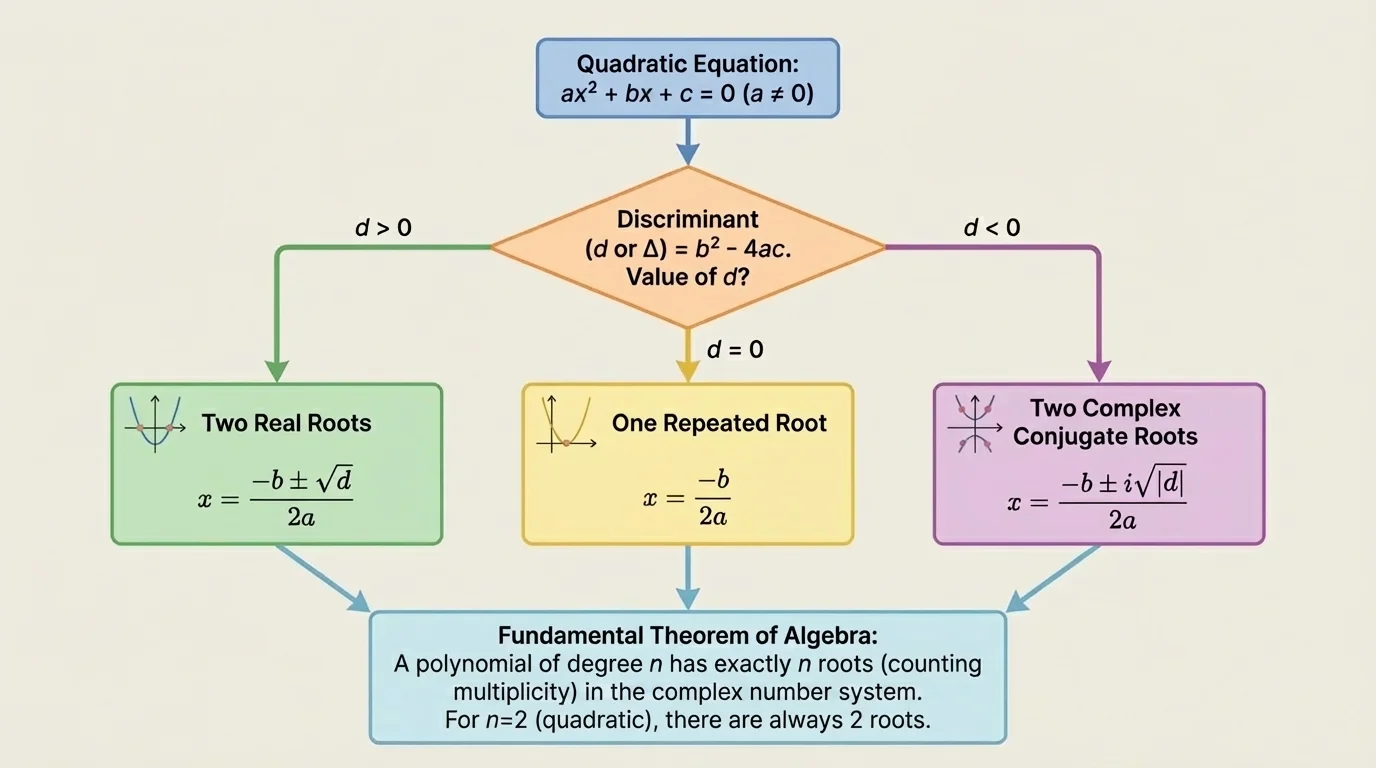
Notice what makes this proof work: the complex numbers allow us to take square roots of negative quantities by writing them in terms of \(i\). Without complex numbers, the case \(b^2 - 4ac < 0\) would seem to "break" the pattern. With complex numbers, the pattern is complete.
Solved example 1: a quadratic with two real roots
Solve \(x^2 - 5x + 6 = 0\).
Step 1: Identify the coefficients.
Here \(a = 1\), \(b = -5\), and \(c = 6\).
Step 2: Compute the discriminant.
\(b^2 - 4ac = (-5)^2 - 4(1)(6) = 25 - 24 = 1\).
Step 3: Apply the quadratic formula.
\(x = \dfrac{-(-5) \pm \sqrt{1}}{2(1)} = \dfrac{5 \pm 1}{2}\).
Step 4: Find both roots.
\(x = \dfrac{6}{2} = 3\) or \(x = \dfrac{4}{2} = 2\).
The solutions are \(x = 2\) and \(x = 3\). Since the discriminant is positive, there are two distinct real roots.
This is the most familiar case because the graph crosses the \(x\)-axis twice. But it is only one of the three possible quadratic behaviors.
Solved example 2: a quadratic with one repeated root
Solve \(x^2 - 4x + 4 = 0\).
Step 1: Identify the coefficients.
\(a = 1\), \(b = -4\), and \(c = 4\).
Step 2: Compute the discriminant.
\(b^2 - 4ac = (-4)^2 - 4(1)(4) = 16 - 16 = 0\).
Step 3: Apply the quadratic formula.
\(x = \dfrac{-(-4) \pm \sqrt{0}}{2(1)} = \dfrac{4}{2} = 2\).
The root is \(x = 2\), but it has multiplicity \(2\). In fact, \(x^2 - 4x + 4 = (x-2)^2\).
This is why "counting multiplicity" is not optional. The polynomial still has degree \(2\), so its roots must count to \(2\), and here the same root appears twice.
Solved example 3: a quadratic with complex roots
Solve \(x^2 + 4x + 13 = 0\).
Step 1: Identify the coefficients.
\(a = 1\), \(b = 4\), and \(c = 13\).
Step 2: Compute the discriminant.
\(b^2 - 4ac = 4^2 - 4(1)(13) = 16 - 52 = -36\).
Step 3: Rewrite the square root.
\(\sqrt{-36} = 6i\).
Step 4: Apply the quadratic formula.
\(x = \dfrac{-4 \pm 6i}{2} = -2 \pm 3i\).
The solutions are \(x = -2 + 3i\) and \(x = -2 - 3i\). Since the coefficients are real, the roots form a conjugate pair.
This third case is exactly why the theorem is so powerful. A graph may never touch the real axis, but the polynomial still has roots in the complex numbers.
Roots and factors are tightly connected. If \(r\) is a root of a polynomial \(P(x)\), then \((x-r)\) is a factor of \(P(x)\). For quadratics, this means that once we know the roots, we can write the polynomial in factored form. [Figure 3] highlights the relationship between graph behavior and complex roots, which is especially interesting when a parabola has no real intercepts.
For example, the roots of \(x^2 + 4x + 13\) are \(-2 + 3i\) and \(-2 - 3i\). So the polynomial factors as
\[x^2 + 4x + 13 = (x - (-2 + 3i))(x - (-2 - 3i))\]
which simplifies to
\[(x + 2 - 3i)(x + 2 + 3i)\]
Using the identity \((u-v)(u+v) = u^2 - v^2\) with \(u = x+2\) and \(v = 3i\), we get
\[(x+2)^2 - (3i)^2 = (x+2)^2 + 9 = x^2 + 4x + 13\]
This is one way complex numbers are used in polynomial identities and equations: they let us factor polynomials completely even when factoring over the real numbers is impossible.
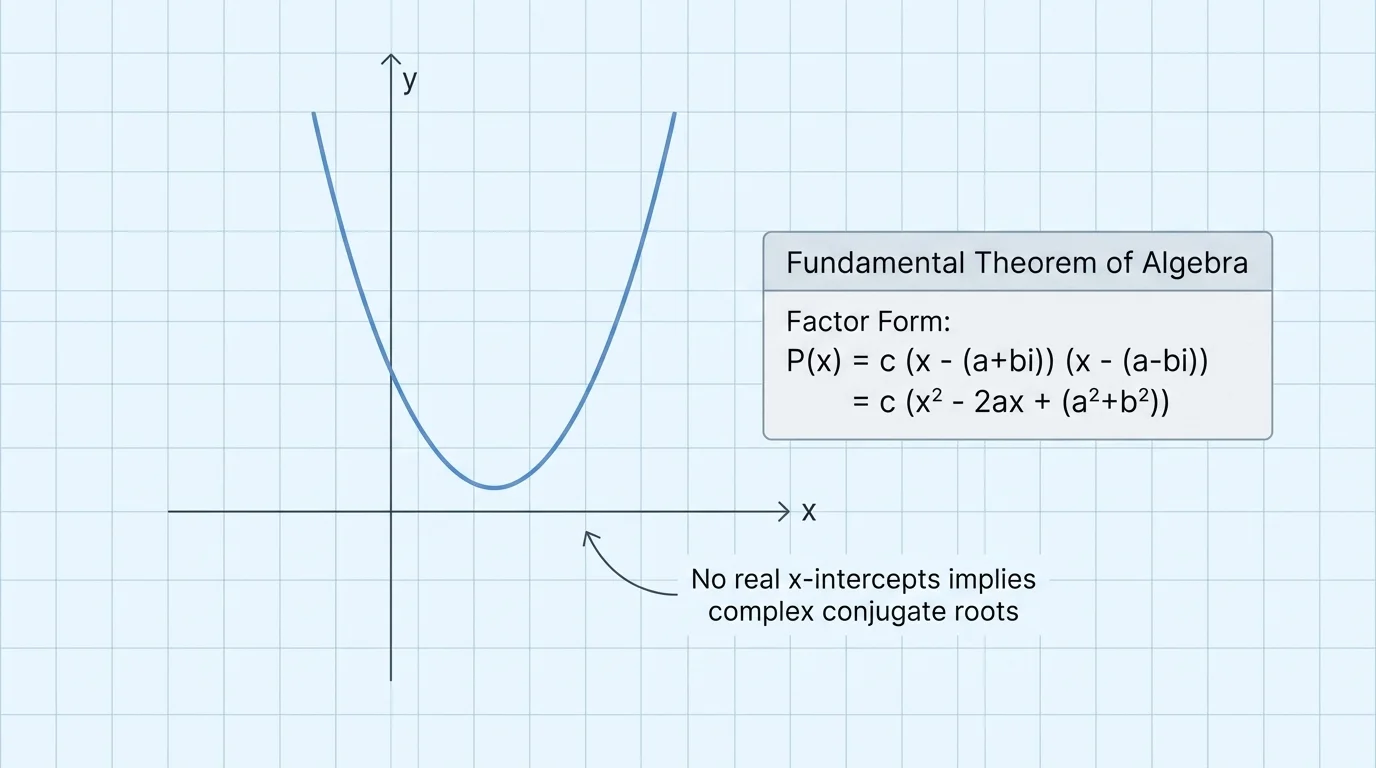
With real coefficients, complex roots come in conjugate pairs, so multiplying the two linear factors gives a polynomial with real coefficients again. That is why a polynomial like \(x^2 + 4x + 13\) can start with real coefficients and still have nonreal roots.
We can also check roots directly by substitution. If \(x = -2 + 3i\), then
\[(-2 + 3i)^2 + 4(-2 + 3i) + 13 = 0\]
When simplified carefully, the real and imaginary parts cancel. This confirms that the complex number really is a root.
A repeated root changes both the factorization and the graph. For \((x-2)^2\), the root \(x = 2\) occurs twice. On a graph, the parabola touches the \(x\)-axis at \(x = 2\) and turns around instead of crossing it. Earlier, [Figure 2] classified this as the discriminant case \(b^2 - 4ac = 0\).
Multiplicity also explains why the theorem gives an exact count. The polynomial \(x^2 - 4x + 4\) does not have two different roots, but it still has two roots counting multiplicity: \(2\) and \(2\).
| Discriminant | Root type | Example | Counting multiplicity |
|---|---|---|---|
| \(b^2 - 4ac > 0\) | Two distinct real roots | \(x^2 - 5x + 6\) | \(2\) roots |
| \(b^2 - 4ac = 0\) | One repeated real root | \(x^2 - 4x + 4\) | \(2\) roots total |
| \(b^2 - 4ac < 0\) | Two nonreal complex roots | \(x^2 + 4x + 13\) | \(2\) roots |
Table 1. The three discriminant cases for quadratics and how each case still gives two roots counting multiplicity.
The same root-counting idea continues in higher-degree polynomials. A cubic can have one real root and two nonreal complex roots, or three real roots, but the total number is always \(3\) counting multiplicity. The quadratic case is the simplest complete model of this bigger pattern.
Complex roots may seem abstract, but they appear in real applications. In electrical engineering, alternating current circuits are often analyzed using complex numbers because oscillations involve sine and cosine behavior that is easier to represent with complex expressions. In physics, solutions to differential equations describing waves and vibrations often lead to polynomials with complex roots.
In signal processing, systems are studied through polynomials whose roots help determine whether signals grow, decay, or oscillate. Even when the final measured quantity is real, the mathematics behind it may use complex numbers as an essential tool. The connection between conjugate roots and real coefficients, which we saw earlier and in [Figure 3], is one reason these models stay physically meaningful.
Engineers often work with complex numbers not because the physical world is "imaginary," but because complex notation makes oscillations and phase changes far easier to calculate accurately.
So the Fundamental Theorem of Algebra is not just a theoretical statement. It guarantees that polynomial models are mathematically complete when handled in the complex number system.
One common mistake is thinking the theorem says every polynomial has only real roots. That is false. For example, \(x^2 + 1\) has no real roots, but it does have the complex roots \(i\) and \(-i\).
Another mistake is forgetting multiplicity. The polynomial \((x-3)^2\) has only one distinct root, but the theorem counts it twice because the factor \((x-3)\) appears twice.
A third misunderstanding is mixing up "at least one root" with "exactly as many roots as the degree." The theorem first guarantees at least one complex root for every nonconstant polynomial. From there, repeated factoring leads to the stronger statement that a degree-\(n\) polynomial has exactly \(n\) complex roots counting multiplicity.
For quadratics with real coefficients, the complete result is immediate from the quadratic formula. As long as \(a \ne 0\), the formula gives roots in the complex numbers.
The big idea is that complex numbers finish the job that real numbers start. Over the reals, some polynomial equations appear incomplete because they seem to have no solutions. Over the complex numbers, polynomial equations behave in a beautifully consistent way.
For quadratics, the theorem is completely visible. The quadratic formula handles every case, and every case leads to complex-number solutions. Whether the roots are two real numbers, one repeated real number, or a conjugate pair of nonreal complex numbers, the total is always \(2\) counting multiplicity.
