[Figure 1] Steel bridges, folding gates, and some mechanical linkages often use one deceptively simple shape: the parallelogram. When engineers want a frame to keep its opposite sides aligned while moving or carrying force, this shape appears again and again. The reason is not just that its sides are parallel. A parallelogram has a set of theorems that make it predictable, and in geometry, predictable shapes are powerful.
A parallelogram is a quadrilateral with both pairs of opposite sides parallel. If quadrilateral ABCD is a parallelogram, then \(AB \parallel CD\) and \(BC \parallel AD\). From that simple definition, many other facts follow. Those facts are not separate definitions. They are theorems, which means they must be proved.
Once the vertices are labeled and a diagonal is drawn, the hidden structure of a parallelogram becomes much easier to see. Parallel lines create equal angle pairs, and that leads directly to congruent triangles, which then unlocks side and angle relationships throughout the figure.
One of the most important habits in geometry is to separate what is given from what must be proved. In a parallelogram proof, you start only with the definition and previously known facts. You cannot assume, for example, that opposite sides are congruent unless you prove it.
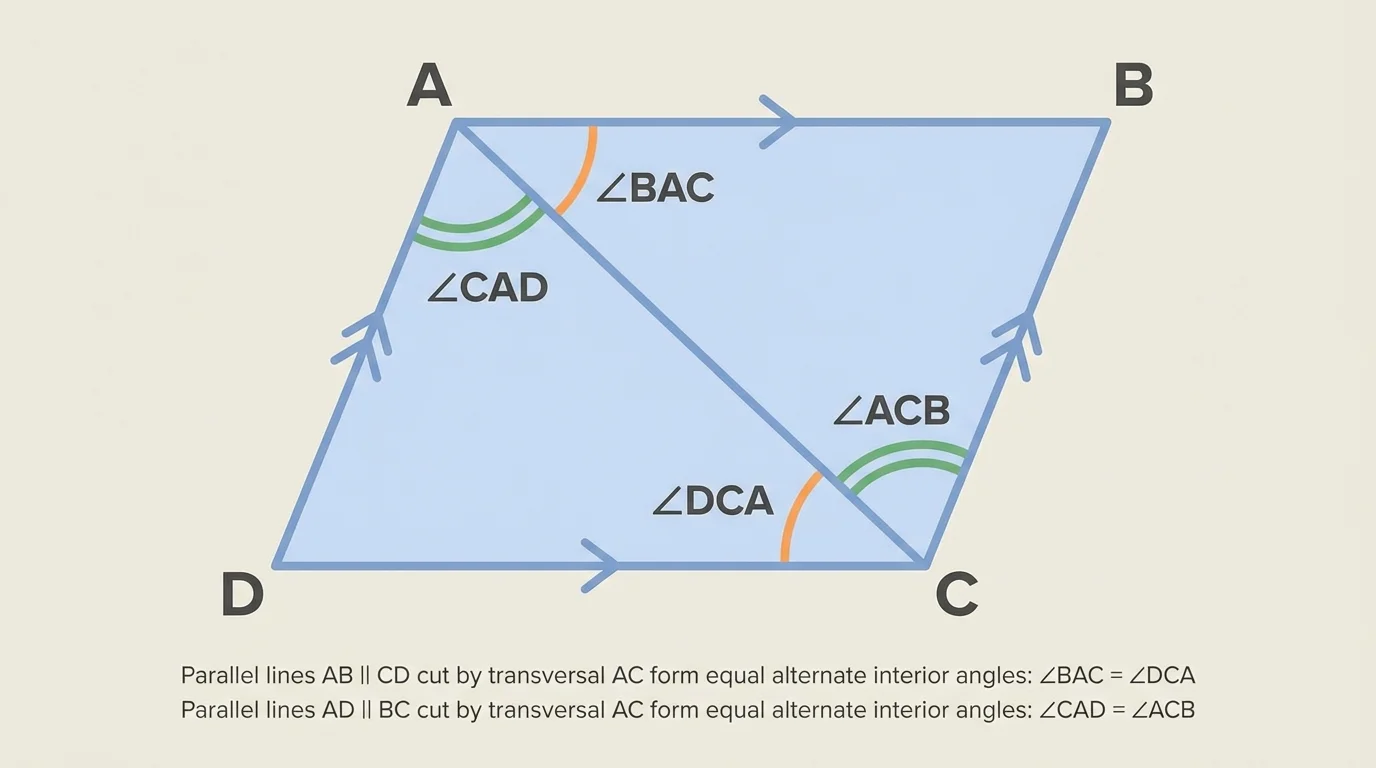
To prove theorems about parallelograms, you need earlier ideas from congruence proofs: alternate interior angles formed by parallel lines, corresponding parts of congruent triangles, and the meaning of supplementary angles. If two angles form a straight line, their measures add to \(180^\circ\).
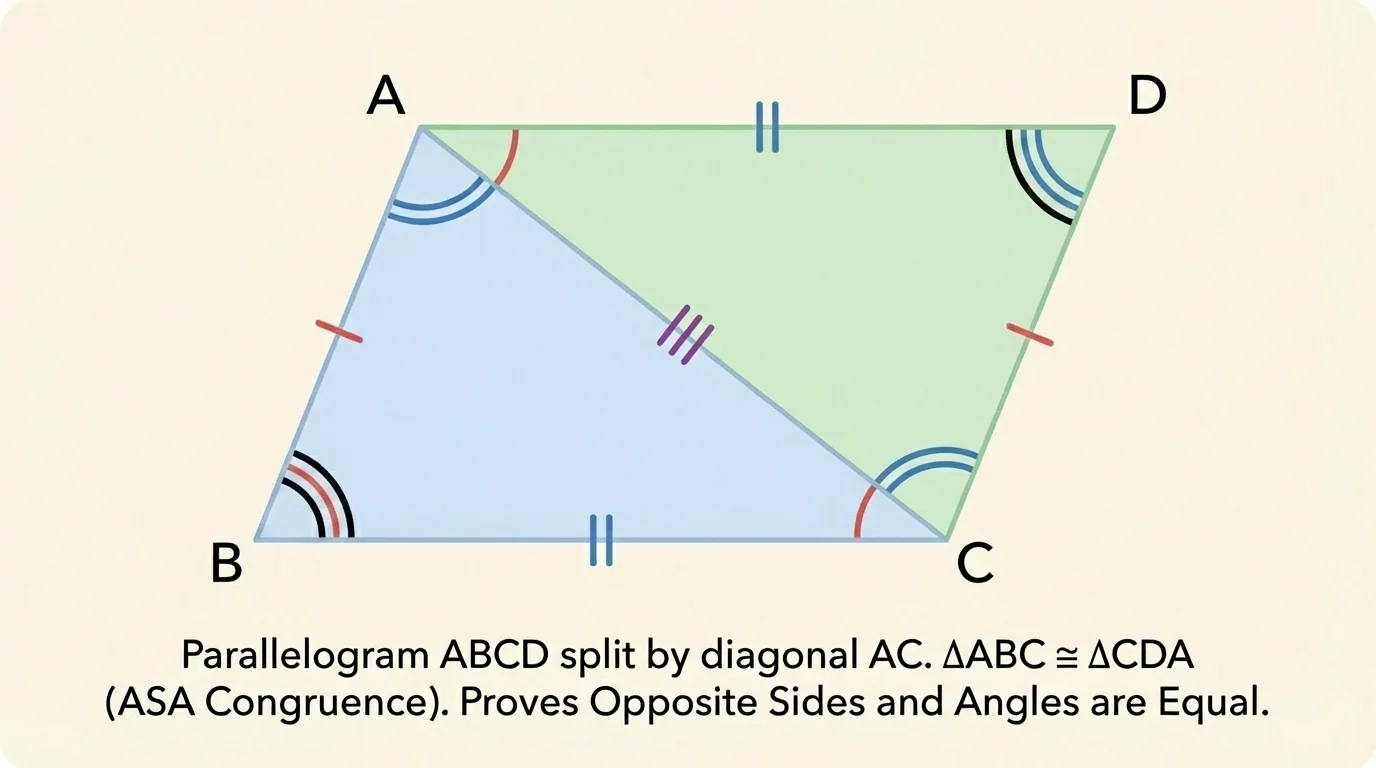
[Figure 2] Because opposite sides are parallel, a diagonal acts like a transversal cutting across two pairs of parallel lines. That is why parallelogram proofs often turn into triangle congruence proofs. Once two triangles are shown congruent, corresponding parts reveal equal sides, equal angles, or bisected diagonals.
Parallelogram is a quadrilateral with both pairs of opposite sides parallel.
Diagonal is a segment joining two nonadjacent vertices of a polygon.
Bisect is to divide into two congruent parts.
Suppose ABCD is a parallelogram. The main theorems you will prove and use are these:
\(AB \cong CD\)
\(BC \cong AD\)
\[\angle A \cong \angle C\]
\[\angle B \cong \angle D\]
\[m\angle A + m\angle B = 180^\circ\]
and if diagonals \(AC\) and \(BD\) intersect at \(M\), then
\[AM = MC \quad \textrm{and} \quad BM = MD\]
These results are connected. In many textbook proofs, you first prove one or two of them using congruent triangles, and then the others follow more quickly.
A diagonal is often the best starting point, because it divides a parallelogram into two triangles. Drawing diagonal \(AC\) in parallelogram ABCD creates triangles \(\triangle ABC\) and \(\triangle CDA\). Since \(AB \parallel CD\), the diagonal gives one pair of alternate interior angles. Since \(BC \parallel AD\), it gives another pair. The diagonal itself is a common side.
That means you can often prove
\[\triangle ABC \cong \triangle CDA\]
by triangle congruence, specifically the \(ASA\) or \(AAS\) criterion depending on how the proof is organized. Once the triangles are congruent, corresponding sides and corresponding angles are congruent.
This is where a proof becomes more than a diagram. Each statement needs a reason: definition of parallelogram, alternate interior angles theorem, reflexive property, triangle congruence, and then corresponding parts of congruent triangles are congruent.
Why a diagonal is so useful
A diagonal turns one quadrilateral into two triangles, and triangles are easier to prove congruent than quadrilaterals. In a parallelogram, the parallel sides create angle pairs, and the shared diagonal provides a matching side. This combination makes the diagonal the bridge from the definition of a parallelogram to its key theorems.
Another frequent proof uses consecutive angles. Because opposite sides are parallel, one side acts as a transversal. For example, if \(AB \parallel CD\), then side \(BC\) acts as a transversal, so the same-side interior angles at \(B\) and \(C\) are supplementary. That is why any two consecutive angles in a parallelogram add to \(180^\circ\).
Opposite sides are congruent. If ABCD is a parallelogram, then \(AB \cong CD\) and \(BC \cong AD\). A diagonal proof shows this directly.
Opposite angles are congruent. Since consecutive angles are supplementary, and each angle supplements the one next to it, opposite angles end up with equal measure. You can also prove this through congruent triangles.
Consecutive angles are supplementary. For example, \(m\angle A + m\angle B = 180^\circ\). This comes from parallel-line angle relationships, not from triangle congruence.
Diagonals bisect each other. If diagonals intersect at \(M\), then \(AM = MC\) and \(BM = MD\). This is another theorem usually proved by creating congruent triangles around the intersection point.
Parallelogram linkages appear in desk lamps, pantographs, and some bicycle suspension systems. Their geometry helps keep parts moving in controlled, nearly parallel ways.
These theorems are powerful because they work in reverse too. Several converse statements let you prove that a quadrilateral is a parallelogram. For example, if both pairs of opposite sides are congruent, or if diagonals bisect each other, that quadrilateral must be a parallelogram.
Let ABCD be a parallelogram. Prove that \(AB \cong CD\).
Worked example
Step 1: State the parallel sides.
Because ABCD is a parallelogram, \(AB \parallel CD\) and \(BC \parallel AD\).
Step 2: Draw diagonal \(AC\) and identify angle pairs.
Since \(AB \parallel CD\), \(\angle BAC \cong \angle DCA\) by alternate interior angles.
Since \(BC \parallel AD\), \(\angle BCA \cong \angle DAC\) by alternate interior angles.
Step 3: Use the shared side.
Segment \(AC\) is common to both triangles, so \(AC \cong AC\) by the reflexive property.
Step 4: Prove the triangles congruent.
Therefore, \(\triangle BAC \cong \triangle DCA\) by \(ASA\).
Step 5: Use corresponding parts.
Corresponding sides of congruent triangles are congruent, so \(AB \cong CD\).
The same proof structure also gives \(BC \cong AD\).
This example is a model for many geometric proofs: start with the definition, create triangles, show the triangles are congruent, and then conclude the desired parts are equal. Notice that nothing was assumed beyond the definition and previously known angle facts.
Suppose EFGH is a parallelogram and \(m\angle E = 3x + 20\), while \(m\angle F = 5x - 10\). Find all four angle measures.
Worked example
Step 1: Use the theorem about consecutive angles.
In a parallelogram, consecutive angles are supplementary, so
\[(3x + 20) + (5x - 10) = 180\]
Step 2: Solve for \(x\).
Combine like terms: \(8x + 10 = 180\).
Then \(8x = 170\), so \(x = 21.25\).
Step 3: Find the two consecutive angles.
\(m\angle E = 3(21.25) + 20 = 83.75^\circ\)
\(m\angle F = 5(21.25) - 10 = 96.25^\circ\)
Step 4: Use opposite angles.
Opposite angles in a parallelogram are congruent, so
\[m\angle G = 83.75^\circ \quad \textrm{and} \quad m\angle H = 96.25^\circ\]
The four angles are \(83.75^\circ\), \(96.25^\circ\), \(83.75^\circ\), and \(96.25^\circ\).
This example shows how proof-based theorems become problem-solving tools. Once the theorem is established, algebra lets you use it efficiently.
[Figure 3] One of the most useful parallelogram theorems says that the diagonals bisect each other. If diagonals \(WY\) and \(XZ\) intersect at \(M\) in parallelogram WXYZ, then \(WM = MY\) and \(XM = MZ\). The midpoint relationship is clear because each diagonal is split into two congruent segments.
A proof of this theorem again relies on congruent triangles. You compare triangles formed by the intersecting diagonals and use the fact that opposite sides are parallel. This theorem is especially useful because it allows geometric relationships to be represented algebraically: equal halves of a diagonal can be written as expressions and solved.
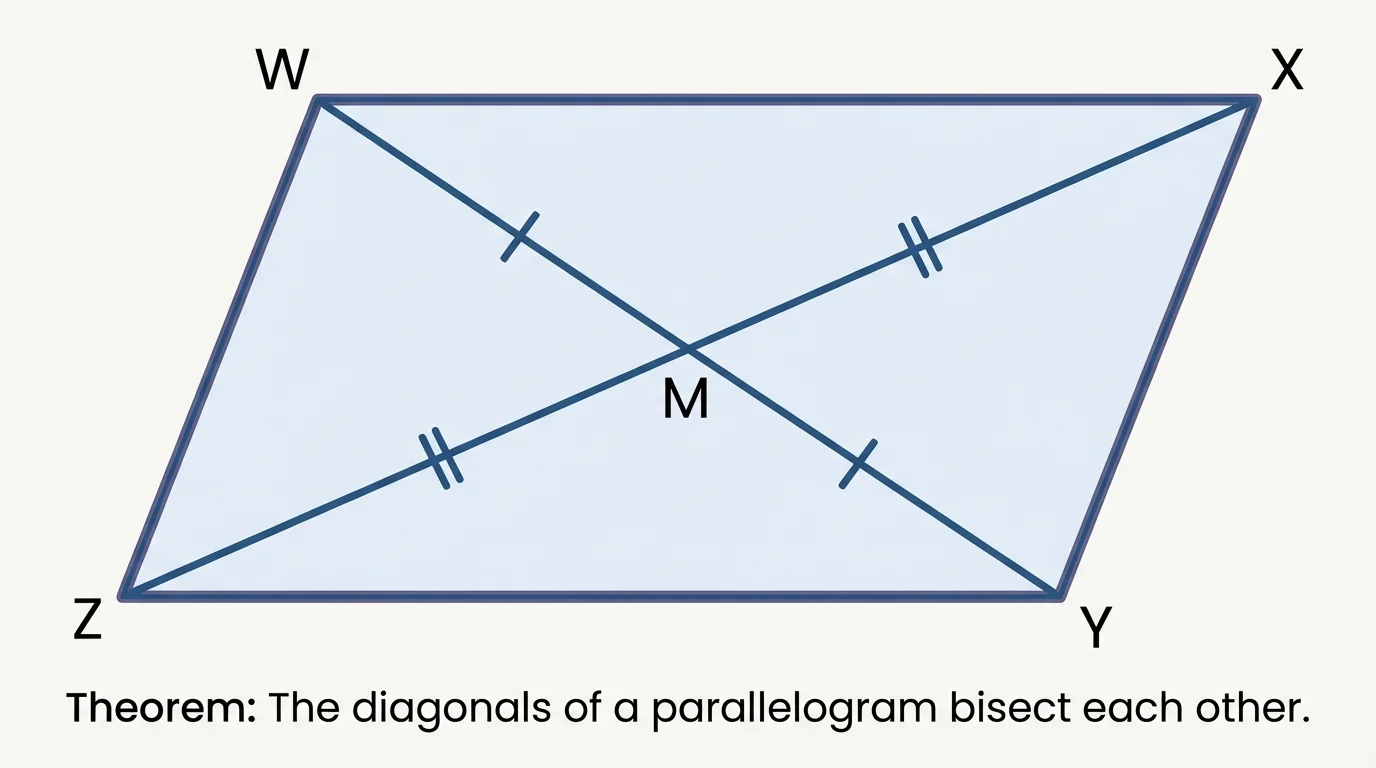
In parallelogram WXYZ, diagonals \(WY\) and \(XZ\) intersect at \(M\). Suppose \(WM = 2x + 1\) and \(MY = 5x - 11\). Find \(WM\), \(MY\), and \(WY\).
Worked example
Step 1: Use the diagonal theorem.
Because diagonals of a parallelogram bisect each other, \(WM = MY\).
Step 2: Write and solve the equation.
Set the expressions equal: \(2x + 1 = 5x - 11\).
Subtract \(2x\): \(1 = 3x - 11\).
Add \(11\): \(12 = 3x\).
So \(x = 4\).
Step 3: Find each half.
\(WM = 2(4) + 1 = 9\)
\(MY = 5(4) - 11 = 9\)
Step 4: Find the whole diagonal.
\[WY = WM + MY = 9 + 9 = 18\]
The lengths are \(WM = 9\), \(MY = 9\), and \(WY = 18\).
Later, when you study coordinate geometry, this same idea connects to midpoints. The intersection of the diagonals of a parallelogram is the midpoint of each diagonal, as shown earlier.
A converse theorem reverses a statement. These are especially important in geometry because they let you classify a quadrilateral as a parallelogram. Several common converses are listed below.
| Condition in a quadrilateral | Conclusion |
|---|---|
| Both pairs of opposite sides are parallel | The quadrilateral is a parallelogram |
| Both pairs of opposite sides are congruent | The quadrilateral is a parallelogram |
| Both pairs of opposite angles are congruent | The quadrilateral is a parallelogram |
| One pair of opposite sides is both parallel and congruent | The quadrilateral is a parallelogram |
| Diagonals bisect each other | The quadrilateral is a parallelogram |
Table 1. Common conditions that are sufficient to prove a quadrilateral is a parallelogram.
These converse theorems matter because geometry often asks not only what is true inside a parallelogram, but also how to recognize when a shape must be one. For example, if a quadrilateral has diagonals that bisect each other, you can conclude it is a parallelogram even before checking side lengths.
Special types of parallelograms include rectangles, rhombi, and squares. A rectangle is a parallelogram with four right angles. A rhombus is a parallelogram with four congruent sides. A square is both a rectangle and a rhombus. These shapes inherit every theorem of parallelograms and add more of their own.
Inherited properties
Every rectangle, rhombus, and square is a parallelogram, so opposite sides are parallel and congruent, opposite angles are congruent, consecutive angles are supplementary, and diagonals bisect each other. Extra properties come on top of those, not instead of them.
This idea of inheritance is important in proofs. If a figure is a square, you are allowed to use parallelogram theorems because a square belongs to that larger family of shapes.
Parallelogram theorems are not just classroom facts. In structural engineering, frames often use parallel members because equal opposite sides and predictable diagonal behavior help distribute forces. In computer graphics, a slanted rectangle on a screen is often modeled as a parallelogram, and knowing how diagonals meet helps with transformations and object positioning.
In manufacturing and design, tiled surfaces, folding supports, and articulated arms frequently rely on quadrilaterals that stay parallel during motion. If a design requires parts to remain aligned, proving that a mechanism is a parallelogram gives a mathematical guarantee of how it behaves.
Real-world application example
A drafting tool called a pantograph uses linked bars arranged in parallelograms. Because opposite sides remain parallel, a tracing point and a drawing point move in controlled ways. The geometry helps copy or scale drawings while preserving shape relationships.
The same logic appears in robotic arms and lifting platforms. When engineers analyze whether a motion stays level, they often rely on the parallel structure and congruent opposite sides of a parallelogram mechanism.
When proving a theorem about a parallelogram, begin by writing the definition clearly. Then decide whether a diagonal will create useful triangles. If your goal involves sides or opposite angles, triangle congruence is often the best path. If your goal involves consecutive angles, use same-side interior angles and supplementary relationships.
A common mistake is to use a property before proving it. For example, if the task is to prove opposite sides are congruent, you cannot start by saying \(AB = CD\). Another mistake is forgetting to justify angle congruence with the correct parallel-line theorem.
Good proofs are precise. A statement like "these triangles look the same" is not a reason. A valid reason would be alternate interior angles, reflexive property, or corresponding parts of congruent triangles. Geometry rewards careful logic.
"A proof tells not only that something is true, but why it must be true."
That idea is exactly why parallelograms are such a rich topic. From one definition, an entire chain of reliable theorems emerges, and each theorem supports the next.
