A bridge truss, a roof frame, and a satellite support arm may look completely different, but they all rely on the same basic fact: triangles maintain their shape. That is why geometry cares so much about proving statements about triangles. A diagram can suggest that two angles look equal or that one side seems longer, but mathematics demands more than appearance. A result is powerful because it tells us something must be true, not just that it seems true in one sketch.
When you prove a triangle theorem, you build a chain of logic from known facts to a conclusion. In geometry, this means using definitions, angle relationships, congruence criteria, and previously proved theorems. The goal is not only to get the right answer, but also to understand why the answer must be true for every triangle that fits the conditions.
Triangles are especially important because many other polygons can be divided into triangles. If you understand how to prove facts about triangles, you gain tools for reasoning about larger geometric figures, coordinate geometry, and even design problems in the real world.
You already know several facts that support triangle proofs: vertical angles are congruent, a linear pair is supplementary, and the angles in a triangle add to \(180^\circ\).
Those facts act like building materials. A proof often begins with given information such as "\(AB \cong AC\)" or "\(\angle 1\) is an exterior angle," and then combines basic angle facts with triangle congruence or definitions.
In triangle theorems, one of the most useful ideas is congruence. If two triangles are congruent, then all corresponding sides and angles are congruent. This is often written as CPCTC, which means corresponding parts of congruent triangles are congruent.
Another important idea is an auxiliary line, which is a segment or ray added to a diagram to make hidden relationships easier to prove. Many triangle proofs become manageable only after drawing a helpful segment.
A theorem about triangles is a statement about triangles that has been proved true using definitions, postulates, and previously established results. Common examples include the isosceles triangle theorem, its converse, the exterior angle theorem, and side-angle inequality theorems.
Careful proof writing also depends on using precise language. If you know two sides are congruent, say exactly which sides. If an angle is supplementary to another angle, state the angle pair clearly. In geometry, details matter because each statement needs a reason.
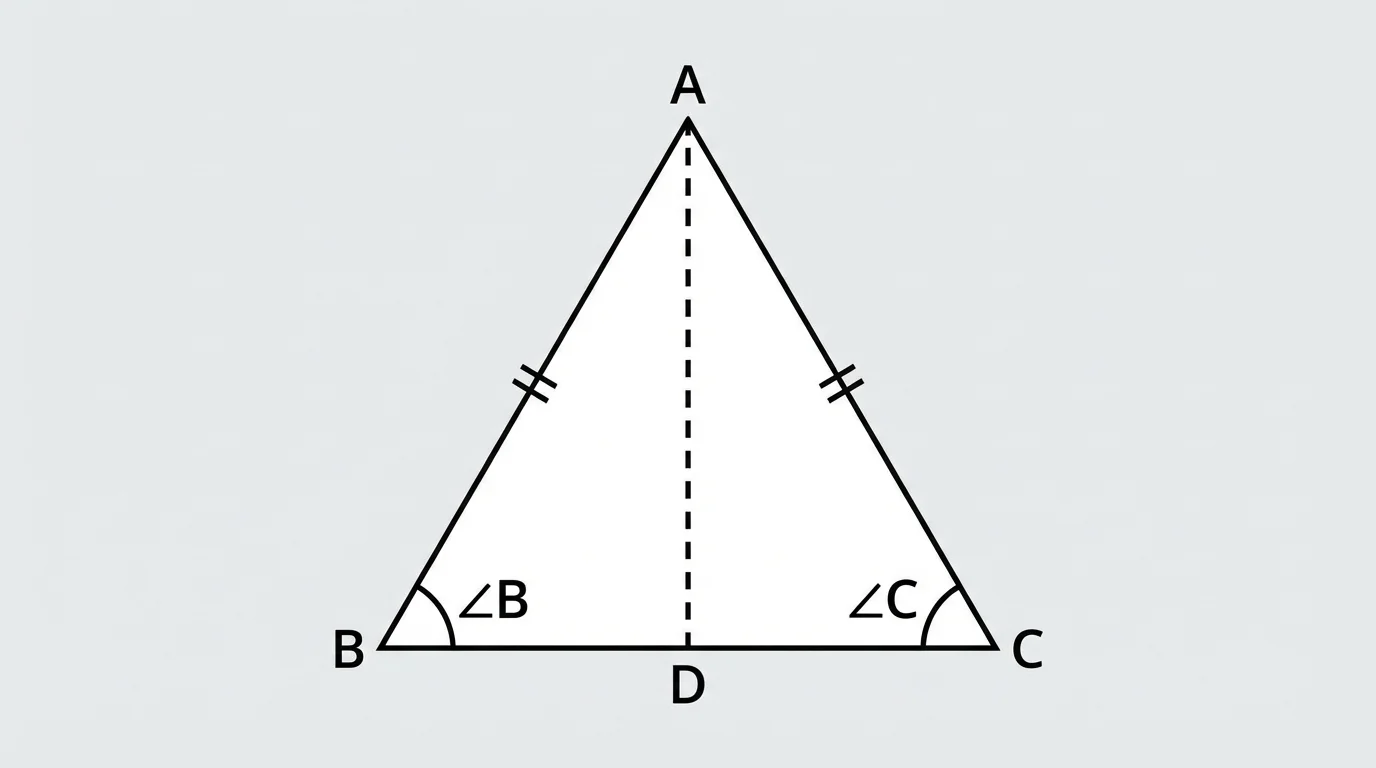
The Isosceles Triangle Theorem says that if two sides of a triangle are congruent, then the angles opposite those sides are congruent. In triangle \(ABC\), if \(AB \cong AC\), then \(\angle B \cong \angle C\). As [Figure 1] shows, a common strategy is to draw an auxiliary segment from the vertex angle to the base so that the original triangle is split into two smaller triangles that can be compared.
The converse is just as important: if two angles of a triangle are congruent, then the sides opposite those angles are congruent. In triangle \(ABC\), if \(\angle B \cong \angle C\), then \(AB \cong AC\). This theorem lets you move from information about angles to information about sides.
These two results are easy to confuse, but they point in opposite directions. One begins with equal sides and concludes equal angles. The other begins with equal angles and concludes equal sides.
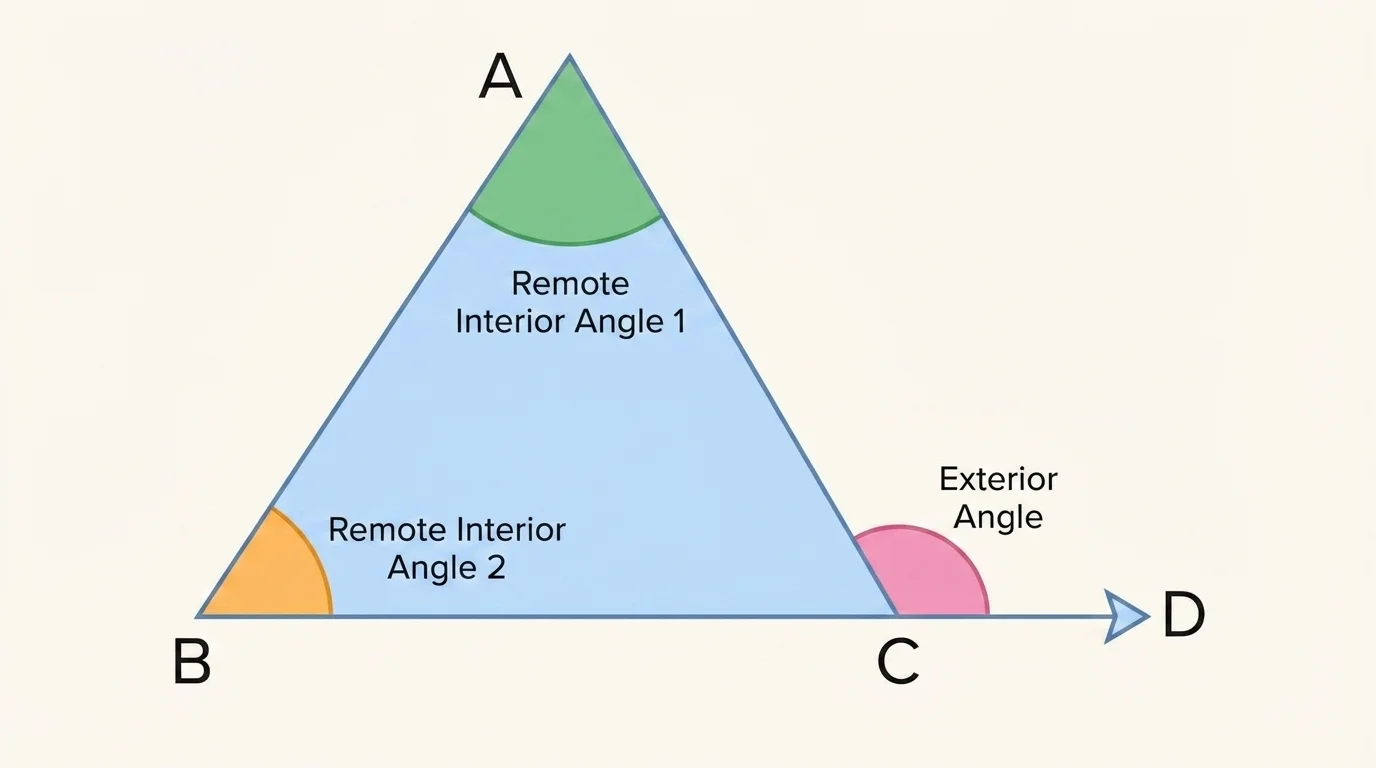
The Exterior Angle Theorem states that the measure of an exterior angle of a triangle equals the sum of the measures of the two remote interior angles. If side \(BC\) of triangle \(ABC\) is extended to point \(D\), then the exterior angle \(\angle ACD\) satisfies \(m\angle ACD = m\angle A + m\angle B\). As [Figure 2] shows, this relationship appears constantly in proofs because it connects an outside angle to two inside angles at once.
The remote interior angles are the two interior angles that are not adjacent to the exterior angle. That idea matters because students sometimes mistakenly include the adjacent interior angle instead.
Another major group of theorems connects side lengths and angle measures. In any triangle, the larger angle lies opposite the longer side, and the longer side lies opposite the larger angle. So if in triangle \(ABC\), \(AB > AC\), then \(\angle C > \angle B\). Conversely, if \(\angle A > \angle B\), then the side opposite \(\angle A\), which is \(BC\), must be longer than the side opposite \(\angle B\), which is \(AC\).
These inequality theorems are useful because they let you reason about a triangle even when exact side lengths or angle measures are not given. They are especially valuable in proof problems that ask which side is longest or which angle is greatest.
Modern engineers still rely on triangle reasoning because a triangle is the simplest polygon that is naturally rigid. A four-sided frame can bend without a brace, but a triangle keeps its shape unless a side changes length.
Later, when comparing special segments, we will return to the same structure from [Figure 1], where one extra segment creates two triangles whose relationships reveal the theorem.
A strong proof usually follows a pattern. Start with the given information. Then identify a useful intermediate goal, such as proving two triangles congruent or showing two angles form a linear pair. Finally, use those facts to reach the conclusion.
In many cases, the hidden key is not the final statement but the step before it. For example, if you want to prove two angles are congruent, you might first prove two triangles congruent. If you want to prove a side relationship, you may first need the converse of a known theorem.
Proof strategy in triangle geometry often means asking, "What theorem would let me conclude what I want?" If the goal is angle congruence, congruent triangles or isosceles structure may help. If the goal is a side comparison, ask which angle lies opposite each side. If the goal involves an outside angle, check whether the exterior angle theorem connects the pieces immediately.
Geometry proofs may be written as paragraphs, two-column proofs, or flow arguments. The format can vary, but the logic cannot. Every statement must follow from a definition, a postulate, a theorem, or given information.
Prove that in isosceles triangle \(ABC\), if \(AB \cong AC\), then \(\angle B \cong \angle C\).
Worked proof using congruent triangles
Step 1: Add a helpful segment.
Draw segment \(AD\) from vertex \(A\) to point \(D\) on base \(BC\) so that \(D\) is the midpoint of \(BC\). Then \(BD \cong DC\).
Step 2: Compare triangles \(ABD\) and \(ACD\).
We know \(AB \cong AC\) from the given, \(BD \cong DC\) by construction, and \(AD \cong AD\) by the reflexive property.
Step 3: Use a congruence theorem.
Since the three pairs of corresponding sides are congruent, \(\triangle ABD \cong \triangle ACD\) by \(SSS\).
Step 4: Conclude the angle relationship.
By corresponding parts of congruent triangles, \(\angle B \cong \angle C\).
The base angles of an isosceles triangle are congruent.
This proof shows why an auxiliary line can be so powerful. The original triangle alone does not immediately reveal two congruent smaller triangles, but the added segment creates a structure that can be proved step by step.
In triangle \(PQR\), side \(QR\) is extended through \(R\) to point \(S\). If \(m\angle P = 52^\circ\) and \(m\angle Q = 61^\circ\), find \(m\angle PRS\) and justify the result.
Using the exterior angle theorem
Step 1: Identify the exterior angle.
\(\angle PRS\) is the exterior angle at vertex \(R\).
Step 2: Identify the remote interior angles.
The remote interior angles are \(\angle P\) and \(\angle Q\).
Step 3: Apply the theorem.
By the exterior angle theorem, \(m\angle PRS = m\angle P + m\angle Q\).
Step 4: Substitute the values.
\(m\angle PRS = 52^\circ + 61^\circ = 113^\circ\).
The exterior angle measure is \[m\angle PRS = 113^\circ\]
Notice that this method is faster than first finding the third interior angle and then using a supplementary relationship, although that method would also work. The theorem combines both steps into one result.
The layout in [Figure 2] helps make sense of why the exterior angle is larger than either remote interior angle alone: it combines both of them.
In triangle \(XYZ\), suppose \(XY = 10\), \(XZ = 13\), and \(YZ = 15\). Determine which angle is greatest and explain why.
Using side-angle inequality
Step 1: Identify the longest side.
The sides have lengths \(10\), \(13\), and \(15\). The longest side is \(YZ = 15\).
Step 2: Find the angle opposite the longest side.
Side \(YZ\) lies opposite \(\angle X\).
Step 3: Apply the theorem.
In a triangle, the longest side lies opposite the largest angle. Therefore, \(\angle X\) is the greatest angle.
The conclusion is that \(\angle X\) is the greatest angle.
A proof-style version of the same reasoning would say: since \(YZ > XZ > XY\), the opposite angles satisfy \(\angle X > \angle Y > \angle Z\).
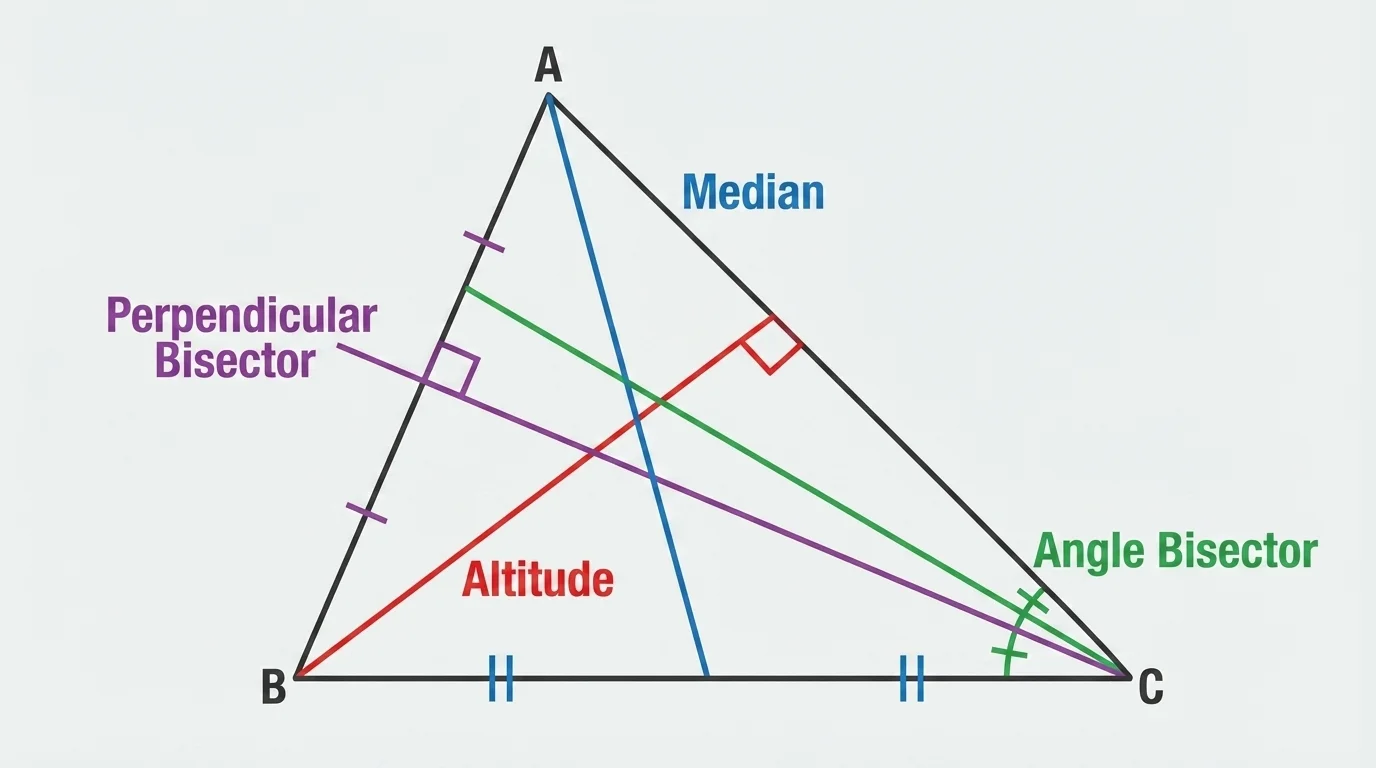
Many theorem proofs use special segments. A median connects a vertex to the midpoint of the opposite side. An altitude goes from a vertex and is perpendicular to the opposite side. An angle bisector divides an angle into two congruent angles. A perpendicular bisector is perpendicular to a segment at its midpoint.
As [Figure 3] suggests, these segments appear in proofs because they create equal lengths, right angles, or pairs of congruent angles. For example, if a point lies on the perpendicular bisector of a segment, then it is equidistant from the segment's endpoints. That fact often helps prove triangles congruent.
In an isosceles triangle, the segment drawn from the vertex angle to the base often turns out to have multiple roles. Depending on the theorem being proved, it may be shown to be a median, an altitude, an angle bisector, or more than one of these at the same time. This is one reason isosceles triangles are so rich in geometric structure.
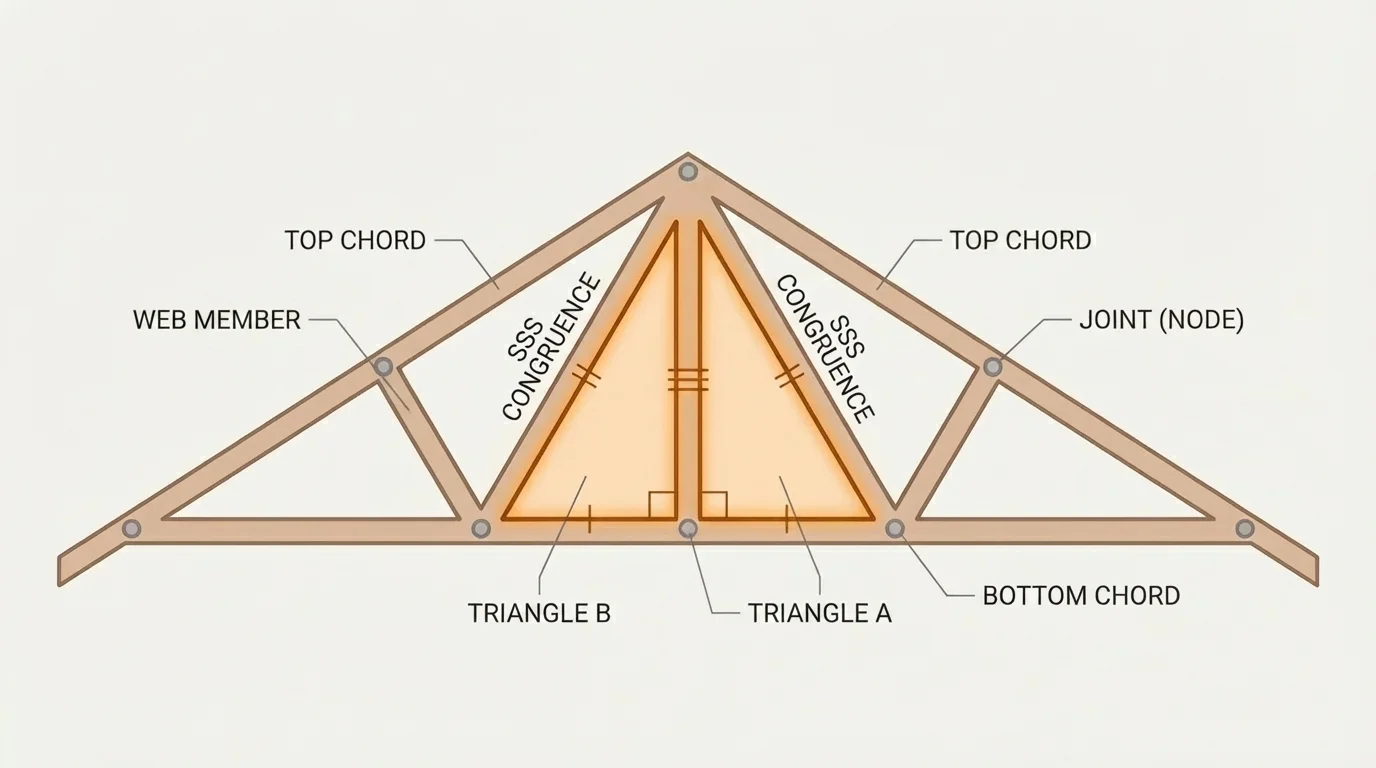
Returning to [Figure 1], the auxiliary segment from the top vertex is not just a random line. In many proofs, it becomes the key to revealing symmetry inside the triangle. A similar structural idea appears in roof trusses, as [Figure 4] shows.
Architects and engineers use triangular frameworks because they are stable under load. If two support beams are designed to be equal, then corresponding angles can be predicted using isosceles triangle reasoning. That helps determine how forces travel through the structure.
Surveyors also use triangle theorems. If two measured angles in a triangular plot are known, the third can be found using the triangle sum theorem, and an exterior angle can be checked using the exterior angle theorem. This matters when land boundaries, roads, or construction layouts must be accurate.
Computer graphics uses triangles too. Complex three-dimensional surfaces are often built from many tiny triangles. The reason is practical: triangles are predictable. Once the side lengths and angle relationships are fixed, the shape is determined. That reliability is exactly what geometric proof captures.
Why proof matters beyond the classroom is simple: a sketch can mislead, but a theorem guarantees. Whether a designer models a bridge, a robot arm, or a digital object, the underlying geometry must work in every valid case, not just in one drawing.
The same logic applies to physical structures everywhere: triangle relationships make designs more reliable because the geometry is constrained and provable.
One common mistake is assuming that a diagram is perfectly drawn. A triangle may look isosceles without any given statement saying so. In proof, appearance never replaces logic.
Another mistake is confusing a theorem with its converse. The statement "if two sides are congruent, then the opposite angles are congruent" is not the same as "if two angles are congruent, then the opposite sides are congruent," even though both happen to be true in this case. In geometry, the converse of a true theorem must be proved separately.
A third mistake is skipping reasons. Writing a sequence of true statements is not enough. The force of a proof comes from justifying each step. If you say two triangles are congruent, you must identify whether it is because of \(SSS\), \(SAS\), \(ASA\), \(AAS\), or \(HL\) in the case of right triangles.
Finally, when working with side-angle inequality, be careful about opposites. The longest side is opposite the largest angle, and the shortest side is opposite the smallest angle. Mixing up adjacent and opposite parts is one of the easiest ways to lose the logic of the argument.
"Geometry is not true because we draw good pictures; it is true because the logic holds for every picture that matches the conditions."
Proving theorems about triangles trains you to move from observation to certainty. That habit of reasoning is one of the most valuable ideas in all of mathematics.
