A single point and a single line can determine an entire curve. That may sound strange at first, but it is exactly what happens with a parabola: give its focus and directrix, and the whole graph is forced into shape. This is one of the most elegant connections in coordinate geometry, because a simple distance rule turns directly into an equation.
Parabolas appear in car headlights, satellite dishes, radio telescopes, and microphones. In each case, the shape matters because of a precise geometric property. To understand that property fully, we need to move back and forth between geometry and algebra: from a description in words to an equation in symbols.
In analytic geometry, a graph is not just a picture; it is the visible result of an equation. A parabola is especially important because it can be described in two very different but connected ways. Geometrically, it is defined using distances. Algebraically, it is written in a standard equation form. Deriving the equation from a focus and directrix shows how those two viewpoints fit together.
You should already be comfortable with the distance formula, midpoint ideas, and graphing points on the coordinate plane. The key fact we will use repeatedly is that the distance between \( (x_1,y_1) \) and \( (x_2,y_2) \) is \(\sqrt{(x_2-x_1)^2+(y_2-y_1)^2}\).
Once you understand this derivation, standard forms such as \(x^2 = 4py\) and \((x-h)^2 = 4p(y-k)\) stop looking like formulas to memorize and start looking like natural results of geometry.
A parabola is the set of all points in a plane that are the same distance from a fixed point and a fixed line. That fixed point is called the focus, and the fixed line is called the directrix. This equal-distance idea is the heart of the entire topic.
The point halfway between the focus and the directrix, measured along the perpendicular line connecting them, is the vertex of the parabola. The line through the focus and vertex, perpendicular to the directrix, is the axis of symmetry. Every parabola is symmetric across this axis.
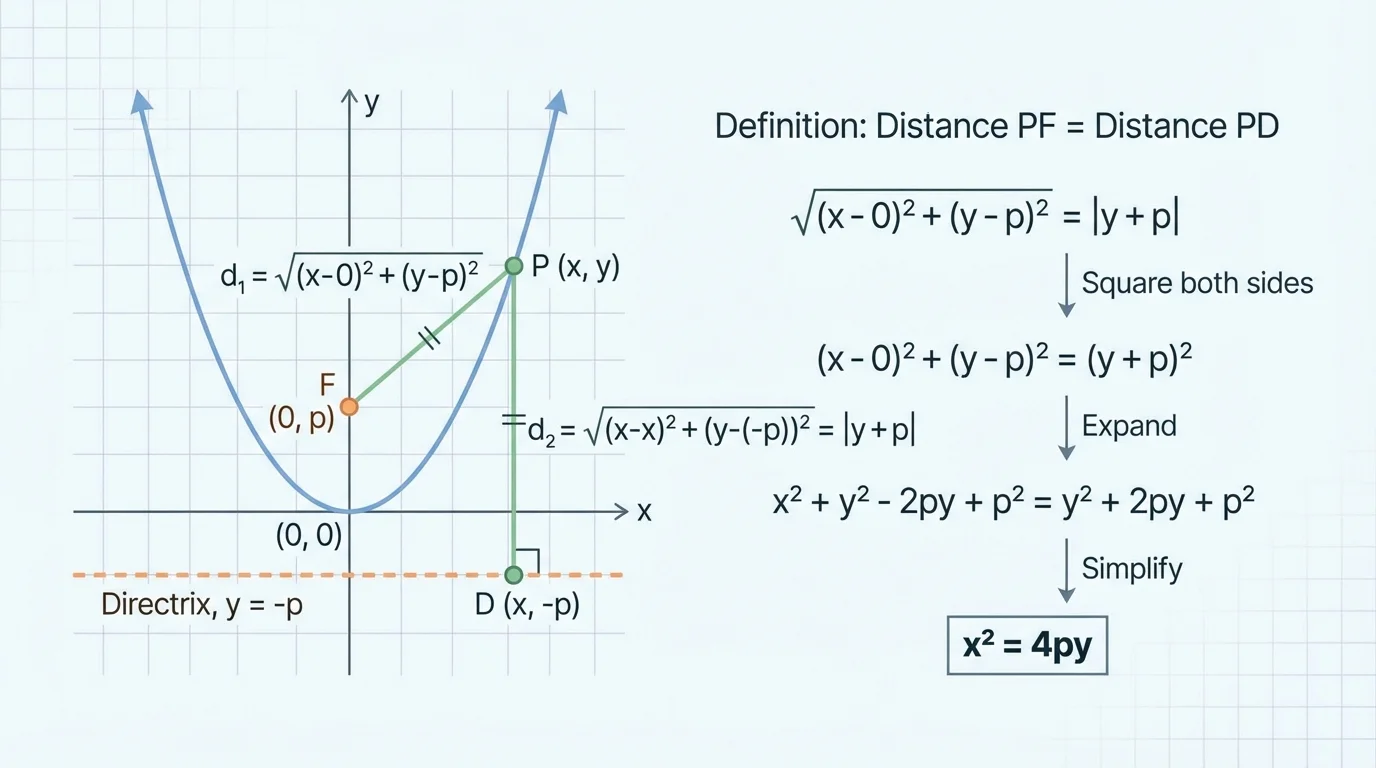
If the directrix is horizontal, then the axis of symmetry is vertical, so the parabola opens either up or down. If the directrix is vertical, then the axis of symmetry is horizontal, so the parabola opens either left or right.
Focus is the fixed point used in the definition of a parabola.
Directrix is the fixed line used in the definition of a parabola.
Vertex is the point on the parabola halfway between the focus and directrix along the axis of symmetry.
Axis of symmetry is the line that passes through the vertex and focus and splits the parabola into mirror-image halves.
[Figure 1] The amazing part is that the equation comes from setting two distances equal: distance from a general point on the curve to the focus, and distance from that same point to the directrix.
[Figure 2] Start with the simplest case. Suppose the vertex is at the origin \( (0,0) \), the parabola opens upward, the focus is \( (0,p) \), and the directrix is \( y=-p \), where \(p>0\). A general point on the parabola is \( (x,y) \). Using the distance rule, we can equate the distance to the focus and the distance to the directrix.
The distance from \( (x,y) \) to the focus \( (0,p) \) is \(\sqrt{x^2+(y-p)^2}\). The distance from \( (x,y) \) to the directrix \( y=-p \) is \( |y-(-p)|=|y+p| \). For points on this upward-opening parabola, \(y\) is at or above the directrix, so we can work with \(y+p\) as the distance.
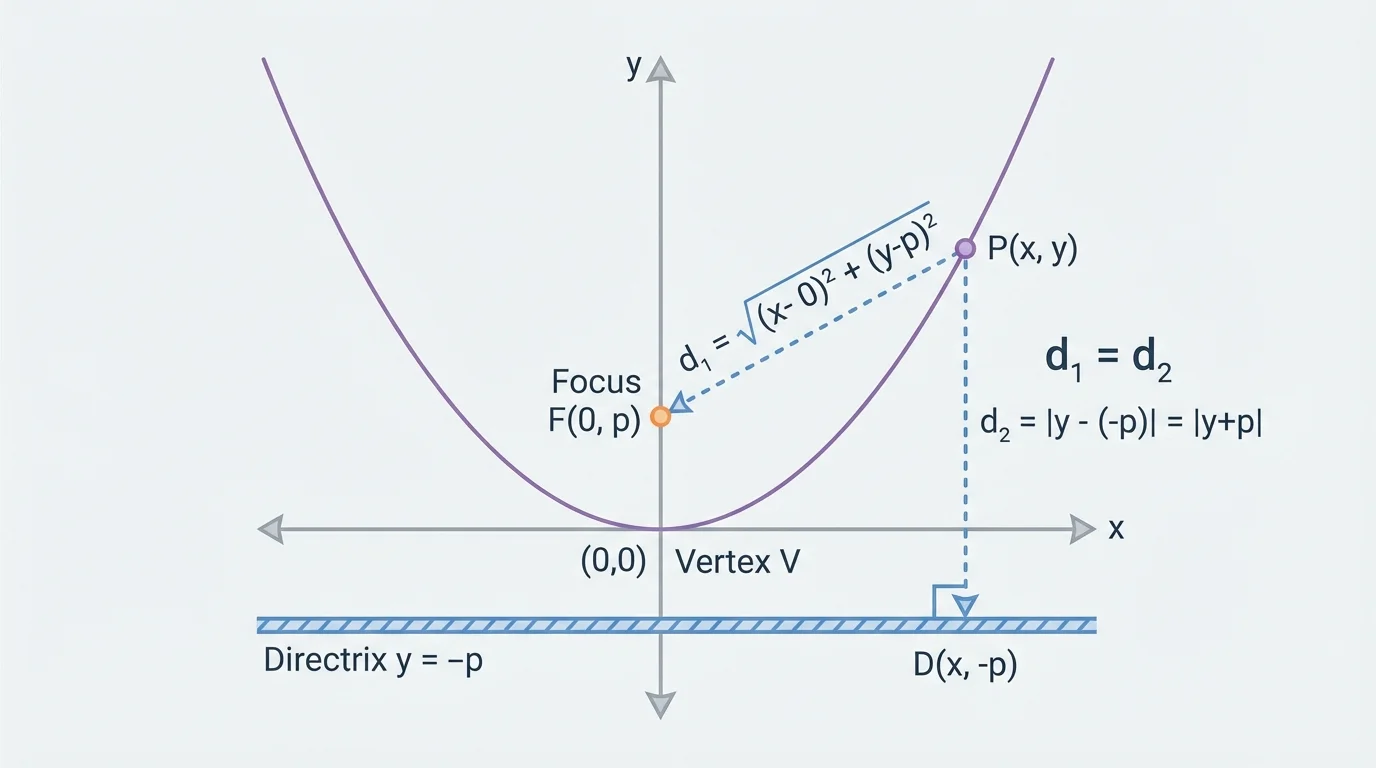
Set the two distances equal:
\[\sqrt{x^2+(y-p)^2}=y+p\]
Now square both sides:
\[x^2+(y-p)^2=(y+p)^2\]
Expand each side:
\[x^2+y^2-2py+p^2=y^2+2py+p^2\]
Subtract \(y^2\) and \(p^2\) from both sides:
\(x^2-2py=2py\)
So:
\(x^2=4py\)
This is the standard form of a vertical parabola with vertex at the origin.
If the focus is \( (0,-p) \) and the directrix is \( y=p \), the parabola opens downward. The same distance process leads to
\(x^2=-4py\)
where here \(p>0\) still represents the distance from the vertex to the focus.
Now consider a horizontal parabola with vertex at the origin. If the focus is \( (p,0) \) and the directrix is \( x=-p \), then a general point \( (x,y) \) satisfies
\[\sqrt{(x-p)^2+y^2}=x+p\]
Squaring and simplifying gives
\(y^2=4px\)
If the focus is \( (-p,0) \) and the directrix is \( x=p \), then the parabola opens left and the equation is
\(y^2=-4px\)
The number \(p\) measures the directed distance from the vertex to the focus along the axis of symmetry. Many textbooks take \(p>0\) and then use the sign in the equation to indicate direction. That leads to these four common forms:
| Opening direction | Focus | Directrix | Equation |
|---|---|---|---|
| Up | \( (0,p) \) | \( y=-p \) | \( x^2=4py \) |
| Down | \( (0,-p) \) | \( y=p \) | \( x^2=-4py \) |
| Right | \( (p,0) \) | \( x=-p \) | \( y^2=4px \) |
| Left | \( (-p,0) \) | \( x=p \) | \( y^2=-4px \) |
Table 1. Standard parabola forms for a vertex at the origin.
A quick way to remember the orientation is this: if \(x\) is squared, the parabola is vertical. If \(y\) is squared, the parabola is horizontal. The unsquared variable tells the direction of opening.
Parabolic reflectors work because rays parallel to the axis reflect through the focus. That geometric property is why satellite dishes and flashlights use parabolic shapes rather than random curves.
That same focus-directrix structure appears in the equations we derive. Even when the graph is shifted, the underlying geometry stays the same, just moved to a new location.
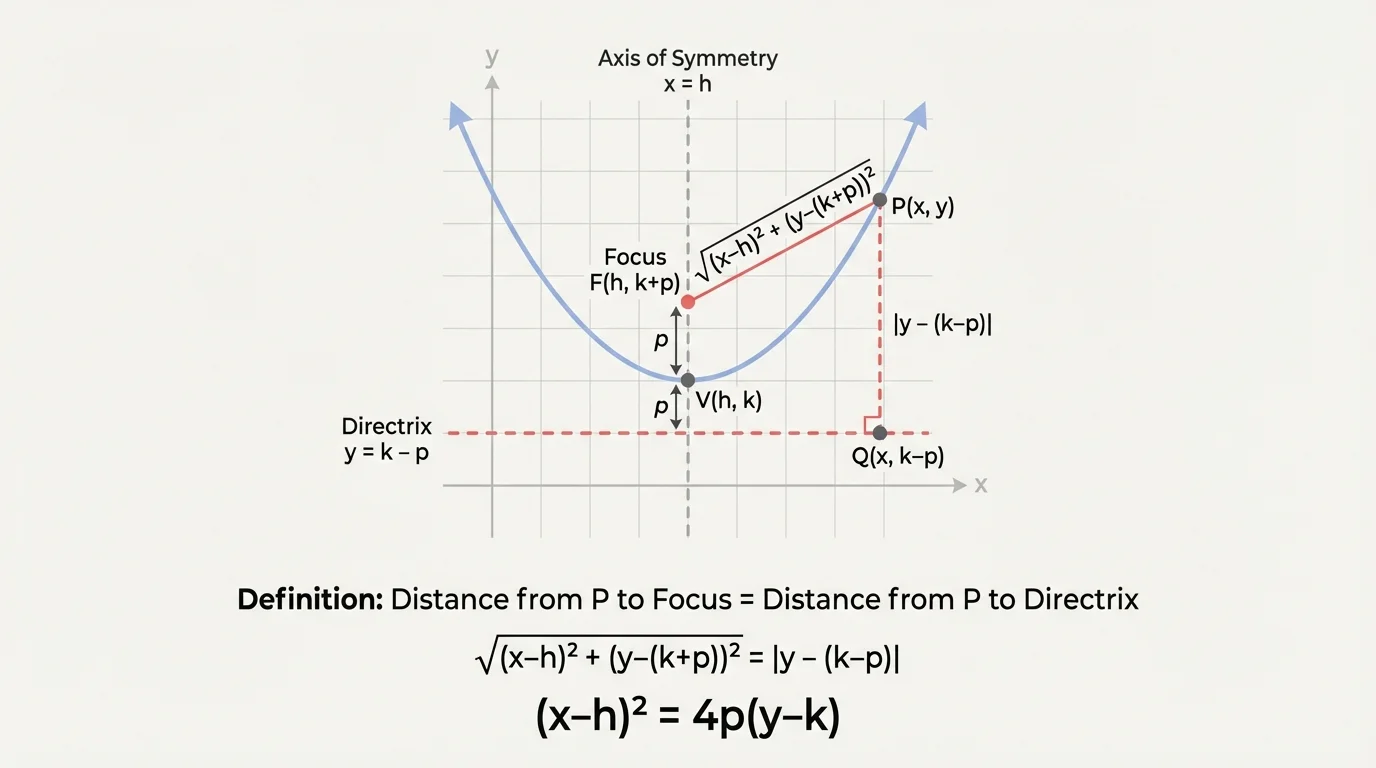
[Figure 3] Suppose the vertex is not at the origin. Let the vertex be \( (h,k) \). If the parabola opens upward, then the focus is \( (h,k+p) \) and the directrix is \( y=k-p \). The translated graph keeps the same structure as the origin case, but every important point has shifted by \(h\) units horizontally and \(k\) units vertically.
Take a general point \( (x,y) \) on the parabola. Its distance to the focus is \(\sqrt{(x-h)^2+(y-(k+p))^2}\). Its distance to the directrix is \(y-(k-p)\) for points on the upward-opening curve. Setting those equal and simplifying gives
\[\sqrt{(x-h)^2+(y-k-p)^2}=y-k+p\]
After squaring and simplifying, we get
\[(x-h)^2=4p(y-k)\]
Similarly, if the parabola opens downward, the equation becomes
\[(x-h)^2=-4p(y-k)\]
For a horizontal parabola with vertex \( (h,k) \), the equations are
\[(y-k)^2=4p(x-h)\]
for opening right, and
\[(y-k)^2=-4p(x-h)\]
for opening left.
Later, when you check your answers, [Figure 3] remains useful because it shows the pattern clearly: the focus is always \(p\) units from the vertex in the direction the parabola opens, and the directrix is \(p\) units from the vertex on the opposite side.
Translation idea
Shifting a parabola changes its equation, but it preserves the same basic form. Replacing \(x\) with \(x-h\) and \(y\) with \(y-k\) moves the vertex from \( (0,0) \) to \( (h,k) \).
Now let's use these ideas in full worked solutions.
Find the equation of the parabola with focus \( (0,3) \) and directrix \( y=-3 \).
Step 1: Identify the orientation and vertex.
The directrix is horizontal, so the axis of symmetry is vertical. The focus is above the directrix, so the parabola opens upward. The vertex is halfway between \( (0,3) \) and the line \( y=-3 \), so the vertex is \( (0,0) \).
Step 2: Find \(p\).
The distance from the vertex to the focus is \(3\), so \(p=3\).
Step 3: Use the correct standard form.
For a vertical parabola opening upward with vertex at the origin, the equation is \(x^2=4py\).
Substitute \(p=3\): \(x^2=4(3)y\).
Therefore, the equation is
\(x^2=12y\)
This example is simple, but it shows the basic pattern: identify direction, locate the vertex, determine \(p\), and write the standard form.
Find the equation of the parabola with focus \( (5,-2) \) and directrix \( x=1 \).
Step 1: Determine orientation.
The directrix is vertical, so the parabola is horizontal. Since the focus is to the right of the directrix, the parabola opens right.
Step 2: Find the vertex.
The vertex lies halfway between the focus \( (5,-2) \) and the directrix \( x=1 \) along the horizontal line \( y=-2 \). The midpoint between \(x=5\) and \(x=1\) is \(x=3\), so the vertex is \( (3,-2) \).
Step 3: Find \(p\).
The distance from the vertex to the focus is \(5-3=2\), so \(p=2\).
Step 4: Write the standard form.
A right-opening parabola with vertex \( (h,k) \) has equation \( (y-k)^2=4p(x-h) \).
Substitute \(h=3\), \(k=-2\), and \(p=2\): \((y+2)^2=8(x-3)\).
Therefore, the equation is
\[(y+2)^2=8(x-3)\]
Notice that the squared part is \(y+2\), not \(x-3\), because this parabola is horizontal.
Derive the equation directly from the definition for focus \( (2,4) \) and directrix \( y=0 \).
Step 1: Locate the vertex and determine orientation.
The directrix is horizontal, so the parabola is vertical. The focus is above the directrix, so it opens upward. The vertex is halfway between \(y=4\) and \(y=0\), so the vertex is \( (2,2) \).
Step 2: Find \(p\).
The distance from the vertex to the focus is \(2\), so \(p=2\).
Step 3: Use a general point and the distance definition.
Let \( (x,y) \) be a point on the parabola. Distance to the focus is \(\sqrt{(x-2)^2+(y-4)^2}\). Distance to the directrix \(y=0\) is \(y\).
Set them equal: \(\sqrt{(x-2)^2+(y-4)^2}=y\).
Step 4: Square and simplify.
Squaring gives \((x-2)^2+(y-4)^2=y^2\).
Expand: \((x-2)^2+y^2-8y+16=y^2\).
Subtract \(y^2\): \((x-2)^2-8y+16=0\).
Rearrange: \((x-2)^2=8(y-2)\).
Therefore, the equation is
\[(x-2)^2=8(y-2)\]
This direct method is powerful because it works even when you do not immediately recognize the standard form.
One common mistake is placing the vertex at the same location as the focus. The vertex is not the focus. It lies halfway between the focus and the directrix along the axis of symmetry.
Another mistake is choosing the wrong variable to square. If the parabola opens up or down, the standard form uses \((x-h)^2\). If it opens left or right, the standard form uses \((y-k)^2\).
A third mistake is sign confusion. If the parabola opens down or left, the coefficient side becomes negative: \((x-h)^2=-4p(y-k)\) or \((y-k)^2=-4p(x-h)\).
Quick check method
Step 1: Find the vertex as the midpoint between the focus and directrix along the axis.
Step 2: Measure \(p\) as the distance from the vertex to the focus.
Step 3: Decide whether the parabola is vertical or horizontal.
Step 4: Make sure the focus and directrix implied by your equation match the originals.
For example, if your equation is \((y+2)^2=8(x-3)\), then \(4p=8\), so \(p=2\). The vertex is \( (3,-2) \), the focus is \( (5,-2) \), and the directrix is \( x=1 \). That confirms the equation from Example 2.
The visual relationships from [Figure 1] and [Figure 2] help explain why this check works: the equation encodes the same equal-distance condition that defines the graph.
Parabolas are not just graphing exercises. A satellite dish uses a cross-sectional parabolic shape so that incoming parallel signals reflect toward the focus, where the receiver is placed. A flashlight or car headlight places the bulb near the focus so reflected light leaves in a more directed beam.
In engineering and architecture, coordinate equations help designers position reflectors, antennas, and support structures accurately. If a reflector must place a sensor at a precise location, then the focus is known, and the equation of the parabola determines the exact shape to build.
"Geometry is not just about shapes; it is about relationships that stay true no matter how the figure moves."
That is exactly what happens here. Whether the parabola is centered at the origin or shifted elsewhere, the same relationship stays true: every point is equally far from the focus and the directrix.
