If a hospital gives a patient two tests, or a basketball team needs two things to happen on a single play, or a card game depends on the order of two draws, one question keeps appearing: what is the probability that both events happen?
In probability, an event like "draw an ace and then draw a king" is called a compound event because it combines more than one condition. To compute its probability correctly, we often need to know not only the probability of the first event, but also what happens to the sample space after that event occurs.
A uniform probability model is a model in which all outcomes in the sample space are equally likely. For example, if a fair die is rolled, each of the six outcomes has probability \(\dfrac{1}{6}\). If a standard deck is shuffled well, each card is equally likely to be drawn first.
In a uniform model, the probability of an event is often found by counting:
\[P(\textrm{event}) = \frac{\textrm{number of favorable outcomes}}{\textrm{total number of equally likely outcomes}}\]
This idea works well for single events and also helps with compound events. But for compound events, especially when one event affects another, simple counting alone can get messy. That is where the multiplication rule becomes powerful.
You should already know that a sample space is the set of all possible outcomes and that an event is a subset of that sample space. You should also remember that probabilities range from \(0\) to \(1\), where \(0\) means impossible and \(1\) means certain.
One key phrase in probability is "and." When we write \(A \textrm{ and } B\), we mean that event \(A\) happens and event \(B\) also happens in the same trial or experiment. The probability of events connected by "and" is not usually found by adding. It is found by multiplying, but in a careful way.
The general multiplication rule states:
\[P(A \textrm{ and } B) = P(A)P(B|A) = P(B)P(A|B)\]
This formula says that the probability of both events occurring can be found in two equivalent ways. You can start with the probability that \(A\) happens, then multiply by the probability that \(B\) happens given that \(A\) already happened. Or you can reverse the roles and start with \(B\), then multiply by the probability of \(A\) given \(B\).
Conditional probability is the probability of an event under the condition that another event has already occurred. It is written with a vertical bar, as in \(P(B|A)\), which is read "the probability of \(B\) given \(A\)."
Dependent events are events for which the occurrence of one affects the probability of the other.
Independent events are events for which the occurrence of one does not affect the probability of the other.
The vertical bar in \(P(B|A)\) is one of the most important symbols in this topic. It means "given." So \(P(B|A)\) is not the same as \(P(B)\). It asks us to recompute the probability of \(B\) using only outcomes where \(A\) has already occurred.
Conditional probability changes your point of view. As [Figure 1] illustrates, once event \(A\) has happened, the original sample space is reduced to only those outcomes consistent with \(A\). Then we ask how many of those reduced outcomes also satisfy \(B\).
Suppose you draw one card from a standard deck and know that it is a face card. The sample space is no longer all \(52\) cards. It is only the \(12\) face cards. If you ask for the probability that the card is a king given that it is a face card, the answer is \(\dfrac{4}{12} = \dfrac{1}{3}\), not \(\dfrac{4}{52}\).
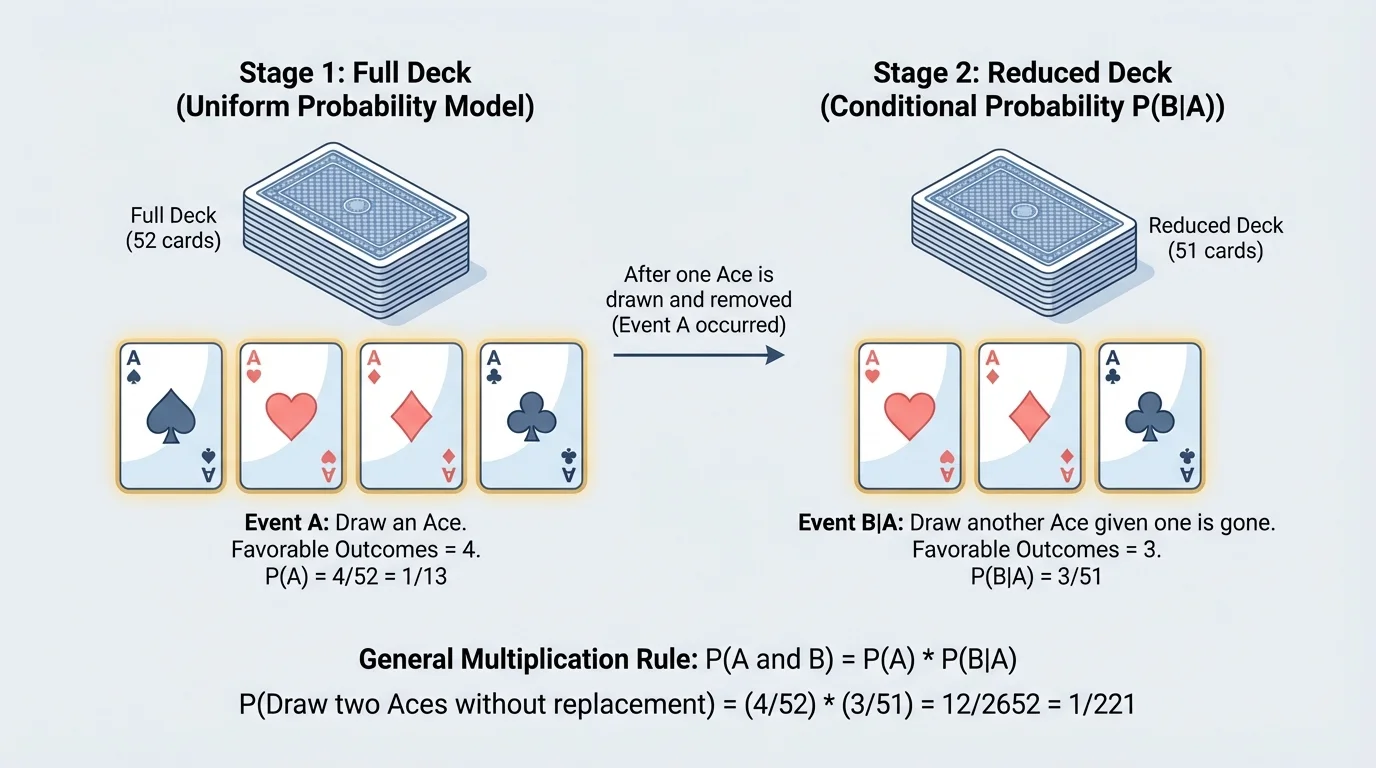
This idea is the heart of the multiplication rule. When events happen in sequence, the first event may change the number of possible outcomes for the second. For example, drawing a card without replacement changes the deck. Choosing one student from a group changes how many students remain for the next choice.
Notice that the formula works no matter which event you start with:
\[P(A \textrm{ and } B) = P(A)P(B|A)\]
or
\[P(A \textrm{ and } B) = P(B)P(A|B)\]
These expressions must give the same result because they describe the same compound event. Sometimes one version is easier to use than the other, depending on the information given.
A standard deck has \(52\) cards. What is the probability of drawing an ace first and then a king second, without replacement?
Worked example
Step 1: Define the events.
Let \(A\) be "the first card is an ace" and \(B\) be "the second card is a king." We want \(P(A \textrm{ and } B)\).
Step 2: Find \(P(A)\).
There are \(4\) aces in \(52\) cards, so \(P(A) = \dfrac{4}{52} = \dfrac{1}{13}\).
Step 3: Find \(P(B|A)\).
If an ace was drawn first and not replaced, then \(51\) cards remain. The number of kings is still \(4\), so \(P(B|A) = \dfrac{4}{51}\).
Step 4: Apply the multiplication rule.
\(P(A \textrm{ and } B) = P(A)P(B|A) = \dfrac{4}{52} \cdot \dfrac{4}{51} = \dfrac{16}{2652} = \dfrac{4}{663}\).
Therefore, \[P(A \textrm{ and } B) = \frac{4}{663}\]
Interpreting the answer matters. The probability \(\dfrac{4}{663}\) means that in this model of repeatedly drawing two cards from a well-shuffled deck without replacement, about \(4\) out of every \(663\) such two-card outcomes would be "ace first, king second." As a decimal, this is about \(0.0060\), or \(0.60\%\).
We can also reverse the order of reasoning: the probability that the second card is a king is \(\dfrac{4}{52}\) by symmetry, and the probability that the first card is an ace given that the second is a king is \(\dfrac{4}{51}\). Multiplying still gives the same result.
When two fair dice are rolled, the outcome grid of \(36\) ordered pairs helps organize the uniform model. Let \(A\) be "the first die is even" and let \(B\) be "the sum is greater than \(9\)." Find \(P(A \textrm{ and } B)\).
[Figure 2] Because this is a uniform probability model, each ordered pair such as \((2,5)\) or \((6,4)\) is equally likely. We can either count the overlap directly or use the multiplication rule.
Worked example
Step 1: Find \(P(A)\).
The first die is even for \(2, 4, 6\), so \(P(A) = \dfrac{3}{6} = \dfrac{1}{2}\).
Step 2: Find \(P(B|A)\).
If the first die is even, the possible first-die values are \(2, 4, 6\). There are \(18\) equally likely ordered pairs in this restricted sample space.
Now count which of these have sum greater than \(9\):
If the first die is \(2\), none work.
If the first die is \(4\), only \((4,6)\) works.
If the first die is \(6\), the pairs \((6,4), (6,5), (6,6)\) work.
So there are \(4\) favorable outcomes out of \(18\), giving \(P(B|A) = \dfrac{4}{18} = \dfrac{2}{9}\).
Step 3: Multiply.
\(P(A \textrm{ and } B) = P(A)P(B|A) = \dfrac{1}{2} \cdot \dfrac{2}{9} = \dfrac{1}{9}\).
Therefore, \[P(A \textrm{ and } B) = \frac{1}{9}\]
The result \(\dfrac{1}{9}\) means that if you repeatedly roll two fair dice, about \(1\) out of every \(9\) rolls will have an even first die and a total greater than \(9\).
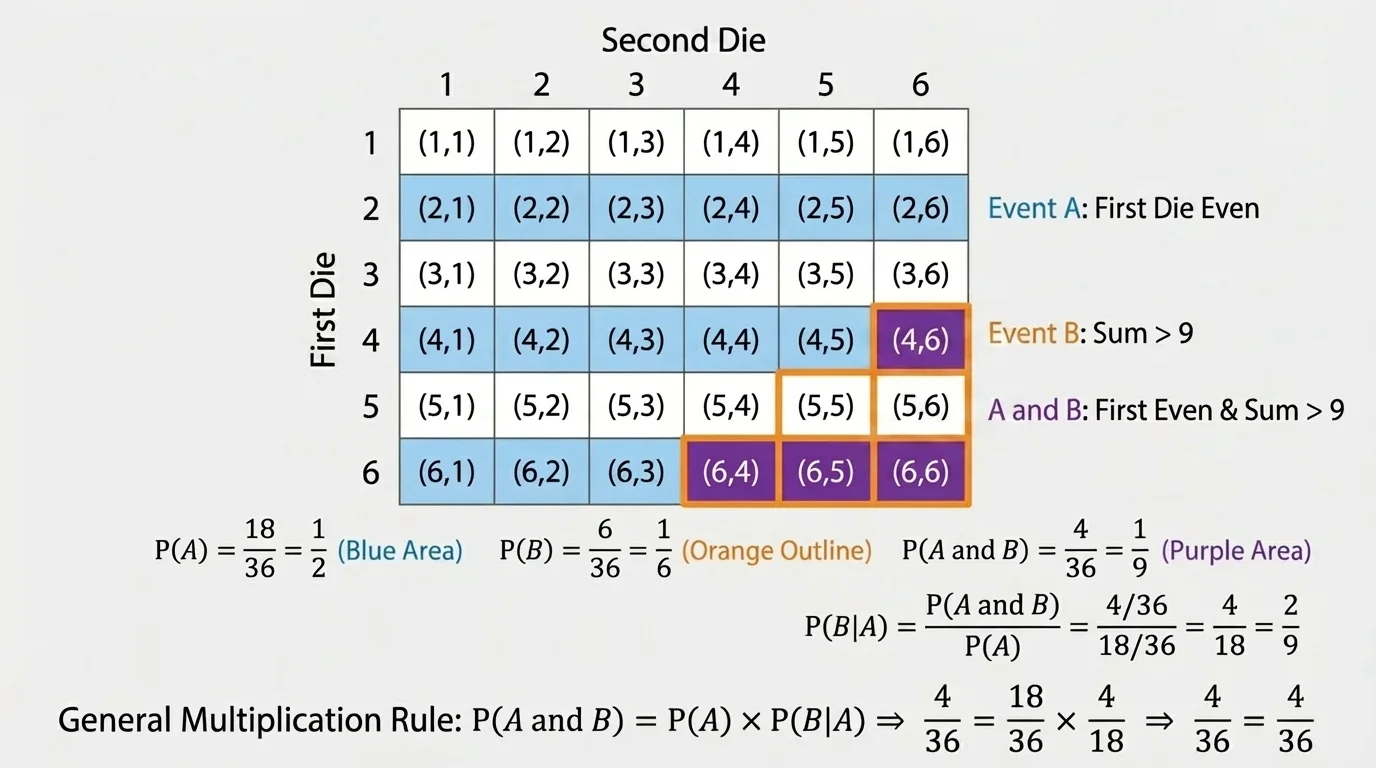
We can check by direct counting from all \(36\) ordered pairs. The favorable outcomes are \((4,6), (6,4), (6,5), (6,6)\), which is \(4\) outcomes. So \(P(A \textrm{ and } B) = \dfrac{4}{36} = \dfrac{1}{9}\), matching the rule.
A class has \(12\) students: \(7\) play a sport and \(5\) do not. Of the \(12\) students, \(8\) are in band and \(4\) are not. Suppose \(5\) students both play a sport and are in band. One student is chosen at random. Then a second student is chosen, without replacement. What is the probability that the first student plays a sport and the second student is in band?
This example is interesting because the two descriptions apply to different students. The first event affects the composition of the group for the second draw.
Worked example
Step 1: Define the events.
Let \(A\) be "the first student plays a sport." Let \(B\) be "the second student is in band." We want \(P(A \textrm{ and } B)\).
Step 2: Find \(P(A)\).
There are \(7\) students who play a sport, so \(P(A) = \dfrac{7}{12}\).
Step 3: Find \(P(B|A)\).
If the first student is known to play a sport, there are two possibilities:
- The chosen student is one of the \(5\) students who both play a sport and are in band.
- Or the chosen student is one of the \(2\) students who play a sport but are not in band.
Among the \(7\) sport players, \(5\) are in band and \(2\) are not. So after event \(A\):
With probability \(\dfrac{5}{7}\), the remaining number of band students is \(7\).
With probability \(\dfrac{2}{7}\), the remaining number of band students is \(8\).
Therefore, \(P(B|A) = \dfrac{5}{7} \cdot \dfrac{7}{11} + \dfrac{2}{7} \cdot \dfrac{8}{11} = \dfrac{35}{77} + \dfrac{16}{77} = \dfrac{51}{77}\).
Step 4: Multiply.
\(P(A \textrm{ and } B) = \dfrac{7}{12} \cdot \dfrac{51}{77} = \dfrac{51}{132} = \dfrac{17}{44}\).
Therefore, \[P(A \textrm{ and } B) = \frac{17}{44}\]
In context, \(\dfrac{17}{44}\) means that in this selection model, about \(17\) out of every \(44\) repeated two-student selections are expected to result in a student who plays a sport first and a student in band second.
This example shows that using the multiplication rule can require careful thinking about what information event \(A\) gives you. The conditional part is not always immediate; sometimes it must be built from cases.
[Figure 3] Not all compound events are dependent. In some situations, the occurrence of one event does not change the probability of the other. With replacement, the second branch of a probability tree remains the same, while without replacement it changes.
If \(A\) and \(B\) are independent events, then \(P(B|A) = P(B)\). In that case, the general multiplication rule becomes the familiar special case:
\[P(A \textrm{ and } B) = P(A)P(B)\]
For example, if you flip a fair coin twice, let \(A\) be "the first flip is heads" and \(B\) be "the second flip is heads." Then \(P(A) = \dfrac{1}{2}\), \(P(B) = \dfrac{1}{2}\), and because the flips do not affect each other, \(P(B|A) = \dfrac{1}{2}\). So:
\[P(A \textrm{ and } B) = \frac{1}{2} \cdot \frac{1}{2} = \frac{1}{4}\]
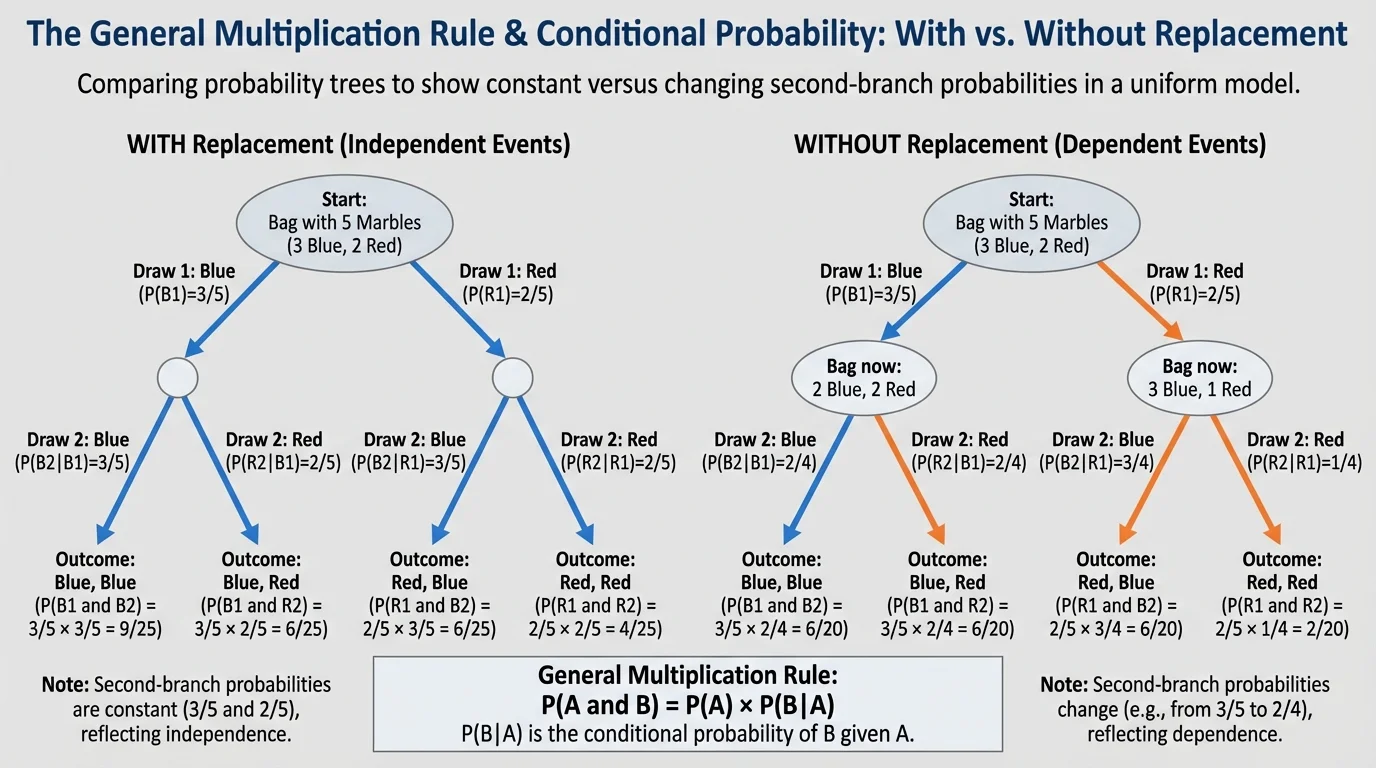
By contrast, if you draw two marbles from a bag without replacement, the first draw changes the bag's contents, so the events are dependent. That is why the general multiplication rule is so important: it works in both dependent and independent cases.
Why the rule is "general"
The rule \(P(A \textrm{ and } B) = P(A)P(B|A)\) always works when the conditional probability makes sense. Independence is just a special case where the condition does not change the probability, so \(P(B|A) = P(B)\).
Later, when you decide whether two events are independent, remember that you are checking whether knowing one event happened changes the probability of the other. If it changes, use the full conditional form.
A common mistake is to add probabilities when the problem asks for "and." Addition is usually connected to "or," not "and." For "and," think about a sequence of requirements: one event must happen, and then the other must also happen.
Another mistake is ignoring the changed sample space. In the card example, after one card is removed, the denominator changes from \(52\) to \(51\). In the student example, after one person is selected, the group changes from \(12\) to \(11\).
A third mistake is confusing \(P(B|A)\) with \(P(A|B)\). These are usually different. The order matters because the condition matters. For example, the probability that a student is in band given that the student plays a sport is not automatically the same as the probability that a student plays a sport given that the student is in band.
Medical screening often depends on conditional probability. A test result can look convincing until you consider the probability of the disease given the test outcome, not just the probability of the test outcome given the disease.
One more subtle mistake is forgetting to interpret the answer in terms of the model. A probability is not just a number to simplify. It describes long-run behavior in a repeated random process under the assumptions of the model.
In sports analytics, a coach may want the probability that a player gets on base and the next batter drives in a run. The second probability depends on the first because the game situation changes. The multiplication rule captures that dependency naturally.
In manufacturing, a company may track the probability that a product passes one inspection stage and then passes a second stage. If the second check depends on surviving the first, conditional probability is essential. The same idea appears in quality control for electronics, vehicles, and medical devices.
In survey research, analysts may ask about two linked traits in a population, such as the probability that a randomly selected person is a registered voter and that the next selected person supports a certain policy. If selections are made without replacement from a small group, the events are dependent.
In genetics, medicine, and public health, professionals often use the logic behind the multiplication rule to combine stages of uncertainty. Even when the calculations become more advanced, the core idea remains the same: probability of the first event multiplied by the probability of the second event under the new condition.
Interpreting a probability means translating it into a clear sentence about the situation. If \(P(A \textrm{ and } B) = \dfrac{1}{9}\) for rolling two dice, that does not simply mean "the answer is \(\dfrac{1}{9}\)." It means "about \(1\) out of every \(9\) rolls is expected to satisfy both conditions in this fair-dice model."
That interpretation must match the experiment, the assumptions, and the order of events. In the card example, "ace first and king second" is different from "an ace and a king in any order." In the student example, the interpretation depends on selection without replacement. In the dice example, it depends on ordered pairs being equally likely.
When you see a probability question involving two linked events, ask yourself three things: What is the first event? How does it change the sample space? What does the final probability mean in the context of this model? Those questions lead directly to correct use of the general multiplication rule.
