If you have \(2\) toy cars and then get \(1\) more, something exciting happens: your group grows. Math helps us show that change. We can show it with blocks, with fingers, with a picture, with claps, or even by acting it out with our bodies. All of these are ways to tell the same math story.
Addition means putting together or adding to. If we start with \(2\) bears and add \(1\) more bear, we have \(3\) bears. We can write that as \(2 + 1 = 3\).
Subtraction means taking apart or taking from. If we have \(3\) bears and \(1\) goes away, \(2\) bears are left. We can write that as \(3 - 1 = 2\).
Addition is putting together or adding more. Subtraction is taking apart or taking away. An equation is a math sentence that uses symbols, like \(2 + 1 = 3\).
Sometimes the numbers stay small, but the idea stays big: math tells what happens to a group. A group can get bigger, or a group can get smaller.
The same math idea can be shown in many ways, as [Figure 1] shows. If we know one story, we can tell it with toys, fingers, a picture, sounds, actions, words, and number sentences. This helps us understand the math, not just say the answer.
We can use objects such as cubes, buttons, or counters. We can use fingers by holding up some fingers and then more fingers. We can make a drawing with circles or stars. We can make sounds with claps: \(1\) clap and \(2\) more claps make \(3\) claps. We can act out a story by letting children join a group or leave a group.
We can also use a mental image. A mental image is a picture in your mind. You might picture \(4\) balloons and then imagine \(1\) more balloon. Now you can think, "That makes \(5\)." We can say the story with words, and we can write an equation like \(4 + 1 = 5\).
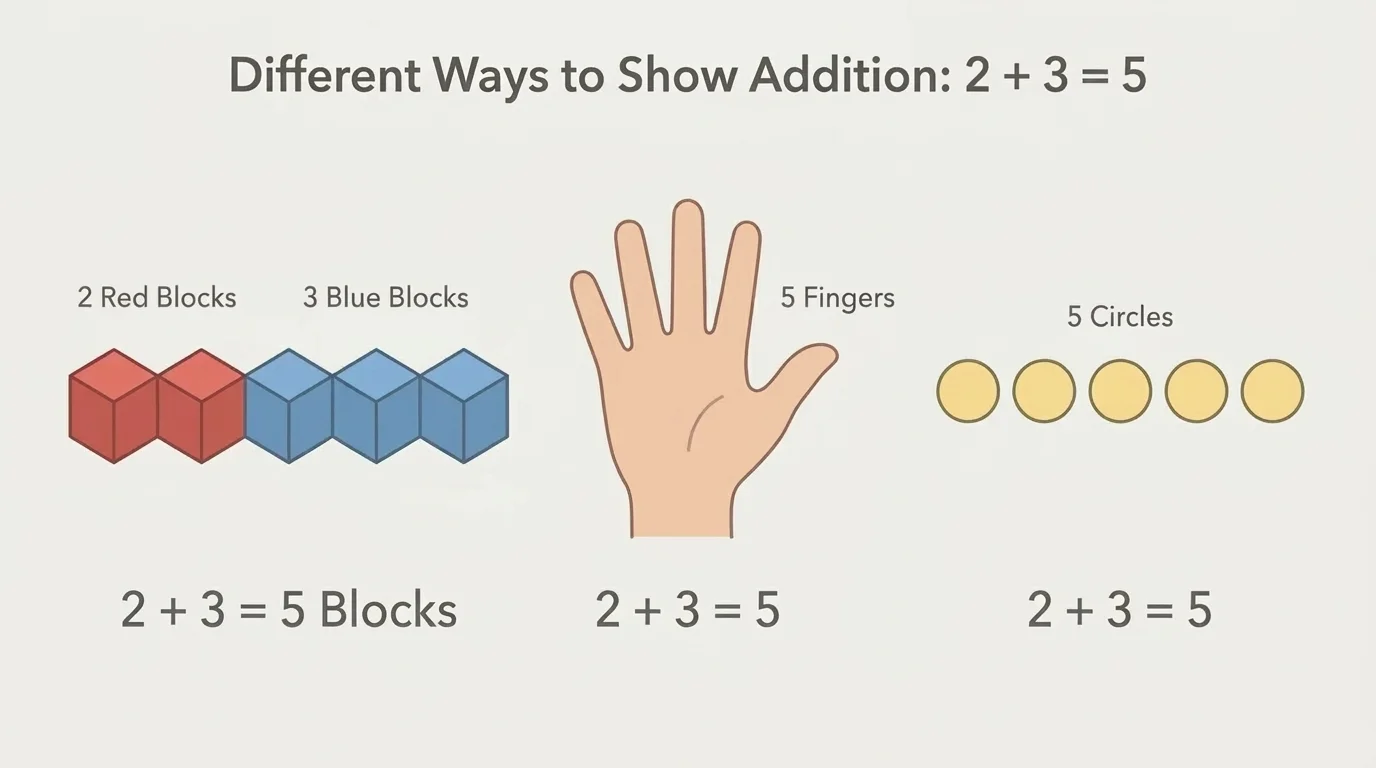
Different ways of showing math can match each other. A pile of cubes, a finger pattern, and a number sentence can all mean the same thing. When you see \(1 + 2 = 3\), you can think of one toy joining two toys, or one clap joining two claps.
One story, many representations
When the math story stays the same, the way we show it can change. For example, "\(3\) birds and \(2\) more birds make \(5\) birds" can be shown with toy birds, fingers, a sketch of birds, \(3\) claps and \(2\) more claps, or the equation \(3 + 2 = 5\). All of these representations help us understand the same idea.
When we take away, the same thing is true. If \(5\) crackers become \(3\) crackers because \(2\) are eaten, we can show that with real crackers, a drawing with \(2\) crossed out, or the equation \(5 - 2 = 3\).
Suppose there are \(2\) blocks on the table. Then \(3\) more blocks are added. How many blocks are there now?
Worked example
Step 1: Start with the first group.
We see \(2\) blocks.
Step 2: Add the second group.
Now \(3\) more blocks join the first \(2\) blocks.
Step 3: Count all the blocks together.
Count: \(1, 2, 3, 4, 5\).
Step 4: Write the math sentence.
\(2 + 3 = 5\)
There are \(5\) blocks.
We can show the same example with fingers. Hold up \(2\) fingers, then hold up \(3\) more fingers. Count all the fingers shown. The total is still \(5\). The representation changes, but the answer stays the same.
Subtraction means taking from a group. Suppose we draw \(5\) stars. Then \(2\) stars are crossed out. How many stars are left?
Worked example
Step 1: Start with the whole group.
There are \(5\) stars.
Step 2: Take away some.
Cross out \(2\) stars.
Step 3: Count what is left.
\(3\) stars are left.
Step 4: Write the math sentence.
\(5 - 2 = 3\)
The answer is \(3\).
Now show it with sounds. Clap \(5\) times. Pretend \(2\) claps are taken away from the story. The number left is \(3\). Sounds can tell a subtraction story too.
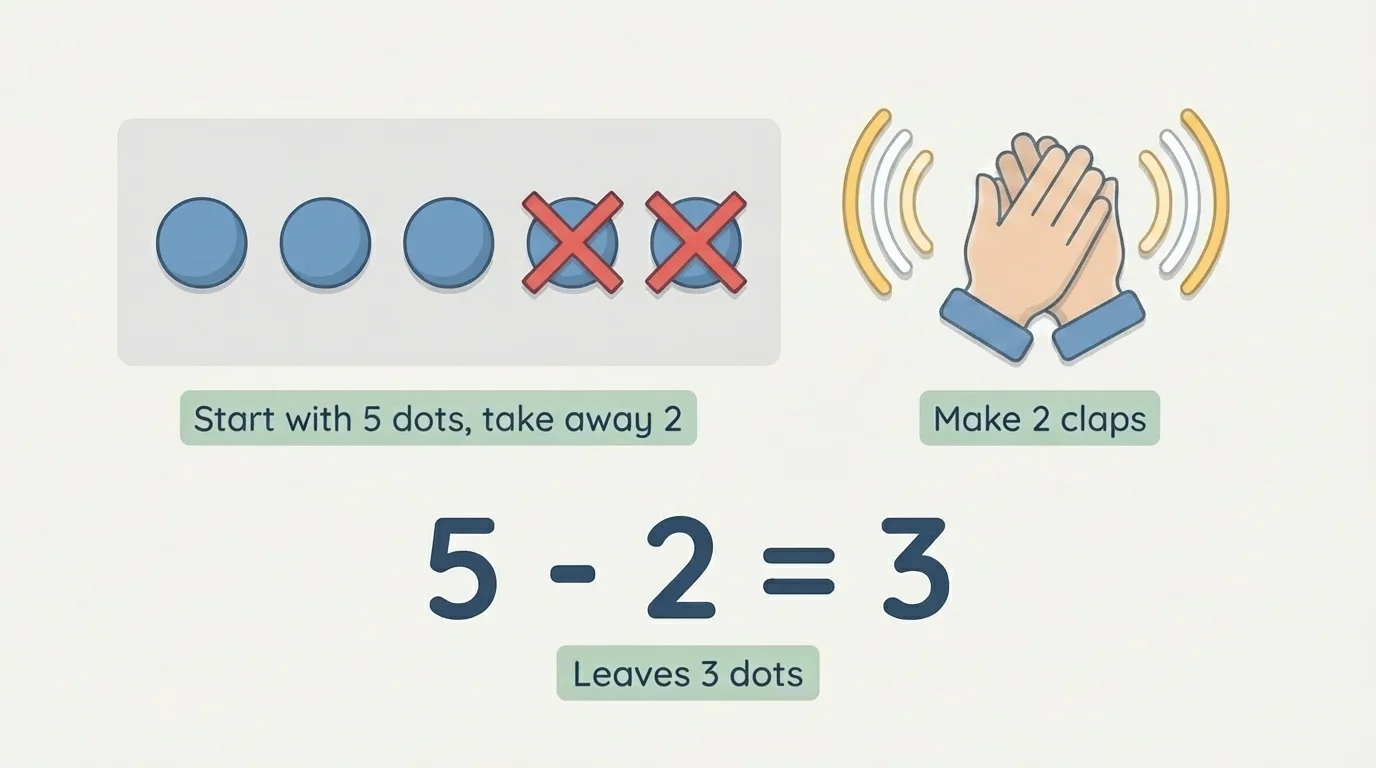
A drawing helps our eyes, and claps help our ears. Both show the same subtraction. Later, when you see \(5 - 2 = 3\), you can remember the picture and the sound pattern.
Math can be a little story. Suppose \(1\) child is standing in a line. Then \(2\) more children join. How many children are in the line?
Worked example
Step 1: Act out the first part.
One child stands in the line, so there is \(1\) child in line.
Step 2: Add more children.
Then \(2\) more children join the line.
Step 3: Count the whole line.
Now there are \(3\) children.
Step 4: Write the equation.
\(1 + 2 = 3\)
The line has \(3\) children.
We can also tell a taking-away story. If \(4\) children are playing and \(1\) child goes to get a drink, then \(3\) children are still playing. That story matches \(4 - 1 = 3\).
Your brain can use a quick picture to solve small math problems. Seeing \(2\) dots and \(2\) more dots often helps you know \(4\) without counting each dot one by one.
Words, actions, and equations belong together. A good math thinker can listen to a story, act it out, and match it to numbers and symbols.
Every day has math stories, as [Figure 3] shows. At snack time, you may have \(3\) crackers and get \(2\) more, so \(3 + 2 = 5\). On the playground, \(5\) children may be at the slide, and \(1\) child leaves, so \(5 - 1 = 4\).
In the classroom, crayons, books, and chairs can help us model math. At home, socks, toys, cups, and steps can help too. Even music can show math: \(2\) drum taps and \(2\) more drum taps make \(4\) taps.
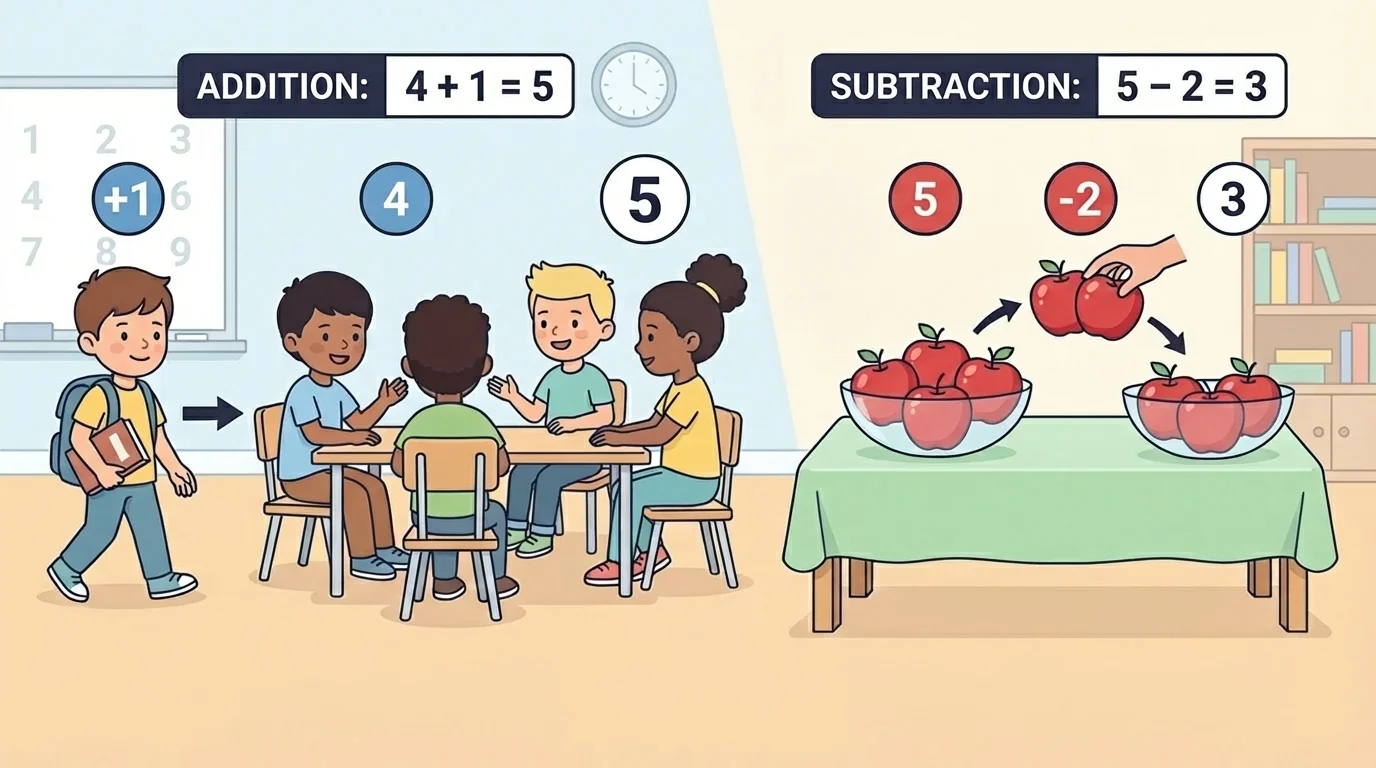
When you notice groups joining or groups getting smaller, you are noticing addition and subtraction in the real world. These stories connect school math to everyday life.
The symbol \(+\) means add. The symbol \(-\) means subtract. The symbol \(=\) means is equal to. An expression such as \(2 + 3\) shows math with numbers and symbols. An equation such as \(2 + 3 = 5\) is a full math sentence.
You do not always need real things in front of you. You can think of the objects in your mind, make a quick sketch, tap sounds, or use your fingers. These are all smart ways to understand what the numbers mean.
When you count, each object gets one number word: \(1, 2, 3, 4, ...\). Counting carefully helps you find how many are in all or how many are left.
If two different representations tell the same story, they should match the same answer. For example, blocks, claps, and a drawing can all match \(3 + 1 = 4\). A crossed-out picture, children leaving a group, and an equation can all match \(4 - 1 = 3\).
