Have you ever had a full set of \(10\) blocks and noticed that some are in your hand and the rest are on the floor? If you know one part, you can find the other part. That is what it means to make \(10\). When we put two parts together and get \(10\), the two numbers are partners.
When we add, we add numbers by putting them together. If one part is \(2\), we can ask, "What other part do we need to make \(10\)?" The answer is \(8\), because \(2 + 8 = 10\).
A equation is a math sentence. It uses numbers and a symbol like \(=\). For example, \(5 + 5 = 10\) is an equation. It tells us that two parts, \(5\) and \(5\), make the whole, \(10\).
Make 10 means to put two numbers together so the total is \(10\).
Number partner means the number that goes with another number to make \(10\).
You can think of \(10\) as a full set. If part of the set is missing, we can find the missing part. For example, if you have \(7\) crayons in a box that holds \(10\), then \(3\) spaces are still empty. So \(7\) and \(3\) are partners to \(10\).
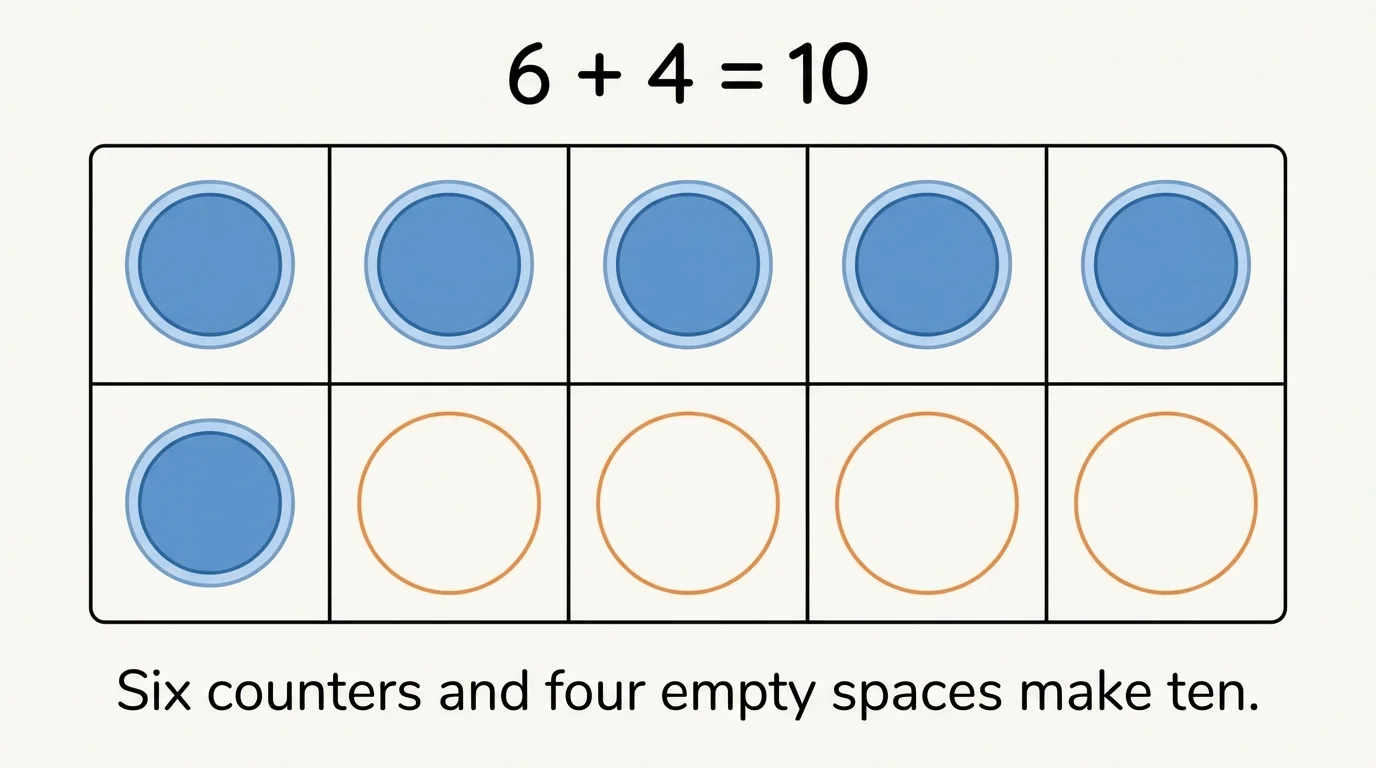
A ten-frame helps us see how many we have and how many more we need, as [Figure 1] shows. You can also use simple drawings of circles to show the same idea, as in [Figure 2]. A ten-frame has \(10\) spaces. Some spaces are filled, and some spaces are empty. The empty spaces tell us the partner number.
If \(6\) spaces are filled, count the empty spaces. There are \(4\) empty spaces. That means \(6 + 4 = 10\). We can use counters, cubes, dots, or little pictures to show this idea.
You can also draw circles. Draw \(8\) circles, then think about how many more circles are needed to make \(10\). Since \(2\) more circles fill the set, we know \(8 + 2 = 10\).
Objects and drawings help us see the two parts clearly. One part is the number we start with. The other part is the number we need to reach \(10\). As we saw with the ten-frame in [Figure 1], the empty spaces are just as important as the filled spaces.
Parts and whole
When a number is less than \(10\), it is one part of \(10\). The partner number is the other part. Together, the two parts make the whole: \(10\).
If the number is small, like \(1\), the partner is big, like \(9\). If the number is big, like \(9\), the partner is small, like \(1\). Sometimes the partners are the same, like \(5\) and \(5\).
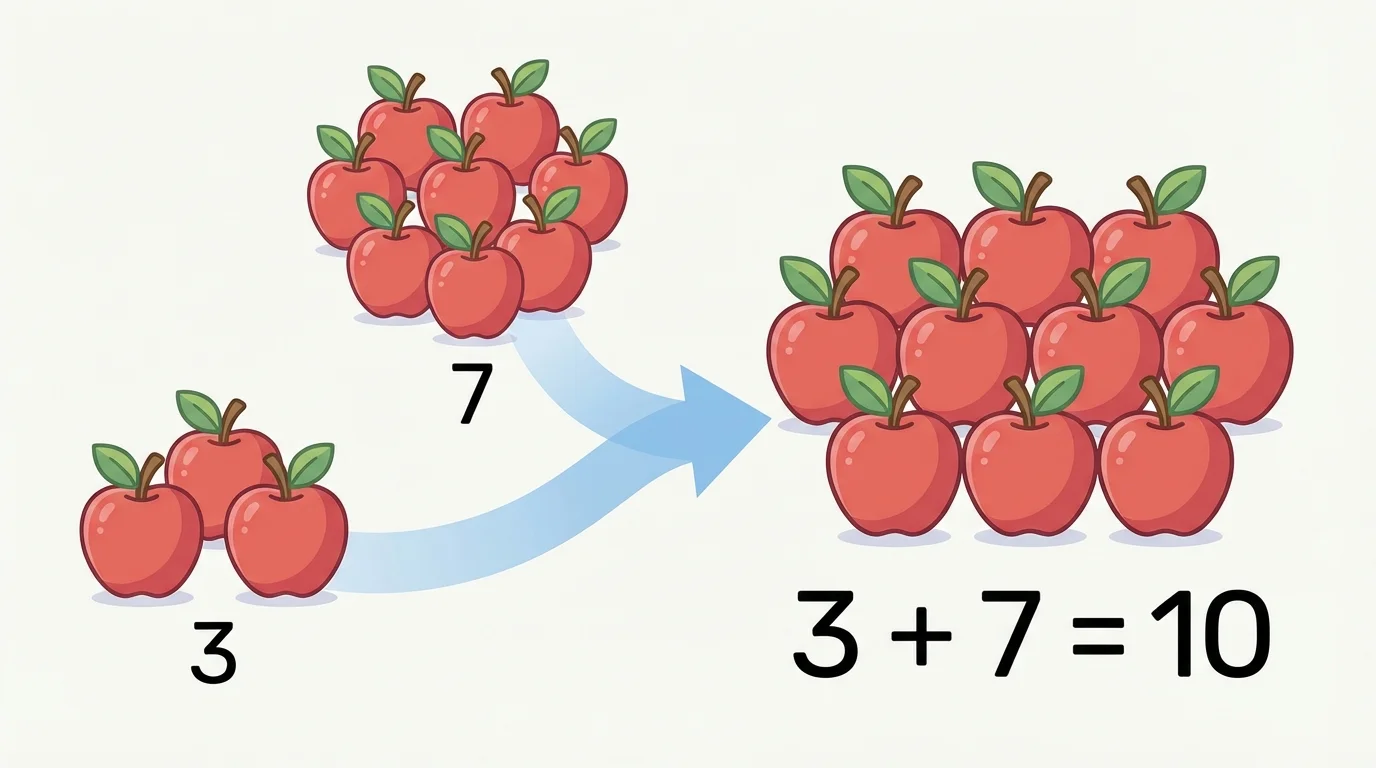
After we use drawings, we can write the math with symbols. A drawing showing \(3\) apples and \(7\) more apples matches the equation \(3 + 7 = 10\).
We can also turn it around and write \(7 + 3 = 10\). Both equations make \(10\). The two addends can switch places, but the total stays \(10\).
Here are more equations that make \(10\): \(1 + 9 = 10\), \(2 + 8 = 10\), and \(4 + 6 = 10\). Each equation tells the same kind of story: one part plus another part equals the whole.
When you look back at a drawing, try to say the equation out loud. For example, if you see \(9\) stars and \(1\) more star, you can say, "\(9 + 1 = 10\)." The picture and the equation mean the same thing, just like the apples in [Figure 2].
Example 1
Find the number that goes with \(1\) to make \(10\).
Step 1: Start with \(1\).
We want \(1 + \Box = 10\).
Step 2: Think about how many more are needed.
If one space is filled in a set of \(10\), then \(9\) spaces are left.
Step 3: Write the equation.
\(1 + 9 = 10\)
The partner number for \(1\) is \(9\).
This example shows a very small part and a much larger partner number. Together, they still make the whole of \(10\).
Example 2
Find the number that goes with \(4\) to make \(10\).
Step 1: Start with the equation frame.
We want \(4 + \Box = 10\).
Step 2: Use a drawing idea.
If \(4\) dots are drawn, then \(6\) more dots are needed to have \(10\) dots.
Step 3: Write the answer.
\(4 + 6 = 10\)
The partner number for \(4\) is \(6\).
Notice that \(4\) and \(6\) are partners. If you start with \(6\), the partner is \(4\). The pair works both ways.
Example 3
Find the number that goes with \(7\) to make \(10\).
Step 1: Write the missing-part equation.
We want \(7 + \Box = 10\).
Step 2: Count on to \(10\).
After \(7\) comes \(8\), \(9\), \(10\). So we need \(3\) more.
Step 3: Record the equation.
\(7 + 3 = 10\)
The partner number for \(7\) is \(3\).
Counting on is another way to find the missing part. It helps when you do not have objects right in front of you.
Example 4
Find the number that goes with \(5\) to make \(10\).
Step 1: Write the problem.
We want \(5 + \Box = 10\).
Step 2: Think about two equal parts.
\(10\) can be split into two equal groups of \(5\) and \(5\).
Step 3: Write the equation.
\(5 + 5 = 10\)
The partner number for \(5\) is \(5\).
This is a special pair because both parts are the same size.
Each number from \(1\) to \(9\) has a partner that makes \(10\). The chart of number partners in [Figure 3] helps us notice the pattern. As one number gets bigger, the partner gets smaller.
Here are the partners:
| Number | Partner to make \(10\) | Equation |
|---|---|---|
| \(1\) | \(9\) | \(1 + 9 = 10\) |
| \(2\) | \(8\) | \(2 + 8 = 10\) |
| \(3\) | \(7\) | \(3 + 7 = 10\) |
| \(4\) | \(6\) | \(4 + 6 = 10\) |
| \(5\) | \(5\) | \(5 + 5 = 10\) |
| \(6\) | \(4\) | \(6 + 4 = 10\) |
| \(7\) | \(3\) | \(7 + 3 = 10\) |
| \(8\) | \(2\) | \(8 + 2 = 10\) |
| \(9\) | \(1\) | \(9 + 1 = 10\) |
Table 1. Number partners from \(1\) to \(9\) that make \(10\).
The middle pair is \(5\) and \(5\). On each side of that pair, the partners match in the opposite order. For example, \(2\) goes with \(8\), and \(8\) goes with \(2\).
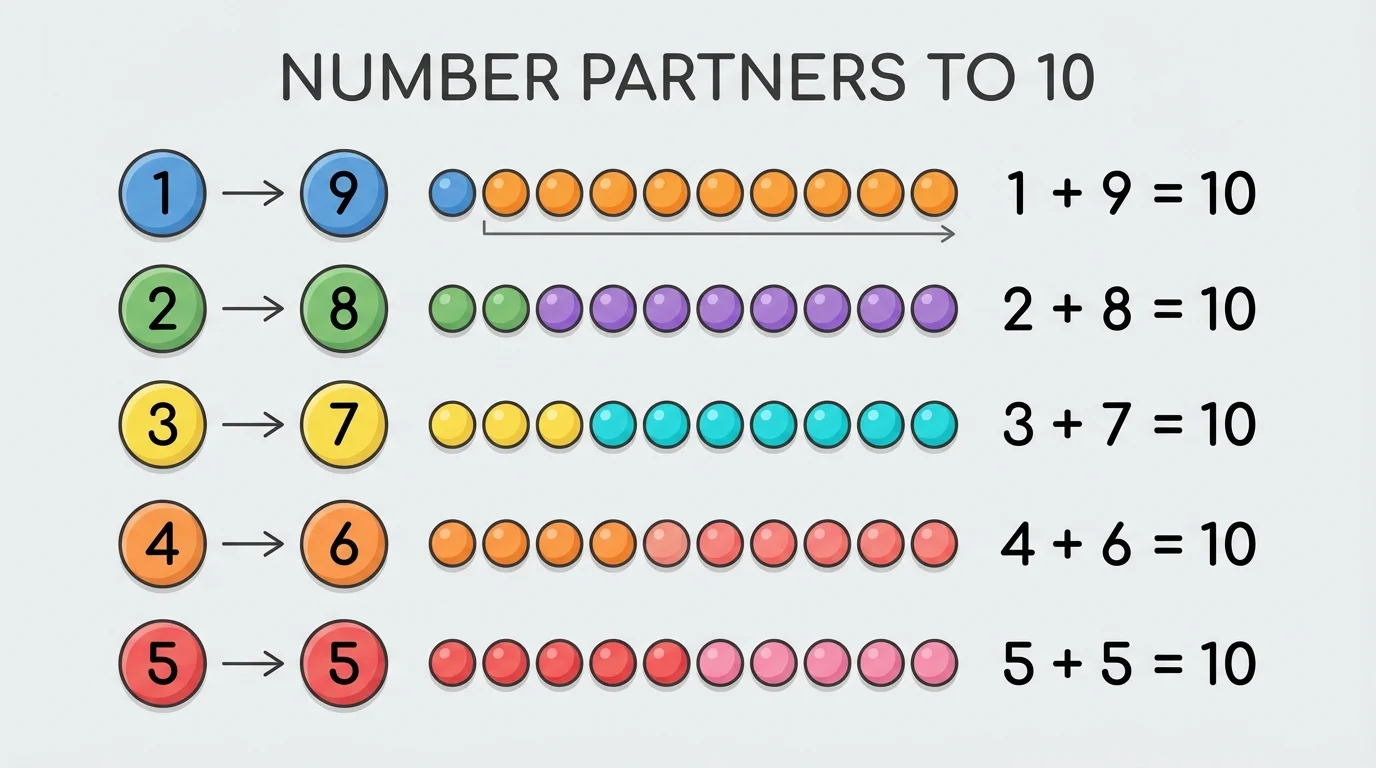
This pattern makes the facts easier to remember. The pairs are balanced around \(5\).
The make-\(10\) facts help with bigger addition later. For example, if you know \(8\) needs \(2\) more to make \(10\), that can help when adding numbers like \(8 + 5\).
Learning these partners is important because \(10\) is a friendly number in our number system. We count in groups of \(10\), and many math problems become easier when we can make a \(10\) first.
Making \(10\) happens in real life. If there are \(10\) seats at a snack table and \(6\) are filled, then \(4\) seats are empty. That means \(6 + 4 = 10\).
If a toy shelf has room for \(10\) cars and there are \(9\) cars already there, only \(1\) more car fits. If a carton holds \(10\) eggs and you see \(3\) eggs, then \(7\) places are empty. We are using addition to find the missing part each time.
You already know how to count to \(10\). Now you are using that counting to find a missing part in an addition story.
When you use objects, drawings, or equations, you are showing the same math idea in different ways. A set of counters, a picture of dots, and an equation like \(2 + 8 = 10\) all tell the same story.
