Have you ever learned something amazing and wanted to tell someone quickly? Maybe you read about sharks, watched a video about tornadoes, or researched how firefighters help a community. You probably did not tell every single fact you learned. Instead, you picked the most important ideas and explained them clearly. That is exactly what good readers and researchers do when they write a summary.
When students do short research projects, they gather facts from books, articles, videos, and trusted websites. After that, they need to interpret the information. This means they consider what the facts show and decide which ideas are most important. Then they share what they learned in a clear way.
A strong summary is short, clear, and full of important information. It tells the main idea and includes a few important details that support it. It does not include every tiny fact. It also does not include personal opinions unless the task asks for them. Learning how to summarize helps you in reading, science, social studies, and everyday life.
Summaries help us remember what we learn. If you read three pages about penguins, you may not remember every sentence. But if you can explain the big idea and key details, you understand the topic much better. A summary shows that you can learn from information and then communicate it to someone else.
Summaries are useful in many real-life situations. A coach may summarize the plan for a game. A doctor may summarize how a patient should take medication. A news reporter may summarize a big event in a short report. Even when you tell a family member about a school project, you are often giving a kind of summary.
A summary is a short restatement of the most important ideas from a text or research project.
Main idea is the most important point the whole text is mostly about.
Supporting details are facts, examples, or explanations that help the reader understand the main idea.
A summary is different from a list of random facts. The ideas must fit together. If the topic is butterflies, the summary should stay focused on butterflies. If one fact is about desert plants and another is about a bus route, those details do not belong together unless the research topic connects them.
A summary is brief. That means it is short compared with the original source. If an article has ten sentences, your summary might have only two, three, or four. The goal is not to shrink every sentence. The goal is to explain the most important information in your own words.
A summary is also accurate. It must tell true information from the source. If a text says that owls hunt mostly at night, the summary should not say they hunt mostly during the day. Good summaries stay faithful to the facts.
A summary should be in your own words whenever possible. Copying whole sentences from a source does not show full understanding. When you put ideas into your own words, you show that you truly understand what you read or researched.
When you read informational text, you already look for important ideas, headings, and facts. Writing a summary uses those same skills, but now you put the learning together into a short explanation.
Sometimes students think a summary is just the first sentence, the last sentence, and one fact from the middle. That is not always true. A summary comes from understanding the whole text, not from grabbing random pieces.
The main idea is the core of a summary, and [Figure 1] shows how one big idea holds several smaller facts together. To find it, ask yourself, "What is this whole text mostly about?" The answer should be broad enough to cover the important details.
For example, imagine a short article about bees. It explains that bees carry pollen from flower to flower, help plants grow fruit, and are important to farms. The main idea is not just "Bees visit flowers." A stronger main idea is "Bees are important because they help plants grow."
Sometimes the main idea is written clearly in the text. Other times, you have to figure it out by looking at many details and asking what they have in common. This is why careful thinking matters during research.
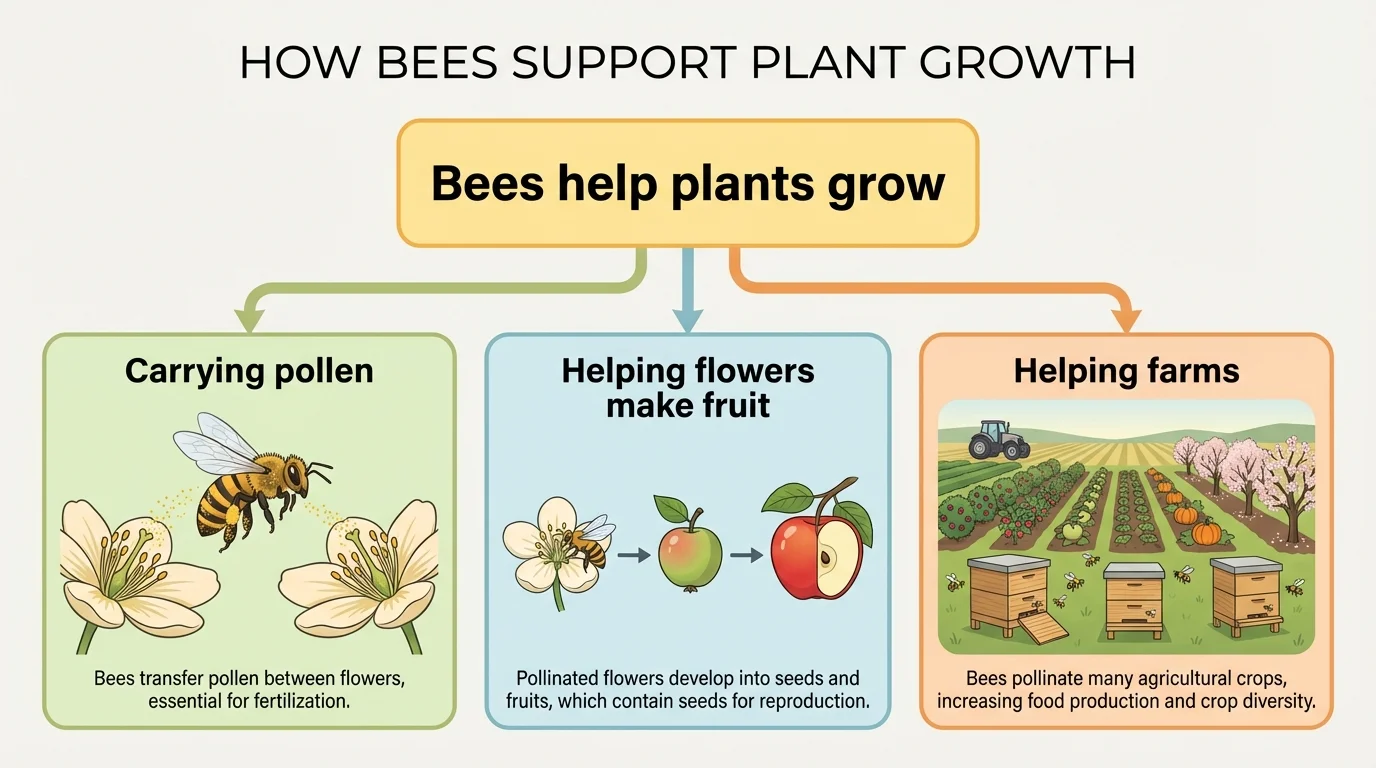
You can test a main idea by checking whether the details fit under it. If the details all connect, your main idea is probably strong. If some details do not fit, you may need to choose a better main idea.
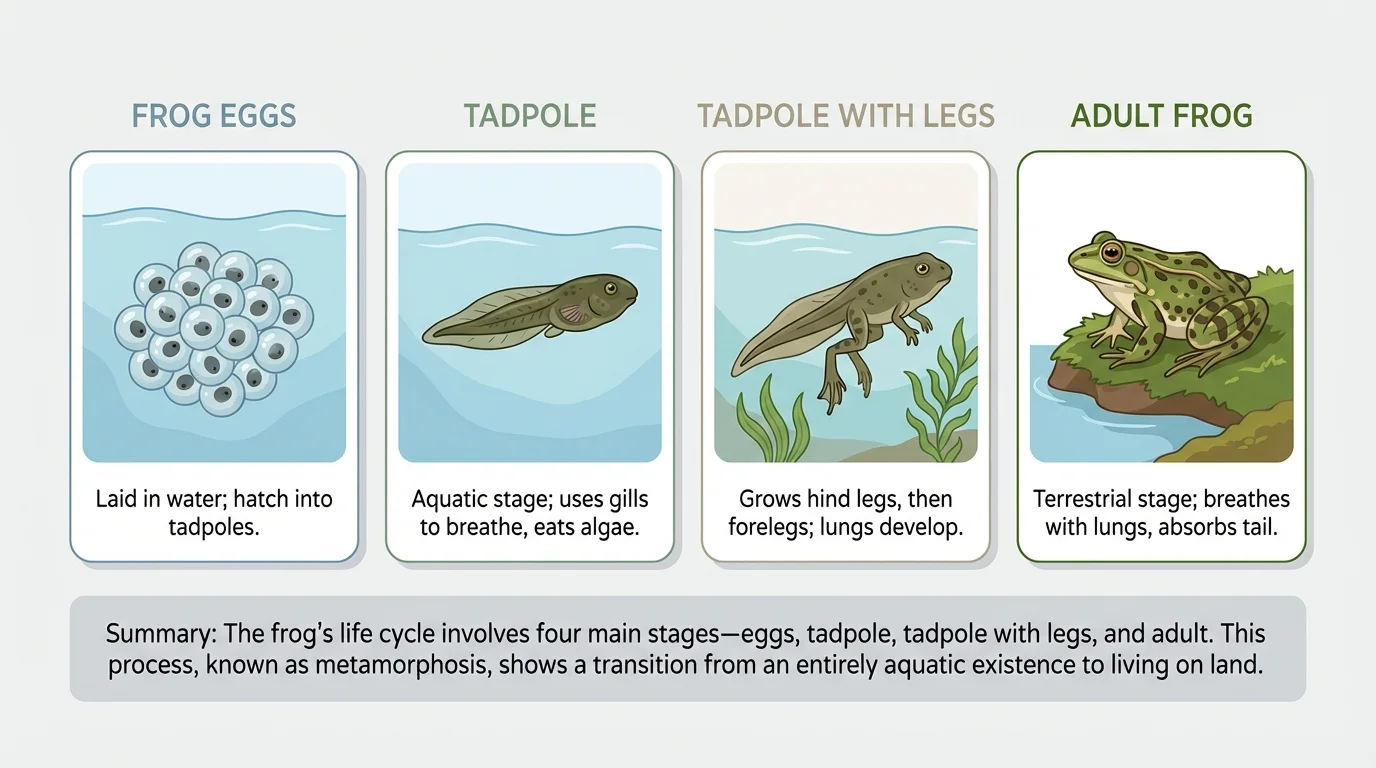
Here is another example. A text says that frogs begin life as eggs, hatch into tadpoles, and later develop legs and become adults. The main idea is not "Frogs have lungs." That is one detail. The main idea is "Frogs change as they grow."
Supporting details are the important facts that help explain the main idea. Not every detail belongs in a summary. Good summarizers choose the details that matter most.
Ask these questions when choosing details: Does this fact explain the topic better? Does it help prove or describe the main idea? Would the summary still make sense without it? If a detail is interesting but not important, it can be left out.
Suppose a text about whales says that blue whales are the largest animals on Earth, they live in oceans, they eat tiny krill, and one whale in the story had a scar on its tail. The first three details support the main idea. The scar might be interesting, but it is probably too small or too specific for a brief summary.
Important details versus extra details
Important details help explain the topic to someone who knows little about it. Extra details may be fun, surprising, or very specific, but they are not needed in a short summary. Strong writers learn to tell the difference.
When you do research, you may collect many notes. That is fine. A researcher often gathers more facts than will fit in the final summary. Your task is to choose the details that best support the main idea.
After reading and taking notes, the process follows a clear order. First, read or listen carefully. Next, jot down key facts. Then decide on the main idea. After that, choose the best supporting details and write complete sentences.
These steps help students stay organized. Without a plan, it is easy to copy too much, forget important details, or mix unrelated facts together.
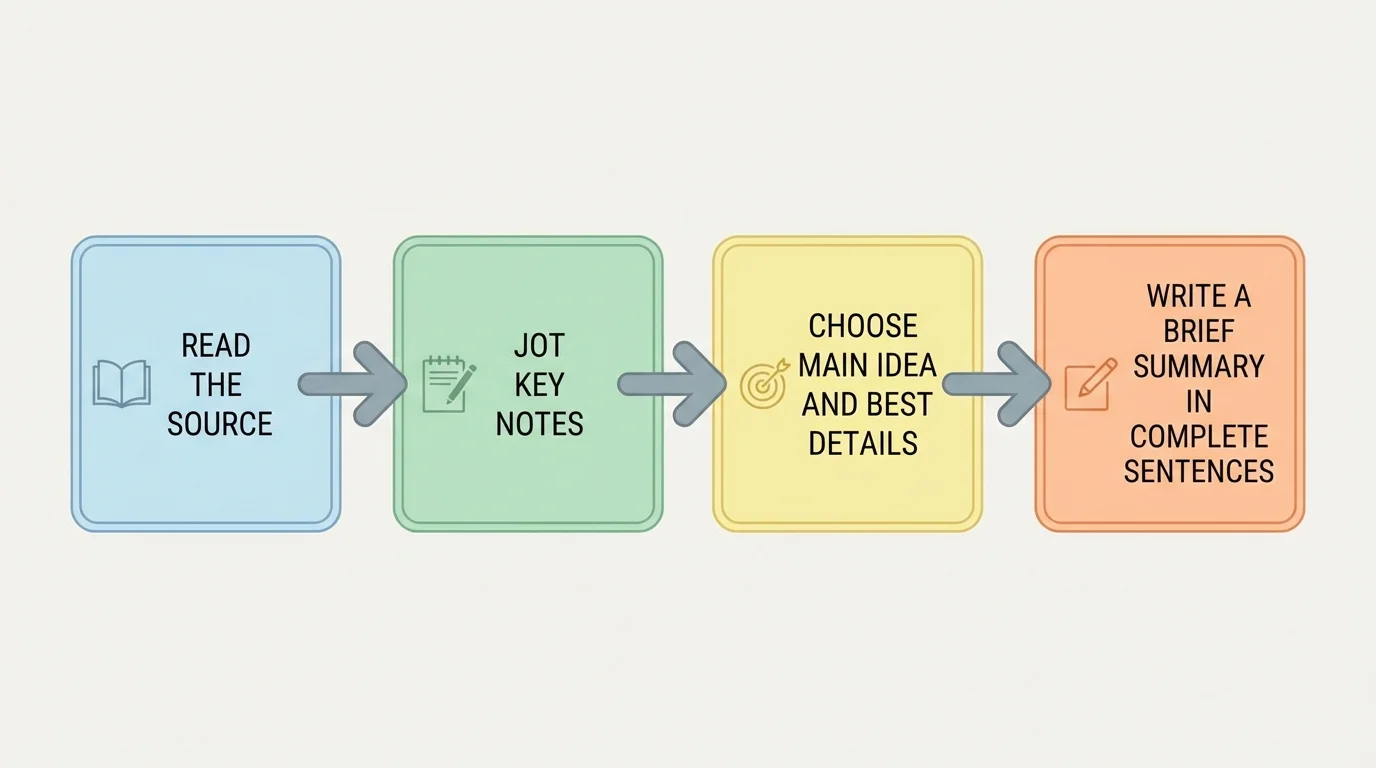
Step 1: Read or view the source carefully. You might read a book page or an article, or watch a short video.
Step 2: Take notes. Write short phrases, not long copied sentences.
Step 3: Ask, "What is the source mostly teaching me?" That gives you the main idea.
Step 4: Pick two to four strong details that support the main idea.
Step 5: Turn your notes into a short paragraph or a few clear sentences.
Notice that note-taking and summary writing are not the same thing. Notes may be messy, short, and out of order. A summary should be organized and easy to understand.
Sometimes you will communicate what you learned by writing. Other times you may explain it aloud to a partner, small group, or class. In both cases, clarity matters. Start with the topic, tell the main idea, and then share supporting details in a sensible order.
Complete sentences help your audience understand you. Compare these two examples. "Volcanoes. Hot rock. Eruptions." That is not very clear. Now listen to this: "Volcanoes are openings in Earth's surface that can erupt with melted rock, ash, and gases." The second sentence is much clearer.
Transitions can help too. Words like first, also, because, and finally connect ideas. They make speaking and writing smoother.
News reporters often begin by giving the most important information first. That is a lot like writing a strong summary: start with the big idea, then add key details.
If you are speaking, it helps to look at your notes, not read every word from the source. If you are writing, it helps to reread your summary and check whether every sentence fits the main idea.
[Figure 3] Short research projects often begin with gathering facts from more than one source. A student may read a library book, watch a short educational video, and use a kid-friendly website. Then the student puts the information together into one clear summary.
Here is a research topic about frogs. Notes might say: frogs begin as eggs, tadpoles live in water, frogs grow legs, and adult frogs can live on land and in water. These notes lead to a summary like this: "Frogs change a lot as they grow. They begin as eggs and hatch into tadpoles that live in water. Later, they grow legs and become adult frogs." This summary is short, clear, and based on important details.
Now think about a project on tornadoes. Notes might include: tornadoes are spinning columns of air, they can form during strong storms, and they can cause damage. A brief summary could be: "Tornadoes are powerful spinning columns of air that form during some strong storms. They can move across land and cause serious damage."
For a project about community helpers, a student might gather facts about firefighters. Notes may say: firefighters put out fires, rescue people, and teach fire safety. A summary could be: "Firefighters help keep communities safe. They put out fires, rescue people in danger, and teach others how to prevent fires."
Example: From notes to summary
Topic: Bees
Step 1: Gather notes
Bees move pollen. Bees help flowers make seeds and fruit. Farmers need bees for many crops.
Step 2: Find the main idea
The notes all show that bees help plants grow and are important in nature and farming.
Step 3: Write the summary
"Bees are important because they help plants grow. They move pollen between flowers, which helps plants make seeds and fruit. Bees also help farmers grow many crops."
Notice how the summary does not list every possible fact about bees. It stays focused. As we saw earlier in [Figure 1], the best details connect back to one big idea.
One common mistake is copying too much from the source. A summary should mostly use your own words. You can fix this by looking away from the source after reading a section and then saying the idea aloud before writing it.
Another mistake is adding personal opinions. If your research is about snakes, a sentence like "Snakes are scary and gross" is not part of a factual summary. A better sentence would share researched information, such as where snakes live or how they move.
A third mistake is including too many tiny details. If your summary is crowded with little facts, the main idea gets lost. Think about the frog notes in [Figure 3]: the important job is to explain the life changes clearly, not to include every small fact from every source.
Another mistake is leaving out the main idea completely. Sometimes students write three facts, but the reader cannot tell what the whole topic is about. A strong summary needs both the main idea and supporting details.
| Mistake | Problem | Better choice |
|---|---|---|
| Copying lines from the source | Does not show your understanding | Use your own words |
| Adding opinions | May change the meaning | Stick to facts from the research |
| Using too many details | Main idea gets lost | Choose only key supporting details |
| Missing the main idea | Reader cannot tell the point | State what the whole text is mostly about |
Table 1. Common summary mistakes and better choices to fix them.
Before sharing your work, ask yourself a few questions. Did I tell the topic clearly? Did I include the main idea? Did I choose important supporting details? Did I use my own words? Is my summary short and easy to understand?
These questions help you check your writing or speaking. Over time, summarizing becomes easier because your brain gets better at spotting what matters most.
"Say the most important things in a clear and careful way."
— A strong rule for summarizing
Good summaries are powerful because they help turn information from research into understanding. When you can gather information, decide what matters, and explain it clearly, you are doing the work of a reader, writer, speaker, and researcher all at once.
