Skilled readers do not know every word the first time they see it. Instead, they use clues. One of the strongest clues hides inside the word itself. If you know that photo means "light," then words like photograph and photosynthesis suddenly become much less mysterious. Learning a few Greek and Latin word parts is like getting keys that open hundreds of new words.
[Figure 1] Many English words are built from pieces that come from Greek and Latin. These pieces often carry meaning from one word to another. When readers notice these parts, they can make smart guesses about unfamiliar words. This is part of morphology, the study of how words are built.
You already do this sometimes without thinking. If you see the word preview, you may notice pre-, which means "before." That helps you understand that a preview is something you see before the main event. When you use word parts in this way, you are reading like a detective.
Root is the main part of a word that carries the core meaning. A prefix is added at the beginning of a word, and a suffix is added at the end. An affix is a general name for a prefix or suffix.
Words can often be taken apart into meaningful pieces. When you spot a prefix, root, or suffix, you gain clues about what the whole word means. Even if you are not completely sure, those clues help you make a strong first guess.
For example, in the word unhelpful, the prefix un- means "not," the root help tells the main idea, and the suffix -ful means "full of" or "having." In the word prediction, pre- means "before," dict relates to "say," and -tion turns the word into a noun.
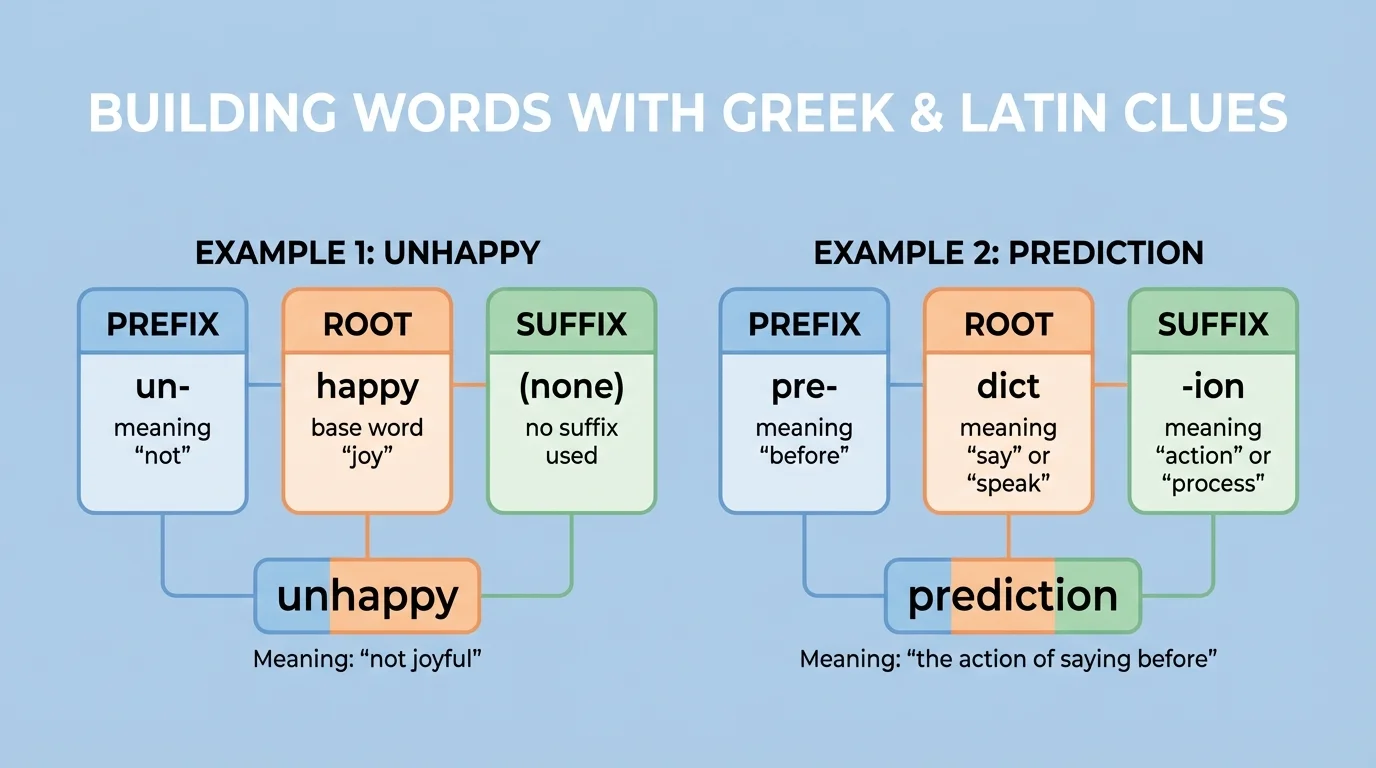
Not every word has all three parts. Some words have only a root. Some have a root and a suffix. Others have a prefix and a root. The important idea is that these parts are meaningful. They are not random letters.
If you know the meaning of one part, you can often connect it to many words. That is why learning roots and affixes is so powerful. Instead of memorizing one word at a time, you learn patterns that appear again and again in stories, science books, and articles.
You may already know how to use context clues, which are hints from the words and sentences around an unfamiliar word. Word-part clues and context clues work best when they work together.
Suppose you read, "The player had to rebuild the model after it fell apart." The prefix re- means "again." The root build means "make." So rebuild means "build again." The sentence context supports that meaning.
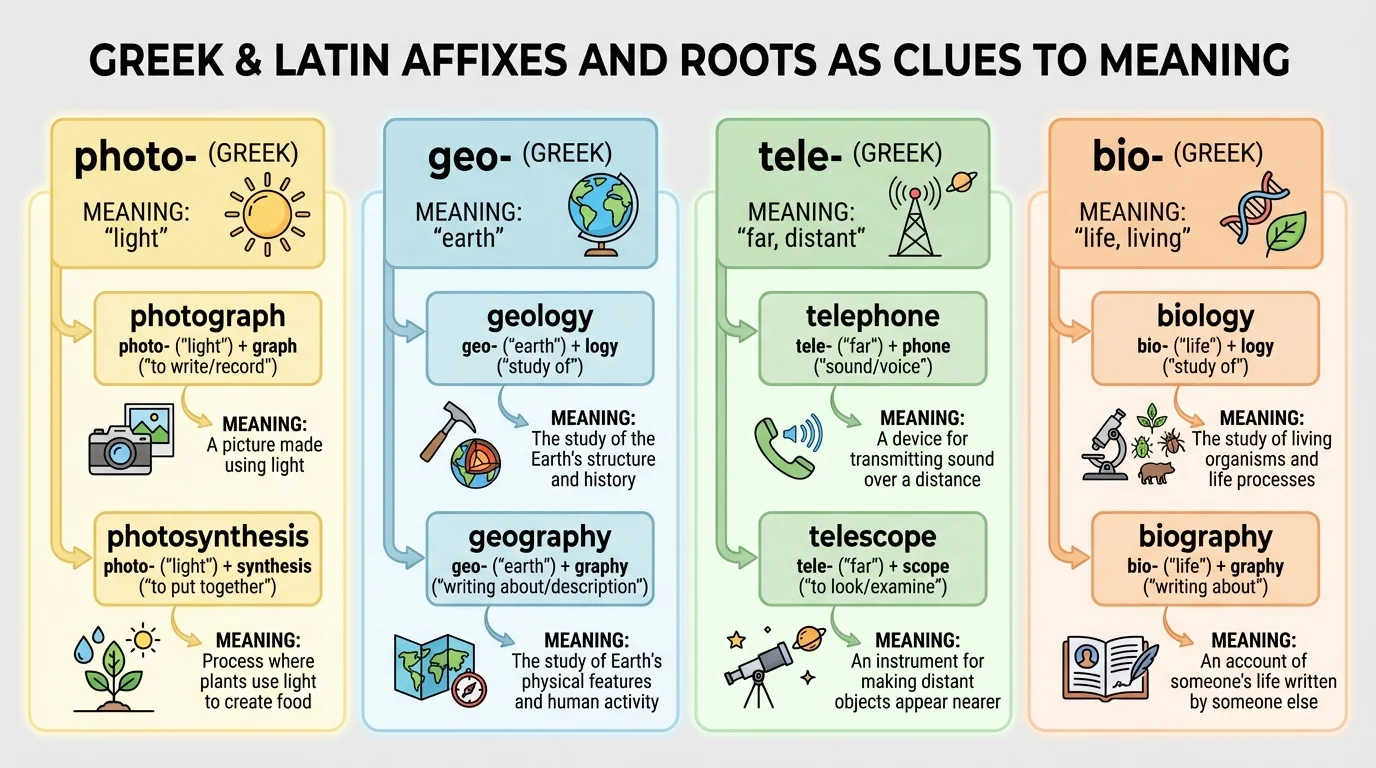
Greek roots appear in many science words, school words, and everyday words. One Greek root can lead to a whole family of related words, as [Figure 2] illustrates. When you learn one root, you often unlock several words at once.
Here are some useful Greek roots. The root photo means "light." A photograph is a picture made using light. In science, photosynthesis is the process plants use to make food using light energy. The root graph means "write" or "record." A paragraph is a section of writing. A biography is writing about a person's life.
The root tele means "far." A telephone carries sound across distance. A television sends images from far away. The root geo means "earth." Geography is the study of Earth's places. Geology is the study of Earth's rocks and structure.
The root bio means "life." Biology is the study of life. A biography tells about a life. The root auto means "self." An autobiography is the story of a person's own life, written by that person.
These roots appear in school subjects because Greek was used long ago to form many academic and scientific terms. Once you notice that pattern, big words become easier to approach.
The word photosynthesis combines Greek parts that mean "light" and "putting together." That matches what plants do: they use light to help make food.
Latin roots also appear all through English. Many action words, school words, and formal words come from Latin. If you know these roots, you can often figure out the meaning of words in reading, writing, science, and social studies.
The root port means "carry." Transport means "carry across." Portable means "able to be carried." The root dict means "say" or "speak." Predict means "say before." A dictionary is a reference source that lists words and their meanings.
The Latin root vis means "see." Visible means "able to be seen." Video and vision also relate to seeing. The root struct means "build." A structure is something built. Construct means "build together."
The root aud means "hear." In an audience, people listen. Audio relates to sound. The root tract means "pull." Attract means "pull toward." Tractor is a vehicle that pulls heavy things.
Notice how often these roots stay close to their original meanings. That does not mean every word will be easy, but it does mean you have strong clues to work with.
Roots give the main meaning, but affixes often change or sharpen that meaning. Some prefixes tell about time, place, direction, number, or whether something is opposite. Some suffixes tell what kind of word it is, such as a noun, adjective, or someone who does an action.
Here are some common prefixes: un- means "not," as in unfair; re- means "again," as in replay; pre- means "before," as in preheat; and mis- means "wrongly" or "badly," as in misread.
Here are some common suffixes: -ful means "full of," as in hopeful; -less means "without," as in careless; -able means "able to be," as in washable; -er can mean "a person or thing that does," as in teacher; and -tion often turns a word into a noun, as in celebration.
| Word Part | Meaning | Example | How It Helps |
|---|---|---|---|
| un- | not | unkind | not kind |
| re- | again | rewrite | write again |
| pre- | before | preview | see before |
| mis- | wrongly | misplace | place wrongly |
| -ful | full of | playful | full of play |
| -less | without | fearless | without fear |
| -able | able to be | readable | able to be read |
| -tion | act or result | prediction | the act or result of predicting |
Table 1. Common affixes, their meanings, and examples of how they help explain words.
Affixes are especially helpful when a word contains a familiar root. If you know dict means "say," then predict means "say before," and contradict means "say against."
When you meet an unfamiliar word, do not panic. Follow a process. Start by looking for a prefix, root, or suffix you recognize. Then make a possible meaning. After that, read the whole sentence again and ask whether your guess makes sense.
[Figure 3] This matters because morphology is a clue, not magic. Sometimes your first guess will be close but not perfect. Context helps you check and adjust.
For example, read this sentence: "The class watched the caterpillar transform into a butterfly." You may notice trans-, which often means "across" or "change," and form, which means "shape." That suggests transform means "change form." The sentence confirms it.
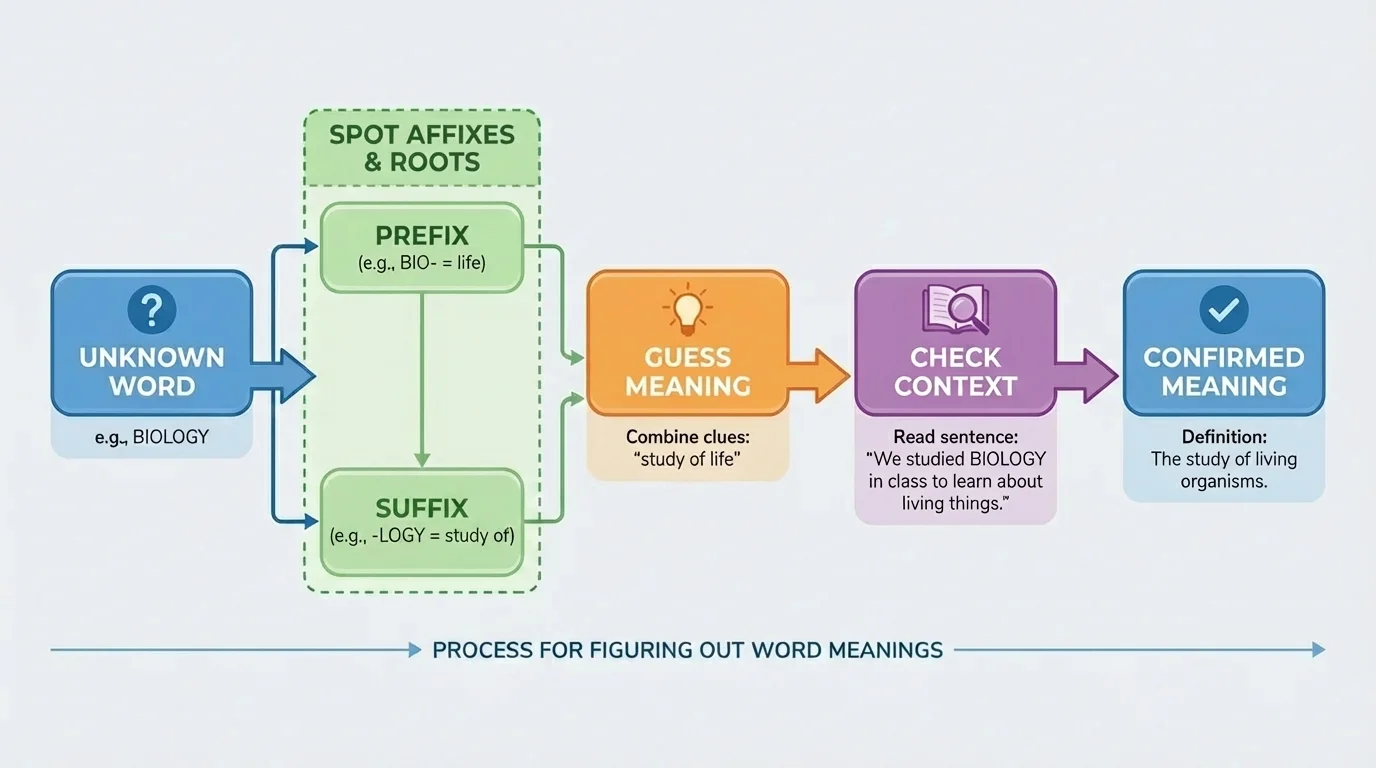
A smart strategy for unknown words is to use at least three clues together: word parts, the sentence around the word, and what you already know about the topic. The strongest readers do not depend on just one clue.
Try another sentence: "The scientist used a microscope to view tiny organisms." You may know micro means "small" and scope relates to "look" or "see." That helps you figure out that a microscope is a tool for looking at very small things. The science context makes that meaning even clearer.
Breaking down words step by step
Here are examples of how a reader can use roots and affixes to find meaning.
Step 1: Look at photograph.
The Greek root photo means "light," and graph means "write" or "record."
Step 2: Put the meanings together.
A photograph is something recorded using light.
Step 3: Check with what you know.
Cameras use light to capture pictures, so the meaning fits.
This type of thinking helps with many new words.
Later, when you come across science terms, this same process still works. Readers can move from noticing a word part to testing a meaning with context instead of guessing wildly.
Some long words look difficult only because they are packed with several meaningful parts. If you slow down and separate them, they become much more manageable.
Take photosynthesis. The part photo means "light." The part synthesis means "putting together." So the word suggests "putting together with light." In science, that matches the way plants use light to help make food.
Take autobiography. The root auto means "self," bio means "life," and graph means "write." Put together, the word means "writing about one's own life."
Take transportation. The root port means "carry." The prefix trans- suggests "across," and the suffix -tion turns the idea into a noun. So transportation has to do with carrying people or things from one place to another.
Take prediction. The prefix pre- means "before," the root dict means "say," and the suffix -tion turns the word into a noun. A prediction is something said before it happens.
When readers see big words in science or social studies, they should remember that those words are often built from familiar pieces. This is one reason learning roots and affixes helps in every subject.
Word parts are very useful, but they are not the only clues. Sometimes a word has changed over time. Sometimes a root meaning gives only part of the answer. Sometimes a word can have more than one meaning.
For example, the word portable clearly connects to port, meaning "carry." A portable speaker is easy to carry. But if you see a word like report, the meaning is less direct. The root still helps, but context is needed to understand exactly what the word means in that sentence.
That is why readers should be flexible. They should not force a meaning that does not fit. If the sentence does not make sense, it is time to revise the guess.
"Good readers use clues, test their ideas, and adjust when needed."
Think of morphology as a flashlight, not a complete map. It helps you see where to go, but you still need the rest of the sentence to guide you.
Words that share a root often belong to the same word family. Seeing these relationships helps you build vocabulary faster. If you know one family member, another one may feel familiar.
Look at the struct family: structure, construct, instruction, and instruct. The meanings are not identical, but they are connected by the idea of building or arranging. Look at the vis family: vision, visible, and television. These words all connect to seeing.
Greek roots also form strong families. The root photo links photograph, photosynthesis, and photocopy. The root geo links geography, geology, and geometry. As seen earlier in [Figure 2], one root can branch into many related words.
When you notice these relationships, vocabulary stops feeling like a pile of separate facts. Instead, it becomes a connected system.
Strong readers pay attention to word parts in novels, articles, instructions, and textbooks. They notice prefixes and suffixes. They search for roots they have seen before. They combine that knowledge with context to make thoughtful guesses.
This skill matters in everyday life. Sports articles use words like predict. Technology words may include tele or auto. Science books are full of Greek roots like bio, geo, and photo. The more you read, the more these parts repeat.
Even when you are unsure, breaking a word apart is a smart first move. If you know pre-, re-, un-, photo, bio, dict, and port, you already have a strong set of tools. Those tools help you unlock many unfamiliar words without needing someone to tell you every definition.
