Every bite of food you eat, whether it is an apple, a sandwich, or even meat from an animal, connects back to one astonishing process: photosynthesis. In this process, certain living things capture energy from sunlight and turn it into chemical energy stored in sugar molecules. That means sunlight can become food. Even more amazing, this process also releases oxygen, which most living things need to survive.
Photosynthesis is one of the most important biological processes on Earth. It powers most food chains, helps control the amount of carbon dioxide in the atmosphere, and produces much of the oxygen in the air and water. Without it, forests would not grow, crops would not feed people, and ocean ecosystems would collapse.
Living things need energy. Animals get energy by eating plants or other animals. But plants do not eat food the way animals do. Instead, they make their own food. Algae do this too, and so do many tiny organisms that live in water or moist environments. These organisms are called producers because they produce food at the base of ecosystems.
When photosynthetic organisms make sugars, they store energy in chemical bonds. Other organisms can then use that energy by eating the producer directly or by eating something that ate the producer. This is why photosynthesis supports nearly every major food web on Earth, from grasslands to coral reefs.
Most of the oxygen you breathe does not come from forests alone. A very large share is produced by photosynthetic organisms in the oceans, especially microscopic phytoplankton near the surface.
Photosynthesis also helps balance gases in the atmosphere. It removes carbon dioxide, written as \(\textrm{CO}_2\), from the air and releases oxygen, written as \(\textrm{O}_2\). Because carbon dioxide is a greenhouse gas, photosynthesis is part of Earth's climate system as well as its life system.
Most students first learn about photosynthesis by studying green plants, and plants are certainly major photosynthetic organisms. Trees, grasses, mosses, ferns, and flowering plants all use sunlight to make sugars. But they are not alone.
Many kinds of algae also photosynthesize. Some algae are large and easy to see, such as seaweed in the ocean. Others are tiny and live floating in ponds, lakes, and oceans. Some microorganisms, including many kinds of bacteria and protists, can also capture light energy and make food.
One especially important group is phytoplankton. These are tiny photosynthetic organisms that drift in sunlit water. They may be microscopic, but together they have a huge effect on Earth. They make food for marine ecosystems and release enormous amounts of oxygen.
All living things are made of cells, and cells carry out the processes of life. Photosynthesis is one example of a life process that happens inside certain cells and depends on specific structures working together.
Not all organisms can photosynthesize. Animals, fungi, and many bacteria cannot make sugars from light. They depend directly or indirectly on photosynthetic organisms for food.
For photosynthesis to happen, an organism needs light energy, water, and carbon dioxide. The overall movement of matter and energy is shown in [Figure 1], where light enters the system, carbon dioxide comes in from the air or water, and water is supplied from the environment. The products are sugar and oxygen.
The most common sugar used to represent photosynthesis is glucose, written as \(\textrm{C}_6\textrm{H}_{12}\textrm{O}_6\). The overall equation is:
\[6\textrm{CO}_2 + 6\textrm{H}_2\textrm{O} + \textrm{light energy} \rightarrow \textrm{C}_6\textrm{H}_{12}\textrm{O}_6 + 6\textrm{O}_2\]
This equation does not show every tiny step, but it captures the big picture. Six molecules of carbon dioxide combine with six molecules of water, using energy from light, to form one glucose molecule and six molecules of oxygen.
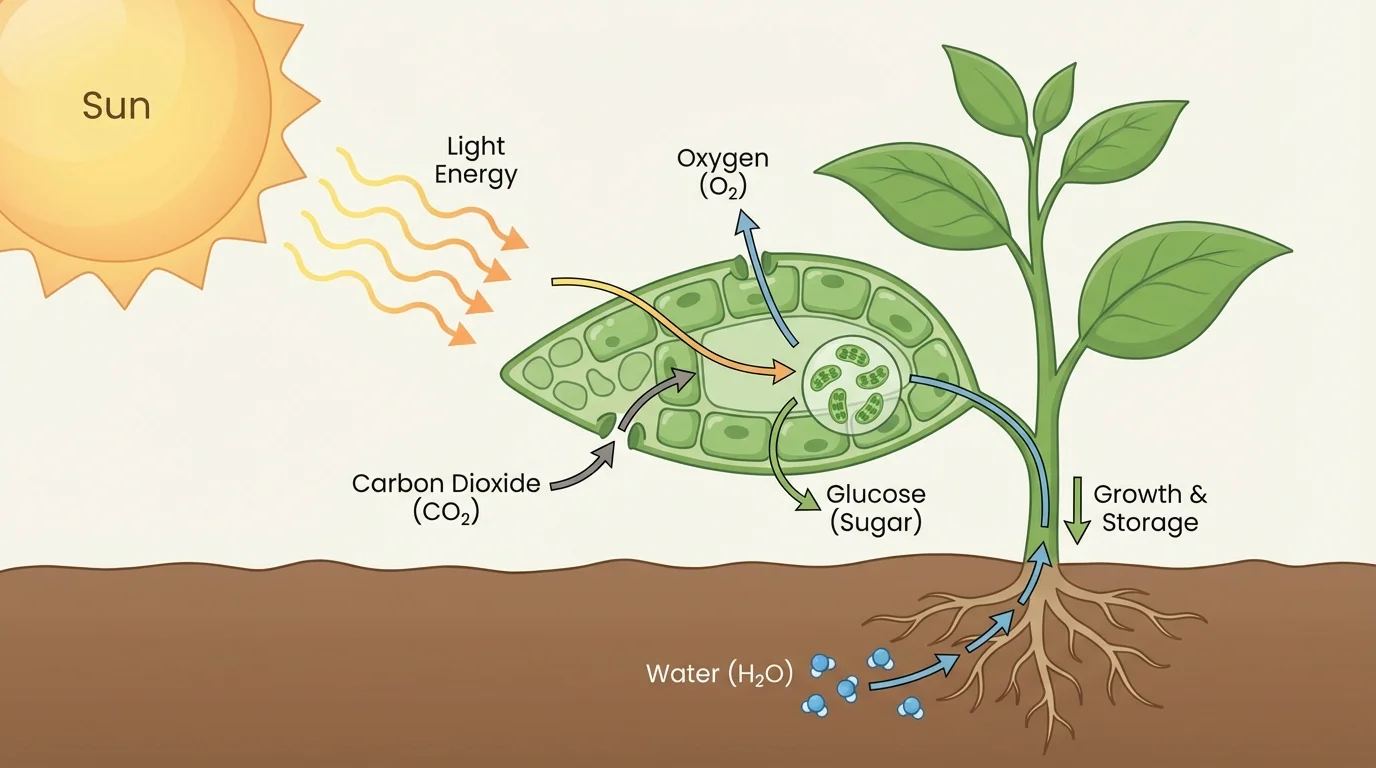
A simple numeric way to read the equation is this: if a plant cell uses \(6\) molecules of \(\textrm{CO}_2\) and \(6\) molecules of \(\textrm{H}_2\textrm{O}\), it can make \(1\) molecule of glucose and release \(6\) molecules of \(\textrm{O}_2\). The numbers matter because atoms must be conserved. The same numbers of carbon, hydrogen, and oxygen atoms must appear on both sides of the equation.
Reading the equation with numbers
Suppose a photosynthetic organism takes in \(12\) molecules of \(\textrm{CO}_2\) and enough water and light are available.
Step 1: Compare the amount to the equation.
The equation uses \(6\) molecules of \(\textrm{CO}_2\) to make \(1\) glucose molecule.
Step 2: Scale the equation.
Since \(12 \div 6 = 2\), the organism has enough carbon dioxide for \(2\) glucose molecules.
Step 3: Find the oxygen released.
Each full equation also releases \(6\) molecules of \(\textrm{O}_2\). Twice that amount is \(12\) molecules of \(\textrm{O}_2\).
So with \(12\) molecules of \(\textrm{CO}_2\), the organism can form \(2\) glucose molecules and release \(12\) molecules of oxygen, if water and light are not limiting.
Another important idea is that the carbon in sugar comes from carbon dioxide, not from soil. Soil provides minerals and support, but the actual carbon atoms in plant sugars are taken from the atmosphere or dissolved carbon dioxide in water.
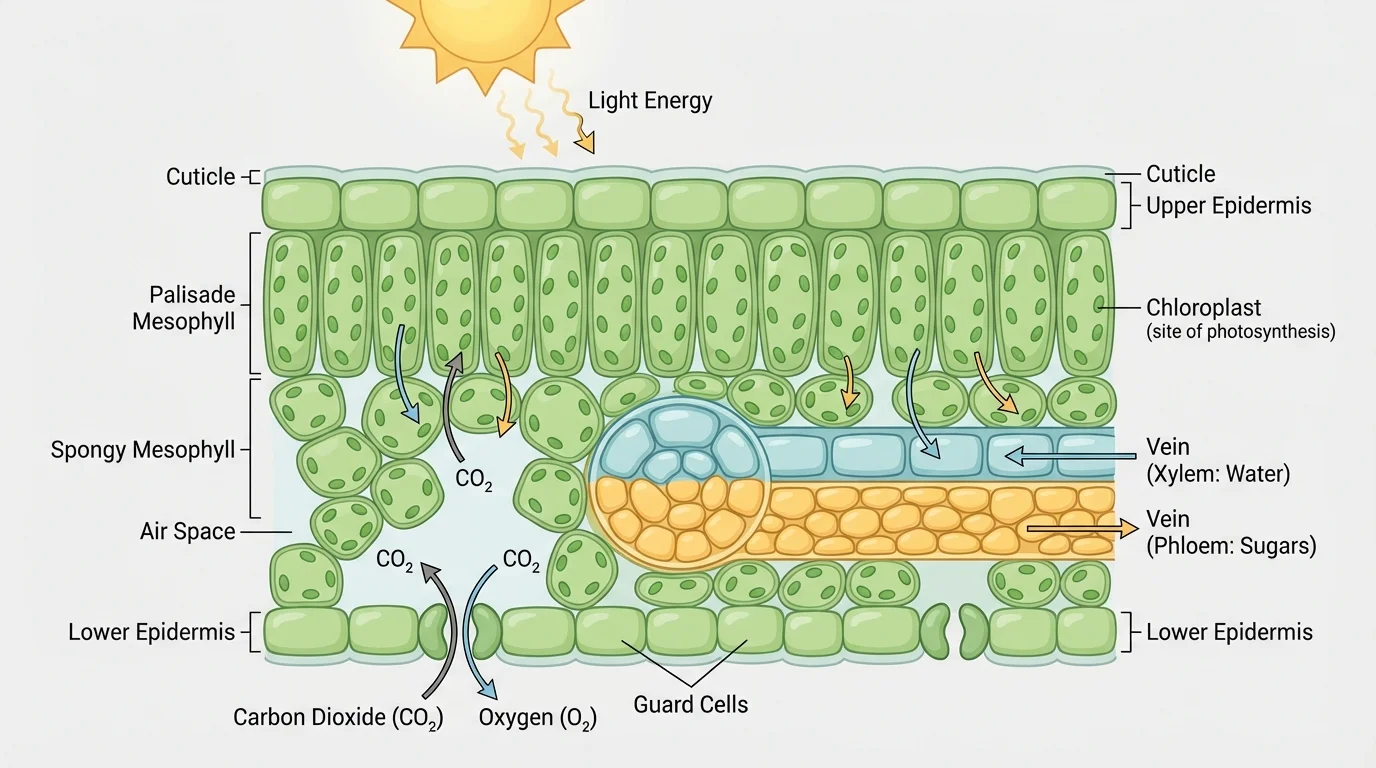
In plants, photosynthesis mainly happens in leaves and green stems. The structures involved are visible in [Figure 2], especially the cells packed with chloroplasts that capture light. Inside leaf cells are tiny organelles called chloroplasts, and these are the main sites of photosynthesis.
Chloroplasts contain a green pigment called chlorophyll. Chlorophyll absorbs certain wavelengths of light, especially red and blue light, and reflects much of the green light. That reflected green light is why many leaves look green to our eyes.
Leaves are designed for this job. They are usually broad and thin, which helps them collect sunlight. Tiny openings called stomata allow gases to move in and out. Carbon dioxide enters through these openings, while oxygen and water vapor can leave.
Veins in the leaf bring water upward from the roots and help transport sugars away from the leaf to other parts of the plant. This means a leaf is not just a flat green surface. It is a busy structure for collecting light, moving materials, and carrying out chemical reactions.
In algae and photosynthetic microorganisms, the structures may be simpler, but the same main idea applies: light-absorbing pigments capture energy, and the cells use that energy to build sugars from carbon dioxide and water. Later, when we compare land plants with ocean producers, this comparison still helps because it reminds us that photosynthesis depends on specialized structures for gas exchange, transport, and light capture.
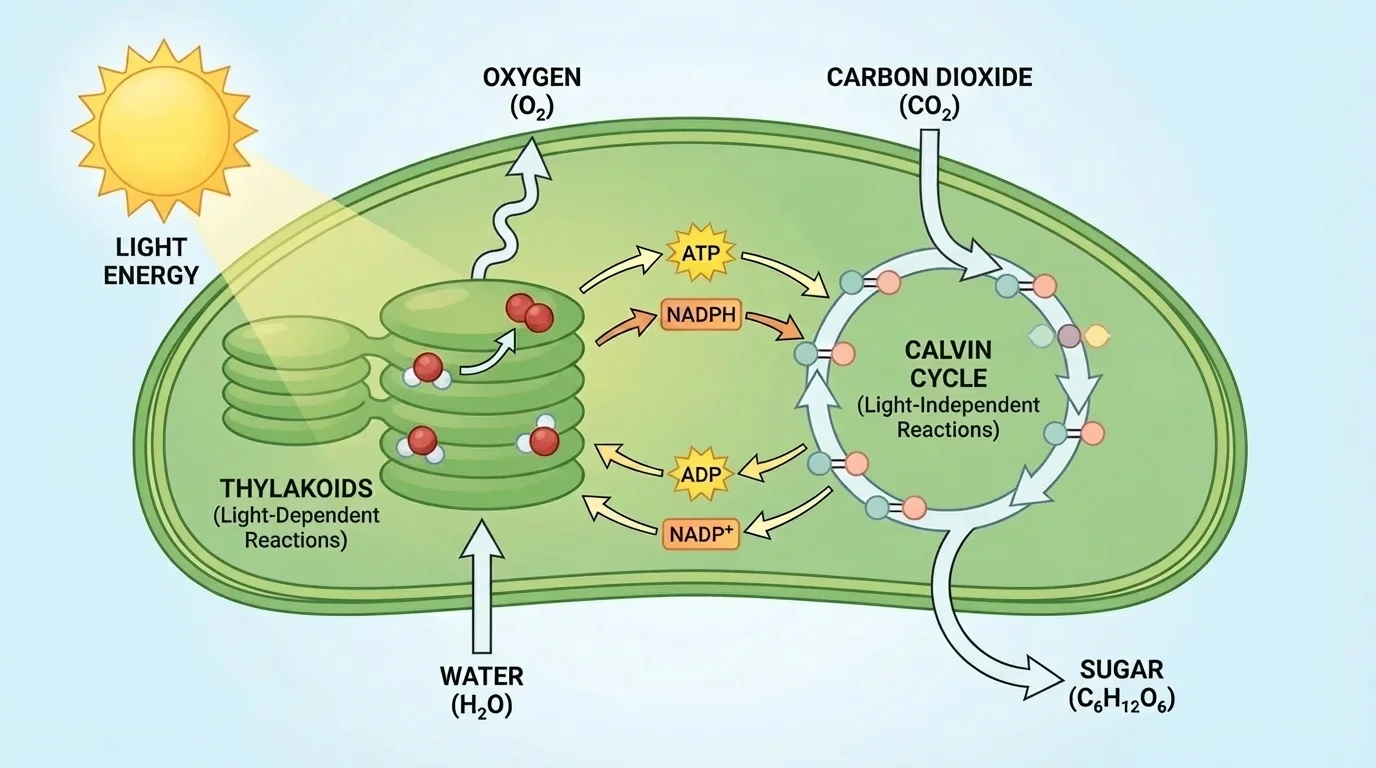
Photosynthesis is not a single instant event. It is a series of linked reactions organized into two broad stages, as [Figure 3] shows. Scientists often call these the light-dependent reactions and the light-independent reactions, although the second stage still depends on products made in the first stage.
In the first stage, light energy is absorbed by chlorophyll and other pigments. That energy is used to power reactions that split water molecules. When water is split, oxygen is released. Energy is also captured in molecules that the cell can use in the next stage.
In the second stage, the cell uses carbon dioxide and the energy captured earlier to build sugars. You do not need to memorize all the details of the chemical pathways at this grade level, but you should understand the main idea: one stage captures light energy, and the next stage uses that energy to build food molecules.
It may help to think of photosynthesis like a solar-powered factory. First, the factory captures energy. Then it uses that energy to assemble raw materials into a useful product. In this case, the product is sugar. That analogy is not perfect, but it explains why photosynthesis involves both energy capture and molecule building.
Why oxygen is released
During photosynthesis, water molecules are broken apart in the light-dependent stage. The oxygen atoms from water can then form oxygen gas, \(\textrm{O}_2\), which is released into the environment. This is one reason photosynthesis is so important to life on Earth.
When scientists studied photosynthesis closely, they found that the oxygen released comes from water, not from carbon dioxide. That idea surprised many people at first. Even today, students sometimes assume oxygen gas comes directly out of carbon dioxide because carbon dioxide contains oxygen atoms. The actual process is more interesting than that.
The sugar made during photosynthesis is not always used immediately. Some of it is used right away in cellular respiration, a process that breaks down sugar to release usable energy for the cell's activities. Plants need energy just as animals do, because living cells must grow, repair themselves, and transport materials.
Some sugar is stored for later use. Many plants convert glucose into starch, a storage molecule. Starch can be kept in roots, stems, seeds, fruits, or tubers. A potato, for example, stores a large amount of starch. That starch began as sugar made through photosynthesis in the leaves of the potato plant.
Plants also use sugars to build other important molecules. They can combine sugars into cellulose, the strong material that helps form cell walls. That means photosynthesis does not just provide food energy. It also provides the raw material for growth and structure.
Sugars can be transported through the plant from leaves to other organs. A tree leaf may make sugar in summer, and some of that sugar can later support growth in roots, flowers, fruits, or seeds. This is why photosynthesis is tied directly to plant growth, reproduction, and survival.
Real-world example: from sunlight to stored food
A corn plant uses sunlight in summer to make sugars in its leaves.
Step 1: The leaves absorb light and take in \(\textrm{CO}_2\).
Step 2: Photosynthesis produces glucose.
Step 3: Some glucose is used immediately for the plant's energy needs.
Step 4: Some is converted into larger storage or structural molecules, including starch in developing kernels.
The food people and animals eat from the corn plant ultimately traces back to photosynthesis.
When you eat fruits, grains, or vegetables, you are often eating stored products of photosynthesis. Even foods from animals trace back to this process, because animals depend on plants or on other animals that ate plants.
Photosynthesis does not happen at the same rate all the time. Its speed depends on environmental conditions. Four major factors are light intensity, carbon dioxide availability, water supply, and temperature.
If light is weak, photosynthesis is usually slower because less energy is available. As light intensity increases, the rate often rises, but only up to a point. After that, other factors may become limiting. For example, a plant may have plenty of light but not enough carbon dioxide or water.
Water matters because it is a raw material in photosynthesis and because plants need it to stay healthy. If a plant loses too much water, it may close its stomata to reduce water loss. When stomata close, less carbon dioxide can enter, so photosynthesis can slow down.
Temperature also affects the enzymes that help drive photosynthesis. If it is too cold, reactions may happen slowly. If it is too hot, enzymes may not work as well, and the plant may lose too much water. Different species are adapted to different temperature ranges.
| Factor | How it affects photosynthesis | Example |
|---|---|---|
| Light intensity | More light usually increases the rate until another factor becomes limiting. | A plant near a sunny window grows faster than one in a dark corner. |
| Carbon dioxide | More \(\textrm{CO}_2\) can increase the rate if light and water are available. | Plants in a greenhouse may grow faster when conditions are carefully controlled. |
| Water | Low water supply reduces photosynthesis and may cause stomata to close. | A wilted plant often photosynthesizes less effectively. |
| Temperature | Each species has an optimal range for the enzymes involved. | Cool-season and warm-season crops grow best under different conditions. |
Table 1. Major environmental factors that influence the rate of photosynthesis.
The idea of a limiting factor is important. If one needed ingredient is in short supply, it can hold back the whole process. This is similar to baking: even if you have plenty of flour and sugar, you cannot finish the recipe without enough water or heat.
Photosynthesis does not belong only to forests and gardens. In lakes, rivers, and oceans, tiny producers near the surface capture sunlight and support entire ecosystems, as [Figure 4] illustrates. The most important of these are phytoplankton, which drift in the sunlit upper layers of water.
Because light does not travel equally well through water, most photosynthesis in oceans happens near the surface. There, phytoplankton absorb light and use dissolved carbon dioxide and water to make sugars. Small animals feed on them, fish feed on those animals, and larger predators feed higher up the chain.
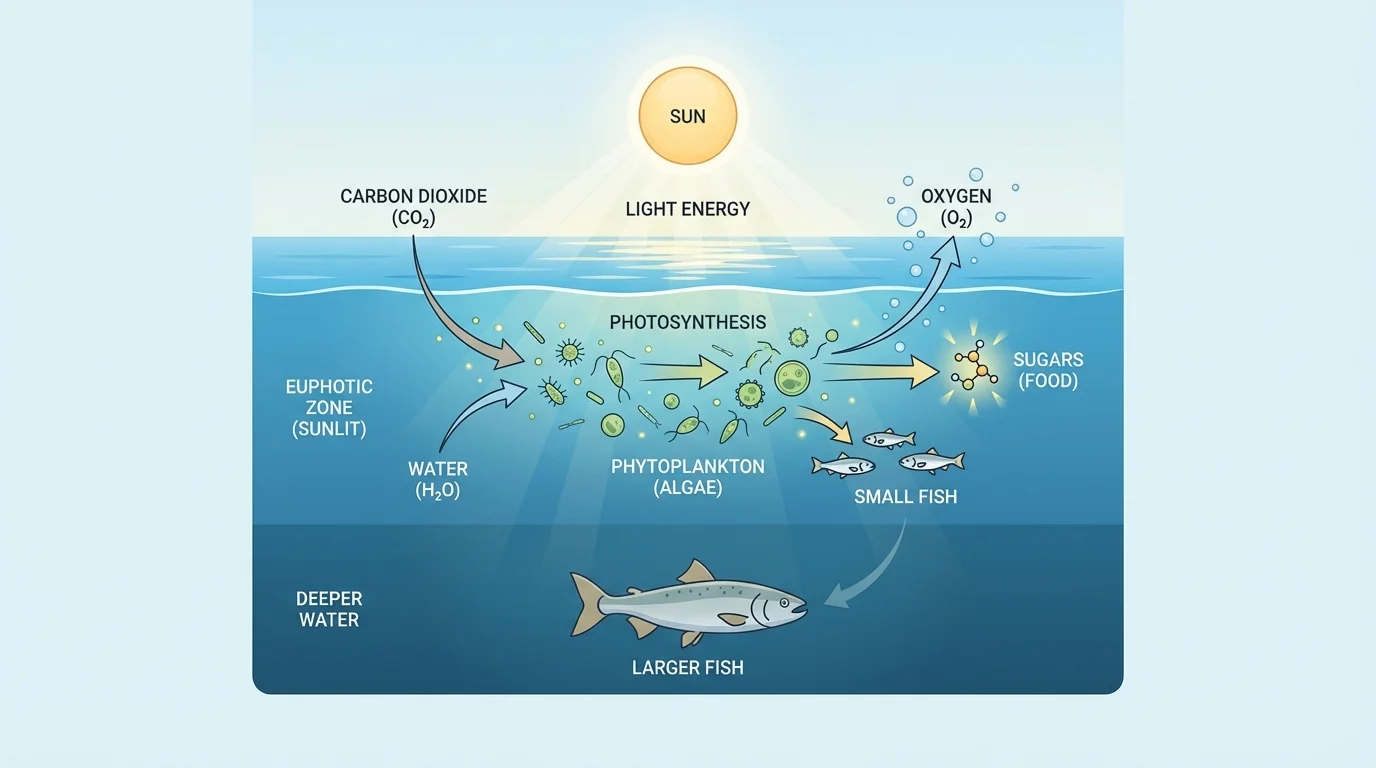
Even though each phytoplankton organism is tiny, together they are incredibly important. They produce a large share of Earth's oxygen and remove large amounts of carbon dioxide from the atmosphere and ocean water. This makes them important not only for marine food webs but also for global cycles of matter.
When we think about oxygen production or carbon movement on Earth, we should remember that massive forests are not the whole story. Microscopic organisms in the ocean are also major players.
Most ecosystems begin with photosynthetic producers. Grasslands depend on grasses. Forests depend on trees and other green plants. Many aquatic systems depend on algae and phytoplankton. Without these producers, there would be much less food available to all the organisms higher in the food web.
Photosynthesis is also connected to Earth's atmosphere over long periods of time. The oxygen-rich atmosphere that supports complex life exists because photosynthetic organisms released oxygen over vast stretches of Earth's history. This changed the planet and made new forms of life possible.
Humans depend on photosynthesis every day. Agriculture depends on it for crops such as rice, wheat, beans, and fruit. Forests depend on it for growth and carbon storage. Scientists who study climate, ecology, and ocean systems all pay close attention to photosynthesis because it links energy flow and matter cycling.
"Nearly all the energy available to life comes from the sun, captured first by photosynthetic organisms."
The process also matters in technology and environmental science. Researchers study algae for biofuels, satellite systems measure plant growth from space, and ecologists track phytoplankton blooms to understand ocean health. A process happening inside tiny chloroplasts has planetary consequences.
You can observe signs of photosynthesis in everyday life. Houseplants bend toward light because their leaves need exposure for efficient energy capture. Garden plants often grow better in proper sunlight because more light supports more photosynthesis, provided water and nutrients are available.
Farmers manage spacing, irrigation, and greenhouse conditions to support photosynthesis and crop production. In greenhouses, growers may control temperature, water, and sometimes carbon dioxide levels to help plants grow more efficiently.
Simple observation: oxygen bubbles from an aquatic plant
A sprig of an aquatic plant placed in water under bright light may produce visible bubbles.
Step 1: Place the plant in clear water and expose it to light.
Step 2: Watch for tiny bubbles forming on the leaves.
Step 3: Move the setup to lower light and compare what happens.
The bubbles are a visible sign that photosynthesis is occurring and oxygen is being released. This is a simple observation, not a precise measurement, but it helps connect the chemical equation to something students can actually see.
Aquarium owners sometimes notice that plants release more visible bubbles during bright parts of the day. This is another reminder that light powers the process. The two-stage model from [Figure 3] helps explain why: without enough captured light energy, the rest of the sugar-building process cannot continue as effectively.
One common misunderstanding is that plants get their food from soil. Plants do absorb water and minerals from soil, and these are essential. But the sugars that count as food are made mainly from carbon dioxide and water using light energy.
Another misunderstanding is that plants only produce oxygen and never use it. In fact, plants also carry out cellular respiration. They use oxygen to break down sugars and release usable energy, especially in times when photosynthesis is not happening, such as at night. During the day, however, a healthy green plant often produces more oxygen through photosynthesis than it uses in respiration.
Students also sometimes think photosynthesis happens only in land plants. In reality, algae and many microorganisms photosynthesize too, and phytoplankton are among the most important photosynthetic organisms on Earth.
Finally, some students assume all sugars are used immediately. In fact, many are stored or turned into other molecules. That is why roots, seeds, fruits, and stems can act as energy reserves for future growth or reproduction.
