A pilot flying through a crosswind does not move in exactly the direction the plane points. A swimmer crossing a river gets pushed downstream. A soccer ball can be kicked forward while spinning sideways through the air. In each case, two motions combine into one actual motion. That combination is a vector sum, and it reveals something that often surprises students: even if one vector has magnitude \(5\) and another has magnitude \(7\), their sum usually does not have magnitude \(12\).
Vectors are one of the most useful ideas in mathematics and science because they describe quantities that have both size and direction. When we add vectors, we are combining movements, forces, velocities, or displacements. There are several valid ways to do this, and each one highlights a different way of thinking.
A vector is a quantity with both magnitude and direction. Examples include velocity, force, acceleration, and displacement. A quantity such as temperature or mass has only size, not direction, so it is not a vector.
The magnitude of a vector is its length or size. If a vector represents a displacement of \(8\) meters east, then \(8\) meters is the magnitude and east is the direction. Two vectors are equal if they have the same magnitude and the same direction, even if they are drawn in different places.
Vector means a quantity with both magnitude and direction.
Magnitude means the length or size of a vector.
Resultant means the single vector that represents the sum of two or more vectors.
We often draw vectors as arrows. The arrow length shows magnitude, and the arrowhead shows direction. In coordinate form, a vector can also be written using components, such as \(\langle 3, 4 \rangle\), which means \(3\) units in the \(x\)-direction and \(4\) units in the \(y\)-direction.
There are three main methods for adding vectors:
These methods give the same resultant. They are not competing rules. They are different views of the same idea.
In the end-to-end method, you draw the first vector, then place the tail of the second vector at the head of the first. The sum is the vector from the tail of the first to the head of the second, as [Figure 1] shows. This method works because vectors can be translated, or slid, without changing their magnitude or direction.
Suppose one vector means "walk \(4\) meters east" and another means "walk \(3\) meters north." If you do those moves one after another, your overall displacement is not \(7\) meters. Instead, you end at a point that is \(4\) units east and \(3\) units north of where you started.
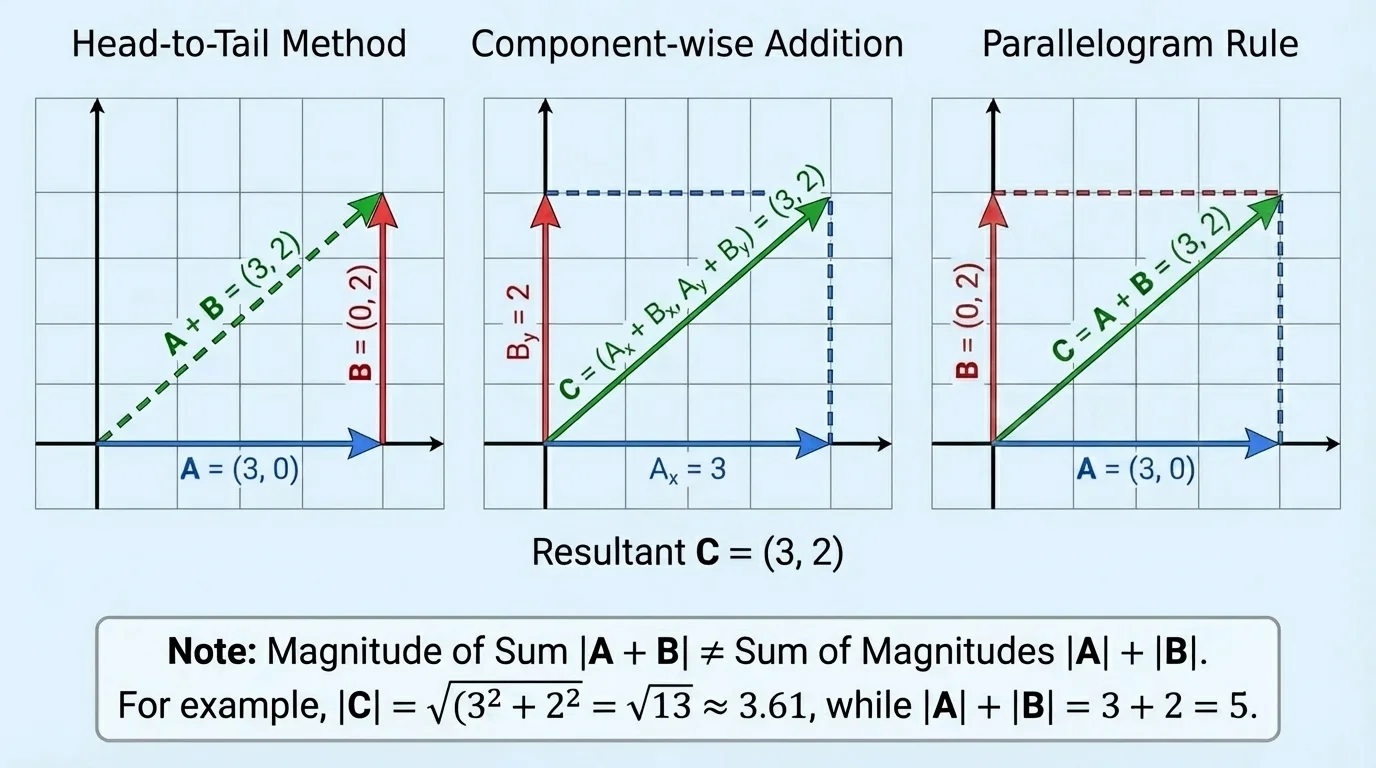
This geometric method is especially helpful when vectors represent actual motion. It matches the physical meaning of one movement followed by another. It also helps students see why direction matters so much. Walking \(5\) meters east and then \(5\) meters west gives a sum of \(0\), not \(10\), because the directions oppose each other.
If two vectors point in exactly the same direction, then the resultant is longer and the magnitudes do add. For example, \(\langle 2, 0 \rangle + \langle 5, 0 \rangle = \langle 7, 0 \rangle\). But that is a special case, not the general rule.
The most efficient method in algebra is to use components. If \(\vec{u} = \langle a, b \rangle\) and \(\vec{v} = \langle c, d \rangle\), then
\[\vec{u} + \vec{v} = \langle a + c,\; b + d \rangle\]
You add horizontal parts together and vertical parts together. This works because each component tells how much the vector contributes in one direction.
For example, if \(\vec{u} = \langle 3, 4 \rangle\) and \(\vec{v} = \langle -1, 2 \rangle\), then
\[\vec{u} + \vec{v} = \langle 3 + (-1),\; 4 + 2 \rangle = \langle 2, 6 \rangle\]
This means the combined vector goes \(2\) units right and \(6\) units up.
On a coordinate plane, positive \(x\) means right, negative \(x\) means left, positive \(y\) means up, and negative \(y\) means down. A negative component does not mean the vector is wrong; it simply points in the opposite coordinate direction.
Component-wise addition is especially powerful because it still works when the vectors are not drawn to scale. It also makes subtraction easy and allows us to calculate exact results rather than estimate from a sketch.
If two vectors start at the same point, the parallelogram rule gives another geometric picture of addition. You draw both vectors from the same tail, complete a parallelogram, and the diagonal from the common start point is the resultant, as [Figure 2] illustrates.
This rule may look different from the end-to-end method, but it gives the same result. In fact, one side of the parallelogram is just a translated copy of a vector, so the two methods are connected.
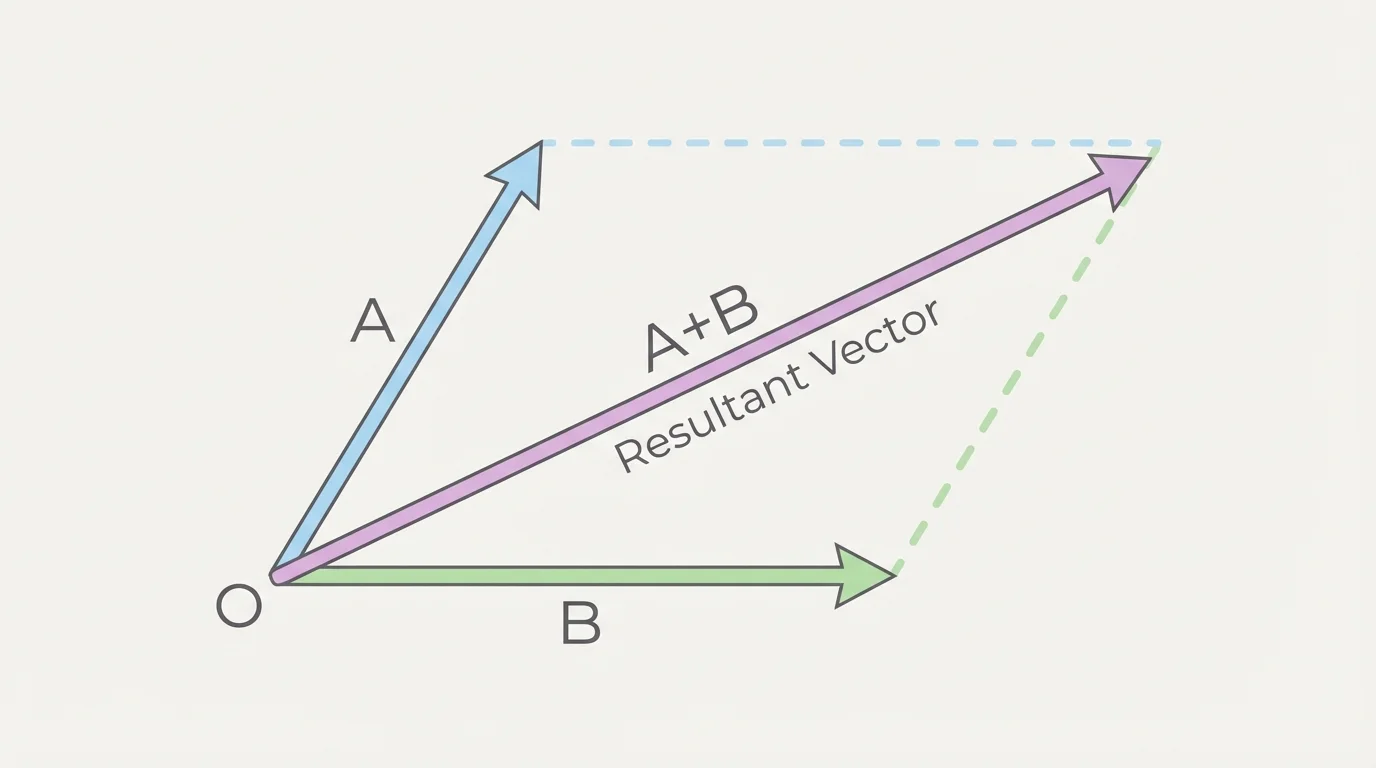
The parallelogram rule is common in physics, especially when combining forces. If two forces act on an object at the same time from the same point, the object responds to their resultant. That resultant is the diagonal of the parallelogram.
Once we know the components of a vector, we can find its length using the Pythagorean theorem. If \(\vec{v} = \langle x, y \rangle\), then its magnitude is
\[|\vec{v}| = \sqrt{x^2 + y^2}\]
If \(\vec{u} + \vec{v} = \langle 2, 6 \rangle\), then the magnitude of the sum is
\[|\vec{u} + \vec{v}| = \sqrt{2^2 + 6^2} = \sqrt{40} = 2\sqrt{10}\]
Notice what happened: if \(|\vec{u}| = 5\) and \(|\vec{v}| = \sqrt{5}\), the magnitude of the sum is not simply \(5 + \sqrt{5}\). The directions affect the result.
Why magnitudes usually do not add
The magnitude of a sum depends on the angle between the vectors. If two vectors point in the same direction, their magnitudes add. If they point in opposite directions, the larger magnitude subtracts the smaller. If they are perpendicular, the resultant comes from the Pythagorean theorem. Most pairs of vectors are somewhere in between, so the magnitude of the sum is typically neither a simple sum nor a simple difference.
This is one of the most important ideas in vector addition. Numbers alone do not determine the sum; direction matters just as much. That is why vectors are more powerful than ordinary signed numbers for describing motion and forces in a plane.
The angle between vectors changes the size of the resultant, as [Figure 3] displays. Here are the most important cases.
Same direction: If two vectors point the same way, then the magnitude of the sum is the sum of the magnitudes. Example: \(\langle 4, 0 \rangle + \langle 3, 0 \rangle = \langle 7, 0 \rangle\), so the magnitude is \(7\).
Opposite directions: If two vectors point exactly opposite, then the magnitude of the sum is the difference of the magnitudes. Example: \(\langle 6, 0 \rangle + \langle -2, 0 \rangle = \langle 4, 0 \rangle\), so the magnitude is \(4\).
Perpendicular vectors: If two vectors are at right angles, then the resultant makes a right triangle. Example: \(\langle 4, 0 \rangle + \langle 0, 3 \rangle = \langle 4, 3 \rangle\), and the magnitude is \(\sqrt{4^2 + 3^2} = 5\).
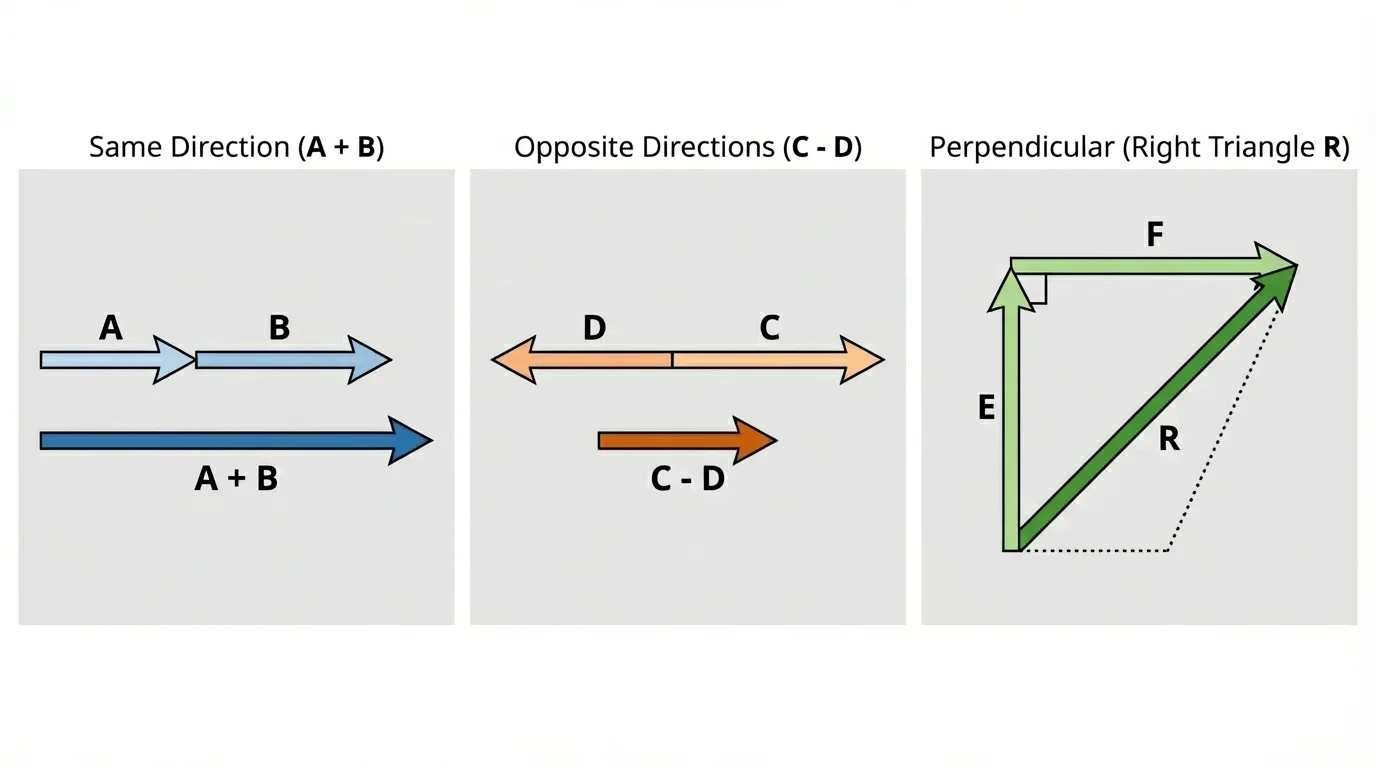
These cases explain why students should not assume \(|\vec{u} + \vec{v}| = |\vec{u}| + |\vec{v}|\). That equality happens only when the vectors point in exactly the same direction. Looking back at [Figure 3], you can see that changing the angle changes the resultant even when the original magnitudes stay the same.
Airplane navigation often depends on vector addition. A plane can have one velocity relative to the air and a different ground velocity because wind adds another vector.
Example 1: Add vectors end-to-end and find the resultant
A student walks \(5\) meters east and then \(2\) meters north. Write the resultant vector in components and find its magnitude.
Step 1: Represent each movement as a vector.
East is positive \(x\), so the first vector is \(\langle 5, 0 \rangle\). North is positive \(y\), so the second vector is \(\langle 0, 2 \rangle\).
Step 2: Add the components.
\(\langle 5, 0 \rangle + \langle 0, 2 \rangle = \langle 5, 2 \rangle\)
Step 3: Find the magnitude.
\(|\langle 5, 2 \rangle| = \sqrt{5^2 + 2^2} = \sqrt{29}\)
The resultant vector is \(\langle 5, 2 \rangle\), and its magnitude is \(\sqrt{29}\) meters.
This example shows clearly that the total distance walked is \(7\) meters, but the displacement magnitude is only \(\sqrt{29}\) meters. Distance and vector displacement are not the same idea.
Example 2: Add vectors component-wise
Let \(\vec{a} = \langle -3, 7 \rangle\) and \(\vec{b} = \langle 6, -2 \rangle\). Find \(\vec{a} + \vec{b}\).
Step 1: Add the \(x\)-components.
\(-3 + 6 = 3\)
Step 2: Add the \(y\)-components.
\(7 + (-2) = 5\)
Step 3: Write the result as a vector.
\[\vec{a} + \vec{b} = \langle 3, 5 \rangle\]
The sum is \(\langle 3, 5 \rangle\).
Notice that one vector had a negative \(x\)-component and the other had a negative \(y\)-component. Component-wise addition handles signs naturally, which is one reason it is so reliable.
Example 3: Compare the magnitude of a sum with the sum of magnitudes
Let \(\vec{u} = \langle 4, 0 \rangle\) and \(\vec{v} = \langle 0, 3 \rangle\). Find \(|\vec{u}|\), \(|\vec{v}|\), \(|\vec{u}| + |\vec{v}|\), and \(|\vec{u} + \vec{v}|\).
Step 1: Find each original magnitude.
\(|\vec{u}| = 4\) and \(|\vec{v}| = 3\)
Step 2: Add the magnitudes.
\(|\vec{u}| + |\vec{v}| = 4 + 3 = 7\)
Step 3: Add the vectors.
\(\vec{u} + \vec{v} = \langle 4, 3 \rangle\)
Step 4: Find the magnitude of the sum.
\(|\vec{u} + \vec{v}| = \sqrt{4^2 + 3^2} = 5\)
So \(|\vec{u}| + |\vec{v}| = 7\), but \(|\vec{u} + \vec{v}| = 5\). They are not equal.
This is a perfect example of the main idea of the lesson. Magnitudes usually do not add because the vectors point in different directions.
Example 4: Use the parallelogram idea with forces
One force pulls an object \(8\) units east, and another pulls it \(6\) units north from the same point. Find the resultant force vector and its magnitude.
Step 1: Write each force as a vector.
\(\langle 8, 0 \rangle\) and \(\langle 0, 6 \rangle\)
Step 2: Add them.
\(\langle 8, 0 \rangle + \langle 0, 6 \rangle = \langle 8, 6 \rangle\)
Step 3: Find the magnitude.
\(|\langle 8, 6 \rangle| = \sqrt{8^2 + 6^2} = \sqrt{100} = 10\)
The resultant force is \(\langle 8, 6 \rangle\), with magnitude \(10\).
Because these forces are perpendicular, the same result appears in the right-triangle case from [Figure 3]. The geometry and the algebra match exactly.
Subtraction fits naturally with addition. To subtract a vector, add its opposite. If \(\vec{u} = \langle a, b \rangle\), then \(-\vec{u} = \langle -a, -b \rangle\).
So if \(\vec{u} = \langle 7, 1 \rangle\) and \(\vec{v} = \langle 2, 5 \rangle\), then
\[\vec{u} - \vec{v} = \langle 7, 1 \rangle + \langle -2, -5 \rangle = \langle 5, -4 \rangle\]
Geometrically, subtracting \(\vec{v}\) means adding a vector with the same magnitude as \(\vec{v}\) but the opposite direction. This idea matters in physics when finding relative velocity or net change.
Navigation: A boat moving \(12\) kilometers per hour east in still water may face a current of \(5\) kilometers per hour south. The actual velocity is the vector sum \(\langle 12, -5 \rangle\). Pilots and sailors use vector addition constantly.
Forces: When several forces act on an object, the object responds to the resultant force. Engineers use component addition to predict motion and stability. The parallelogram rule from [Figure 2] is a classic force model.
Sports: A basketball player running toward the hoop while jumping upward has a motion made from horizontal and vertical components. The combined motion is a vector sum.
Robotics and game design: A robot moving forward while correcting sideways drift combines movement vectors. Video game physics engines also use vectors to control direction, speed, and collision responses.
"Direction is just as important as size."
— A central idea of vector thinking
These applications matter because they show that vector addition is not just a drawing trick. It is a way of describing how separate influences combine into one actual outcome.
One common mistake is adding magnitudes instead of adding vectors. If one vector is \(\langle 3, 4 \rangle\) and another is \(\langle -3, 4 \rangle\), their magnitudes are both \(5\), but their sum is \(\langle 0, 8 \rangle\), whose magnitude is \(8\), not \(10\).
Another mistake is mixing up a vector with its magnitude. The vector \(\langle 4, 3 \rangle\) is not the same thing as its magnitude \(5\). One is an arrow with direction; the other is just a length.
You can check your work by asking whether the direction of the resultant makes sense. For example, if you add a vector pointing mostly right and another pointing upward, the result should usually point somewhere between those directions. End-to-end sketches like the one in [Figure 1] help make this intuitive.
| Situation | Example | Result |
|---|---|---|
| Same direction | \(\langle 2, 0 \rangle + \langle 5, 0 \rangle\) | \(\langle 7, 0 \rangle\), magnitudes add |
| Opposite direction | \(\langle 6, 0 \rangle + \langle -2, 0 \rangle\) | \(\langle 4, 0 \rangle\), magnitudes subtract |
| Perpendicular | \(\langle 4, 0 \rangle + \langle 0, 3 \rangle\) | \(\langle 4, 3 \rangle\), use Pythagorean theorem |
| General case | Different directions | Magnitude depends on direction and angle |
Table 1. Comparison of vector sums in several important cases.
As you continue studying vectors, you will see that these same ideas extend to three dimensions, physics formulas, matrices, and even computer graphics. But the foundation remains simple: add vectors by combining their directional parts, and never forget that the magnitude of the sum depends on direction, not just size.
