A floor can be covered with tiles, a wall can be covered with paint, and a desk can be covered with paper. But how do we tell how much surface is covered? That is where area comes in. Area helps us measure flat surfaces, and one of the best ways to understand area is by counting squares.
Area is the amount of surface inside a flat shape. If you cover a rectangle with same-size squares and there are more squares, the area is bigger. If there are fewer squares, the area is smaller.
Area is about covering, not walking around the edge. The edge of a shape is called the perimeter, but area measures what is inside. For example, if a tabletop is covered by paper squares, the number of squares tells the area of the tabletop.
Area is the amount of space inside a flat shape.
Unit square is a square used for measuring area. All the unit squares used to measure one shape must be the same size.
When we measure area, we use squares because squares fit together neatly without gaps or overlaps. That makes counting easier and fair.
A unit square is one square used as a measuring piece. The size of the square can change, but each one is still a square unit. If the side of the square is measured in centimeters, then the area unit is square centimeters. If the side is measured in meters, then the area unit is square meters.
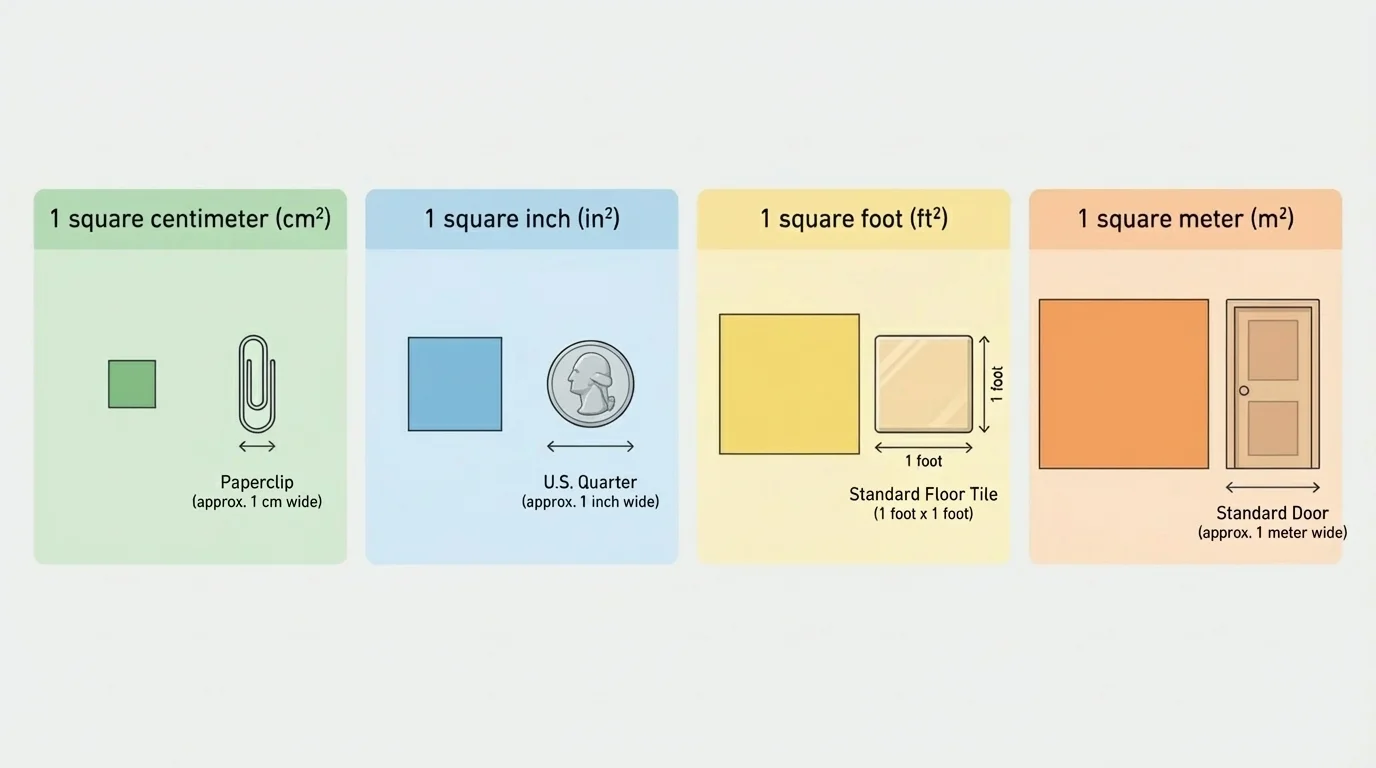
As [Figure 1] shows, here are some common square units: square centimeters, square meters, square inches, and square feet. We write them as \(\textrm{cm}^2\), \(\textrm{m}^2\), \(\textrm{in}^2\), and \(\textrm{ft}^2\). A square centimeter is the area of a square that is \(1 \textrm{ cm}\) long on each side. A square foot is the area of a square that is \(1 \textrm{ ft}\) long on each side.
Sometimes we also use improvised units. These are made-up units that are all the same size, such as paper squares, sticky notes, tiles, or even cut-out squares from cardboard. Improvised units are useful when we want to measure area even if we do not have a ruler or standard measuring tools.
If one shape covers \(12\) paper squares and another covers \(18\) paper squares, then the second shape has the greater area, as long as the paper squares are the same size. If the squares are different sizes, the comparison is not fair.
To count area correctly, the squares must be the same size, and they must cover the shape with no gaps and no overlaps.
You may notice that area units have the word square in them. That is because the measuring unit is a square, not a line. Length uses units like centimeters or feet, but area uses square centimeters or square feet.
As [Figure 2] illustrates, one direct way to find area is to cover a shape with equal squares and count them. In a rectangle, the squares often line up in rows and columns. This pattern helps us count carefully and avoid missing any squares.
Suppose a rectangle has \(4\) rows of squares, and each row has \(5\) squares. We can count one by one: \(1, 2, 3, 4, 5\), then the next row, and so on until we reach \(20\). So the area is \(20\) square units.
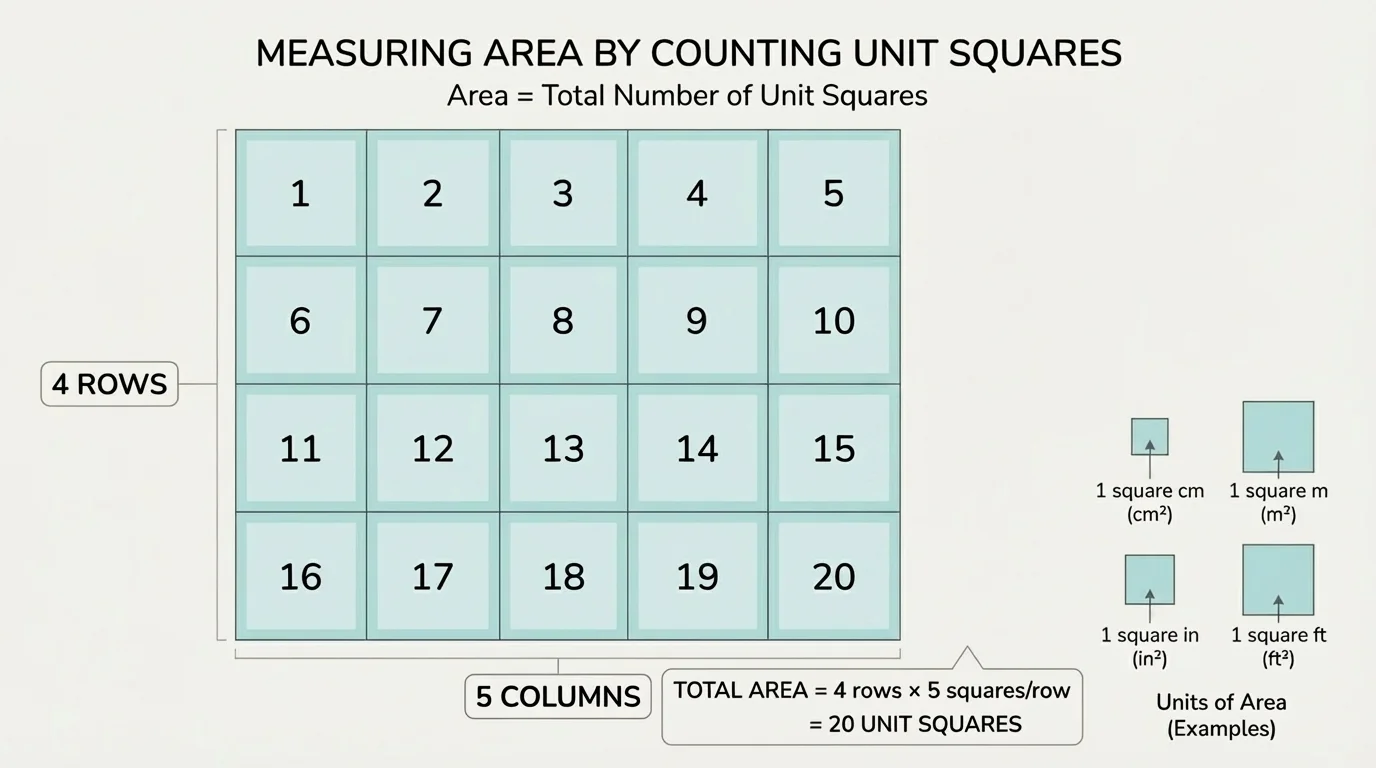
Because the squares are organized in rows and columns, counting can become faster. We can count the number in each row and the number of rows. This is where multiplication helps us.
If a rectangle is not completely filled with squares yet, we can imagine or draw the missing squares to make the counting easier, as long as the shape really matches that full rectangle. In grade \(3\), most of the shapes we measure this way are rectangles or shapes made from rectangles.
When equal squares are arranged in rows and columns, repeated counting becomes multiplication. If there are \(3\) rows with \(6\) squares in each row, then the total number of squares is \(3 \times 6 = 18\). So the area is \(18\) square units.
This is an important idea: area is related to multiplication because a rectangle is made of equal rows. Instead of counting each square one at a time, we can count how many rows there are and how many squares are in each row.
Why multiplication helps with area
A rectangle with equal rows of equal-size unit squares can be measured in two ways. You can count all the squares one by one, or you can multiply the number of rows by the number of squares in each row. Both methods give the same area because multiplication is a quicker way to add equal groups.
For example, a rectangle with \(2\) rows of \(7\) squares has area \(2 \times 7 = 14\) square units. A rectangle with \(5\) rows of \(4\) squares has area \(5 \times 4 = 20\) square units. This matches what we would get if we counted every square.
We can also think of multiplication in either order. If a rectangle has \(4\) rows and \(6\) squares in each row, then \(4 \times 6 = 24\). We could also say there are \(6\) columns with \(4\) squares in each column, so \(6 \times 4 = 24\). The area stays the same.
Some shapes are not one simple rectangle. They can still be measured by breaking them into smaller rectangles and adding the areas. This idea appears clearly in [Figure 3], where a larger shape is split into two parts. Each part can be measured, and then the parts are combined.
For example, an L-shaped figure might be made from one rectangle on top and one rectangle on the side. If the top part has area \(8\) square units and the side part has area \(6\) square units, then the total area is
\(8 + 6 = 14\)
This means area is also related to addition. We can add the areas of smaller pieces to find the area of the whole shape.
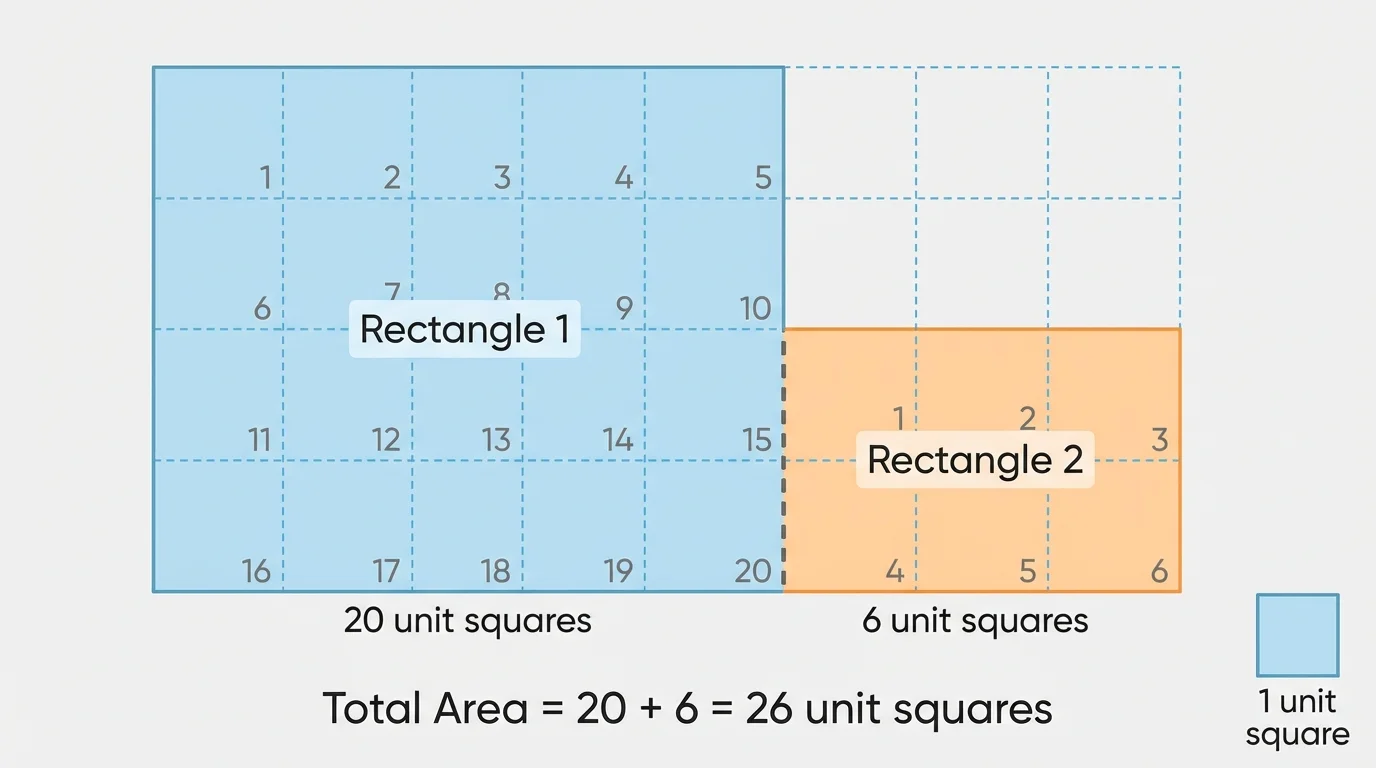
Adding parts works best when the smaller parts do not overlap and when together they cover the whole shape. If one part is counted twice, the answer will be too large. If part of the shape is left out, the answer will be too small.
Now let us work through some examples step by step.
Worked Example 1
A rectangle is covered by \(3\) rows of unit squares. Each row has \(4\) squares. Find the area.
Step 1: Count the rows and columns.
There are \(3\) rows and \(4\) squares in each row.
Step 2: Use multiplication.
Multiply rows by squares in each row: \(3 \times 4 = 12\).
Step 3: Write the answer with units.
The area is
\[12 \textrm{ square units}\]
If we counted each square one by one, we would also get \(12\).
This first example shows how multiplication saves time when the squares are arranged in neat rows and columns, just like the rectangle in [Figure 2].
Worked Example 2
A small book cover is covered by \(15\) equal squares. Each square is \(1 \textrm{ cm}\) by \(1 \textrm{ cm}\). Find the area.
Step 1: Count the unit squares.
There are \(15\) equal squares covering the book cover.
Step 2: Identify the unit.
Each square is a square centimeter, so the unit is \(\textrm{cm}^2\).
Step 3: Write the answer.
\[15 \textrm{ cm}^2\]
The area of the book cover is \(15 \textrm{ cm}^2\).
The unit matters. If the same number of larger squares had been used, the area would represent a larger surface. That is why the square unit must always be named.
Worked Example 3
An L-shaped figure is split into two rectangles. One rectangle has area \(9\) square units. The other rectangle has area \(5\) square units. Find the total area.
Step 1: Look at the two parts.
The shape is made of two non-overlapping rectangles.
Step 2: Add the areas.
\(9 + 5 = 14\)
Step 3: Write the total area.
\[14 \textrm{ square units}\]
The total area is \(14\) square units.
This is the same idea shown earlier in [Figure 3]: when a shape is made from parts, we can add the areas of the parts.
Worked Example 4
A classroom rug has \(4\) rows of squares and \(6\) squares in each row. Each square is \(1 \textrm{ ft}\) by \(1 \textrm{ ft}\). Find the area.
Step 1: Multiply the rows and columns.
\(4 \times 6 = 24\)
Step 2: Use the correct unit.
Because each square is a square foot, the unit is \(\textrm{ft}^2\).
Step 3: Write the answer.
\[24 \textrm{ ft}^2\]
The rug has area \(24 \textrm{ ft}^2\).
Notice that this answer is not \(24\) feet. It is \(24\) square feet because we are measuring a surface, not a length.
Area is all around us. Builders use area when they decide how many floor tiles are needed. Gardeners use area when they plan how much space a flower bed covers. Painters think about area when they cover a wall with paint. Even a notebook label covers area on the front cover.
If a floor has \(20\) square tiles, then the floor covers \(20\) tile-sized units of area. If each tile is \(1 \textrm{ ft}^2\), then the floor area is \(20 \textrm{ ft}^2\). If the tiles are smaller, such as \(1 \textrm{ in}^2\), then the same count would describe a much smaller space, which is the idea of scale introduced in [Figure 1].
A square meter is much bigger than a square centimeter. That means a surface measured in \(\textrm{m}^2\) can often be covered by many, many square centimeters.
Improvised units are useful in real life too. Suppose a student wants to compare the area of two folders but does not have a ruler. The student could use same-size sticky notes or paper squares to cover each folder. The folder covered by more same-size notes has the larger area.
In sports, the area of a court or field helps show how much playing space there is. In art, area matters when covering a poster board with colored paper. In home design, area helps people know how much carpet or tile to buy.
There are several important rules to remember when measuring area by counting unit squares.
First, all the measuring squares must be the same size. If one square is larger than another, we cannot mix them and count fairly.
Second, the squares must cover the shape with no gaps and no overlaps. Gaps leave out part of the surface. Overlaps count part of the surface more than once.
Third, always include the unit in the answer. The area might be \(18 \textrm{ cm}^2\), \(12 \textrm{ in}^2\), \(30 \textrm{ ft}^2\), \(9 \textrm{ m}^2\), or \(14\) square paper units.
Fourth, do not confuse area with perimeter. A rectangle might have a large perimeter but not the largest area, or it might have a large area but a different perimeter. Perimeter measures the distance around the outside. Area measures the surface inside.
| Measurement idea | What it measures | Example unit |
|---|---|---|
| Length | How long something is | \(\textrm{cm}\), \(\textrm{ft}\) |
| Perimeter | Distance around a shape | \(\textrm{cm}\), \(\textrm{m}\) |
| Area | Surface inside a shape | \(\textrm{cm}^2\), \(\textrm{ft}^2\) |
Table 1. This table compares length, perimeter, and area and shows example units for each.
When a rectangle is made of rows and columns, area can be found by counting or by multiplying. When a shape is made of parts, area can be found by adding the smaller areas. These two ideas make area both simple and powerful.
