Have you ever wondered how a store can put hundreds of pencils into equal boxes so quickly, or how a school can seat students in equal rows? Division helps answer those questions. When numbers get bigger, division still works the same way, but we use smart strategies to make it easier. Instead of guessing, we can use place value, multiplication facts, and models to see exactly what is happening.
When you divide a large number, you are finding how many equal groups can be made. Sometimes everything is shared equally. Sometimes a few are left over. Those leftovers are called remainders. By the end of this lesson, you will see that division is not just a set of steps. It is a way to think about numbers and how they fit into equal groups.
Division means separating a number into equal groups. In \(24 \div 6\), you are asking, "How many groups of \(6\) are in \(24\)?" The answer is \(4\), because \(6 \times 4 = 24\).
Division is closely connected to subtraction and multiplication. You can think of division as repeated subtraction. For example, to solve \(20 \div 5\), you can subtract \(5\) over and over: \(20 - 5 = 15\), \(15 - 5 = 10\), \(10 - 5 = 5\), \(5 - 5 = 0\). You subtracted \(5\) a total of \(4\) times, so \(20 \div 5 = 4\).
Remember that multiplication and division are inverse operations. That means they undo each other. If \(7 \times 8 = 56\), then \(56 \div 8 = 7\) and \(56 \div 7 = 8\).
For larger numbers, we use the same ideas, but we organize the work using place value. That helps us divide hundreds, tens, and ones without getting lost.
Dividend is the number being divided.
Divisor is the number you divide by.
Quotient is the answer to a division problem.
Remainder is the amount left over when the dividend does not divide evenly.
In the problem \(965 \div 4\), the number \(965\) is the dividend because it is being divided. The number \(4\) is the divisor. The answer is the quotient, and if something is left over, that is the remainder.
You can write division using an equation such as \(965 = 4 \times 241 + 1\). This equation says that \(965\) is made from \(241\) groups of \(4\), plus \(1\) extra.
One powerful strategy is to break the dividend into parts using place value. In [Figure 1], the number is separated into hundreds, tens, and ones so each part can be divided more easily. This helps you use facts you already know instead of trying to divide the whole number at once.
Suppose you want to divide \(864 \div 4\). Think of \(864\) as \(800 + 60 + 4\). Then divide each part by \(4\): \(800 \div 4 = 200\), \(60 \div 4 = 15\), and \(4 \div 4 = 1\). Add the partial quotients: \(200 + 15 + 1 = 216\). So \(864 \div 4 = 216\).
This works because the dividend can be broken into parts that are easier to divide, and then the partial quotients can be added together. Place value keeps each part organized and makes the reasoning clear.
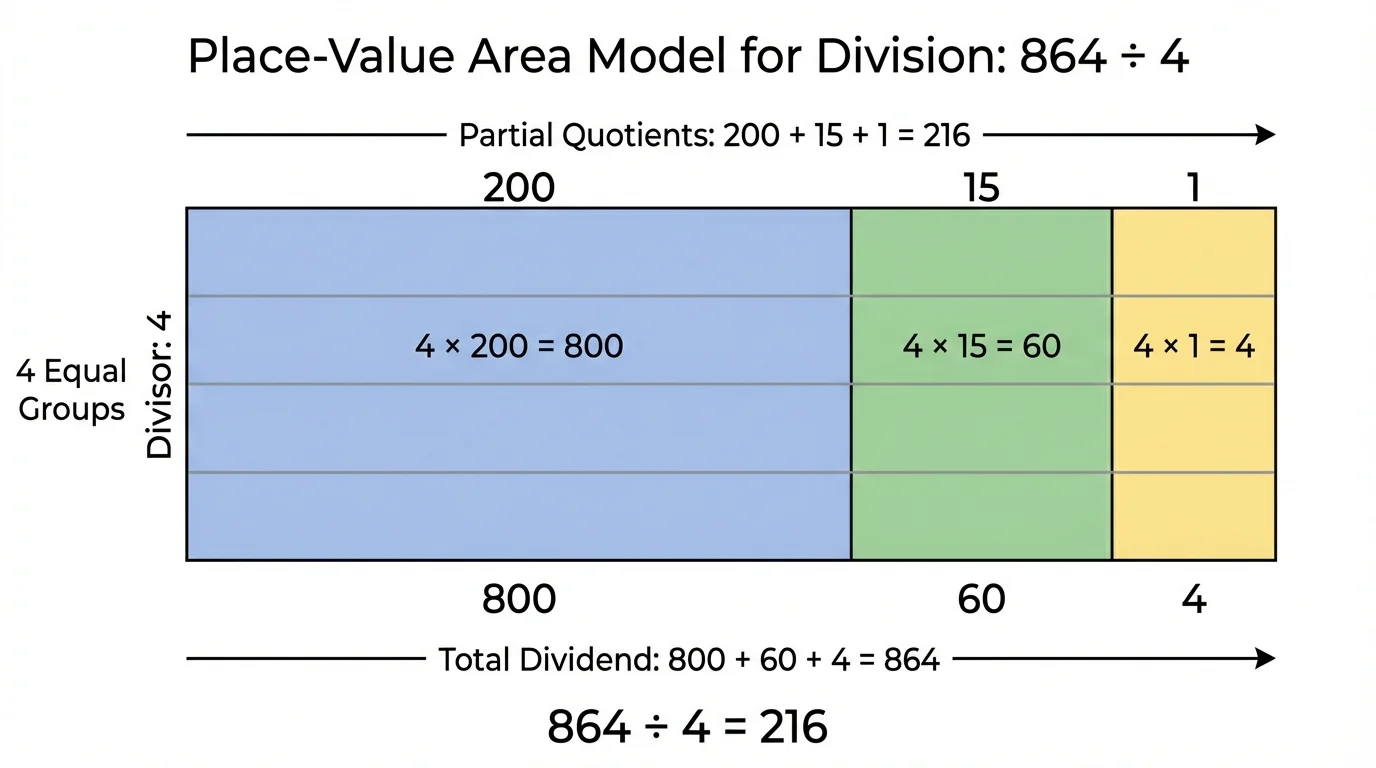
You can also write this with equations:
\[864 \div 4 = (800 \div 4) + (60 \div 4) + (4 \div 4) = 200 + 15 + 1 = 216\]
Notice how the value of each digit matters. The \(8\) in \(864\) really means \(800\), not just \(8\). That is why place value is so important in multi-digit division.
A rectangle can help show division because a rectangle has equal rows or equal columns. In [Figure 2], a large rectangle is split into smaller parts to show how partial quotients add together. This is called an area model.
Suppose we want to solve \(1{,}248 \div 6\). Think of a rectangle with one side length \(6\). The total area is \(1{,}248\). We can split the area into easier parts: \(1{,}200\) and \(48\). Then divide each part by \(6\). Since \(1{,}200 \div 6 = 200\) and \(48 \div 6 = 8\), the total quotient is \(200 + 8 = 208\).
The rectangle model helps you see that division is finding a missing side length. If the area and one side are known, the other side is the quotient.
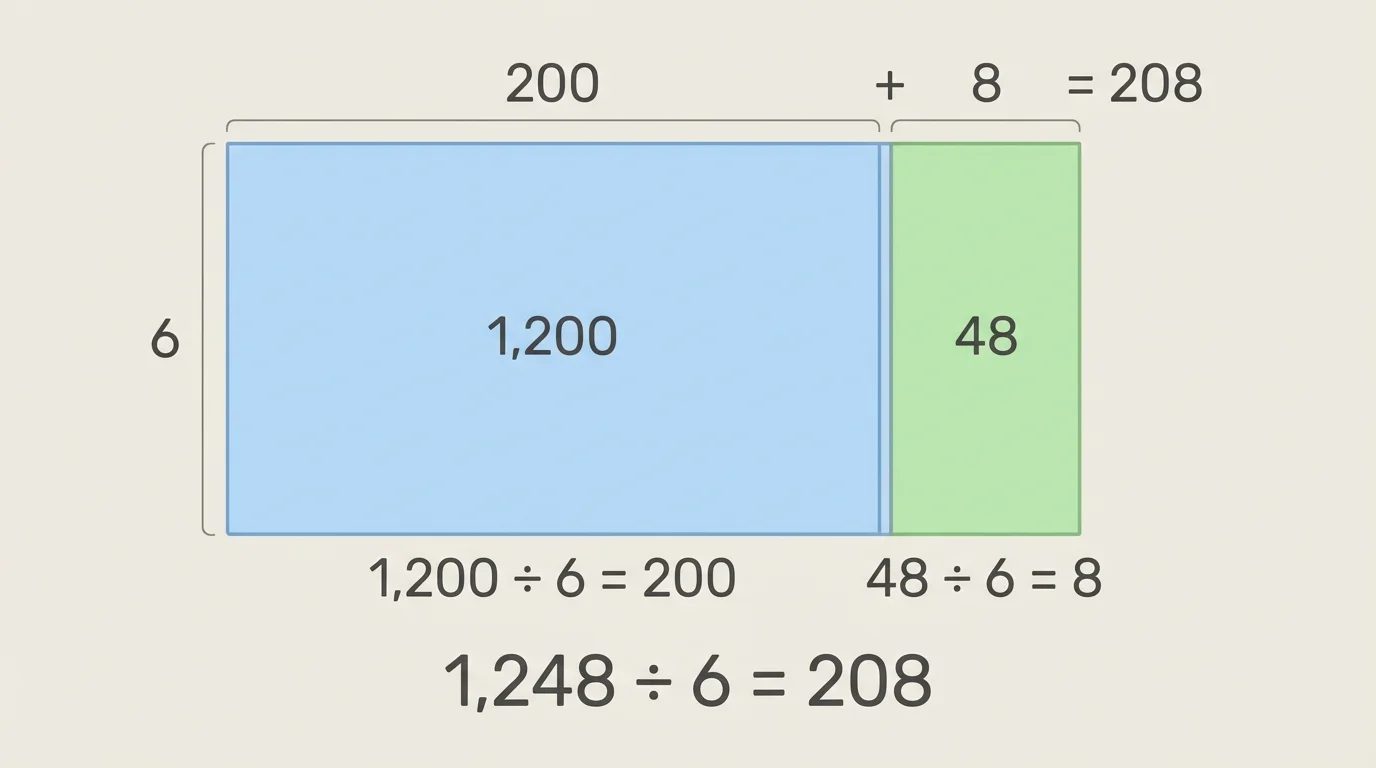
This model matches the equation:
\[1{,}248 \div 6 = (1{,}200 \div 6) + (48 \div 6) = 200 + 8 = 208\]
Later, when you check your work, you can multiply: \(208 \times 6 = 1{,}248\). That tells you the quotient is correct, just as the rectangle in [Figure 2] shows the full area built from the two parts.
Worked example 1
Find \(736 \div 4\).
Step 1: Break the dividend into place-value parts.
\(736 = 700 + 36\)
Step 2: Divide each part by \(4\).
\(700 \div 4\) is not a whole number, so use a more convenient split: \(736 = 400 + 320 + 16\).
Then \(400 \div 4 = 100\), \(320 \div 4 = 80\), and \(16 \div 4 = 4\).
Step 3: Add the partial quotients.
\(100 + 80 + 4 = 184\)
So, \[736 \div 4 = 184\]
Check: \(184 \times 4 = 736\).
This example shows that you do not need only one way to split a number. You can choose place-value parts that divide easily by the divisor.
Worked example 2
Find \(965 \div 4\).
Step 1: Make equal groups as much as possible.
Use \(800 + 160 + 4 + 1 = 965\).
Step 2: Divide the parts that work evenly.
\(800 \div 4 = 200\), \(160 \div 4 = 40\), and \(4 \div 4 = 1\).
Step 3: Add the quotients and keep the leftover.
\(200 + 40 + 1 = 241\), with \(1\) left over.
So, \(965 \div 4 = 241\) remainder \(1\).
You can also write: \(965 = 4 \times 241 + 1\).
That last equation is very important because it shows both the quotient and the remainder in one line.
Worked example 3
Find \(3{,}456 \div 8\).
Step 1: Break the dividend into easy parts.
\(3{,}456 = 3{,}200 + 240 + 16\)
Step 2: Divide each part by \(8\).
\(3{,}200 \div 8 = 400\), \(240 \div 8 = 30\), and \(16 \div 8 = 2\).
Step 3: Add the partial quotients.
\(400 + 30 + 2 = 432\)
So, \[3{,}456 \div 8 = 432\]
Check: \(432 \times 8 = 3{,}456\).
Here, the dividend has four digits, but the same strategy still works. Place value helps you break the number into manageable parts.
Sometimes a number cannot be divided into equal groups with nothing left over. Counters can be shared into equal groups, and a few counters may remain outside the groups. Those extra counters represent a remainder.
[Figure 3] For example, \(17 \div 5\) means making groups of \(5\) from \(17\). You can make \(3\) full groups because \(5 \times 3 = 15\). Then \(2\) are left over. So \(17 \div 5 = 3\) remainder \(2\).
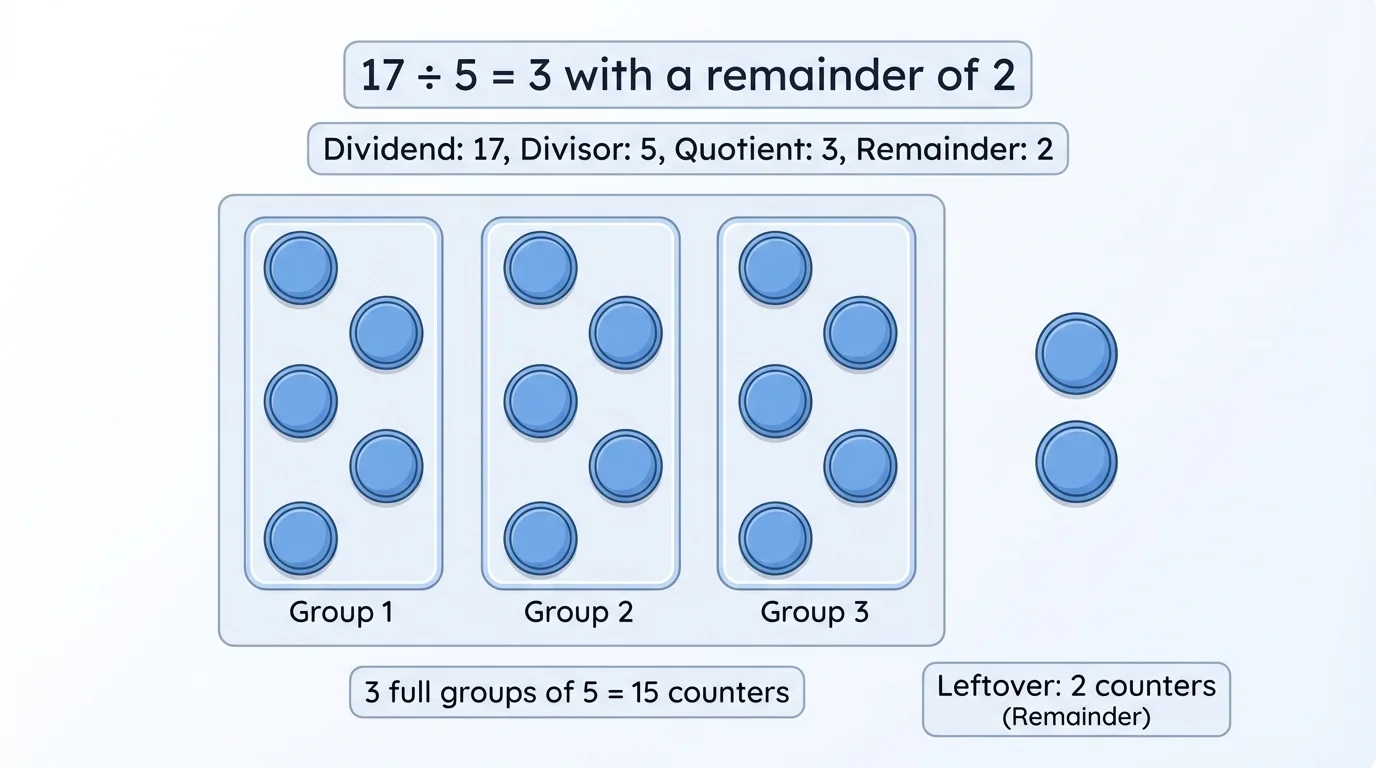
A remainder must always be less than the divisor. If you divide by \(5\), the remainder can be \(0\), \(1\), \(2\), \(3\), or \(4\), but never \(5\) or greater. If the leftover were \(5\), that would make another full group.
You can write remainders in different ways, depending on the situation. In Grade 4, it is common to write them like this: \(29 \div 6 = 4\) remainder \(5\). You can also write an equation: \(29 = 6 \times 4 + 5\).
| Division Problem | Quotient | Remainder | Equation Check |
|---|---|---|---|
| \(17 \div 5\) | \(3\) | \(2\) | \(17 = 5 \times 3 + 2\) |
| \(29 \div 6\) | \(4\) | \(5\) | \(29 = 6 \times 4 + 5\) |
| \(965 \div 4\) | \(241\) | \(1\) | \(965 = 4 \times 241 + 1\) |
Table 1. Examples of quotients and remainders with equation checks.
The leftovers in the diagram make the idea of a remainder easy to see: equal groups come first, and anything that does not complete another full group stays as the remainder.
Multiplication is one of the best tools for checking division. If \(a \div b = q\) remainder \(r\), then the check is:
\[a = b \times q + r\]
For example, if \(842 \div 7 = 120\) remainder \(2\), check by multiplying: \(7 \times 120 = 840\). Then add the remainder: \(840 + 2 = 842\). The answer is correct.
Why the check works
Division asks how many groups of the divisor fit into the dividend. Multiplication rebuilds those groups. If there is a remainder, adding it back gives the original dividend again.
This relationship is useful because it helps catch mistakes. If your multiplication check does not return the original dividend, something went wrong in the division.
Division with quotients and remainders appears in everyday life. Suppose \(128\) juice boxes are packed into crates that hold \(9\) each. Since \(9 \times 14 = 126\), you can fill \(14\) full crates, with \(2\) juice boxes left over. So \(128 \div 9 = 14\) remainder \(2\).
Suppose a theater has \(1{,}152\) seats arranged in \(8\) equal rows. The number of seats in each row is \(1{,}152 \div 8 = 144\). This is a perfect example of equal groups with no remainder.
School supplies also use division. If \(2{,}436\) pencils are shared equally among \(6\) classes, each class gets \(406\) pencils because \(2{,}400 \div 6 = 400\) and \(36 \div 6 = 6\), so \(400 + 6 = 406\).
Multi-digit division problems often become much easier when you think about nearby multiplication facts. Knowing that \(6 \times 40 = 240\) can help you quickly divide numbers like \(2{,}436 \div 6\).
In some real situations, the remainder matters exactly as it is. In others, you have to think about what the remainder means. If \(33\) students ride in vans that hold \(8\) students each, \(33 \div 8 = 4\) remainder \(1\). But you still need \(5\) vans, because the extra student needs a seat too.
One mistake is forgetting place value. For example, in \(864 \div 4\), the \(8\) means \(800\), not \(8\). That is why \(800 \div 4 = 200\), not \(2\).
Another mistake is giving a remainder that is too large. If you say \(26 \div 4 = 5\) remainder \(6\), that cannot be right because a remainder must be smaller than \(4\). Since \(6\) is larger than the divisor, you can make more groups.
A third mistake is forgetting to check with multiplication. A quick check can save time and help you feel confident about your answer.
"Division and multiplication are partners: one takes groups apart, and the other puts them back together."
As you keep practicing division, think about numbers in parts. Break them apart, use facts you know, and then put the answer back together. That is exactly what strong mathematicians do.
