If one friend eats \(\dfrac{1}{4}\) of a pizza and another eats \(\dfrac{2}{4}\), how much of the pizza is gone? That question seems simple, but it hides a big idea: fractions can be joined and separated only when the parts are talking about the same whole. Once you understand that, fraction addition and subtraction become much more logical.
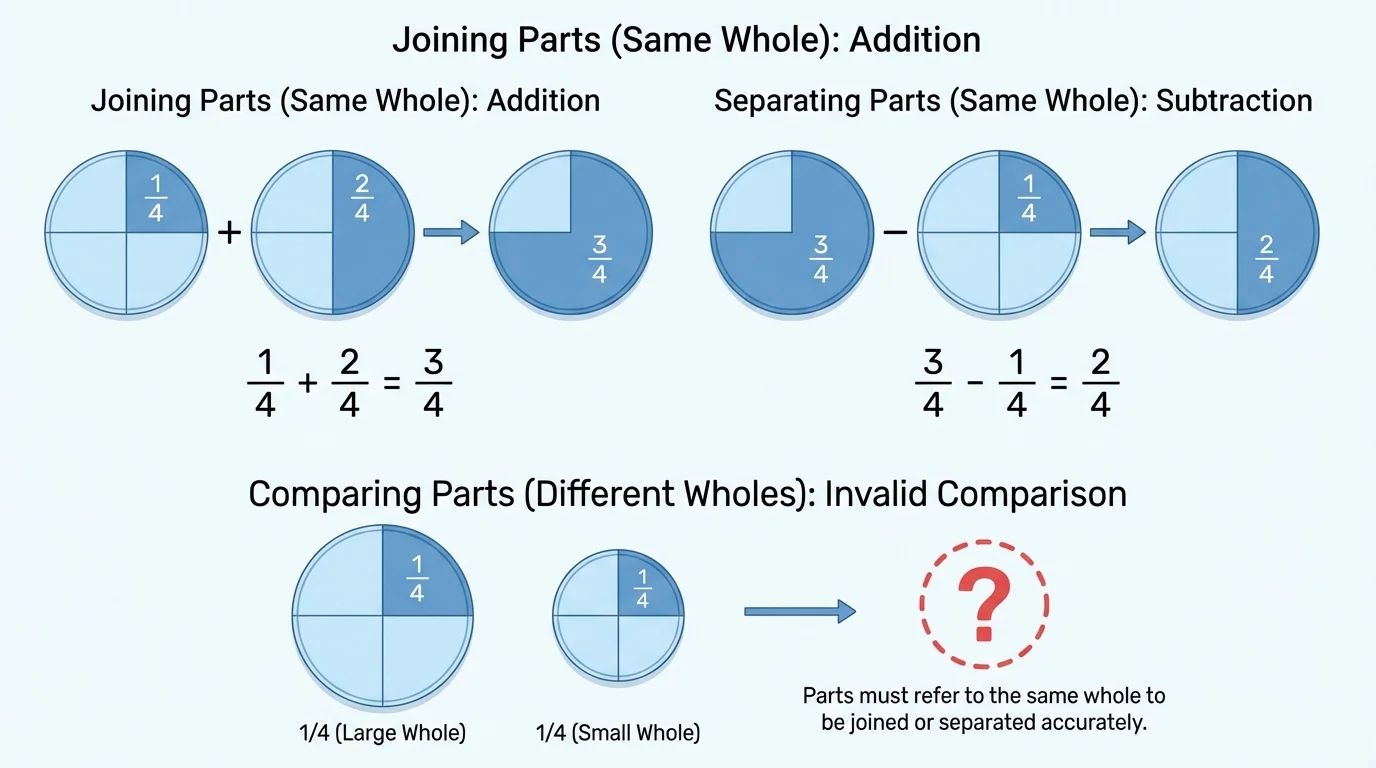
A fraction names part of a whole or part of a group. In this lesson, we focus on parts of one whole. A whole could be one pizza, one pan of brownies, one ribbon, or one number line from \(0\) to \(1\). The important idea is that the whole is cut into equal parts. As [Figure 1] shows, fraction pieces only match when they refer to the same whole and the same-size parts.
In the fraction \(\dfrac{1}{4}\), the bottom number tells how many equal parts the whole is divided into. The top number tells how many of those parts we are talking about. So \(\dfrac{1}{4}\) means one part when the whole is split into four equal parts.
You already know that equal parts matter. If two sandwiches are cut in different ways, one piece from each sandwich may not be the same amount. Fractions work the same way.
The bottom number of a fraction is called the denominator. It names the size of the parts. If the denominator is \(6\), the whole is split into sixths. If the denominator is \(8\), the whole is split into eighths. Sixths and eighths are not the same-size parts, so they cannot be joined in a simple same-denominator addition sentence.
The top number tells how many parts are being counted. When the denominator stays the same, the size of the parts stays the same. That is why we can add and subtract fractions with the same denominator in this lesson.
A unit fraction is a fraction with \(1\) in the numerator, such as \(\dfrac{1}{2}\), \(\dfrac{1}{5}\), or \(\dfrac{1}{8}\). A unit fraction names exactly one equal part of a whole.
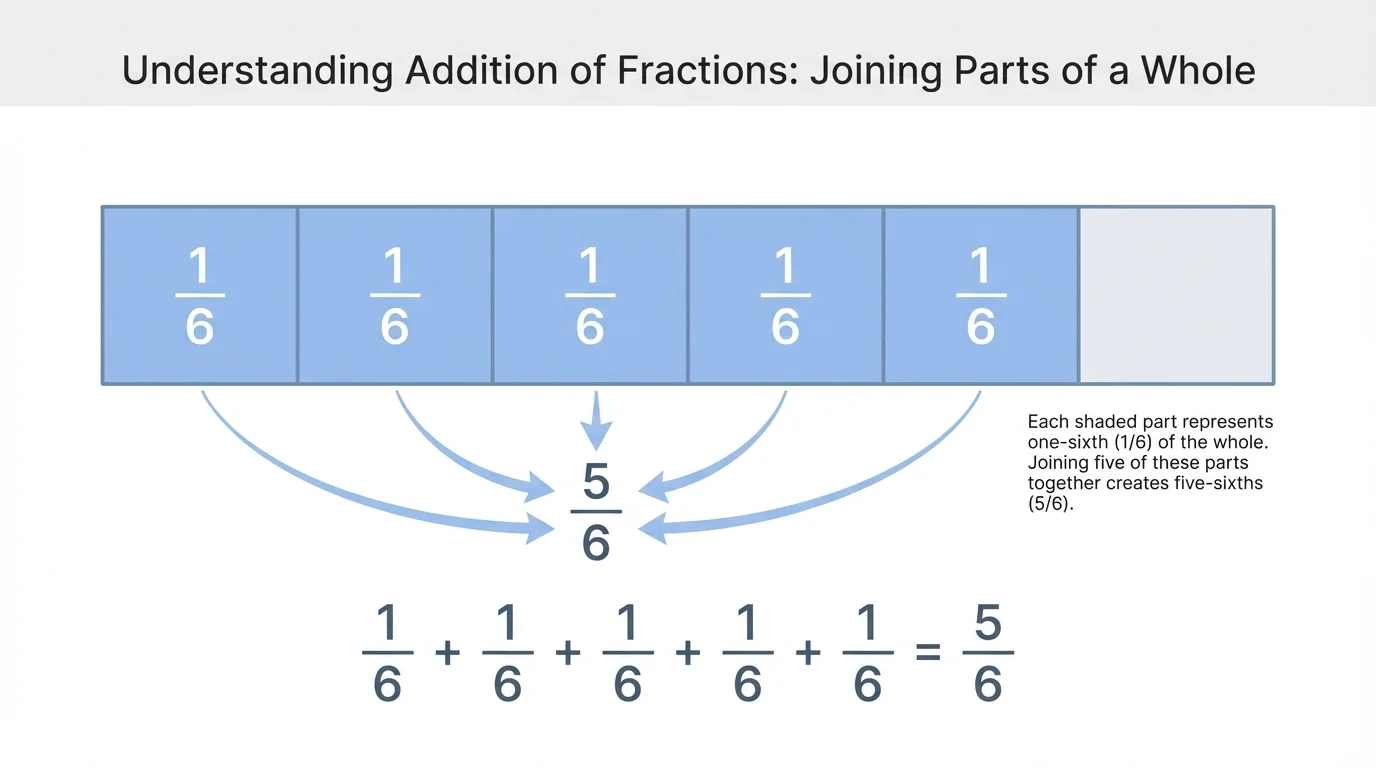
As [Figure 2] helps show, every fraction with numerator greater than \(1\) can be built by joining unit fractions. For example, \(\dfrac{3}{4}\) means three copies of \(\dfrac{1}{4}\):
\[\frac{3}{4} = \frac{1}{4} + \frac{1}{4} + \frac{1}{4}\]
Unit fraction means one equal part of a whole, like \(\dfrac{1}{6}\).
Numerator is the top number in a fraction. It tells how many parts are being counted.
Denominator is the bottom number in a fraction. It tells how many equal parts make the whole.
This idea works for any fraction \(\dfrac{a}{b}\) when \(a>1\). It means \(a\) copies of \(\dfrac{1}{b}\). For example, \(\dfrac{5}{6}\) can be built from five unit fractions:
\[\frac{5}{6} = \frac{1}{6} + \frac{1}{6} + \frac{1}{6} + \frac{1}{6} + \frac{1}{6}\]
This is a powerful idea because it shows what a fraction really means. A fraction is not just two numbers written one above the other. It is a sum of equal-size parts.
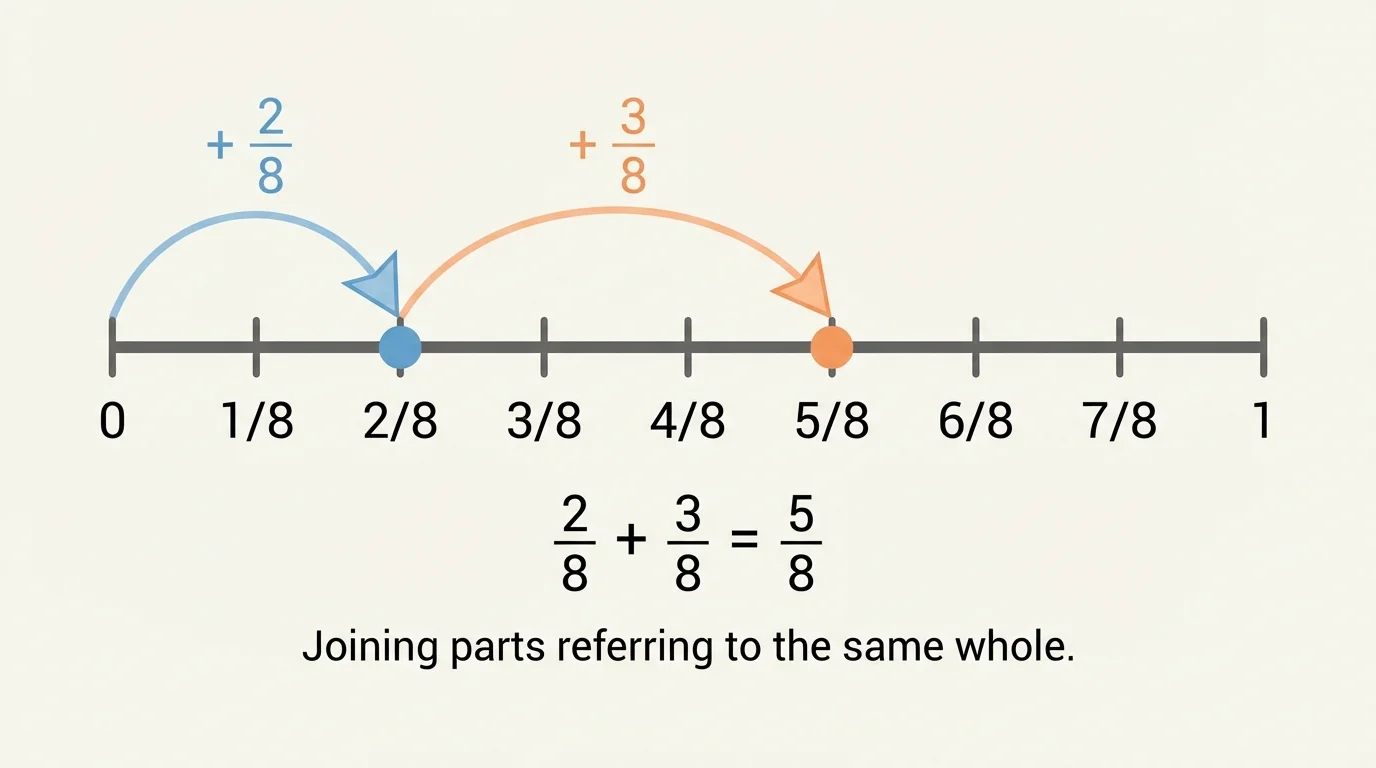
When we add fractions with the same denominator, we are joining parts of the same size. On a number line, as [Figure 3] shows, each jump is the same size because the whole is divided into equal parts.
For example, if you have \(\dfrac{2}{8}\) of a chocolate bar and then get \(\dfrac{3}{8}\) more of the same-size chocolate bar, you now have \(\dfrac{5}{8}\). We add the numerators because we are counting how many eighths there are altogether.
\[\frac{2}{8} + \frac{3}{8} = \frac{5}{8}\]
Why the denominator stays the same
When you add \(\dfrac{2}{8}\) and \(\dfrac{3}{8}\), the parts are still eighths. You are not changing the size of the pieces. You are only counting more of them. That is why the denominator stays \(8\), and the numerator changes from \(2\) and \(3\) to \(5\).
You can also think of the addition as a sum of unit fractions:
\(\dfrac{2}{8} = \dfrac{1}{8} + \dfrac{1}{8}\) and \(\dfrac{3}{8} = \dfrac{1}{8} + \dfrac{1}{8} + \dfrac{1}{8}\). Joined together, that makes five copies of \(\dfrac{1}{8}\), which is \(\dfrac{5}{8}\).
If the denominator is the same, use this rule:
\[\frac{a}{b} + \frac{c}{b} = \frac{a+c}{b}\]
This rule makes sense because both fractions are counting parts of size \(\dfrac{1}{b}\).
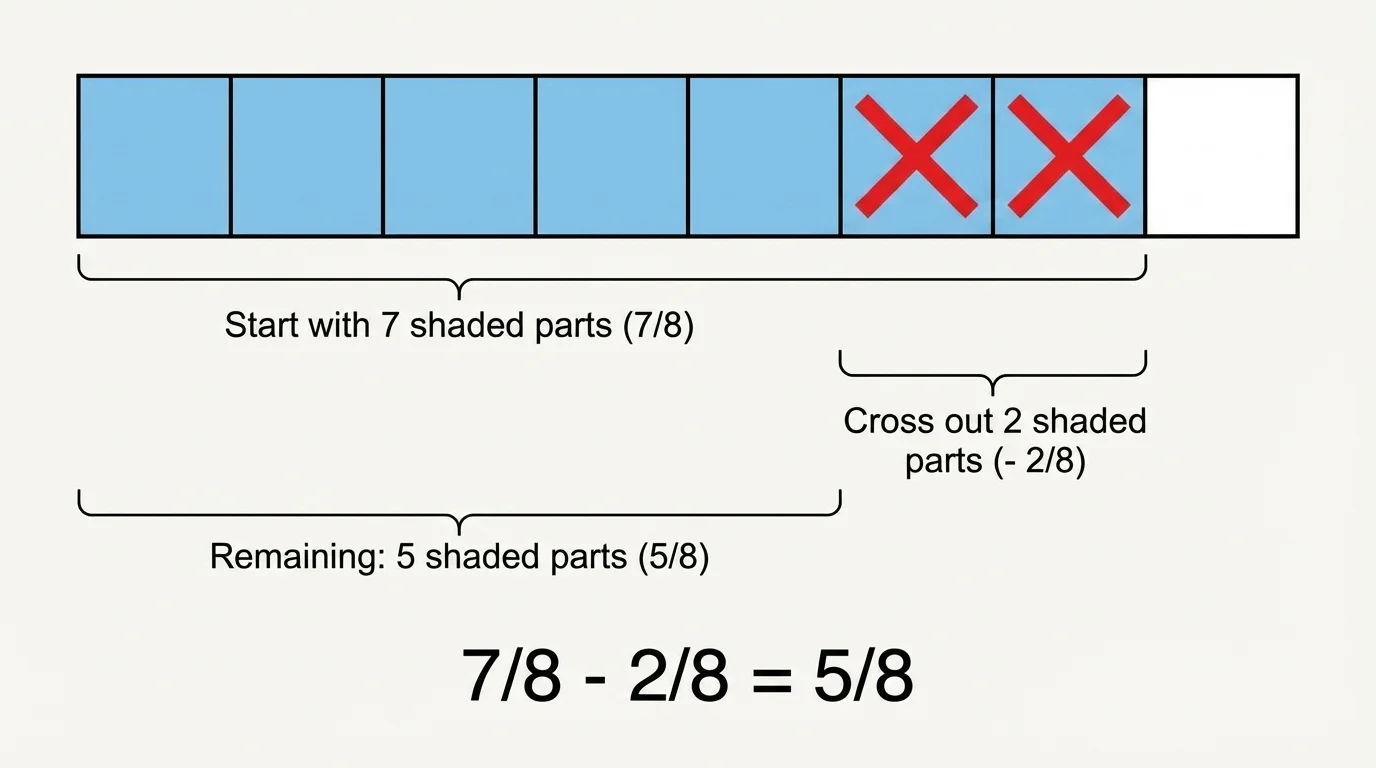
Subtraction means separating or taking away parts. If the parts are the same size, we can subtract by taking away some of those equal parts. In a shaded bar, as [Figure 4] shows, removing \(2\) eighths from \(7\) eighths leaves \(5\) eighths.
Suppose \(\dfrac{7}{8}\) of a ribbon is colored, and \(\dfrac{2}{8}\) is cut off. The amount left is \(\dfrac{5}{8}\).
\[\frac{7}{8} - \frac{2}{8} = \frac{5}{8}\]
Again, the denominator stays the same because the size of the parts does not change. We still have eighths. We are just counting fewer of them.
Here is the subtraction rule for fractions with the same denominator:
\[\frac{a}{b} - \frac{c}{b} = \frac{a-c}{b}\]
You can also think of subtraction using unit fractions. Since \(\dfrac{7}{8}\) is seven copies of \(\dfrac{1}{8}\), taking away two copies leaves five copies of \(\dfrac{1}{8}\).
Fractions can be shown in several ways. A circle model shows parts of a shape. A fraction strip shows parts of a bar. A number line shows fractions as numbers located between \(0\) and \(1\). These models all represent the same idea in different forms.
For example, \(\dfrac{4}{6}\) can be shown as four shaded pieces out of six equal parts in a rectangle. It can also be shown on a number line by moving four steps of size \(\dfrac{1}{6}\) from \(0\). Thinking this way connects fraction pictures to addition: \(\dfrac{4}{6}\) is four jumps of \(\dfrac{1}{6}\).
Fractions on a number line help show that fractions are real numbers, not just pieces of pizza. The point \(\dfrac{3}{4}\) is a location between \(0\) and \(1\), just like \(3\) is a location on a whole-number line.
This also explains why the work in [Figure 3] matches the work in shape models. Whether you join shaded parts or make jumps on a number line, you are adding equal-size pieces of the same whole.
Let's work through some examples carefully. Notice that each problem uses fractions with the same denominator, so the parts are the same size.
Worked Example 1
Find \(\dfrac{1}{5} + \dfrac{3}{5}\).
Step 1: Check the denominators.
Both fractions have denominator \(5\), so both are fifths.
Step 2: Add the numerators.
\(1 + 3 = 4\)
Step 3: Keep the denominator the same.
The parts are still fifths, so the denominator stays \(5\).
\[\frac{1}{5} + \frac{3}{5} = \frac{4}{5}\]
The answer is \(\dfrac{4}{5}\).
You can read this as "one fifth plus three fifths equals four fifths." That sounds natural because we are counting fifths of the same size, just as we count apples or blocks.
Worked Example 2
Find \(\dfrac{6}{10} - \dfrac{2}{10}\).
Step 1: Check the denominators.
Both fractions have denominator \(10\), so both are tenths.
Step 2: Subtract the numerators.
\(6 - 2 = 4\)
Step 3: Keep the denominator the same.
The parts are still tenths.
\[\frac{6}{10} - \frac{2}{10} = \frac{4}{10}\]
The answer is \(\dfrac{4}{10}\).
This means if \(\dfrac{6}{10}\) of a meter of string is used and \(\dfrac{2}{10}\) of a meter is removed, \(\dfrac{4}{10}\) of a meter remains.
Worked Example 3
Find \(\dfrac{2}{6} + \dfrac{1}{6} + \dfrac{2}{6}\).
Step 1: Check the denominators.
All the fractions are sixths.
Step 2: Add the numerators.
\(2 + 1 + 2 = 5\)
Step 3: Keep the denominator.
The pieces are still sixths.
\[\frac{2}{6} + \frac{1}{6} + \frac{2}{6} = \frac{5}{6}\]
The answer is \(\dfrac{5}{6}\).
This example shows that more than two fractions can be added if all the parts are the same size.
Worked Example 4
Find \(\dfrac{9}{12} - \dfrac{4}{12}\).
Step 1: Identify the part size.
Both fractions are twelfths.
Step 2: Subtract the counted parts.
\(9 - 4 = 5\)
Step 3: Write the result with the same denominator.
The remaining parts are still twelfths.
\[\frac{9}{12} - \frac{4}{12} = \frac{5}{12}\]
The answer is \(\dfrac{5}{12}\).
Fractions appear in everyday life more often than many people notice. Recipes use fractions when measuring ingredients. If a recipe uses \(\dfrac{1}{4}\) cup of oil and then another \(\dfrac{2}{4}\) cup is added, the total is \(\dfrac{3}{4}\) cup.
Lengths also use fractions. A piece of wood might be \(\dfrac{7}{8}\) meter long. If \(\dfrac{3}{8}\) meter is cut off, \(\dfrac{4}{8}\) meter remains. Carpenters, bakers, and artists all need to think about equal-size parts.
Sports can use fractions too. If a runner completes \(\dfrac{2}{6}\) of a lap and then runs \(\dfrac{3}{6}\) more, the runner has completed \(\dfrac{5}{6}\) of a lap. Since the lap is the same whole the entire time, the fraction addition makes sense.
Fractions must refer to the same whole
If one fraction is part of a small pizza and another is part of a large pizza, the pieces may not be equal in size. Even if both fractions are fourths, they may not represent the same amount. Before adding or subtracting fractions in real life, make sure they refer to the same whole.
The warning in [Figure 1] matters here. A fourth of a large pan is not the same as a fourth of a small pan. The denominator tells the kind of part, but the whole still matters.
One common mistake is adding both the numerators and denominators, such as saying \(\dfrac{2}{7} + \dfrac{3}{7} = \dfrac{5}{14}\). That is not correct here because the parts are still sevenths, not fourteenths. The correct answer is \(\dfrac{5}{7}\).
Another mistake is forgetting to check whether the fractions refer to the same whole. If they do not, the comparison or operation may not make sense.
A third mistake is thinking the denominator tells how many pieces are shaded. It does not. The denominator tells how many equal parts make the whole. The numerator tells how many of those parts are being counted.
| Fraction | Meaning | As unit fractions |
|---|---|---|
| \(\dfrac{2}{3}\) | Two thirds | \(\dfrac{1}{3}+\dfrac{1}{3}\) |
| \(\dfrac{4}{5}\) | Four fifths | \(\dfrac{1}{5}+\dfrac{1}{5}+\dfrac{1}{5}+\dfrac{1}{5}\) |
| \(\dfrac{7}{8}\) | Seven eighths | Seven copies of \(\dfrac{1}{8}\) |
Table 1. Examples of fractions understood as sums of unit fractions.
Seeing fractions as sums of unit fractions also makes subtraction easier. If \(\dfrac{7}{8}\) is seven copies of \(\dfrac{1}{8}\), then taking away two copies leaves five copies. That is exactly what the bar model in [Figure 4] shows.
"When the parts stay the same size, you only count how many parts there are."
This idea is the heart of fraction addition and subtraction with like denominators. Keep the part size fixed, then count the parts being joined or separated.
