When a skateboarder turns a little, the board changes direction only a bit. When the skateboarder turns a lot, the board swings much farther. That turning idea is exactly what angle measure is about. An angle is not measured by how long its sides are. It is measured by how much turn happens.
An angle is a geometric shape formed when two rays share a common endpoint, as shown in [Figure 1]. A ray is a part of a line that starts at one point and goes on in one direction. The shared endpoint is called the vertex.
You can think of an angle as a corner or an opening. If you open a book a little, you make a small angle. If you open the book wider, you make a larger angle. The two covers of the book act like rays, and the book's spine acts like the common endpoint.
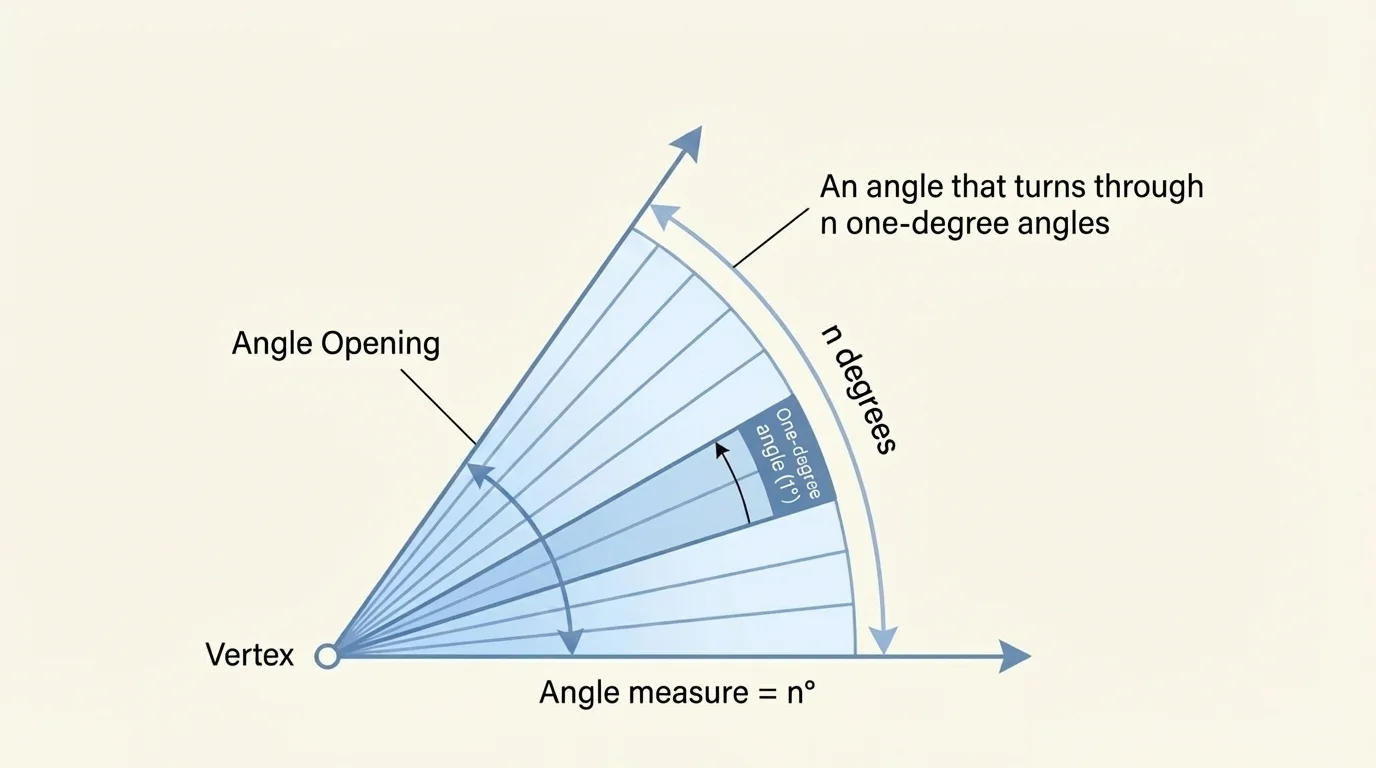
Angles are everywhere: the hands of a clock, scissors opening, a door swinging, and streets meeting at a corner. In geometry, we name an angle by looking at its two rays and the space between them.
Angle means a geometric shape formed by two rays that share a common endpoint.
Vertex means the shared endpoint of the two rays.
Degree means a unit used to measure the size of an angle.
The important idea is that an angle describes an amount of turning. One ray can stay still while the other ray turns away from it. The bigger the turn, the bigger the angle.
Suppose one ray starts in one position and then turns. If it turns through exactly one tiny angle of size \(1\) degree, then the angle measures \(1\) degree. If it turns through \(2\) one-degree angles, then it measures \(2\) degrees. In general, an angle that turns through \(n\) one-degree angles has an angle measure of \(n\) degrees.
This is why degrees are useful. They let us count how much turning has happened. A larger number of degrees means a larger turn. For example, as [Figure 2] helps show, \(10\) degrees is a bigger turn than \(5\) degrees because \(10\) one-degree angles are more than \(5\) one-degree angles.
If one ray turns from a starting position to a new position and passes through \(35\) one-degree angles, the angle measure is \(35\) degrees. We write this as \(35^\circ\). The symbol \(^\circ\) means degrees.
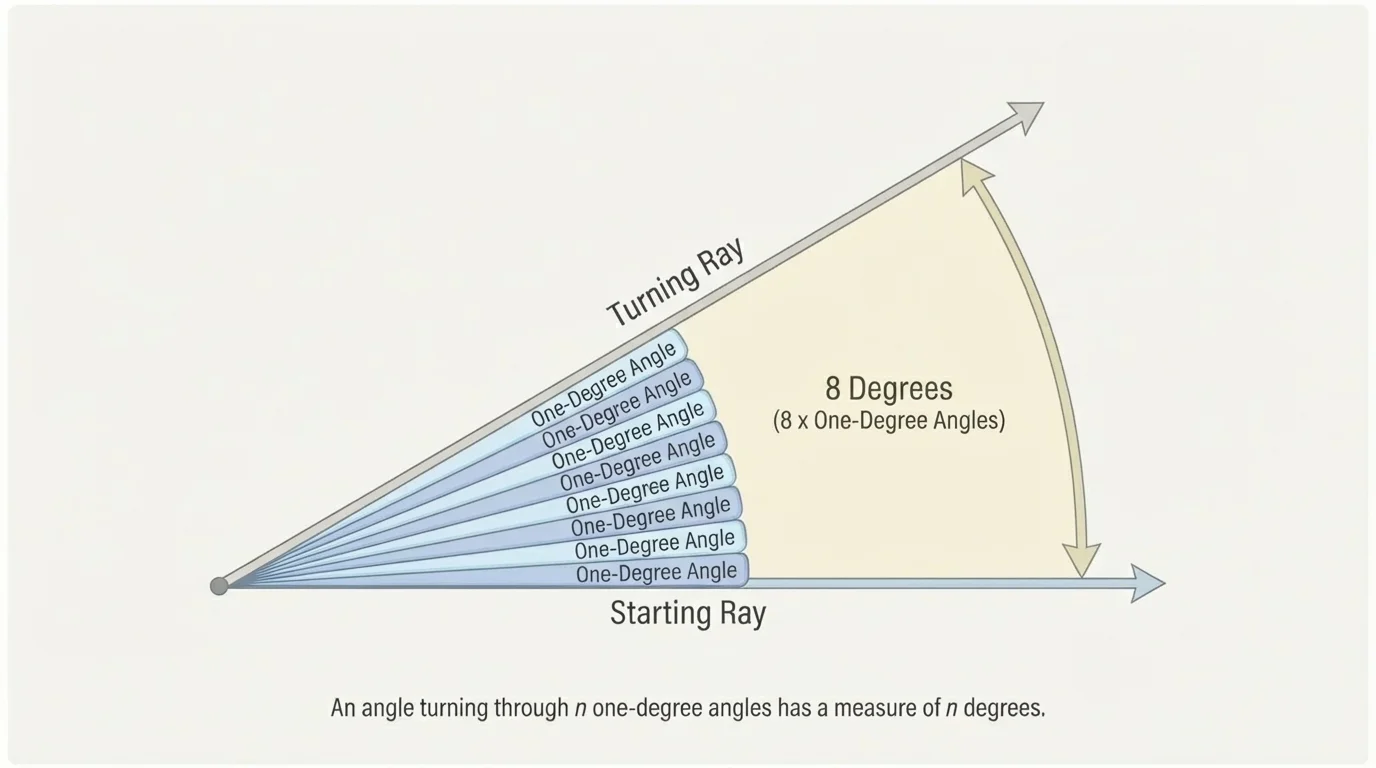
Angle measure is like counting steps in a turn. If you take many tiny turning steps, the total turn becomes larger. This idea helps us understand all angle sizes, from very small openings to a full turn.
Angle measure tells the amount of rotation. It does not tell how long the rays are, how far apart their tips are, or whether the angle points up, down, left, or right. It tells only how much one ray has turned from the other.
A full turn all the way around measures \(360^\circ\). Half of a full turn measures \(180^\circ\). A quarter turn measures \(90^\circ\). These benchmark turns help us estimate angle sizes.
Sometimes two angles look different at first because one is drawn bigger on the page. But if the amount of turn is the same, the angles have the same measure. Ray length does not change angle measure.
For example, as [Figure 3] shows, one angle may have short rays and another may have long rays. If both rays open the same amount, then both angles have the same measure. An angle measuring \(45^\circ\) is still \(45^\circ\) whether the rays are short, long, thick, thin, slanted, or upright.
Also, turning the whole angle on the page does not change its measure. A \(90^\circ\) angle rotated sideways is still \(90^\circ\). The direction it faces does not matter. Only the amount of opening matters.
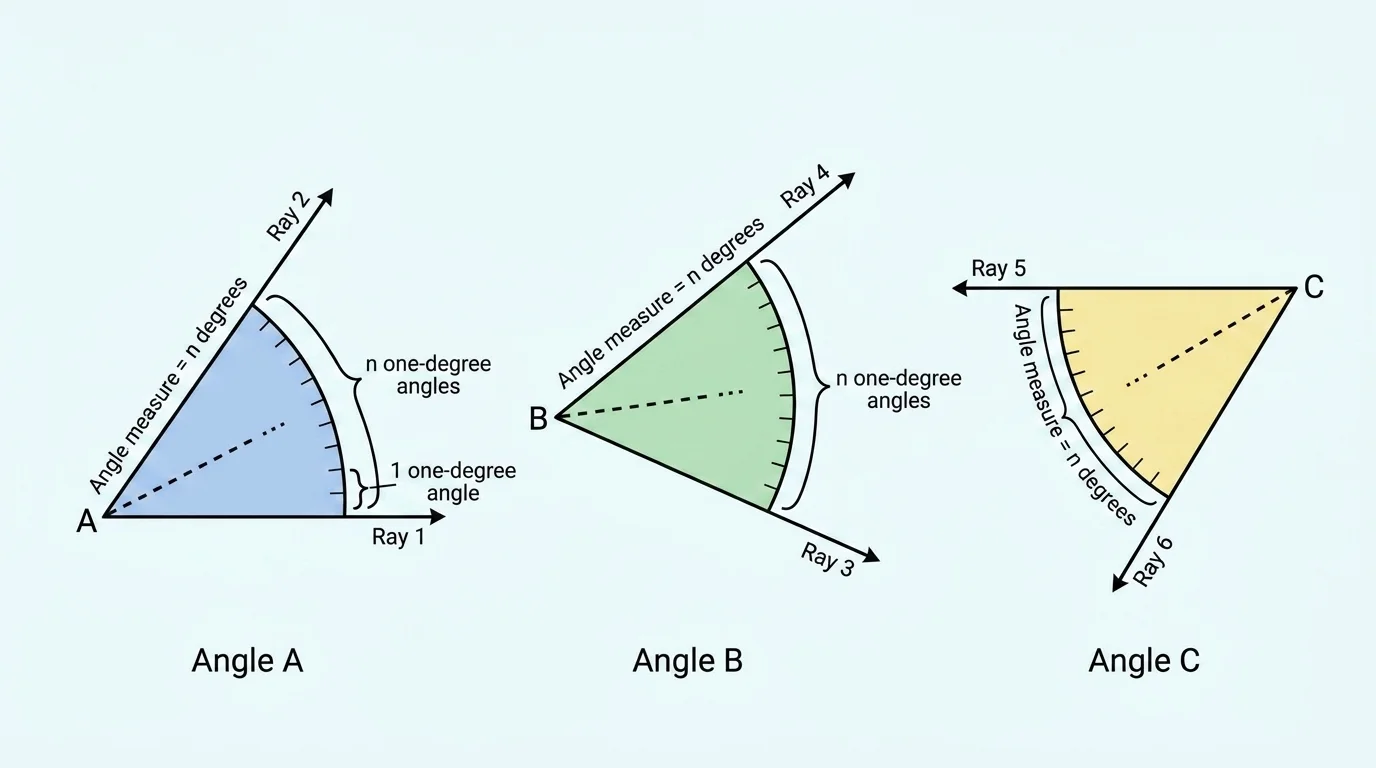
This is an important geometry idea. Measure is about the size of the turn, not about appearance. A picture can look larger, but the angle can still be equal to a smaller-looking one if the opening matches.
You already know how to compare lengths by how long something is. Angles are different. When comparing angles, you are comparing the amount of turn, not the length of the rays.
So if Angle A measures \(60^\circ\) and Angle B measures \(90^\circ\), then Angle B is larger because \(90 > 60\). The rays of Angle A could even be drawn longer than the rays of Angle B, but that would not change the comparison.
Some angles are so common that it helps to know their special sizes. These are called benchmark angles. They help you estimate and recognize other angles quickly.
A right angle measures exactly \(90^\circ\). It is the size of a square corner. An angle smaller than \(90^\circ\) is called acute. An angle greater than \(90^\circ\) but less than \(180^\circ\) is called obtuse. A straight angle measures \(180^\circ\), which is a half turn. A full turn measures \(360^\circ\).
| Angle Type | Measure | Description |
|---|---|---|
| Zero angle | \(0^\circ\) | No turn at all |
| Acute angle | Greater than \(0^\circ\) and less than \(90^\circ\) | Small opening |
| Right angle | \(90^\circ\) | Quarter turn |
| Obtuse angle | Greater than \(90^\circ\) and less than \(180^\circ\) | Wide opening |
| Straight angle | \(180^\circ\) | Half turn |
| Full turn | \(360^\circ\) | Whole turn around |
Table 1. Common angle types and their measures.
Benchmark angles help in everyday thinking. If a door opens halfway to a square corner, it might be about \(45^\circ\). If a clock hand moves from \(12\) to \(3\), it has turned \(90^\circ\).
A circle is divided into \(360\) degrees. That is why one full turn around a point is \(360^\circ\).
Using benchmarks, as shown in [Figure 4], you can decide whether an angle is close to \(30^\circ\), \(60^\circ\), \(90^\circ\), or another familiar measure even before using a tool.
A protractor is a tool that measures angles in degrees. It matches the idea of one ray turning away from another ray. The curved edge has degree marks, and the center point goes on the vertex.
To measure an angle with a protractor, place the center hole on the vertex. Line up one ray with the \(0^\circ\) line. Then read the number where the other ray crosses the scale. That number tells the angle measure in degrees.
You have to choose the correct scale. Many protractors have two number lines going in opposite directions. Start at the \(0^\circ\) that matches the ray you lined up. If the second ray points to \(70\) on that scale, then the angle measures \(70^\circ\).
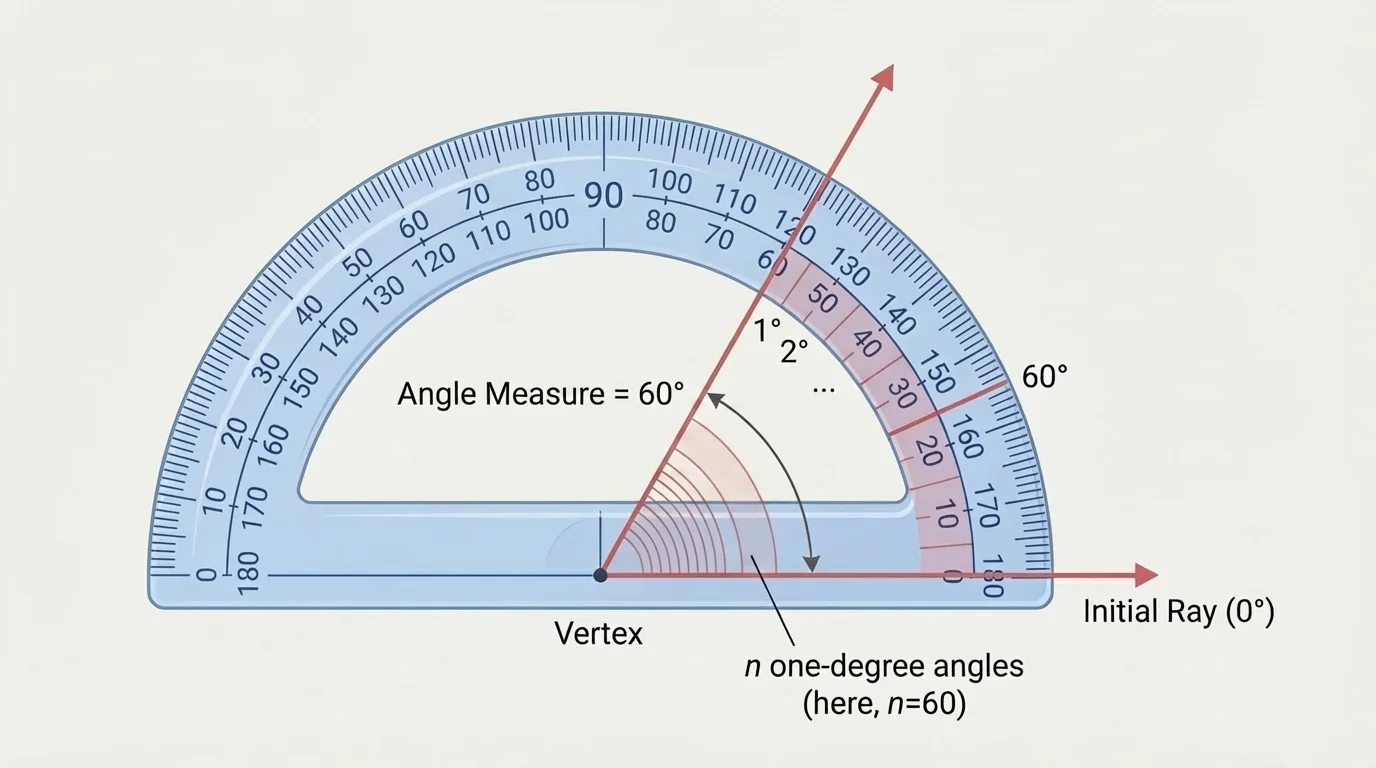
Estimating first is very helpful. If an angle looks a little smaller than a right angle, it should measure a little less than \(90^\circ\). If your protractor reading says \(140^\circ\), you know something went wrong because that would be obtuse, not slightly less than a right angle.
Later, when you compare protractor readings with benchmark angles, the diagram remains useful because it shows the connection between the vertex, the starting ray, and the degree scale.
Worked examples help turn the idea of angle measure into something clear and concrete.
Example 1
An angle is formed by a ray turning through \(18\) one-degree angles. What is the angle measure?
Step 1: Use the meaning of degree measure.
If an angle turns through \(n\) one-degree angles, then its measure is \(n\) degrees.
Step 2: Substitute \(n = 18\).
The angle turns through \(18\) one-degree angles, so its measure is \(18\) degrees.
The angle measure is \(18^\circ\).
This example shows the basic rule directly: count the one-degree turns, and that count is the angle measure.
Example 2
An angle measures \(90^\circ\). What kind of angle is it?
Step 1: Recall the benchmark angles.
A right angle measures exactly \(90^\circ\).
Step 2: Compare the given measure to the benchmark.
Since the angle measure is \(90^\circ\), it matches a right angle exactly.
The angle is a right angle.
Knowing benchmark angles helps you classify angles quickly and correctly.
Example 3
A clock's minute hand moves from \(12\) to \(2\). How many degrees does it turn?
Step 1: Recall the full turn on a clock.
A full turn is \(360^\circ\). The clock is divided into \(12\) equal spaces.
Step 2: Find the angle for one space.
Each space is \(360^\circ \div 12 = 30^\circ\), so each space measures \(30^\circ\).
Step 3: Count the spaces from \(12\) to \(2\).
From \(12\) to \(1\) is one space, and from \(1\) to \(2\) is one more space. That is \(2\) spaces total.
Step 4: Multiply.
\(2 \times 30 = 60\)
The minute hand turns \(60^\circ\).
Clock turns are excellent real-life angle examples because they show rotation clearly.
Example 4
Angle A is \(45^\circ\). Angle B is \(45^\circ\), but its rays are drawn twice as long. Are the angles equal?
Step 1: Focus on angle measure, not ray length.
Angle measure depends on the amount of turn.
Step 2: Compare the measures.
Angle A is \(45^\circ\) and Angle B is \(45^\circ\).
Step 3: Decide.
Since the measures are the same, the angles are equal.
The angles are equal.
This is the same idea seen earlier in [Figure 3]: longer rays do not make a larger angle.
Angle measure helps people describe turning and direction in many situations. Drivers turn steering wheels, basketball players bank shots, carpenters check square corners, and dancers rotate their bodies through different angles.
In sports, a soccer player may kick the ball at a certain direction compared with a sideline. In construction, builders use right angles to make walls and floors fit correctly. In maps and navigation, directions involve turning from one path to another.
At home, you can notice angles in folding chairs, cabinet doors, ladders, and slices of pizza. If a pizza is cut into \(8\) equal slices, each slice has a central angle of \(360 \div 8 = 45\), so each central angle is \(45^\circ\).
Why degrees matter in real life Degrees give people a precise way to talk about turning. Saying "turn a little" is not exact, but saying "turn \(90^\circ\)" tells exactly how much to turn.
Even technology uses angles. A robot arm may turn by a set number of degrees. A video game character may rotate to face a new direction. These all depend on the same idea: angle measure is the amount of turn.
One common mistake is thinking a larger drawing means a larger angle. But if the opening stays the same, the angle measure stays the same.
Another common mistake is reading the wrong scale on a protractor. Estimate first. If the angle looks acute, your answer should be less than \(90^\circ\). If it looks obtuse, your answer should be greater than \(90^\circ\) but less than \(180^\circ\).
A third mistake is measuring the space between the ray endpoints instead of the turn at the vertex. The correct focus is always the amount of rotation from one ray to the other.
"Angles are measured by turn, not by length."
When you remember that one ray turns away from another, angle measure becomes much easier to understand. Counting one-degree angles, using benchmark measures, and checking with a protractor all support the same big idea.
