Suppose you had to fill a gift box with tiny cubes, one cube at a time. How many cubes would fit? That question is really asking about volume. Volume helps us measure how much space is inside a solid object, such as a box, a drawer, a fish tank, or a storage bin. When a shape is a rectangular box with square corners, we can find its volume by thinking about cubes, layers, and multiplication.
People use volume all the time, even if they do not always say the word. A moving company needs to know how much can fit in a truck. A toy company needs to know the size of a package. A builder may need to know how much space is inside a container. Volume tells us the amount of space inside a three-dimensional object.
Area measures the space on a flat surface, but volume measures the space inside a solid figure. That is why volume uses cubic units, not square units. If one little cube has side lengths of 1 unit, then it is called a unit cube, and it has a volume of 1 cubic unit.
You already know that a rectangle has length and width, and its area is found by multiplying: \(A = l \times w\). Volume builds on that idea by adding a third measurement: height.
A shape with length, width, and height is three-dimensional. That makes volume different from perimeter and area. Perimeter measures the distance around a figure, area measures the amount of surface covered on a flat region, and volume measures the space inside a solid.
A right rectangular prism is a box-shaped solid with rectangular faces and right angles at the corners. Words like cereal box, brick, and shipping box describe objects shaped like right rectangular prisms. The word right means the corners are right angles.
This prism has three main dimensions: length, width, and height. These measurements tell how long, how wide, and how tall the prism is. If all three measurements are whole numbers, then we can imagine packing the prism with whole numbers of unit cubes.
Volume is the amount of space inside a solid figure. Base is the face chosen to be the bottom of a solid. Cubic units are the units used to measure volume, such as cubic centimeters or cubic inches.
Any face of a rectangular prism can be chosen as the base. Once a base is chosen, the height is the distance straight up from that base to the opposite face. This idea becomes important because we can find volume using the area of the base and the height.
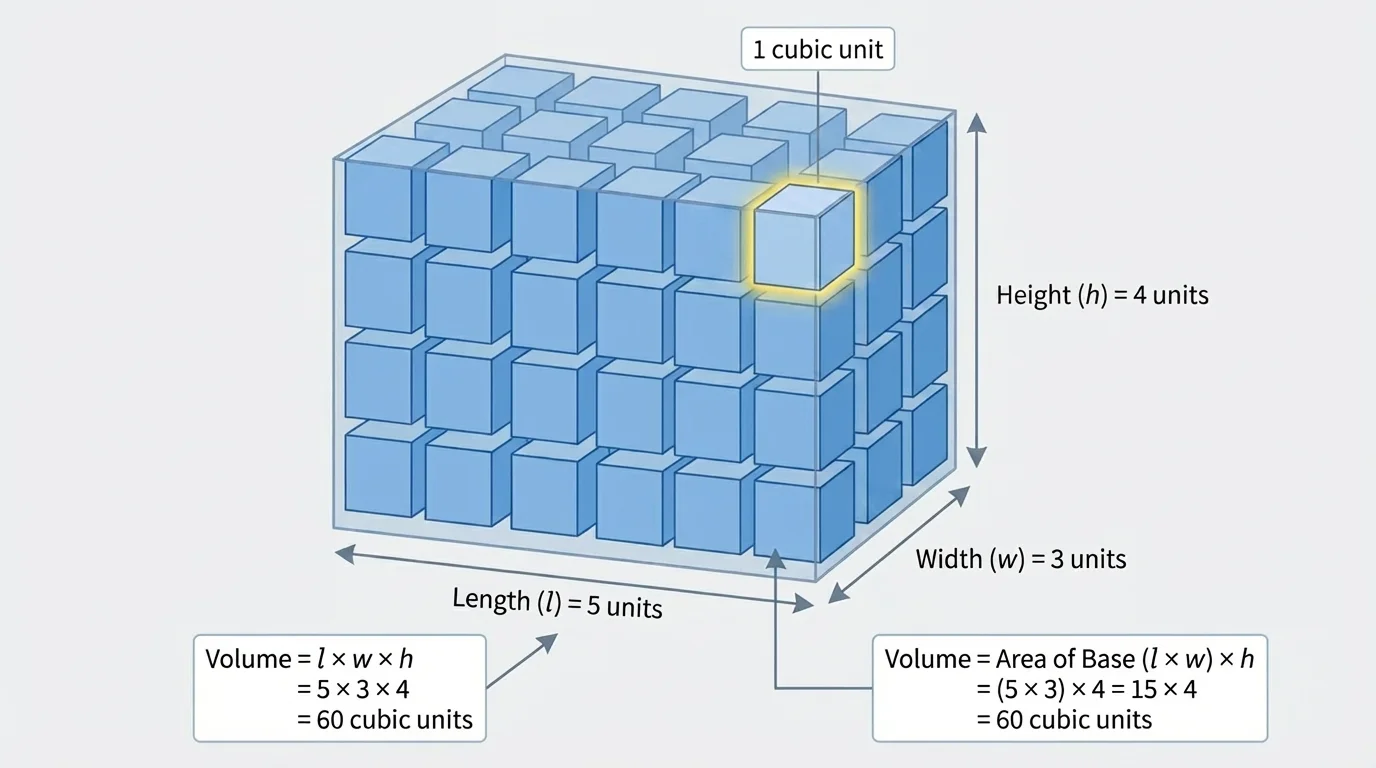
Volume becomes much easier to understand when you picture filling a solid with cubes, as shown in [Figure 1]. Each unit cube takes up exactly 1 cubic unit of space, so counting the cubes tells the volume.
Suppose a prism is 3 units long, 2 units wide, and 4 units high. If you pack it completely with unit cubes and there are no gaps or overlaps, then the number of cubes inside is the volume.
One way to count the cubes is to count them one by one, but that can take a long time. A better way is to look for rows, columns, and layers. This turns cube counting into multiplication.
If the bottom layer has 3 rows and 2 cubes in each row, then the bottom layer has \(3 \times 2 = 6\) cubes. If the prism is 4 layers high, then there are 4 layers of 6 cubes each. So the volume is \(6 \times 4 = 24\) cubic units.
This matches multiplying all three side lengths: \(3 \times 2 \times 4 = 24\). Counting cubes and multiplying dimensions give the same result because multiplication helps us count equal groups quickly.
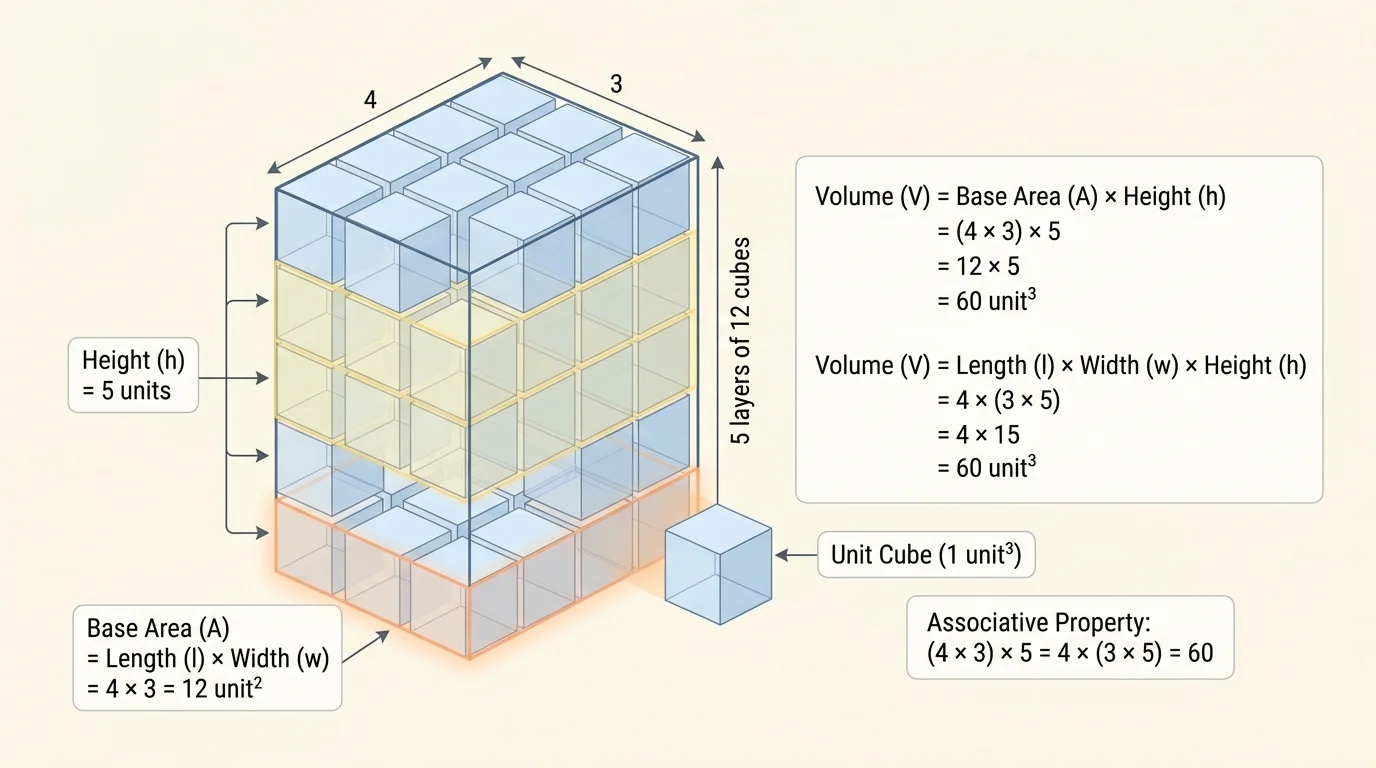
Layers are the bridge between area and volume, and [Figure 2] shows this clearly. Every layer that matches the base has the same number of cubes. So if you know how many cubes fit in one layer, you can multiply by the number of layers.
Think about the base of a prism. If the base is a rectangle that is 5 units by 3 units, then its area is \(5 \times 3 = 15\) square units. That means one layer holds 15 unit cubes.
If the prism has a height of 4 units, then there are 4 layers. The total number of cubes is \(15 \times 4 = 60\). So the volume is 60 cubic units.
This gives an important formula:
\(V = B \times h\)
Here, \(V\) is volume, \(B\) is the area of the base, and \(h\) is the height. Since the base of a rectangular prism is a rectangle, \(B = l \times w\). That means:
\(V = l \times w \times h\)
The formula is not magic. It comes directly from packing equal layers of unit cubes. Later, when you solve problems faster with multiplication, the cube model still explains why the formula works.
For a right rectangular prism with whole-number side lengths, volume can be found in two matching ways:
These are equivalent because the first two dimensions tell how many cubes are in one layer, and the third dimension tells how many layers there are.
Sometimes students say the dimensions in a different order, such as \(w \times h \times l\) or \(h \times l \times w\). That is fine. The product is the same because multiplying whole numbers can be done in any order.
Why area connects to volume
The base is a flat rectangle, so its area tells how many unit squares cover one layer. When that layer becomes one cube tall, each square turns into a unit cube. Stacking the same layer over and over creates the whole prism. That is why volume equals base area times height.
If a prism has dimensions 7 units, 2 units, and 3 units, then the volume is \(7 \times 2 \times 3 = 42\) cubic units. If you instead find the base area first, \(7 \times 2 = 14\) square units, then multiply by height, \(14 \times 3 = 42\) cubic units. Both methods agree.
Worked examples help show how the ideas of cubes, layers, and multiplication all fit together.
Example 1
A right rectangular prism is 4 units long, 3 units wide, and 2 units high. Find its volume.
Step 1: Find the number of cubes in one layer.
The base has \(4 \times 3 = 12\) unit squares, so one layer holds 12 unit cubes.
Step 2: Multiply by the number of layers.
The prism is 2 layers high, so the total is \(12 \times 2 = 24\).
Step 3: State the volume.
\(V = 24\) cubic units.
The prism holds 24 unit cubes.
Notice that the same answer comes from multiplying all three edge lengths: \(4 \times 3 \times 2 = 24\).
Example 2
A storage box has dimensions 6 units by 5 units by 3 units. Find the volume using base area times height.
Step 1: Choose a base.
Use the 6-unit by 5-unit face as the base.
Step 2: Find the base area.
\(B = 6 \times 5 = 30\) square units.
Step 3: Multiply by the height.
\(V = B \times h = 30 \times 3 = 90\).
The volume is 90 cubic units.
This example shows that finding area first can make volume problems easier, especially when you picture the prism as 3 identical layers of 30 cubes each.
Example 3
A prism is 8 units long, 2 units wide, and 5 units high. Find the volume in two ways.
Step 1: Multiply all three dimensions.
\(V = 8 \times 2 \times 5 = 16 \times 5 = 80\) cubic units.
Step 2: Use base area times height.
Base area: \(8 \times 2 = 16\) square units.
Then \(16 \times 5 = 80\) cubic units.
Step 3: Compare the results.
Both methods give the same answer, so the volume is 80 cubic units.
This confirms that \(l \times w \times h\) and \(B \times h\) are equivalent for rectangular prisms.
Once you understand why these two methods match, you can choose the one that makes the most sense in a problem.
Volume also helps us see the associative property of multiplication, and [Figure 3] makes this idea concrete. The associative property says that when multiplying three numbers, the grouping can change, but the product stays the same.
For example, compare \((2 \times 3) \times 4\) and \(2 \times (3 \times 4)\). In the first expression, you might think of one layer with \(2 \times 3 = 6\) cubes, then 4 layers, giving \(6 \times 4 = 24\) cubes. In the second expression, you might group \(3 \times 4 = 12\) first, then multiply by 2, giving \(2 \times 12 = 24\) cubes.
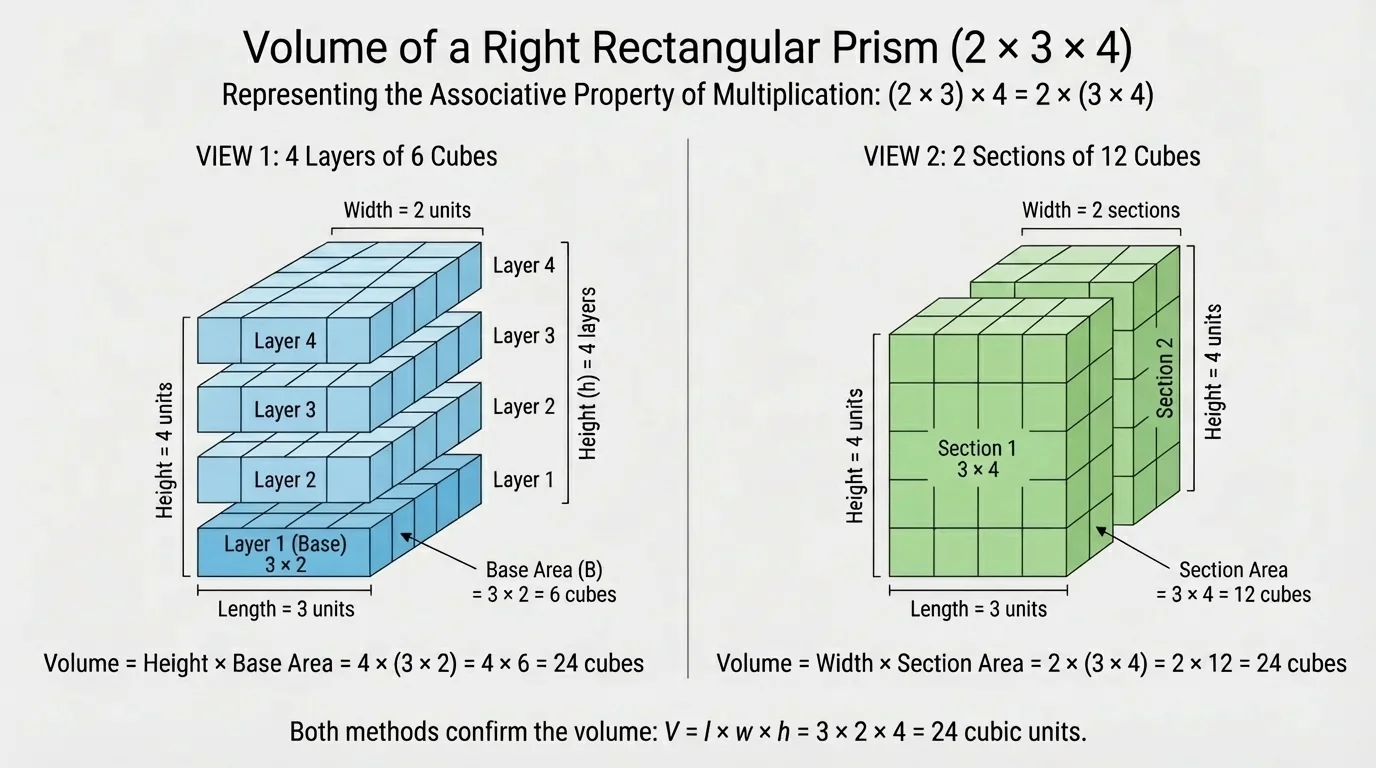
Both expressions describe the same prism with side lengths 2, 3, and 4. Nothing about the prism changes. Only the way we group the multiplication changes.
That means volume gives a model for the associative property:
\((2 \times 3) \times 4 = 2 \times (3 \times 4)\)
\(6 \times 4 = 2 \times 12\)
\(24 = 24\)
Much later, when you see larger multiplication expressions, this same idea still works. The prism in [Figure 3] shows that different groupings can count the same set of cubes.
A single rectangular prism can help show several multiplication ideas at once: repeated addition, arrays, equal groups, and the associative property. Geometry and arithmetic connect more than many students expect.
You can even test another example: \((5 \times 2) \times 3 = 5 \times (2 \times 3)\). One grouping gives \(10 \times 3 = 30\). The other gives \(5 \times 6 = 30\). Both represent the same prism volume of 30 cubic units.
Volume matters whenever people need to know how much can fit inside something. A shipping box with dimensions \(10\,\textrm{in}\) by \(6\,\textrm{in}\) by \(4\,\textrm{in}\) has volume \(10 \times 6 \times 4 = 240\,\textrm{in}^3\). That tells how much space is available inside the box.
An aquarium shaped like a rectangular prism might be \(24\,\textrm{in}\) long, \(12\,\textrm{in}\) wide, and \(16\,\textrm{in}\) high. Its volume is \(24 \times 12 \times 16 = 4{,}608\,\textrm{in}^3\). That is a lot of space, and fish owners care because the size of the tank affects how much water it holds.
A warehouse worker stacking small boxes inside a larger crate is really thinking about unit-cube ideas. Even if the boxes are not exact cubes, the idea of filling space efficiently still connects to volume.
One common mistake is confusing area and volume. If a rectangular base is 4 units by 3 units, its area is 12 square units, not cubic units. If the prism built on that base is 5 units high, then the volume is \(12 \times 5 = 60\) cubic units.
Another mistake is forgetting one dimension. A prism has three dimensions, so volume needs three measurements or a base area and a height. Using only two measurements gives area, not volume.
Students also sometimes write the wrong units. Volume must be written in cubic units, such as \(\textrm{cm}^3\), \(\textrm{in}^3\), or cubic units.
Same volume, different viewpoints
You can choose different faces as the base of a rectangular prism, but the volume stays the same. For example, a prism with dimensions 2, 3, and 4 can have base area \(2 \times 3 = 6\) and height 4, or base area \(3 \times 4 = 12\) and height 2. Both give 24 cubic units.
This is a powerful check. If two correct methods give different answers, then something went wrong in the calculations.
Suppose a prism has dimensions 3 units, 4 units, and 5 units. You can find the volume as \(3 \times 4 \times 5 = 60\). But you can also think of it as 4 layers of \(3 \times 5 = 15\) cubes, so \(15 \times 4 = 60\). Or as 5 layers of \(3 \times 4 = 12\) cubes, so \(12 \times 5 = 60\).
This flexibility matters because mathematics is not just about getting an answer. It is also about seeing the structure of a problem. Rectangular prisms are excellent models because they connect geometry, multiplication, area, and number properties all at once.
When you picture the cubes inside the prism, the formula has a meaning. When you multiply the dimensions, you are not just following a rule. You are counting the cubes in rows, columns, and layers.
