If two friends each eat half of something, did they eat the same amount? Not always. One friend might eat \(\dfrac{1}{2}\) of a small sandwich, while the other eats \(\dfrac{1}{2}\) of a giant pizza. That is why fraction word problems are about more than just numbers. They are about understanding what the fractions mean, what whole they belong to, and whether the answer makes sense in the real world.
Fractions appear in recipes, sports statistics, measuring lengths, building projects, and dividing time. To solve word problems with fractions, you need to understand the situation, write a math sentence, and sometimes rename fractions so they have a common denominator. Then you can add or subtract correctly and check your answer with estimation.
Word problems turn fraction skills into thinking skills. Instead of only solving something like \(\dfrac{1}{4}+\dfrac{3}{4}\), you might need to decide whether to add or subtract, figure out what the whole is, and explain why your answer is reasonable.
For example, if a runner jogs \(\dfrac{2}{3}\) mile in the morning and \(\dfrac{1}{6}\) mile in the evening, you are finding a total, so you add. But if a rope is \(\dfrac{5}{6}\) yard long and \(\dfrac{1}{3}\) yard is cut off, you are finding what remains, so you subtract.
You already know that fractions name equal parts of a whole and that equivalent fractions have the same value. For example, \(\dfrac{1}{2}=\dfrac{2}{4}=\dfrac{3}{6}\). That idea is the key to adding and subtracting fractions with unlike denominators.
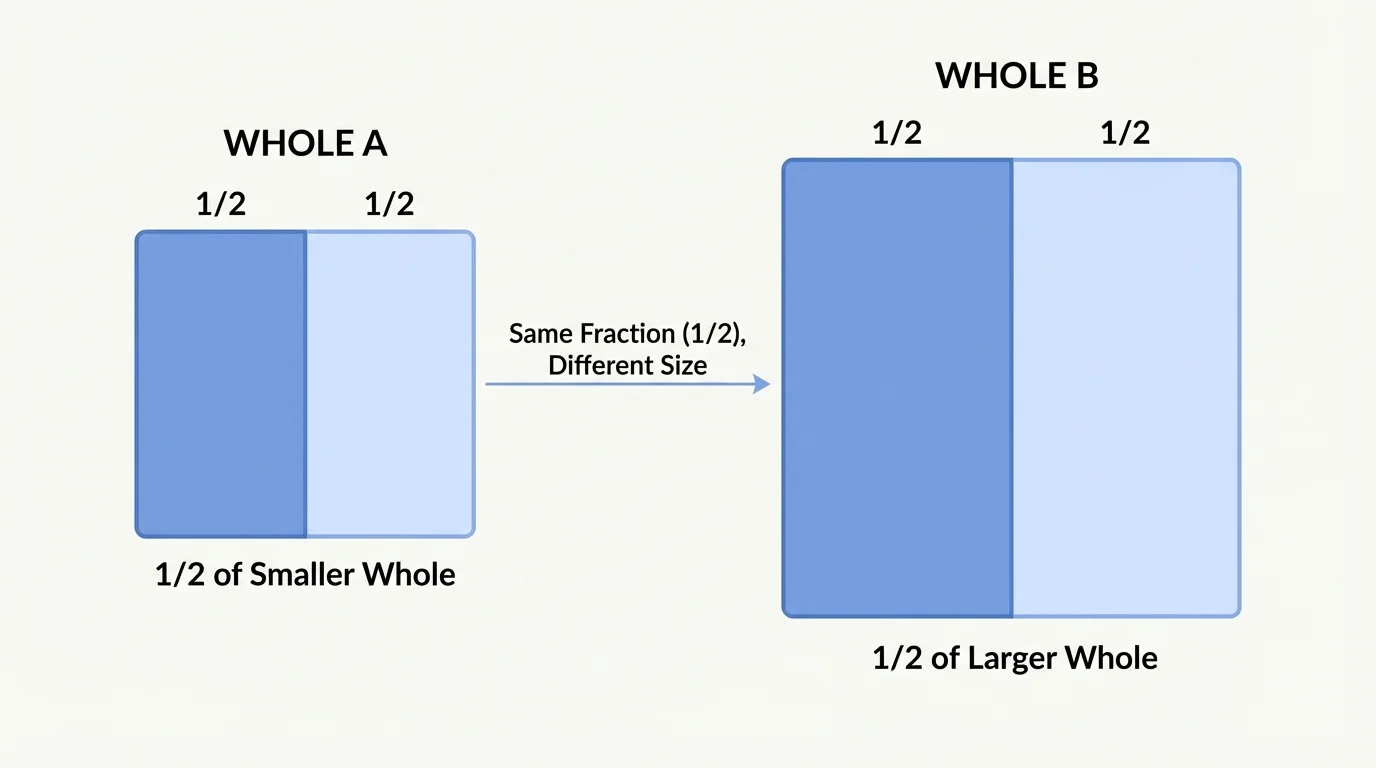
A same whole means all the fractions in the problem refer to one whole object, one whole length, one whole group, or one whole unit. This matters because fractions can only be combined meaningfully when they describe parts of the same-sized whole, as [Figure 1] shows.
Suppose one student drinks \(\dfrac{1}{2}\) of a small bottle of water and another drinks \(\dfrac{1}{2}\) of a large bottle. Both drank one-half, but not the same amount of water. In a word problem, always ask: What is the whole?
When a problem says a pan of brownies, a yard of ribbon, a tank of gas, or one hour, that tells you the whole. If all the fractions refer to that same whole, then adding and subtracting makes sense.
Equivalent fractions are different fractions that name the same amount. Common denominator means a denominator shared by two or more fractions. Benchmark fractions are familiar fractions such as \(0\), \(\dfrac{1}{2}\), and \(1\) that help you estimate.
Later, when you check your answers, the idea of the same whole is still important. An answer might be correct mathematically but incorrect for the situation if the fractions were not parts of the same whole. That is one reason careful reading matters in fraction word problems.
When fractions have the same denominator, addition and subtraction are straightforward because the parts are the same size. You add or subtract the numerators and keep the denominator.
For example, \(\dfrac{2}{8}+\dfrac{3}{8}=\dfrac{5}{8}\). Also, \(\dfrac{7}{10}-\dfrac{4}{10}=\dfrac{3}{10}\). The denominator stays the same because you are still counting tenths or eighths.
When fractions have unlike denominators, the parts are not the same size. You cannot combine them until you rename the fractions as equivalent fractions with a common denominator.
For example, to add \(\dfrac{1}{3}+\dfrac{1}{6}\), notice that thirds and sixths are different-sized parts. Rewrite \(\dfrac{1}{3}\) as \(\dfrac{2}{6}\). Then \(\dfrac{2}{6}+\dfrac{1}{6}=\dfrac{3}{6}=\dfrac{1}{2}\).
The same idea works for subtraction. To solve \(\dfrac{3}{4}-\dfrac{1}{6}\), use a common denominator of \(12\): \(\dfrac{3}{4}=\dfrac{9}{12}\) and \(\dfrac{1}{6}=\dfrac{2}{12}\). Then \(\dfrac{9}{12}-\dfrac{2}{12}=\dfrac{7}{12}\).
Why common denominators work
Denominators tell the size of the parts. If one fraction is in thirds and another is in sixths, you are counting different-sized pieces. Renaming both fractions with a common denominator changes them into the same-sized pieces, so adding or subtracting is fair and accurate.
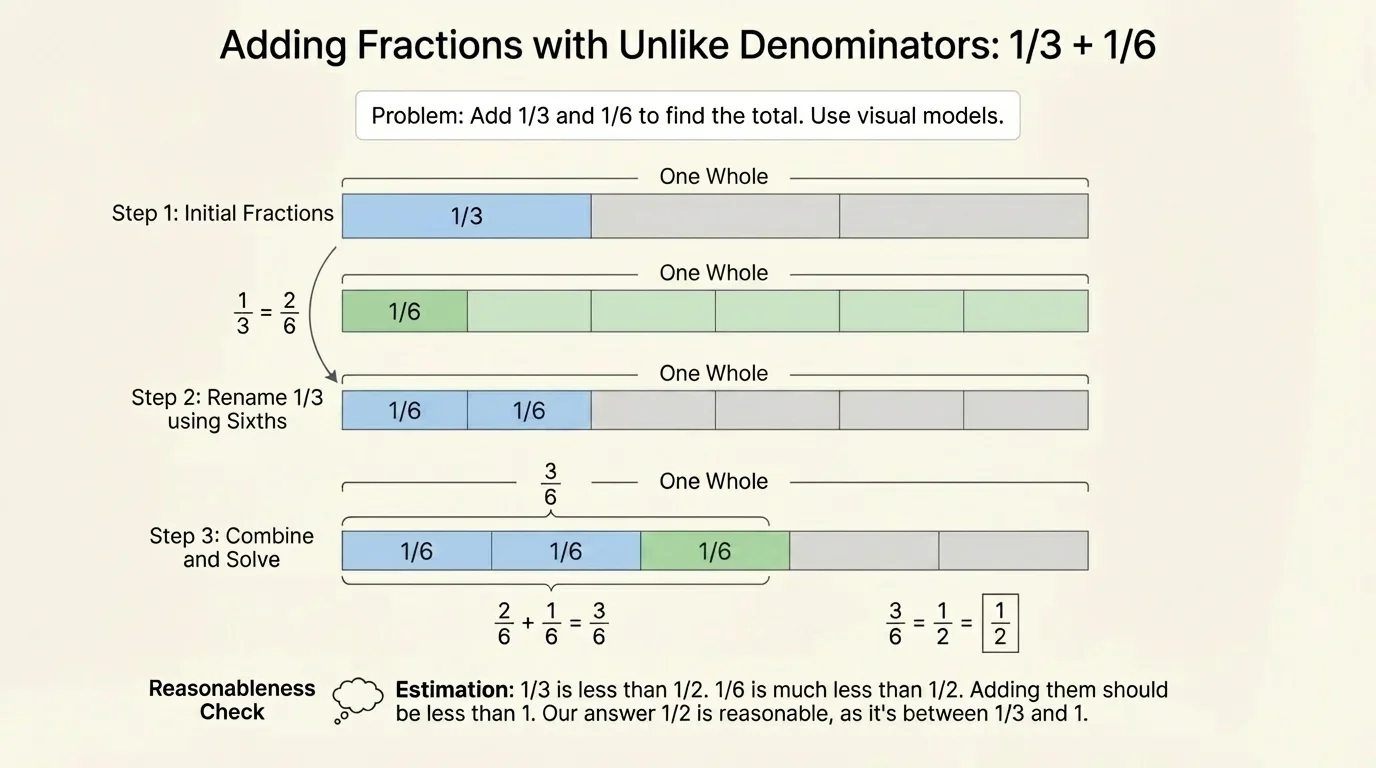
A visual fraction model helps you see the parts of the whole. Fraction bars, strips, area models, and number lines are useful tools. For unlike denominators, a model often makes the need for equivalent fractions very clear, as [Figure 2] illustrates.
Suppose you want to add \(\dfrac{1}{3}\) and \(\dfrac{1}{6}\). If one bar is divided into thirds and another into sixths, the pieces do not match. But if you divide the whole into sixths, then \(\dfrac{1}{3}\) becomes \(\dfrac{2}{6}\). Now both amounts are in sixths, and together they make \(\dfrac{3}{6}\), or \(\dfrac{1}{2}\).
You can also represent the same problem with an equation:
\[\frac{1}{3}+\frac{1}{6}=\frac{2}{6}+\frac{1}{6}=\frac{3}{6}=\frac{1}{2}\]
In word problems, equations are especially helpful because they show the operation clearly. If the problem asks for a total, write an addition equation. If it asks how much is left or how much more, write a subtraction equation.
For example, "Lena used \(\dfrac{1}{4}\) of a yard of fabric on one project and \(\dfrac{3}{8}\) of a yard on another" becomes \(\dfrac{1}{4}+\dfrac{3}{8}\). "A pitcher held \(\dfrac{5}{6}\) liter of juice and \(\dfrac{1}{3}\) liter was poured out" becomes \(\dfrac{5}{6}-\dfrac{1}{3}\).
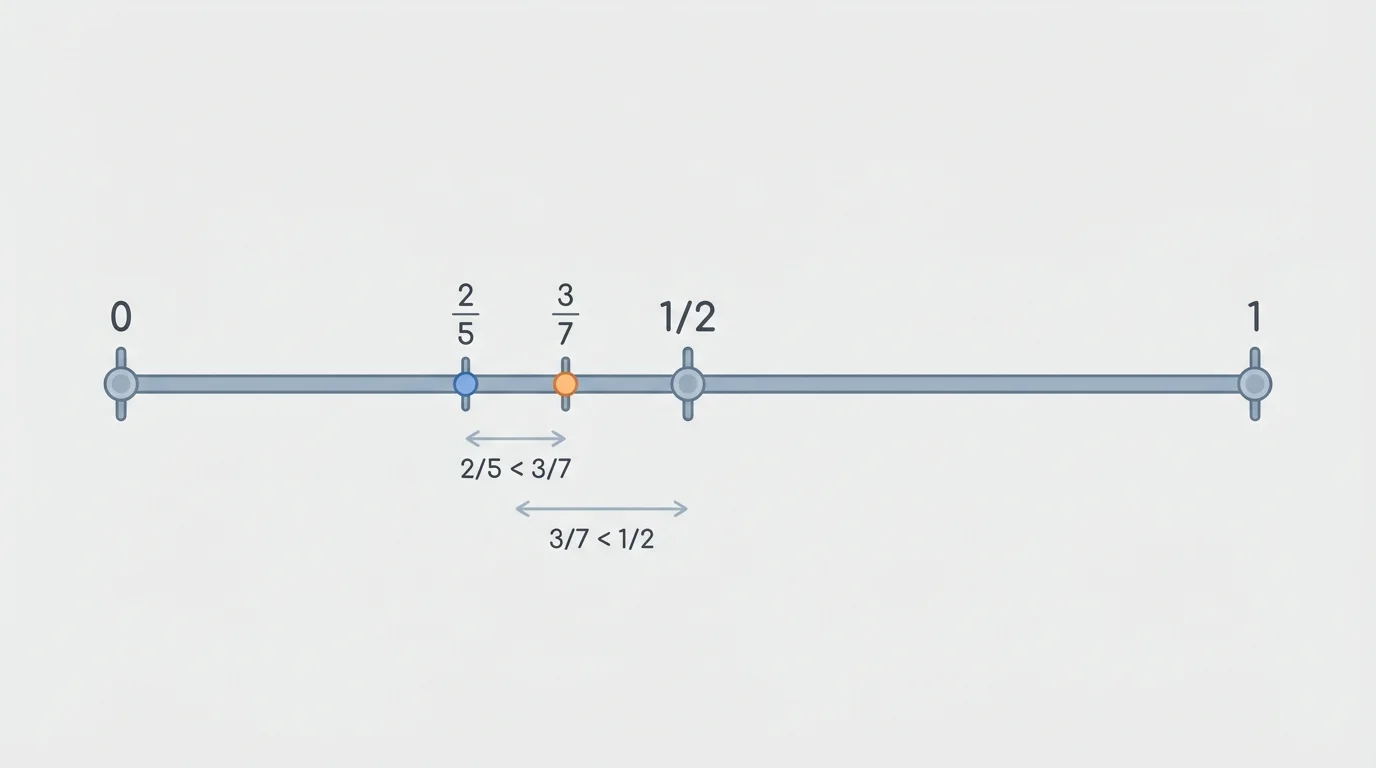
A benchmark fraction is a fraction you know well, such as \(0\), \(\dfrac{1}{2}\), or \(1\). These familiar values help you estimate quickly. On a number line, as shown in [Figure 3], you can compare a fraction to benchmark fractions and decide whether an answer is reasonable.
For example, \(\dfrac{2}{5}\) is a little less than \(\dfrac{1}{2}\). If you add \(\dfrac{2}{5}+\dfrac{1}{2}\), the result must be greater than \(\dfrac{1}{2}\) because you are adding a positive amount to \(\dfrac{1}{2}\). So the answer \(\dfrac{3}{7}\) cannot be correct, because \(\dfrac{3}{7}\) is less than \(\dfrac{1}{2}\).
This is a powerful checking strategy. Even before finding the exact answer, you can think about whether the answer should be close to \(0\), close to \(\dfrac{1}{2}\), close to \(1\), or greater than \(1\).
Fractions can help you catch mistakes without doing every step again. If your answer to an addition problem is smaller than one of the numbers you added, something is wrong.
Here are some useful mental estimates:
As you continue solving problems, come back to the number-line thinking in [Figure 3]. It helps you judge size, not just perform a procedure.
Now let's solve some fraction word problems step by step.
Worked example 1
Mia walked \(\dfrac{1}{4}\) mile to the park and \(\dfrac{3}{8}\) mile around the park. How far did she walk in all?
Step 1: Decide whether to add or subtract.
The words "in all" tell us to add: \(\dfrac{1}{4}+\dfrac{3}{8}\).
Step 2: Find a common denominator.
The common denominator for \(4\) and \(8\) is \(8\). Rewrite \(\dfrac{1}{4}\) as \(\dfrac{2}{8}\).
Step 3: Add the fractions.
\(\dfrac{2}{8}+\dfrac{3}{8}=\dfrac{5}{8}\).
Step 4: Check whether the answer makes sense.
Since \(\dfrac{1}{4}\) is less than \(\dfrac{1}{2}\) and \(\dfrac{3}{8}\) is also less than \(\dfrac{1}{2}\), the total should be less than \(1\). The answer \(\dfrac{5}{8}\) is reasonable.
Mia walked \(\dfrac{5}{8}\) mile in all.
This problem used addition because the question asked for a total amount. Notice that the fractions referred to the same whole: miles.
Worked example 2
A ribbon is \(\dfrac{5}{6}\) yard long. Nora uses \(\dfrac{1}{3}\) yard. How much ribbon is left?
Step 1: Decide whether to add or subtract.
The words "how much is left" tell us to subtract: \(\dfrac{5}{6}-\dfrac{1}{3}\).
Step 2: Rewrite with a common denominator.
Rewrite \(\dfrac{1}{3}\) as \(\dfrac{2}{6}\).
Step 3: Subtract.
\(\dfrac{5}{6}-\dfrac{2}{6}=\dfrac{3}{6}\).
Step 4: Simplify if possible.
\(\dfrac{3}{6}=\dfrac{1}{2}\).
Step 5: Estimate to check.
\(\dfrac{5}{6}\) is close to \(1\), and \(\dfrac{1}{3}\) is less than \(\dfrac{1}{2}\), so the result should be a little more than \(\dfrac{1}{3}\) and about \(\dfrac{1}{2}\) is reasonable.
Nora has \(\dfrac{1}{2}\) yard of ribbon left.
Subtraction problems often use words such as left, remains, how much more, or difference. Those words help you choose the correct operation.
Worked example 3
A recipe uses \(\dfrac{2}{5}\) cup of oats and \(\dfrac{1}{2}\) cup of nuts. How much do the oats and nuts amount to altogether in cups?
Step 1: Write the addition equation.
\(\dfrac{2}{5}+\dfrac{1}{2}\)
Step 2: Estimate first.
\(\dfrac{2}{5}\) is a little less than \(\dfrac{1}{2}\). So the total should be a little less than \(1\), but definitely more than \(\dfrac{1}{2}\).
Step 3: Find a common denominator.
The least common denominator of \(5\) and \(2\) is \(10\). Rewrite \(\dfrac{2}{5}=\dfrac{4}{10}\) and \(\dfrac{1}{2}=\dfrac{5}{10}\).
Step 4: Add.
\(\dfrac{4}{10}+\dfrac{5}{10}=\dfrac{9}{10}\).
Step 5: Check a wrong answer.
If someone says \(\dfrac{2}{5}+\dfrac{1}{2}=\dfrac{3}{7}\), that cannot be correct. The answer \(\dfrac{3}{7}\) is less than \(\dfrac{1}{2}\), but adding \(\dfrac{2}{5}\) to \(\dfrac{1}{2}\) must give more than \(\dfrac{1}{2}\).
The total is \(\dfrac{9}{10}\) cup.
This example shows why number sense matters. Estimation can catch errors fast, even before you look closely at each step.
Worked example 4
During a science project, Carlos filled a container with soil to \(\dfrac{7}{8}\) of its height. Then the soil settled down by \(\dfrac{1}{4}\) of the container's height. What fraction of the container's height is filled now?
Step 1: Understand the action.
The soil settled down, so the amount filled became less. We subtract: \(\dfrac{7}{8}-\dfrac{1}{4}\).
Step 2: Rewrite with a common denominator.
\(\dfrac{1}{4}=\dfrac{2}{8}\).
Step 3: Subtract.
\(\dfrac{7}{8}-\dfrac{2}{8}=\dfrac{5}{8}\).
Step 4: Check reasonableness.
Starting from almost \(1\) and subtracting \(\dfrac{1}{4}\) should give a little more than \(\dfrac{1}{2}\). The answer \(\dfrac{5}{8}\) makes sense.
The container is now filled to \(\dfrac{5}{8}\) of its height.
One common mistake is adding both numerators and denominators, such as saying \(\dfrac{1}{4}+\dfrac{1}{4}=\dfrac{2}{8}\). That is incorrect. Since the parts are fourths, the denominator should stay \(4\): \(\dfrac{1}{4}+\dfrac{1}{4}=\dfrac{2}{4}=\dfrac{1}{2}\).
Another common mistake is doing the same thing with unlike denominators, such as \(\dfrac{2}{5}+\dfrac{1}{2}=\dfrac{3}{7}\). As we saw earlier and as the number line in [Figure 3] helps us understand, this answer is too small to be reasonable.
A third mistake is forgetting to simplify when possible. For example, \(\dfrac{4}{8}\) and \(\dfrac{1}{2}\) name the same amount, but \(\dfrac{1}{2}\) is simpler and easier to understand.
A fourth mistake is not paying attention to the question. Sometimes students solve correctly but answer the wrong thing. If the problem asks how much is left, an addition answer will not match the situation.
| Problem clue | Likely operation | Question to ask yourself |
|---|---|---|
| in all, total, altogether | Add | Am I combining amounts? |
| left, remains, how much more, difference | Subtract | Am I comparing or taking away? |
| different denominators | Rename first | What common denominator can I use? |
| answer seems too small or too large | Estimate | Does my result fit between benchmark fractions? |
Table 1. Clues that help choose operations and check answers in fraction word problems.
Fraction addition and subtraction are useful in everyday life. In cooking, you may combine \(\dfrac{1}{3}\) cup of one ingredient and \(\dfrac{1}{6}\) cup of another. In woodworking or sewing, you may cut \(\dfrac{3}{4}\) yard from a piece that is \(1\) yard long and then find what remains.
In sports, you might compare parts of a game. If a team held the ball for \(\dfrac{2}{5}\) of the game in the first half and \(\dfrac{1}{4}\) of the game in the second half, adding fractions helps describe the total time. In science and engineering, measured amounts are often parts of units, and those parts must be combined carefully.
Math habits that make word problems easier
Strong problem solvers read carefully, identify the whole, choose an operation based on the story, rewrite fractions with a common denominator when needed, and estimate before and after solving. These habits are just as important as the arithmetic.
Sometimes the best first step is to draw a model. If the fractions are hard to picture, a bar model can help. Other times, writing an equation is enough. If the numbers look familiar, estimation with benchmark fractions may quickly tell you whether your final answer is reasonable.
When you solve, a good order is: understand the whole, choose add or subtract, find a common denominator if needed, solve, simplify, and check. That process works for many fraction word problems.
And remember the big idea from [Figure 1]: fractions only make sense when the whole is clear. Once the whole is clear, equivalent fractions, visual models, and benchmark fractions help you solve problems accurately and confidently.
