A decimal on a screen may look modern, but it is often hiding an old idea: division. When a gas tank is \(\dfrac{3}{4}\) full, when a game statistic is \(\dfrac{2}{3}\), or when a recipe uses \(\dfrac{5}{8}\) of a cup, those fractions can all be written as decimals. Some stop neatly, like \(0.75\). Others go on forever in a pattern, like \(0.666\ldots\). Learning how to uncover that decimal using long division helps you connect fractions, division, and place value all at once.
A fraction is another way to write a division problem. In general, \(\dfrac{a}{b}\) means \(a \div b\), as long as \(b \ne 0\). This means that to turn a fraction into a decimal, you divide the numerator by the denominator.
For example, \(\dfrac{1}{2}\) means \(1 \div 2\), which equals \(0.5\). Also, \(\dfrac{3}{4}\) means \(3 \div 4\), which equals \(0.75\). This is why decimals and fractions are just different ways to represent the same number.
Any number that can be written as a fraction of integers is called a rational number. That includes positive fractions, negative fractions, whole numbers, and integers. For example, \(5\) is rational because \(5 = \dfrac{5}{1}\), and \(-2\) is rational because \(-2 = \dfrac{-2}{1}\).
Rational number is any number that can be written in the form \(\dfrac{a}{b}\), where \(a\) and \(b\) are integers and \(b \ne 0\).
Terminating decimal is a decimal that ends, such as \(0.25\) or \(1.875\).
Repeating decimal is a decimal in which one digit or a group of digits repeats forever, such as \(0.333\ldots\) or \(0.1666\ldots\).
Quotient is the answer to a division problem, and remainder is what is left over.
When you divide a rational number, the decimal result will do one of two things: it will stop, or it will continue with a repeating pattern. It will not behave randomly forever. That fact is one of the most important ideas in this lesson.
As shown in [Figure 1], to convert a fraction to a decimal, divide the numerator by the denominator using long division. The basic setup places the numerator inside the division symbol and the denominator outside. If the denominator does not divide evenly into the numerator, you write a decimal point in the quotient and add zeros to the numerator as needed.
Suppose you want to convert \(\dfrac{3}{8}\) to a decimal. You compute \(3 \div 8\). Since \(8\) does not go into \(3\), you write \(0\) in the ones place of the quotient, place a decimal point, and continue by thinking of \(3\) as \(3.0\), then \(30\) tenths.
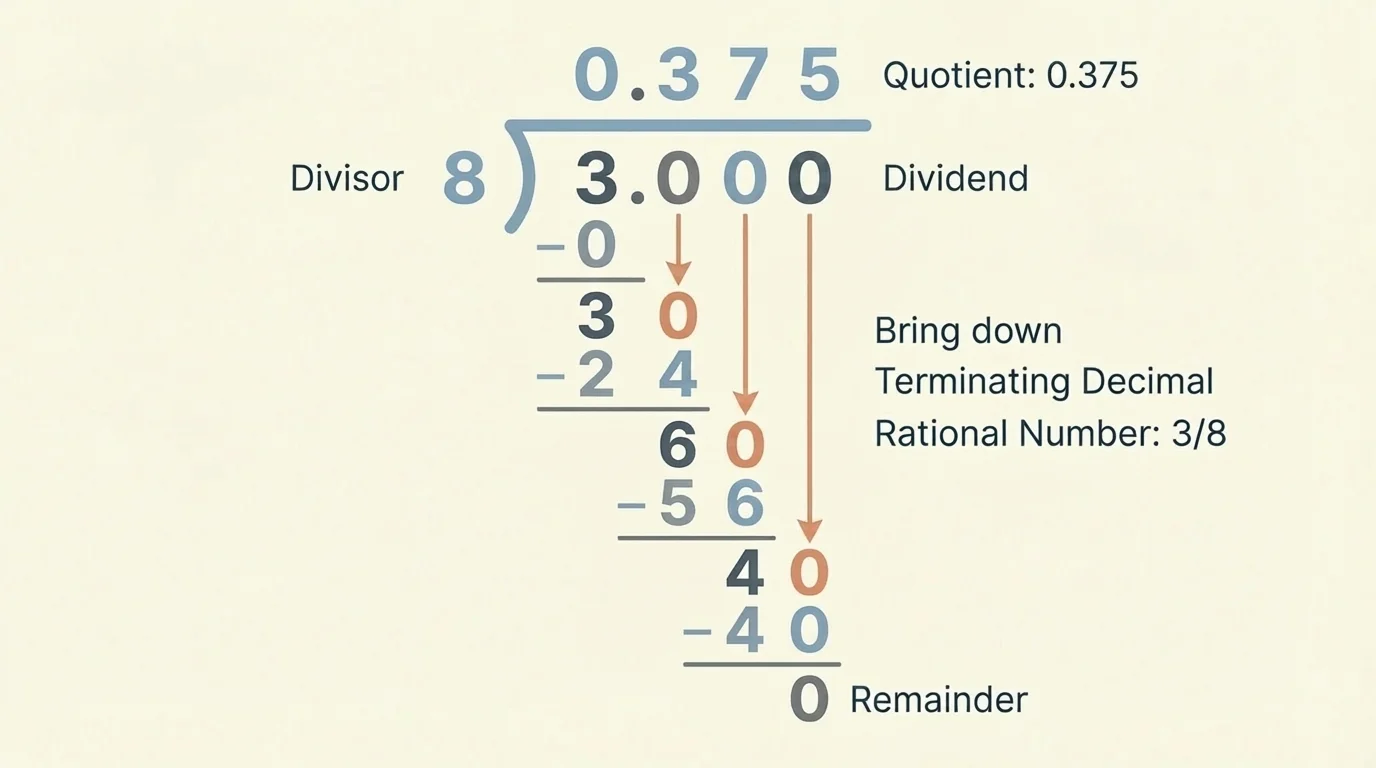
Adding a zero after the decimal point does not change the value of the number you are dividing. For example, \(3 = 3.0 = 3.00 = 3.000\). This is what allows long division to continue into tenths, hundredths, thousandths, and beyond.
Each time you divide, multiply, subtract, and bring down the next digit. If there are no more digits to bring down, you can add another zero. This keeps the division going until the remainder becomes \(0\) or a pattern starts to repeat.
Remember two ideas from earlier work with division: first, the remainder must always be less than the divisor. Second, a decimal point in the quotient goes directly above the decimal point in the number being divided.
The place values matter. The first digit after the decimal point is the tenths place, the second is the hundredths place, and the third is the thousandths place. Long division is really a place-value method for finding exactly how many tenths, hundredths, and thousandths are in a fraction.
Some fractions become decimals that stop. These are called terminating decimals.
Worked example 1
Convert \(\dfrac{3}{8}\) to a decimal.
Step 1: Rewrite the fraction as division.
Compute \(3 \div 8\).
Step 2: Set up long division.
Since \(8\) does not go into \(3\), write \(0\) and a decimal point in the quotient. Use \(3.000\) so you can continue dividing.
\[\begin{array}{r|l} 8 & 3.000 \end{array}\]
Step 3: Divide into tenths.
\(8\) goes into \(30\) three times because \(3 \times 8 = 24\). Subtract: \(30 - 24 = 6\).
Step 4: Divide into hundredths.
Bring down the next \(0\) to make \(60\). Then \(8\) goes into \(60\) seven times because \(7 \times 8 = 56\). Subtract: \(60 - 56 = 4\).
Step 5: Divide into thousandths.
Bring down the next \(0\) to make \(40\). Then \(8\) goes into \(40\) five times exactly. The remainder is \(0\).
\[\frac{3}{8} = 0.375\]
The decimal terminates because the remainder becomes \(0\).
Notice how each new digit in the quotient gave more precision: \(0.3\), then \(0.37\), then \(0.375\). Because the remainder finally reached \(0\), the process ended.
Other fractions do not end. Instead, one digit or a group of digits repeats forever.
Worked example 2
Convert \(\dfrac{2}{3}\) to a decimal.
Step 1: Rewrite as division.
Compute \(2 \div 3\).
Step 2: Begin long division.
\(3\) does not go into \(2\), so write \(0.\) in the quotient and think of the number as \(2.000\).
Step 3: Divide into tenths.
\(3\) goes into \(20\) six times because \(6 \times 3 = 18\). Subtract: \(20 - 18 = 2\).
Step 4: Notice the repeating remainder.
Bring down \(0\) to get \(20\) again. The same division happens again, giving another \(6\) and remainder \(2\).
Step 5: Recognize the pattern.
The remainder keeps returning to \(2\), so the digit \(6\) repeats forever.
\[\frac{2}{3} = 0.666\ldots\]
This decimal is repeating. It can also be written with a bar as \(0.\overline{6}\).
Repeating decimals do not mean your work failed. They mean you discovered the exact decimal pattern of the fraction. The dots in \(0.666\ldots\) show that the digits continue forever.
Sometimes a decimal has one or more digits that do not repeat at first, and then a pattern begins.
Worked example 3
Convert \(\dfrac{5}{6}\) to a decimal.
Step 1: Rewrite as division.
Compute \(5 \div 6\).
Step 2: Start the decimal.
\(6\) does not go into \(5\), so write \(0.\) in the quotient and use \(5.000\).
Step 3: Find the tenths digit.
\(6\) goes into \(50\) eight times because \(8 \times 6 = 48\). Subtract: \(50 - 48 = 2\).
Step 4: Continue dividing.
Bring down \(0\) to get \(20\). Then \(6\) goes into \(20\) three times because \(3 \times 6 = 18\). Subtract: \(20 - 18 = 2\).
Step 5: Identify the repetition.
The remainder is \(2\) again, so the digit \(3\) repeats forever.
\[\frac{5}{6} = 0.8333\ldots\]
The \(8\) does not repeat, but the \(3\) does. This can be written as \(0.8\overline{3}\).
This is an eventually repeating decimal because the repeating part starts after some beginning digits.
The same method works for negative fractions and fractions greater than \(1\). The sign stays negative, and the division process stays the same.
For example, to convert \(-\dfrac{7}{4}\), divide \(7 \div 4\) first. Since \(4\) goes into \(7\) one time with remainder \(3\), then \(4\) goes into \(30\) seven times with remainder \(2\), and into \(20\) five times exactly, you get \(1.75\). Because the original fraction was negative, the decimal is \(-1.75\).
So, \[ -\frac{7}{4} = -1.75 \]
An improper fraction can also be changed to a mixed number first, but that is optional. Long division works either way. For instance, \(\dfrac{11}{4} = 2.75\), whether you think of it as \(11 \div 4\) or as \(2\dfrac{3}{4}\).
The decimal form of a rational number might look endless on a calculator screen, but if the number is rational, the digits either stop or fall into a repeating pattern. A calculator may simply cut off the display before you can see the pattern clearly.
This is why \(0.142857142857\ldots\) is still rational: its digits repeat in a cycle, even though the cycle is longer than one digit.
As [Figure 2] illustrates, there is a deep reason every rational number behaves this way. When you divide by a fixed denominator, there are only so many possible remainders. Long division must eventually reach remainder \(0\) or repeat a remainder it had before. When a remainder repeats, the digits in the quotient begin repeating too.
Suppose you divide by \(6\). The remainder after each step can only be one of \(0, 1, 2, 3, 4, 5\). It cannot be \(6\) or larger, because remainders are always smaller than the divisor. That means the division process has only a limited number of remainder possibilities.
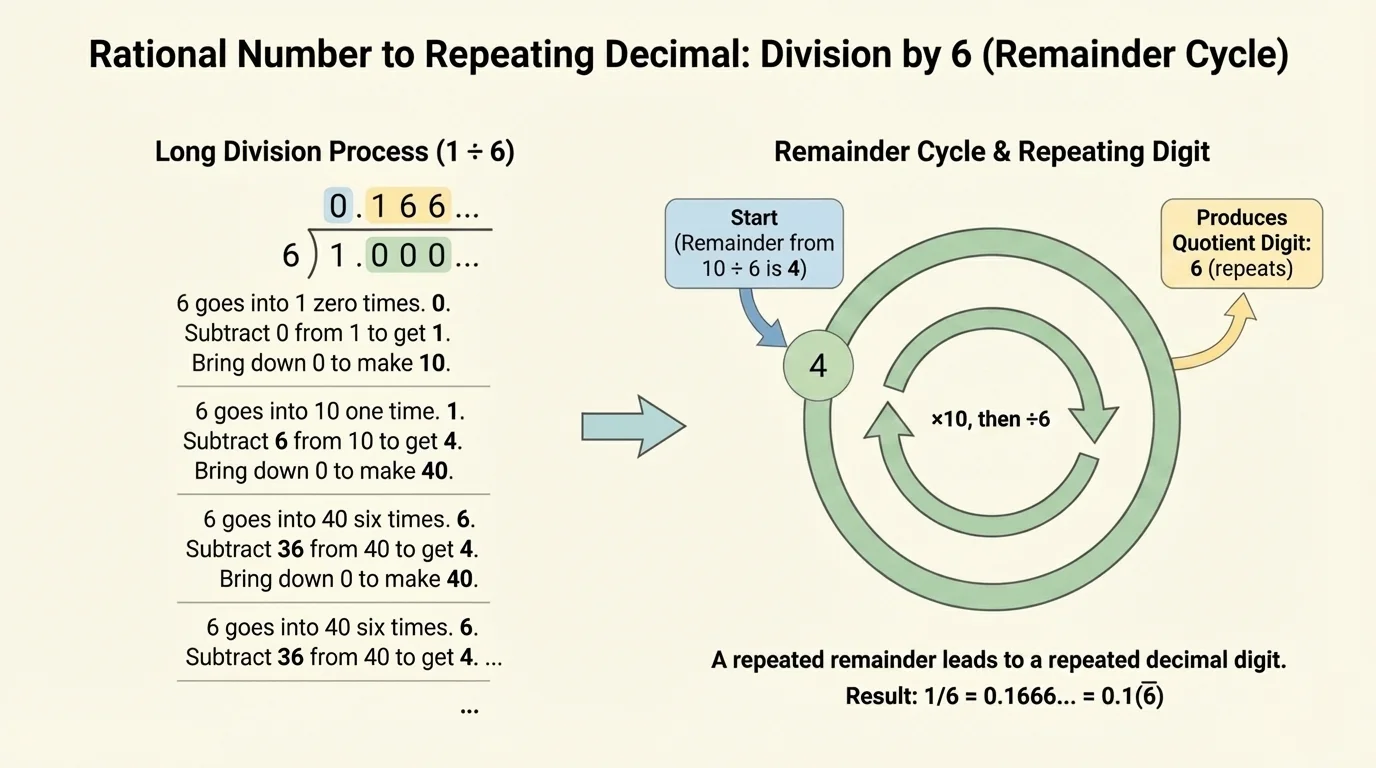
If one of those remainders is \(0\), the decimal ends. If no remainder becomes \(0\), then one of the nonzero remainders must show up again. When that happens, the exact same division steps repeat, so the exact same digits repeat.
This is why a rational number cannot have a decimal that goes on forever with no repeating pattern. A nonrepeating, nonterminating decimal is irrational, such as \(\pi\) or \(\sqrt{2}\).
We already saw this idea in \(\dfrac{2}{3}\). The remainder \(2\) came back again and again, so the digit \(6\) kept appearing. The same logic applies to every rational number, just as [Figure 2] shows with remainder cycles.
As [Figure 3] shows, you do not always need to perform long division to predict whether a decimal will terminate. After simplifying the fraction, look at the denominator. The key idea is that if the simplified denominator has only prime factors \(2\) and/or \(5\), the decimal will terminate.
This works because powers of \(10\) are built from \(2\)s and \(5\)s: \(10 = 2 \times 5\), \(100 = 2^2 \times 5^2\), \(1000 = 2^3 \times 5^3\), and so on. If a denominator can fit into some power of \(10\), the fraction can be rewritten with a denominator like \(10\), \(100\), or \(1000\), which gives a terminating decimal.
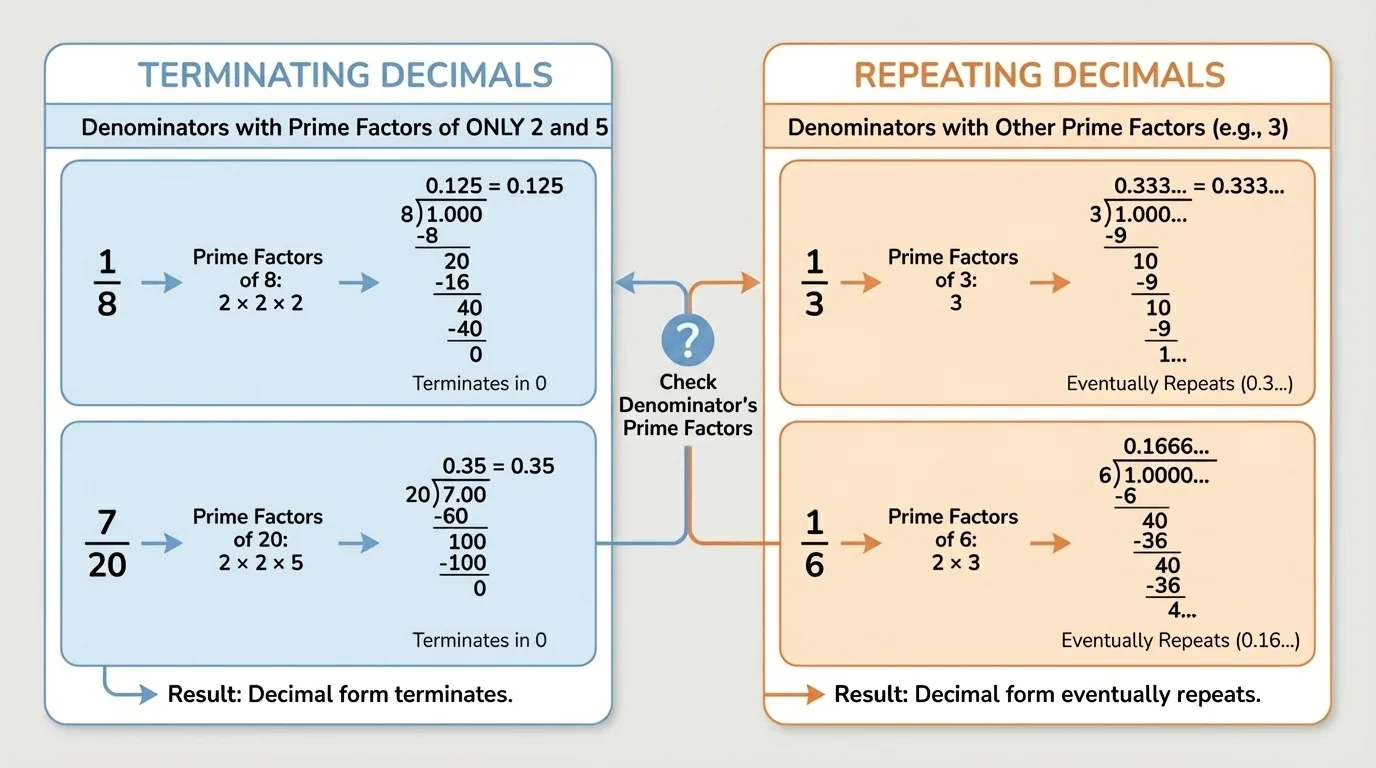
For example, \(\dfrac{3}{8}\) terminates because \(8 = 2^3\). Also, \(\dfrac{7}{20}\) terminates because \(20 = 2^2 \times 5\). But \(\dfrac{1}{3}\) repeats because \(3\) is not made from only \(2\)s and \(5\)s. And \(\dfrac{5}{6}\) repeats because \(6 = 2 \times 3\), and that factor \(3\) causes repetition.
It is important to simplify first. Consider \(\dfrac{6}{15}\). The denominator \(15\) has factors \(3\) and \(5\), which might suggest repeating. But \(\dfrac{6}{15} = \dfrac{2}{5}\), and \(\dfrac{2}{5} = 0.4\), which terminates.
| Fraction | Simplified Form | Simplified Denominator Factors | Decimal Type |
|---|---|---|---|
| \(\dfrac{3}{8}\) | \(\dfrac{3}{8}\) | \(2^3\) | Terminating |
| \(\dfrac{7}{20}\) | \(\dfrac{7}{20}\) | \(2^2 \times 5\) | Terminating |
| \(\dfrac{1}{3}\) | \(\dfrac{1}{3}\) | \(3\) | Repeating |
| \(\dfrac{5}{6}\) | \(\dfrac{5}{6}\) | \(2 \times 3\) | Repeating |
| \(\dfrac{6}{15}\) | \(\dfrac{2}{5}\) | \(5\) | Terminating |
Table 1. Examples of how simplified denominators help predict whether a decimal terminates or repeats.
This shortcut is powerful, but long division is still important because it tells you the actual decimal digits, not just whether the decimal stops or repeats.
Decimals are often more convenient in real life because they fit naturally with calculators, money, measurements, and data. Fractions and decimals represent the same values, but the form you choose can make a task easier.
In shopping, a discount of \(\dfrac{1}{4}\) off means \(0.25\), or \(25\%\). In science and engineering, measurements often appear in decimals because equipment is marked in tenths or hundredths. In sports, a winning percentage like \(\dfrac{3}{5}\) becomes \(0.6\), which is easy to compare with other teams.
Suppose a runner completes \(7\) miles in \(\dfrac{3}{2}\) hours. Since \(\dfrac{3}{2} = 1.5\), the time is \(1.5\) hours. Converting rational numbers to decimals helps when using formulas, calculators, or graphs.
Fractions, decimals, and percent are connected forms
A single rational number can be written in more than one useful form. For example, \(\dfrac{3}{4} = 0.75 = 75\%\). In problems about speed, cost, probability, and measurement, moving between these forms helps you choose the representation that makes the situation easiest to understand.
Even digital devices rely on this connection. A calculator may display a decimal approximation, while the exact value might come from a fraction. Knowing how the decimal is produced helps you judge whether the display is exact or rounded.
One common mistake is reversing the numerator and denominator. For \(\dfrac{3}{8}\), you must compute \(3 \div 8\), not \(8 \div 3\).
Another mistake is forgetting to place the decimal point in the quotient when the divisor does not go into the numerator at first. If \(8\) does not go into \(3\), the quotient starts with \(0.\), not just an empty space.
Students also sometimes stop too early. For \(\dfrac{2}{3}\), the first quotient digit is \(6\), but the remainder is not \(0\), so the decimal is not just \(0.6\). The process continues, and the \(6\) repeats forever.
Another common issue is failing to simplify when using the denominator shortcut. The decimal behavior depends on the denominator in simplest form, not necessarily the original denominator.
Finally, make sure you understand repeating notation. The decimal \(0.333\ldots\) means the \(3\) continues forever. It does not mean "about \(0.333\)." It is an exact value equal to \(\dfrac{1}{3}\).
