Hospitals can build detailed images of the inside of your body without opening it, and engineers can design smooth machine parts by spinning flat shapes around an axis. Those ideas sound completely different, but they rely on the same geometry: cross-sections and rotations. A slice through a solid reveals a two-dimensional shape, while a rotation of a flat region can create a three-dimensional object. Once you see these relationships, many shapes become easier to understand.
Geometry is not only about naming shapes. It is also about seeing how shapes transform. When a loaf of bread is cut, each slice is a two-dimensional view of a three-dimensional object. When a potter spins clay on a wheel, a flat profile can guide the creation of a curved solid. Medical imaging, architecture, product design, and computer graphics all depend on this kind of spatial thinking.
In this topic, you study two related questions: What two-dimensional shape appears when a plane cuts a solid? and What three-dimensional solid appears when a plane figure rotates around a line? These questions connect flat geometry and solid geometry in a very visual way.
Cross-section is the two-dimensional shape formed when a plane cuts through a three-dimensional object.
Solid of revolution is a three-dimensional object formed when a two-dimensional figure rotates around a line called an axis.
Axis of rotation is the line about which a figure turns.
A cross-section depends on the shape of the solid and on the direction of the cut. A horizontal cut, a vertical cut, and a diagonal cut through the same solid can all create different results. The slicing plane may pass through the center, near an edge, or at an angle, and each choice matters.
A solid of revolution depends on the original two-dimensional figure and the line around which it rotates. If the figure spins around one of its sides, one type of solid forms. If it spins around a different line, a different solid may appear.
When studying a cross-section, picture an infinitely thin plane passing through a solid. The shape you see on the slicing plane is the cross-section. For many solids, as [Figure 1] shows, changing the slice changes the shape you get.
A prism has two parallel congruent bases and flat rectangular or parallelogram side faces. If a plane cuts a prism parallel to its base, the cross-section has the same shape as the base. For example, slicing a triangular prism parallel to its triangular base gives a triangle. Slicing a rectangular prism parallel to its rectangular base gives a rectangle.
If a rectangular prism is sliced vertically, the cross-section can also be a rectangle. With some slanted slices, the cross-section may become a parallelogram or, in a cube, even a hexagon. That surprises many students: a cube does not always produce squares when sliced.
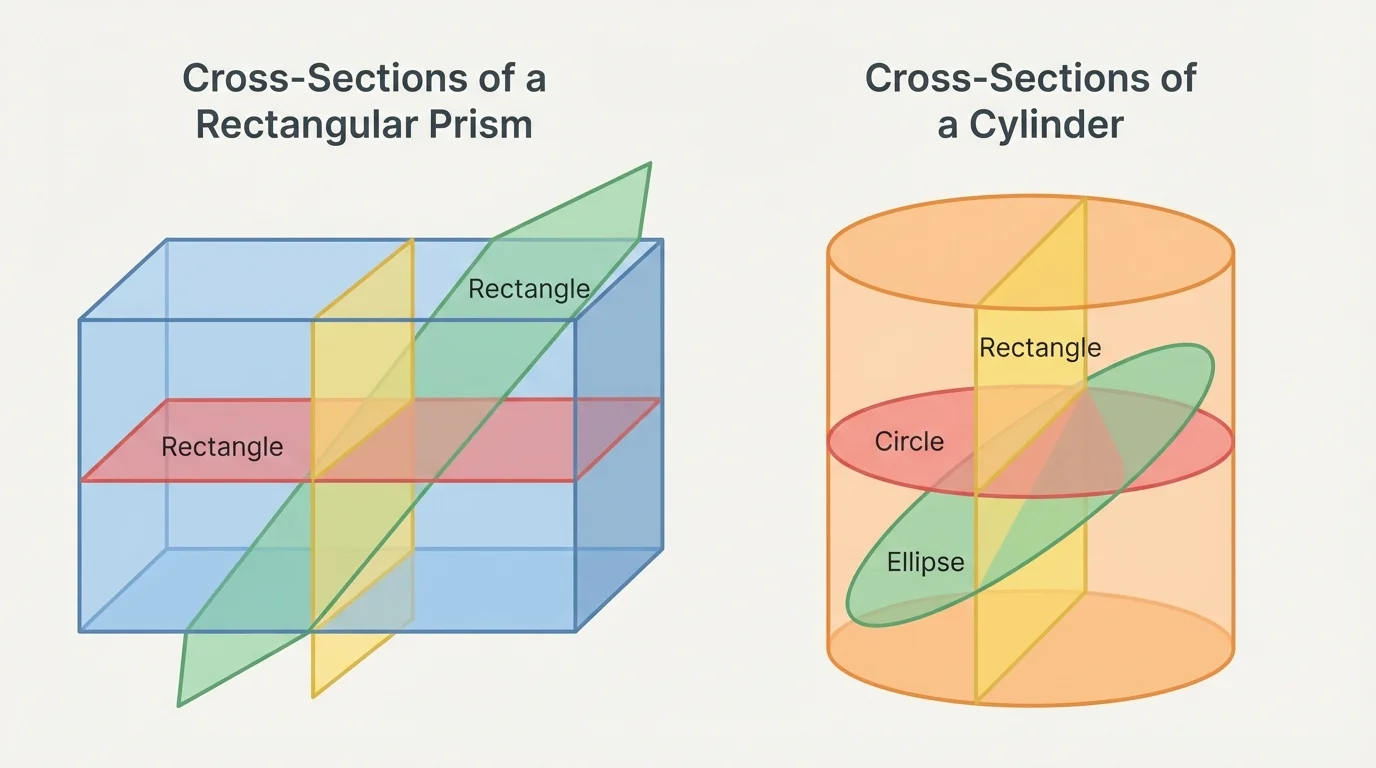
A cylinder behaves in a similar way. A cut parallel to the circular base gives a circle. A cut parallel to the axis of the cylinder gives a rectangle. A slanted cut usually gives an ellipse, which looks like a stretched circle.
Pyramids and cones narrow to a point called a vertex. In these solids, slices parallel to the base produce smaller shapes similar to the base. For example, a slice parallel to the base of a square pyramid forms a smaller square. A slice parallel to the base of a cone forms a smaller circle.
A sphere is different because every point on its surface is the same distance from the center. Every plane slice through a sphere produces a circle. If the plane passes through the center, that circle is the largest possible one, called a great circle. A slice that misses the center still gives a circle, but a smaller one.
The same solid can produce very different cross-sections depending on how it is cut, and [Figure 2] makes this especially clear for a cone. Thinking about the direction of the slicing plane is often the key to the whole problem.
For a cylinder, there are three especially important cases. A horizontal slice, parallel to the base, gives a circle. A vertical slice through the side gives a rectangle. A slanted slice gives an ellipse. Since a cylinder has straight sides and circular bases, these three cases appear often in geometry and in real life, such as cutting pipes.
For a cone, a horizontal slice gives a circle. A vertical slice through the vertex gives a triangle. A slanted slice that does not pass through the vertex gives an ellipse. This idea connects to the larger family of curves called conic sections, though here the main goal is recognizing the resulting shape.
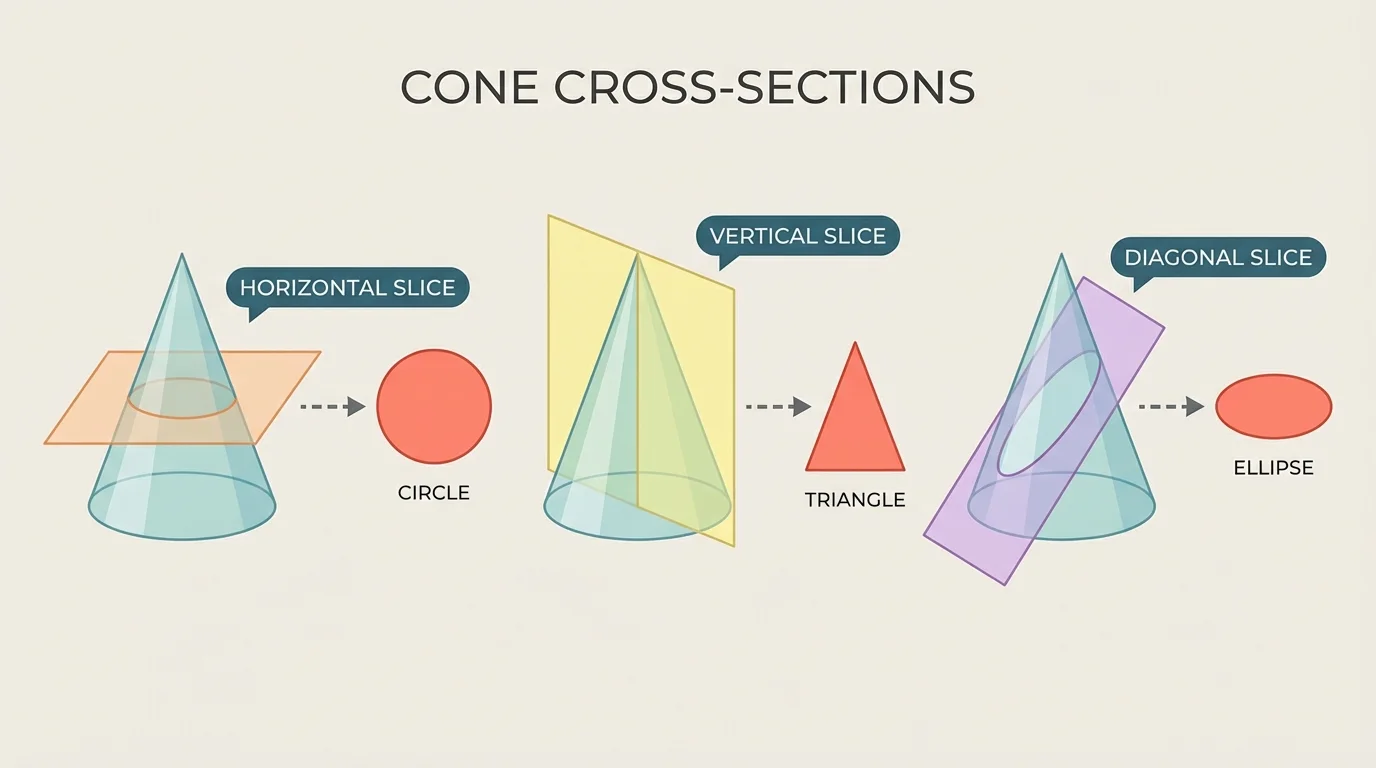
For prisms and pyramids, slices parallel to the base give shapes similar to the base. A slanted slice can create other polygons. In a cube, for instance, a carefully chosen plane can intersect six faces and form a hexagon. This is a good reminder that the cross-section is made from the intersection of the plane with the faces of the solid.
One useful strategy is to ask which faces the plane meets. If a plane cuts through three faces of a prism, the cross-section is usually a triangle. If it meets four faces, the cross-section may be a quadrilateral. Counting intersections helps you predict the shape before drawing it exactly.
Earlier geometry work with parallel lines and similar figures is helpful here. When a plane cuts parallel to the base of a pyramid or cone, the new cross-section is similar to the base because corresponding angles stay equal and side lengths scale by the same factor.
Notice that words like parallel to the base, perpendicular to the base, and through the vertex are not small details. They tell you exactly how the cut is made, so they often determine the answer immediately.
Now reverse the process. Instead of slicing a solid, start with a flat region and spin it. This produces a solid of revolution. The line around which the figure turns is the axis of rotation.
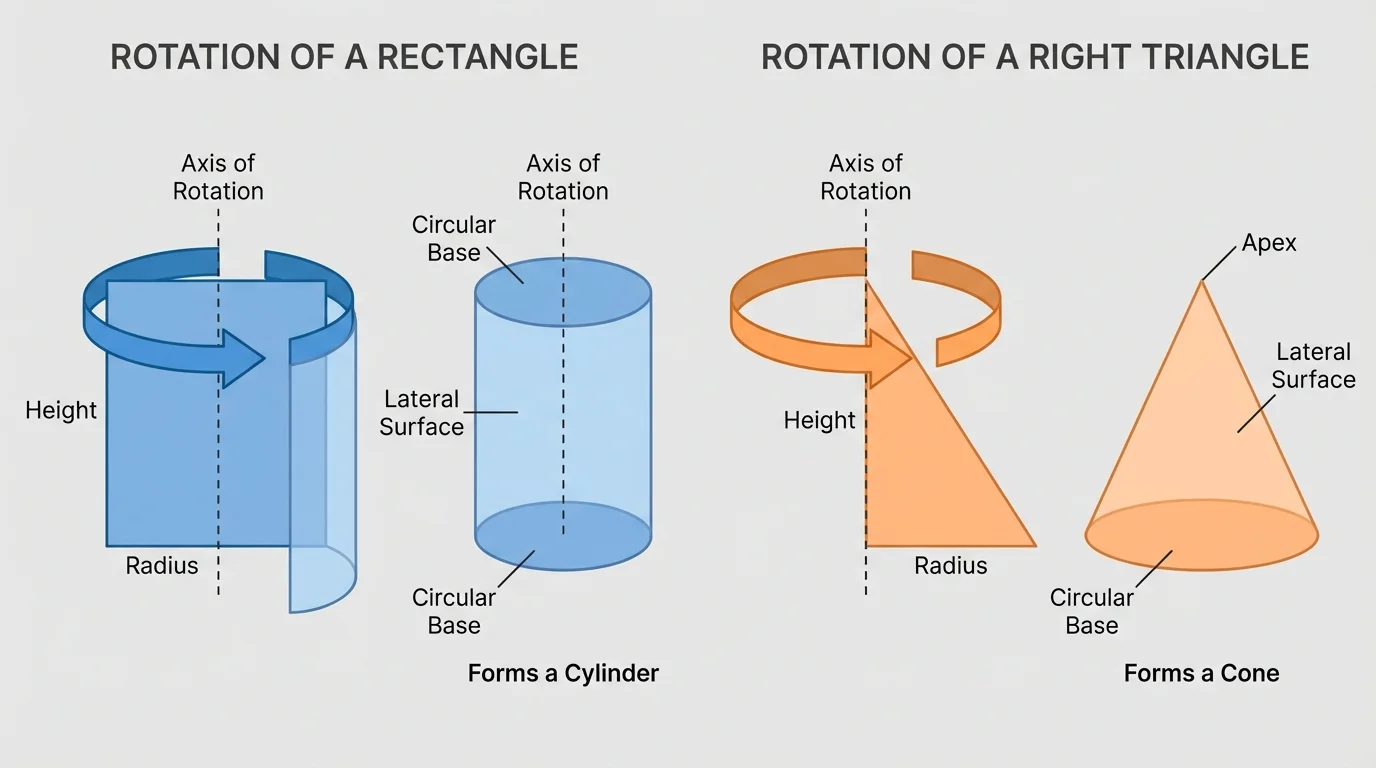
[Figure 3] If a rectangle rotates around one of its sides, every point in the rectangle traces out a circle. The result is a cylinder. The side on the axis becomes the height, and the distance from the axis to the opposite side becomes the radius of the cylinder.
If a right triangle rotates around one of its legs, the result is a cone. The rotating leg on the axis becomes the height of the cone, and the other leg becomes the radius of the circular base.
If a semicircle rotates around its diameter, it generates a sphere. Every point on the semicircle sweeps out a circular path, filling out the spherical solid. This is one of the most elegant examples because a simple curved boundary creates a perfectly symmetric three-dimensional shape.
When deciding what solid forms, it helps to imagine what path a single point follows. Under rotation, points move in circles around the axis. The collection of all those circular paths creates the solid.
Curved and straight boundaries generate different surfaces, and [Figure 4] illustrates this well. A straight segment rotating around an axis often forms a conical or cylindrical surface, while a curved arc can form a spherical or more rounded surface.
Here are some important matches between two-dimensional figures and three-dimensional solids:
| Two-dimensional figure | Axis of rotation | Three-dimensional object formed |
|---|---|---|
| Rectangle | One side | Cylinder |
| Right triangle | One leg | Cone |
| Semicircle | Its diameter | Sphere |
| Trapezoid | One side or an external line | Often a frustum-like solid or another rounded solid depending on the axis |
| Region between two parallel line segments | Parallel edge | Hollow cylinder-like solid |
Table 1. Common relationships between plane figures, axes of rotation, and the solids they generate.
A radius in a rotation problem is the distance from the axis to the outer edge of the rotating region. The farther a point is from the axis, the larger the circle it traces. That is why changing the axis can completely change the final solid.
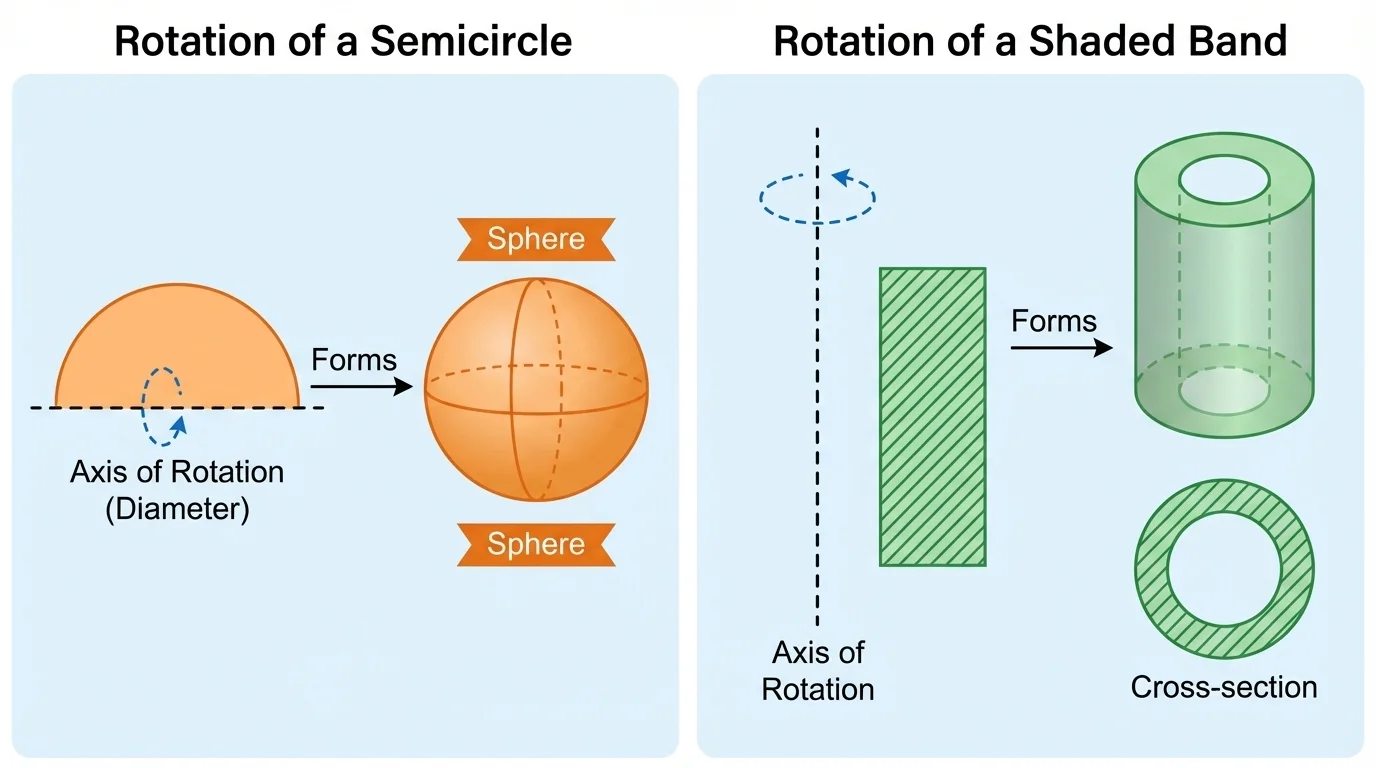
For example, the same rectangle can create different solids if it rotates around different lines. Rotating around a side forms a cylinder of one radius. Rotating around a line outside the rectangle forms a larger hollow solid of revolution because every point is farther from the axis.
This is one reason engineers care about the axis: the shape, volume, and function of the object can all change when the axis changes.
Many parts on a machine lathe are made by spinning material around a central axis. The geometry of solids of revolution is built directly into how those parts are designed and manufactured.
The same reasoning from [Figure 1] helps here too: geometry often depends on orientation. A slice changes with the plane you choose, and a solid of revolution changes with the axis you choose.
When you are asked to identify a three-dimensional object generated by rotation, focus on three questions. First, what is the original two-dimensional figure? Second, where is the axis? Third, what distance from the axis acts like the radius?
Suppose a right triangle has legs of lengths \(3\) and \(4\). If it rotates around the leg of length \(3\), the solid is a cone with height \(3\) and radius \(4\). If it rotates around the leg of length \(4\), the solid is still a cone, but now the height is \(4\) and the radius is \(3\). The solid type stays the same, but the dimensions change.
Likewise, when identifying cross-sections, ask whether the plane is parallel to the base, passes through a vertex, or cuts the solid at a slant. Those clues usually tell you whether the answer is a circle, triangle, rectangle, ellipse, or another polygon.
Worked examples make these relationships much clearer because they force you to identify the solid, the cut, or the axis carefully.
Worked example 1
A plane slices a cylinder parallel to its base. What is the cross-section?
Step 1: Identify the base of the solid.
A cylinder has circular bases.
Step 2: Use the phrase parallel to its base.
A slice parallel to a base has the same shape as that base.
Step 3: State the result.
The cross-section is a circle.
Answer: The cross-section is a circle.
This kind of problem is often easiest because the direction of the cut directly matches the base shape.
Worked example 2
A right triangle with legs \(5\) and \(12\) rotates around the leg of length \(5\). Identify the solid formed and its basic dimensions.
Step 1: Recognize the generating figure.
A right triangle rotated around one leg forms a cone.
Step 2: Identify the axis of rotation.
The leg of length \(5\) lies on the axis, so it becomes the height.
Step 3: Find the radius.
The other leg, of length \(12\), becomes the radius of the circular base.
Step 4: State the result.
The solid is a cone with height \(5\) and radius \(12\).
Answer: A cone is formed, with \(h = 5\) and \(r = 12\).
Notice that no volume formula is needed here. The main goal is visual identification.
Worked example 3
A plane cuts a cone through its vertex and perpendicular to the base. What cross-section is formed?
Step 1: Picture the cut.
A plane through the vertex of a cone and vertical through the center reaches the apex and both sides of the cone.
Step 2: Determine the boundary of the slice.
The slice includes two slanted sides meeting at the vertex and a segment across the base.
Step 3: Identify the two-dimensional shape.
Those three edges form a triangle.
Answer: The cross-section is a triangle.
This is exactly the kind of relationship highlighted earlier in [Figure 2], where the orientation of the plane determines the cross-section.
Worked example 4
A semicircle of radius \(7\) rotates about its diameter. What solid is generated?
Step 1: Identify the figure.
The figure is a semicircle.
Step 2: Identify the axis.
The axis is the diameter of the semicircle.
Step 3: Recall the standard result.
A semicircle rotated about its diameter forms a sphere.
Step 4: State the radius of the solid.
The sphere has radius \(7\).
Answer: The solid generated is a sphere of radius \(7\).
The curved boundary is what makes the final object round in every direction, just as shown in [Figure 4].
Cross-sections are crucial in medicine. In a CT scan or MRI, the body is studied in many thin slices. Each image is a cross-sectional view. By stacking these views, doctors can detect tumors, fractures, or internal bleeding. A three-dimensional structure becomes understandable through many two-dimensional sections.
In engineering and manufacturing, solids of revolution appear constantly. Bottles, wheels, axles, bowls, and many machine parts are designed from a profile that is rotated around an axis. A designer can sketch one side of the object and use rotation to describe the entire shape.
Architecture also uses these ideas. Domes can be modeled from arcs that rotate, and beams or columns may be analyzed through cross-sections to understand strength. The shape of a cross-section affects how a structure handles force.
In computer graphics and animation, artists often build complex objects by revolving a two-dimensional outline. This saves time and creates smooth symmetric forms. The same mathematics behind textbook geometry helps create digital objects that look realistic.
One common mistake is assuming that a solid always produces the shape of its base. That is only true for slices parallel to the base. A cylinder can produce a circle, rectangle, or ellipse depending on the cut. A cone can produce a circle, triangle, or ellipse.
Another mistake is forgetting to pay attention to the axis of rotation. A figure does not have one automatic solid attached to it. The axis matters. A rectangle rotated around one side gives a cylinder, but around an outside line it creates a different rotational shape.
A strong strategy is to sketch just enough to reason clearly. Draw the solid, mark the plane, and trace the edges where the plane meets the solid. Or draw the two-dimensional figure, mark the axis, and imagine several points moving in circles. Those circles build the solid.
Also remember that not every slice through a sphere looks like a sphere. The solid is three-dimensional, but the cross-section is always two-dimensional. For a sphere, every plane slice is a circle, never a three-dimensional ball.
A powerful mental model
Think of cross-sections as freezing one slice of space, while solids of revolution are sweeping a shape through space. In one case, a plane reveals a flat shape hidden inside a solid. In the other, motion creates a solid from a flat shape. These are opposite processes, but they are deeply connected.
When problems become more complex, return to the same core questions: What is the solid? How is it sliced? Or what is the figure? What is the axis? Geometry becomes much easier when you organize your thinking that way.
