A firefighter leans a ladder against a building, a phone screen is measured from corner to corner, and a moving company needs to know whether a sofa can fit through a room diagonally. These situations look different, but they all connect to the same powerful idea in geometry: the Pythagorean Theorem. It provides a way to find missing side lengths in right triangles, and it even helps in three-dimensional shapes such as boxes and rooms.
Right triangles appear everywhere. Builders use them to measure ramps and roofs. Designers use them to find diagonal distances on screens and floor plans. Athletes and coaches can use them to analyze direct paths across a field or court. Once you know how to recognize a right triangle, you can turn many real situations into a solvable geometry problem.
The key idea is simple: in any right triangle, the squares of the two shorter sides add up to the square of the longest side. Written as a formula, the theorem is
\[a^2 + b^2 = c^2\]
Here, the letters represent side lengths. The side labeled \(c\) must be the longest side, because it is always the side across from the right angle.
The Pythagorean Theorem states that in a right triangle, if the legs have lengths \(a\) and \(b\), and the hypotenuse has length \(c\), then \(a^2 + b^2 = c^2\).
A right triangle is a triangle with one angle equal to \(90^\circ\).
The hypotenuse is the side opposite the right angle, and it is always the longest side of a right triangle.
Before using the theorem, make sure the triangle is actually a right triangle. If there is no \(90^\circ\) angle, the formula does not apply in this form.
To use the theorem correctly, you must identify the parts of the triangle. As shown in [Figure 1], a right triangle has two shorter sides that form the right angle. These are called the legs.
The side across from the right angle is the hypotenuse. This side is always the longest side.
If you mix up a leg and the hypotenuse, your equation will be wrong. In the formula \(a^2 + b^2 = c^2\), the values \(a\) and \(b\) are the legs, and \(c\) is the hypotenuse.
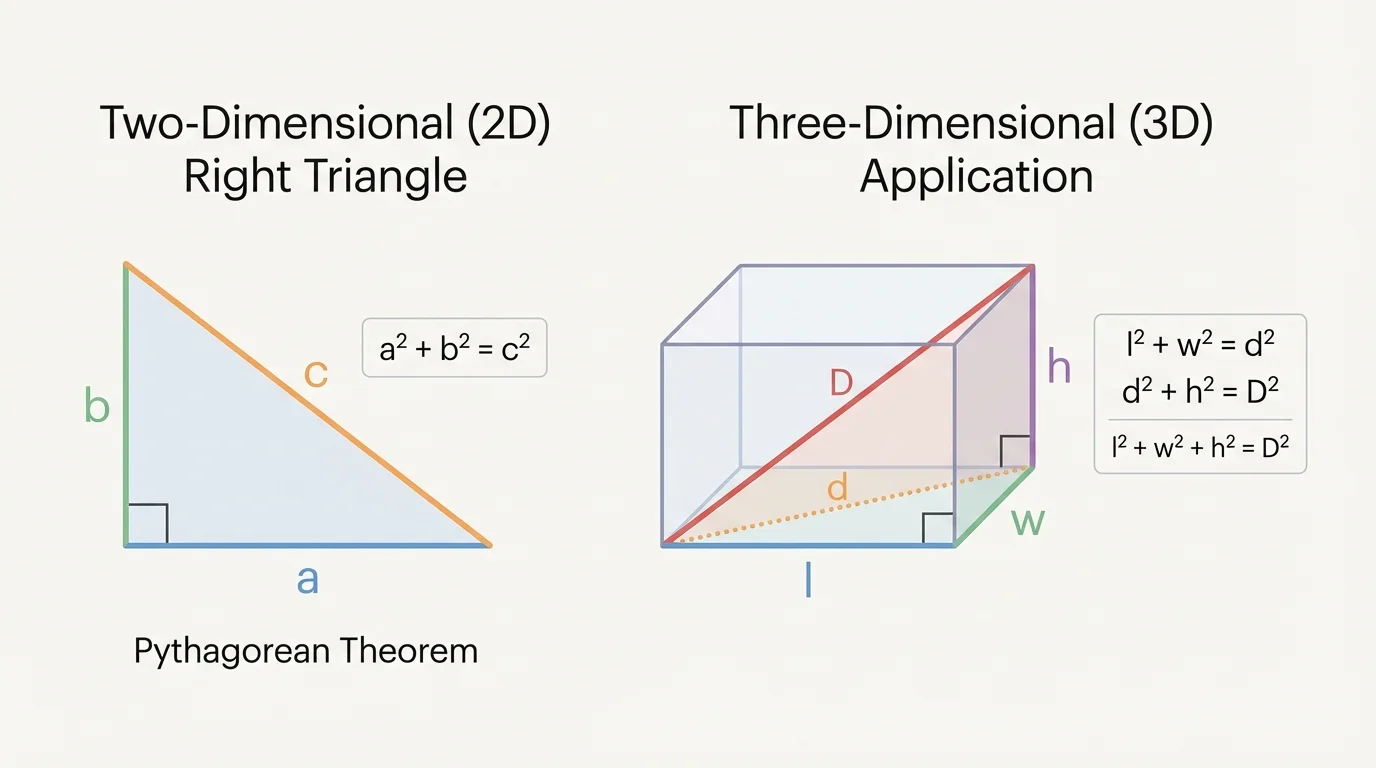
A quick way to check is this: ask yourself which side is opposite the \(90^\circ\) angle. That side must be the hypotenuse. Also, the hypotenuse should be longer than either leg.
When a number is squared, it is multiplied by itself. For example, \(5^2 = 25\), \(12^2 = 144\), and if \(x^2 = 49\), then \(x = 7\) because side lengths are positive in geometry.
Square roots are also important because after finding a squared value, you may need to take the square root to get the actual side length. For example, if \(c^2 = 81\), then \(c = 9\).
There are two main cases. In one case, you know both legs and want the hypotenuse. In the other case, you know one leg and the hypotenuse and want the other leg.
If the unknown side is the hypotenuse, add the squares of the legs and then take the square root. If the unknown side is a leg, subtract the square of the known leg from the square of the hypotenuse, and then take the square root.
These two setups look like this:
\[c = \sqrt{a^2 + b^2}\]
\[a = \sqrt{c^2 - b^2}\]
or
\[b = \sqrt{c^2 - a^2}\]
Even though the formulas look short, the most important part is understanding why you are adding or subtracting. You add when finding the longest side. You subtract when finding a shorter side.
Suppose a right triangle has legs of lengths \(6\) and \(8\). Find the hypotenuse.
Worked example 1
Step 1: Write the theorem.
\(a^2 + b^2 = c^2\)
Step 2: Substitute the known side lengths.
\(6^2 + 8^2 = c^2\)
Step 3: Square each number.
\(36 + 64 = c^2\)
Step 4: Add.
\(100 = c^2\)
Step 5: Take the square root.
\(c = \sqrt{100} = 10\)
The hypotenuse is \(10\).
This triangle is a well-known example of a Pythagorean triple: \(6\), \(8\), and \(10\). A Pythagorean triple is a set of whole numbers that satisfy the theorem exactly.
Now suppose the hypotenuse is \(13\) and one leg is \(5\). Find the other leg.
Worked example 2
Step 1: Start with the theorem.
\(a^2 + b^2 = c^2\)
Step 2: Let the unknown leg be \(a\), and substitute the known values.
\(a^2 + 5^2 = 13^2\)
Step 3: Square the known numbers.
\(a^2 + 25 = 169\)
Step 4: Subtract \(25\) from both sides.
\(a^2 = 144\)
Step 5: Take the square root.
\(a = \sqrt{144} = 12\)
The missing leg is \(12\).
Notice that subtraction appears because the unknown side is not the longest side. The hypotenuse must stay alone on the side of the equation with \(c^2\).
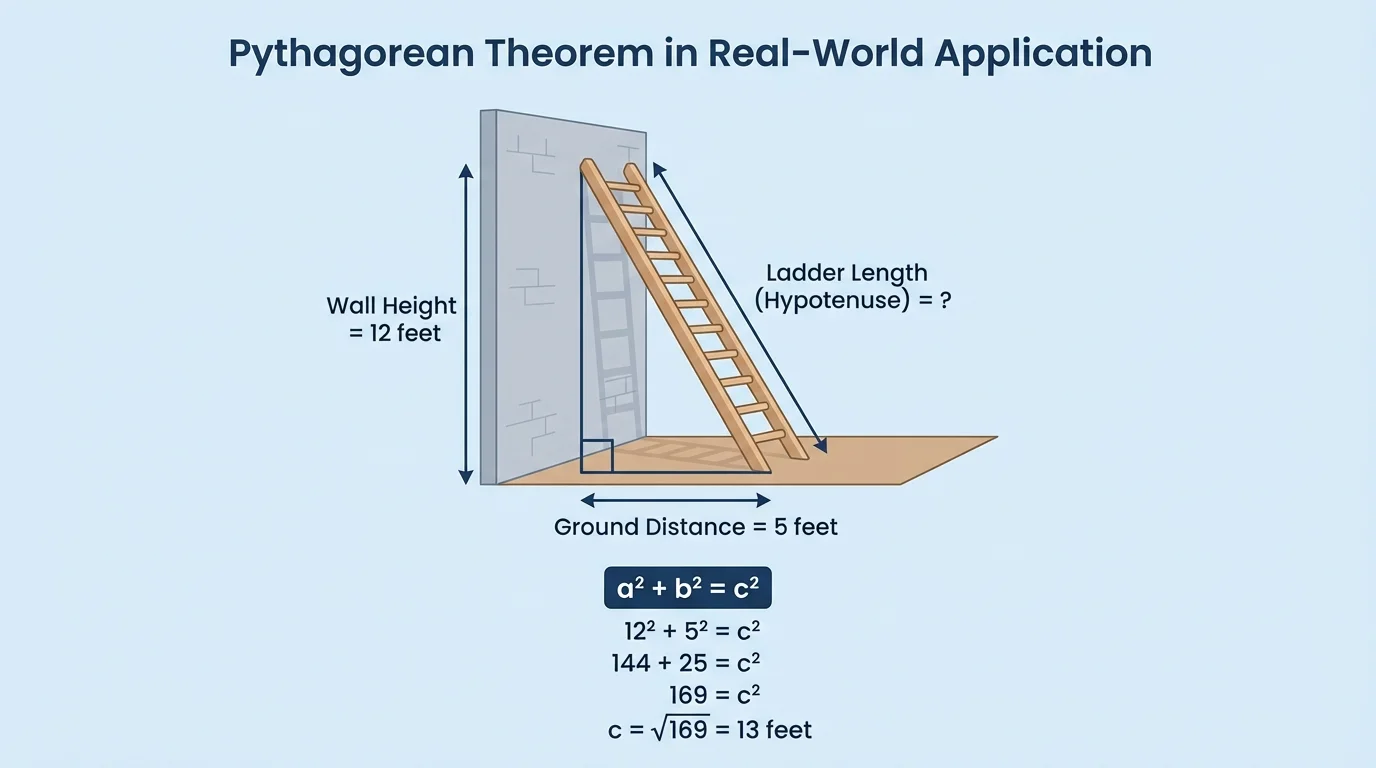
As shown in [Figure 2], a classic real-world situation involves a ladder leaning against a wall. The wall and ground are perpendicular, so they form a right angle.
That means the ladder, wall, and ground make a right triangle.
Suppose a ladder reaches \(12\) feet up a wall, and the bottom of the ladder is \(5\) feet from the wall. How long is the ladder?
Worked example 3
Step 1: Identify the legs and the hypotenuse.
The legs are \(12\) and \(5\), and the ladder is the hypotenuse.
Step 2: Use the theorem.
\(5^2 + 12^2 = c^2\)
Step 3: Square and add.
\(25 + 144 = 169\), so \(c^2 = 169\).
Step 4: Take the square root.
\(c = \sqrt{169} = 13\)
The ladder is \(13\) feet long.
This result is reasonable because the ladder must be longer than both the wall height and the ground distance. As in [Figure 2], the slanted side stretches farther than either straight side.
The theorem also works with rectangles. If a rectangular park is \(30\) meters long and \(40\) meters wide, the diagonal path across it has length \(d\), where \(30^2 + 40^2 = d^2\). So \(900 + 1{,}600 = d^2\), which gives \(2{,}500 = d^2\), and therefore \(d = 50\). The diagonal is \(50\) meters long.
The famous triple \(3\), \(4\), and \(5\) has been used for centuries by builders to create right angles. If the sides of a triangle have those lengths, the angle opposite the side of length \(5\) is a right angle.
Because of this, surveyors and construction workers can use rope or measuring tape to check whether corners are square.
As shown in [Figure 3], the Pythagorean Theorem is not limited to flat figures. In a rectangular prism such as a box, a room, or a shipping container, you can use the theorem to find a diagonal through space.
This usually happens in two stages: first find a diagonal on one face, then use that diagonal with the third dimension.
Suppose a box has length \(4\), width \(3\), and height \(12\). First, find the diagonal of the base. The base is a rectangle, so its diagonal \(d\) satisfies \(3^2 + 4^2 = d^2\). That gives \(9 + 16 = 25\), so \(d = 5\).
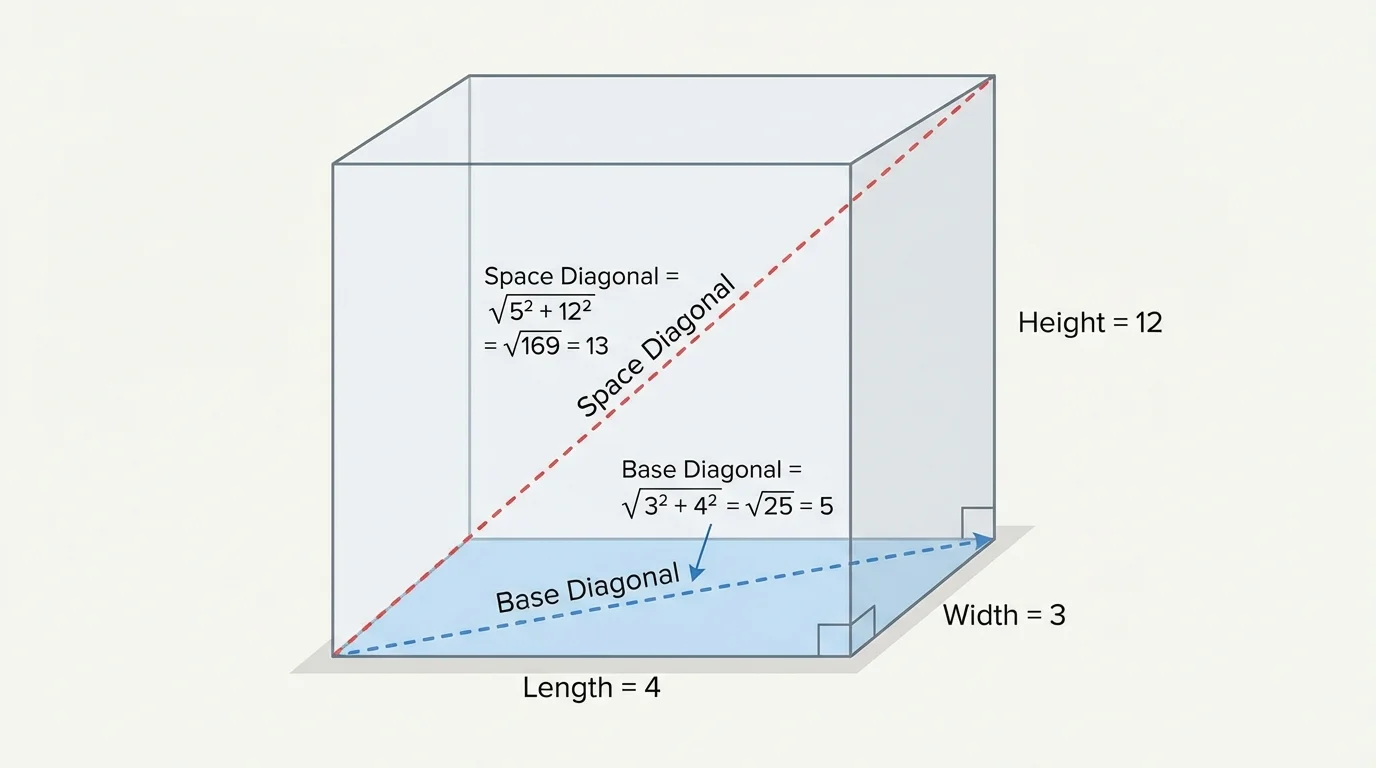
Now use that base diagonal and the height to make another right triangle inside the prism. If the full space diagonal is \(s\), then \(5^2 + 12^2 = s^2\). So \(25 + 144 = 169\), and \(s = 13\).
This is a great example of using the theorem more than once. The base diagonal becomes part of a new right triangle. In three-dimensional geometry, that kind of chain of reasoning is very common.
A storage box measures \(8\) inches by \(6\) inches by \(24\) inches. Find the distance from one bottom corner to the opposite top corner.
Worked example 4
Step 1: Find the diagonal of the base rectangle.
Let the base diagonal be \(d\). Then \(8^2 + 6^2 = d^2\).
\(64 + 36 = 100\), so \(d = 10\).
Step 2: Use the base diagonal with the height.
Let the space diagonal be \(s\). Then \(10^2 + 24^2 = s^2\).
Step 3: Compute.
\(100 + 576 = 676\), so \(s^2 = 676\).
Step 4: Take the square root.
\(s = \sqrt{676} = 26\)
The space diagonal is \(26\) inches.
Problems like this appear in packaging, architecture, and shipping. If an object is longer than the inside diagonal of a box, it will not fit.
Not every problem ends with a whole number. For example, if the legs of a right triangle are \(7\) and \(9\), then \(c^2 = 7^2 + 9^2 = 49 + 81 = 130\). So the exact answer is \(c = \sqrt{130}\).
Sometimes an exact answer with a square root is useful, especially in mathematics. Other times, especially in real-world measurement, a decimal approximation is more practical. Since \(\sqrt{130} \approx 11.4\), the hypotenuse is about \(11.4\) units.
A approximate answer is usually written when the square root is not a perfect square. It is important to include units when the problem has them, such as feet, inches, or meters.
Why exact and approximate answers both matter
An exact answer such as \(\sqrt{130}\) keeps the value perfectly precise. An approximate answer such as \(11.4\) is easier to use in measurement and real situations. In school mathematics, you should pay attention to whether the problem asks for an exact form, a rounded decimal, or a measurement with units.
You should also check whether the answer makes sense. If the hypotenuse comes out smaller than one of the legs, something went wrong. If a leg comes out longer than the hypotenuse, that is also impossible.
One common mistake is putting the wrong side in place of \(c\). Remember, \(c\) is always the hypotenuse. Looking back at [Figure 1], the side opposite the right angle is the only side that can be \(c\).
Another common mistake is forgetting to square a number. For example, \(5^2\) is \(25\), not \(10\). Students also sometimes take the square root too early. It is better to first find the value of the squared side, then take the square root at the end.
A third mistake is using the theorem when the triangle is not a right triangle. The theorem depends on the \(90^\circ\) angle. Without that angle, the relationship does not work in the same way.
Finally, watch for arithmetic errors, especially when working with larger numbers. Writing each step clearly helps prevent mistakes.
The Pythagorean Theorem has many practical uses. In construction, workers use it to check whether walls, floors, and foundations form right angles. In design and manufacturing, it helps determine diagonal lengths of parts, screens, and containers.
In navigation and mapping, a direct route between two points on a grid can be modeled with a right triangle. In sports, a player's straight-line distance to a goal or base can be compared to movement along the field lines. In computer graphics and robotics, distances between points often depend on the same geometric idea.
Even inside a room, the theorem can answer questions like whether a long board can fit from one corner to another, or how far a security camera is from a corner across a ceiling. The theorem is simple, but its reach is surprisingly wide.
| Situation | Known Measurements | Unknown Distance |
|---|---|---|
| Ladder against a wall | Height and distance from wall | Ladder length |
| Rectangle | Length and width | Diagonal |
| Box or room | Length, width, and height | Space diagonal |
| Construction corner check | Two side lengths | Expected diagonal |
Table 1. Common situations where the Pythagorean Theorem helps find an unknown distance.
When you see two perpendicular directions, such as horizontal and vertical, or length and width, there is a good chance a right triangle is hidden in the problem. Finding that triangle is often the hardest part. Once you find it, the theorem does the rest.
