A phone plan, a recipe, a discount, and a speed calculation can all lead to the same kind of puzzle: an equation where the unknown is hidden inside fractions, decimals, or parentheses. At first, an equation like \(\dfrac{3}{4}(x-8)+2=11\) may look messy, but it follows a small set of powerful rules. Once you know those rules, you can untangle expressions step by step and find the value of \(x\).
A linear equation is a mathematical way to describe a relationship that changes at a constant rate. When you solve one, you are finding the number that makes two expressions equal. That matters in everyday life: a scientist might solve for an unknown measurement, an engineer might solve for time, and a shopper might solve for the original price before a discount.
In this topic, the numbers attached to the variable may be whole numbers, fractions, or decimals. These are all rational numbers, and they can make equations look more complicated. The good news is that the same main idea still works: use valid operations that keep the equation balanced until the variable is isolated.
Before solving more complex equations, remember these earlier skills: adding and subtracting integers, multiplying and dividing signed numbers, working with fractions and decimals, and using order of operations. Also remember that whatever you do to one side of an equation, you must do to the other side.
One reason students find this topic interesting is that equations can look very different on the surface while secretly having the same structure. For example, \(2x+5=17\), \(0.5x+5=17\), and \(\dfrac{2}{3}(x+6)=10\) all ask the same basic question: what value of \(x\) makes the two sides equal?
Linear equation means an equation in which the variable has an exponent of \(1\) only. A common form is \(ax+b=c\), where \(a\), \(b\), and \(c\) are numbers and \(a \neq 0\).
Distributive property means multiplying a factor by each term inside parentheses: \(a(b+c)=ab+ac\).
Like terms are terms with the same variable part. For example, \(3x\) and \(-\dfrac{1}{2}x\) are like terms, but \(3x\) and \(3x^2\) are not.
Fractions and decimals do not change the rules of algebra. They only change the arithmetic. If a coefficient is \(-1.2\), \(\dfrac{5}{6}\), or \(0.04\), you still use inverse operations in a sensible order and simplify carefully.
It is often helpful to decide early whether you want to keep fractions, convert decimals to fractions, or use decimal operations. For example, \(0.75\) can be written as \(\dfrac{3}{4}\). Sometimes fractions make the exact structure easier to see.
An equation stays balanced as you solve it, as [Figure 1] shows with a balance model. If you add \(3\) to one side, you must add \(3\) to the other. If you divide one side by \(2\), you must divide the other side by \(2\). Solving is really a process of keeping equality true while isolating the variable.
For instance, in \(4x-7=13\), the variable \(x\) is multiplied by \(4\) and then \(7\) is subtracted. To isolate \(x\), undo those steps in reverse order: add \(7\), then divide by \(4\).
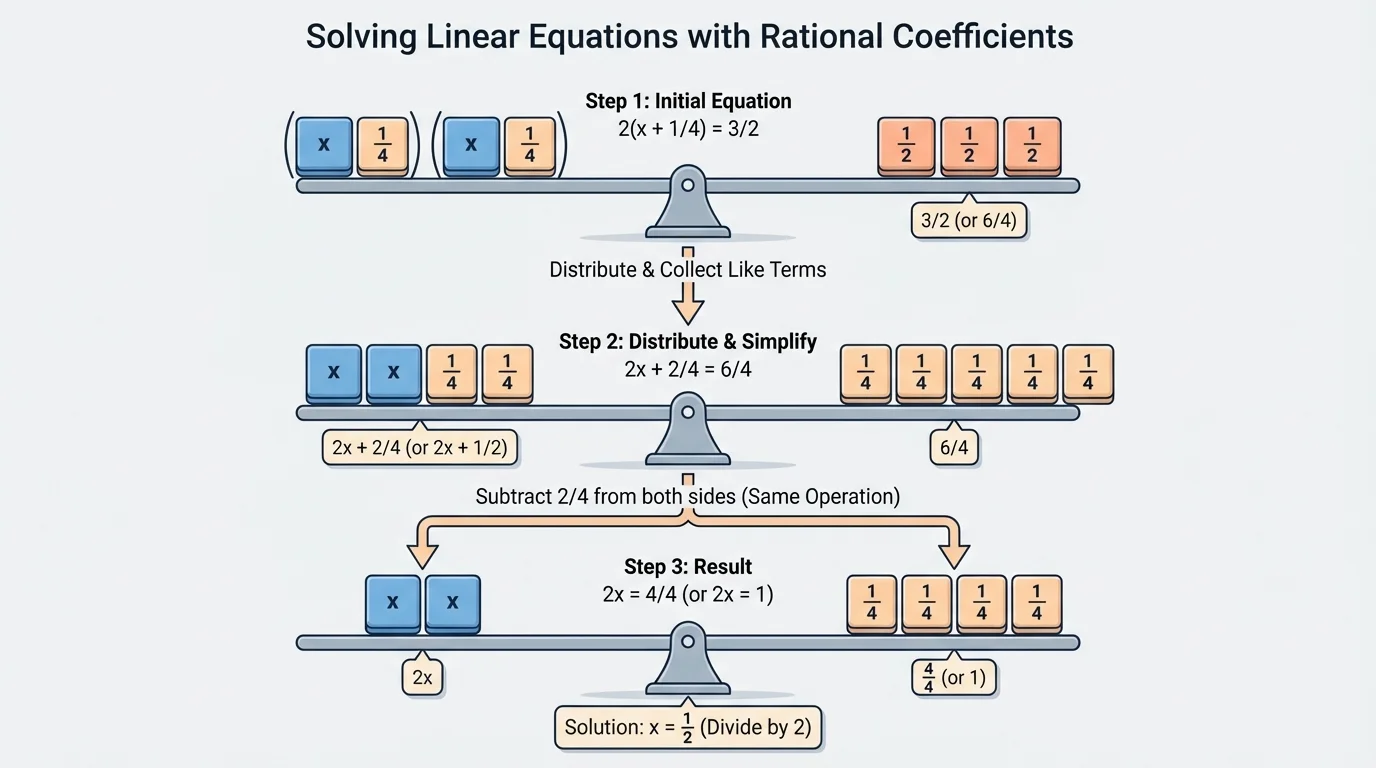
This balance idea is useful even when equations become longer. In \(\dfrac{2}{3}x+5=\dfrac{11}{3}\), the same principle applies. Subtract \(5\) from both sides first, then divide by \(\dfrac{2}{3}\), or multiply by its reciprocal \(\dfrac{3}{2}\).
Start with equations that do not need distribution. These still may have rational coefficients, so careful arithmetic matters.
Worked example 1
Solve \(\dfrac{3}{5}x+4=10\).
Step 1: Undo the addition.
Subtract \(4\) from both sides: \(\dfrac{3}{5}x=6\).
Step 2: Undo the multiplication by \(\dfrac{3}{5}\).
Divide by \(\dfrac{3}{5}\), which is the same as multiplying by \(\dfrac{5}{3}\): \(x=6\cdot\dfrac{5}{3}=10\).
Step 3: Check the solution.
Substitute \(x=10\): \(\dfrac{3}{5}(10)+4=6+4=10\).
The solution is \(x=10\)
Notice that dividing by a fraction can feel awkward at first. Many students prefer multiplying by the reciprocal because it is usually faster and clearer.
Decimals work the same way.
Worked example 2
Solve \(1.5x-2.7=6.3\).
Step 1: Undo subtraction.
Add \(2.7\) to both sides: \(1.5x=9.0\).
Step 2: Undo multiplication.
Divide both sides by \(1.5\): \(x=\dfrac{9.0}{1.5}=6\).
Step 3: Check.
Substitute \(x=6\): \(1.5(6)-2.7=9-2.7=6.3\).
The solution is \(x=6\)
Sometimes clearing fractions first is helpful. For example, in \(\dfrac{1}{2}x+\dfrac{3}{4}=\dfrac{5}{2}\), you could multiply every term by \(4\) to get \(2x+3=10\), which is easier to solve. This technique is allowed because you are multiplying both sides of the equation by the same nonzero number.
Some equations hide the variable inside parentheses. In these cases, use the distributive property first, as [Figure 2] illustrates, by multiplying the factor outside the parentheses by every term inside. This step is essential; missing one term creates an incorrect equation.
For example, \(\dfrac{1}{2}(x+6)=7\) becomes \(\dfrac{1}{2}x+3=7\). The \(\dfrac{1}{2}\) multiplies both \(x\) and \(6\).
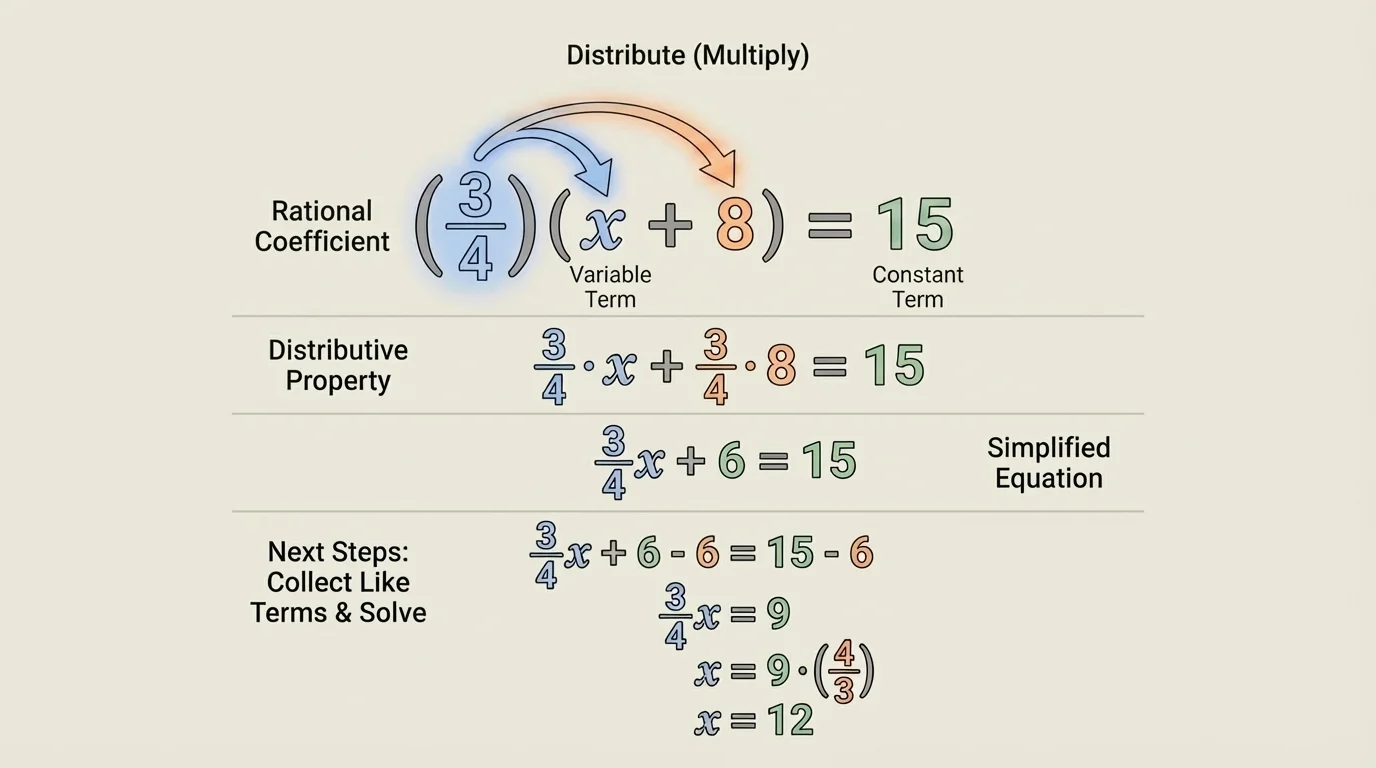
Be especially careful with negative signs. In \(-2(x-3)\), the \(-2\) multiplies both terms, so the result is \(-2x+6\), not \(-2x-3\).
Worked example 3
Solve \(\dfrac{3}{4}(x-8)+2=11\).
Step 1: Distribute.
\(\dfrac{3}{4}(x-8)=\dfrac{3}{4}x-6\), so the equation becomes \(\dfrac{3}{4}x-6+2=11\).
Step 2: Combine constants.
\(\dfrac{3}{4}x-4=11\).
Step 3: Undo subtraction.
Add \(4\) to both sides: \(\dfrac{3}{4}x=15\).
Step 4: Undo multiplication by the fraction.
Multiply both sides by \(\dfrac{4}{3}\): \(x=15\cdot\dfrac{4}{3}=20\).
Step 5: Check.
Substitute \(x=20\): \(\dfrac{3}{4}(20-8)+2=\dfrac{3}{4}(12)+2=9+2=11\).
The solution is \(x=20\)
As we saw in [Figure 2], distribution is really a way of expanding an expression so that hidden terms become visible. Once the parentheses are removed correctly, the rest of the equation usually becomes easier to manage.
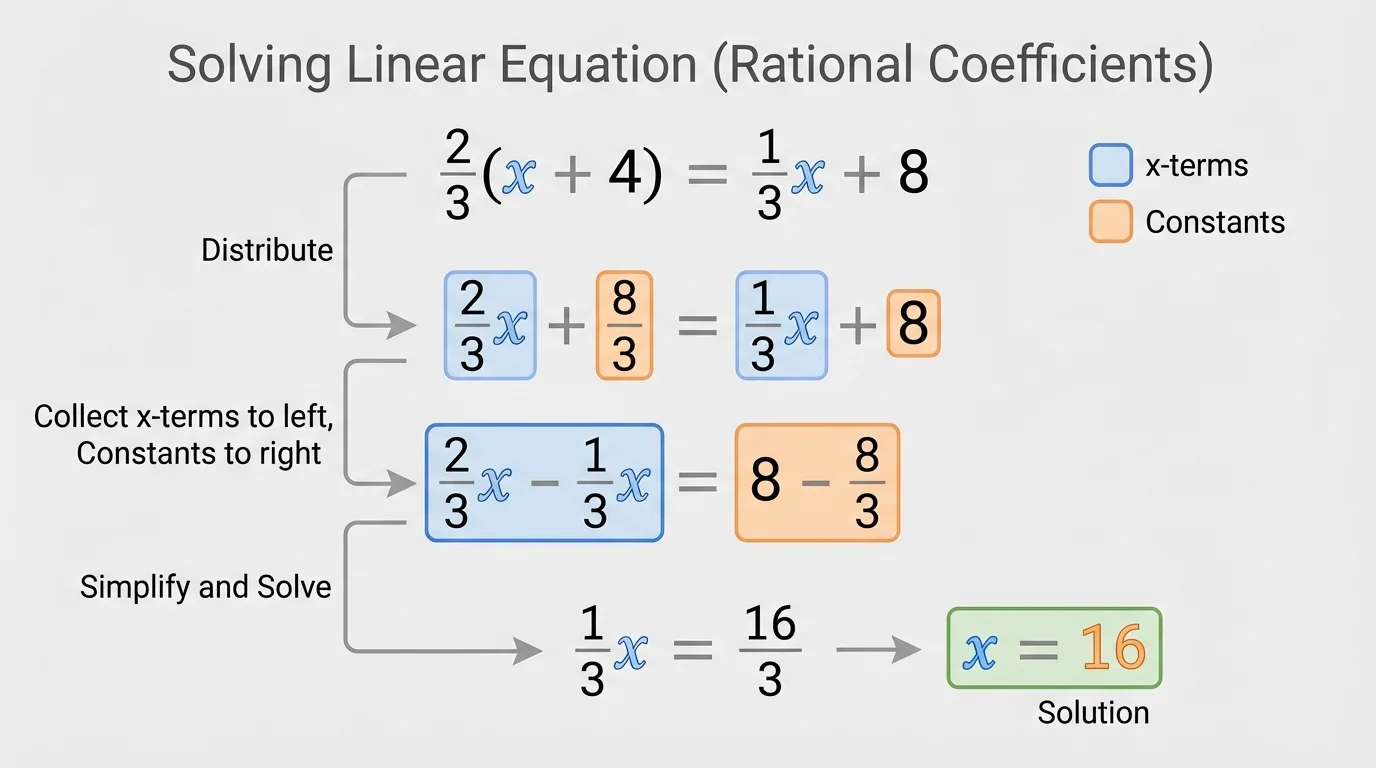
Many equations require more than distribution. After expanding, you often need to combine like terms, as [Figure 3] shows by grouping variable terms together and constants together. This reduces the clutter and reveals the structure of the equation.
Suppose you have \(2x+5-\dfrac{1}{2}x=14\). The terms \(2x\) and \(-\dfrac{1}{2}x\) are like terms, so combine them: \(\dfrac{3}{2}x+5=14\).
When variables appear on both sides, a smart strategy is to move all variable terms to one side and all constants to the other side. There is more than one correct way to do this, but choose the path that keeps coefficients positive when possible.
Worked example 4
Solve \(2(1.5x-4)-3=x+5\).
Step 1: Distribute.
\(2(1.5x-4)=3x-8\), so the equation becomes \(3x-8-3=x+5\).
Step 2: Combine like terms.
\(3x-11=x+5\).
Step 3: Move variable terms to one side.
Subtract \(x\) from both sides: \(2x-11=5\).
Step 4: Move constants to the other side.
Add \(11\) to both sides: \(2x=16\).
Step 5: Solve.
Divide by \(2\): \(x=8\).
The solution is \(x=8\)
Here is another example with fractions on both sides: \(\dfrac{2}{3}x+4=\dfrac{1}{6}x+9\). Subtract \(\dfrac{1}{6}x\) from both sides to get \(\dfrac{1}{2}x+4=9\). Then subtract \(4\): \(\dfrac{1}{2}x=5\). Finally, multiply by \(2\): \(x=10\).
The grouping idea from [Figure 3] helps you stay organized. You are not just moving things randomly; you are reorganizing the equation so each type of term has a clear place.
Most linear equations have exactly one solution, but not all do. After simplifying, sometimes the variable disappears completely.
If you end with a true statement such as \(4=4\), then the equation is true for every value of the variable. That means there are infinitely many solutions.
If you end with a false statement such as \(2=7\), then no value of the variable can make the equation true. That means there is no solution.
How to recognize the outcome
If simplifying leads to \(ax=b\) with \(a \neq 0\), there is one solution. If the variable terms cancel and you get a true statement, there are infinitely many solutions. If the variable terms cancel and you get a false statement, there is no solution.
Example of infinitely many solutions: \(2(x+3)=2x+6\). Distribute to get \(2x+6=2x+6\). Subtract \(2x\) and you have \(6=6\), so every real value of \(x\) works.
Example of no solution: \(3(x-1)=3x+5\). Distribute to get \(3x-3=3x+5\). Subtract \(3x\) and you get \(-3=5\), which is impossible.
Checking is not optional busywork; it is one of the best ways to catch mistakes. A correct solution must make the original equation true, not just the simplified one.
To check, substitute your value for the variable into the original equation and simplify both sides. If both sides are equal, the solution is correct. If not, look back for an arithmetic mistake, a sign error, or a distribution mistake.
Professional scientists and engineers routinely check results even after using advanced software. A small sign mistake in an equation can completely change a prediction.
Checking is especially useful when the equation contains fractions or negative numbers, because those are common places for small errors to sneak in.
Linear equations with rational coefficients appear whenever rates, discounts, and fixed amounts interact. For example, a streaming service might charge a monthly fee plus a per-movie fee. If you know the total bill, you can solve for how many movies were watched.
Worked example 5
A bike rental shop charges a fixed fee of $6 plus $2.50 per hour. A customer pays $21. Solve for the number of hours \(h\).
Step 1: Write the equation.
\(2.5h+6=21\).
Step 2: Subtract the fixed fee.
\(2.5h=15\).
Step 3: Divide by \(2.5\).
\(h=6\).
The customer rented the bike for \(6\) hours.
Cooking can also lead to rational coefficients. Suppose a recipe uses \(\dfrac{3}{4}\) cup of milk per batch, and you have used \(3\) cups total. The equation \(\dfrac{3}{4}b=3\) tells you how many batches \(b\) were made. Solving gives \(b=4\).
In science and engineering, formulas are often rearranged by solving linear equations. If a formula contains a measurement multiplied by a decimal or fraction, algebra helps isolate the unknown value exactly.
One common mistake is forgetting to distribute to every term. For example, \(2(x+5)\) is \(2x+10\), not \(2x+5\).
Another common mistake is combining terms that are not like terms. You can combine \(3x\) and \(-x\), but you cannot combine \(3x\) and \(3\) into one term.
Students also sometimes make sign mistakes when subtracting expressions. If you subtract \((x-4)\), the negative affects both terms: \(-(x-4)=-x+4\).
Fractions can be made easier by multiplying the entire equation by the least common denominator. Decimals can sometimes be converted to fractions, or you can multiply both sides by a power of \(10\) to remove decimal places. For example, in \(0.2x+1.3=2.9\), multiplying everything by \(10\) gives \(2x+13=29\).
| Situation | Helpful strategy |
|---|---|
| Fractions in several terms | Multiply both sides by the least common denominator |
| Decimals in several terms | Multiply both sides by a power of \(10\) |
| Parentheses present | Distribute first |
| Variable on both sides | Move variable terms to one side, constants to the other |
| Unsure about answer | Substitute back into the original equation |
Table 1. Useful strategies for different kinds of linear equations.
A strong habit is to write one clean algebra step per line. This makes your thinking visible and makes mistakes easier to find. Even experienced mathematicians rely on careful organization.
"Algebra is the art of doing the same thing to both sides until the unknown stands alone."
That idea captures the whole topic. Whether the equation contains fractions, decimals, or parentheses, the goal is the same: simplify carefully, keep the equation balanced, and isolate the variable.
