A city can feel crowded even when it covers hundreds of square miles, while a small mechanical room can hold an enormous amount of heat energy in a tight space. These two situations look completely different, but they are connected by the same mathematical idea: density. In geometry-based modeling, density is not just about the mass of a substance. It can mean how many people, how much energy, how many trees, or how many boxes fit into a region of space. Once you understand what belongs in the numerator and what belongs in the denominator, density becomes a powerful way to describe the world.
In many real situations, a total amount by itself does not tell the whole story. A population of \(500{,}000\) may sound large, but it means something very different in a county with an area of \(100 \textrm{ mi}^2\) than in a county with area of \(5{,}000 \textrm{ mi}^2\). A heating system that delivers \(90{,}000\) BTUs also needs context: is that energy spread through a huge warehouse or concentrated in a small room?
That is why density is useful. Density compares an amount to the size of the region that contains it. In modeling, we often use density to answer questions like: How crowded is this place? How concentrated is this resource? How much energy is available in a certain space? Geometry matters because the size of the region is measured with area or volume.
Density is a ratio that compares a quantity to the space it occupies. When the space is a flat region, density is based on area. When the space is a three-dimensional region, density is based on volume.
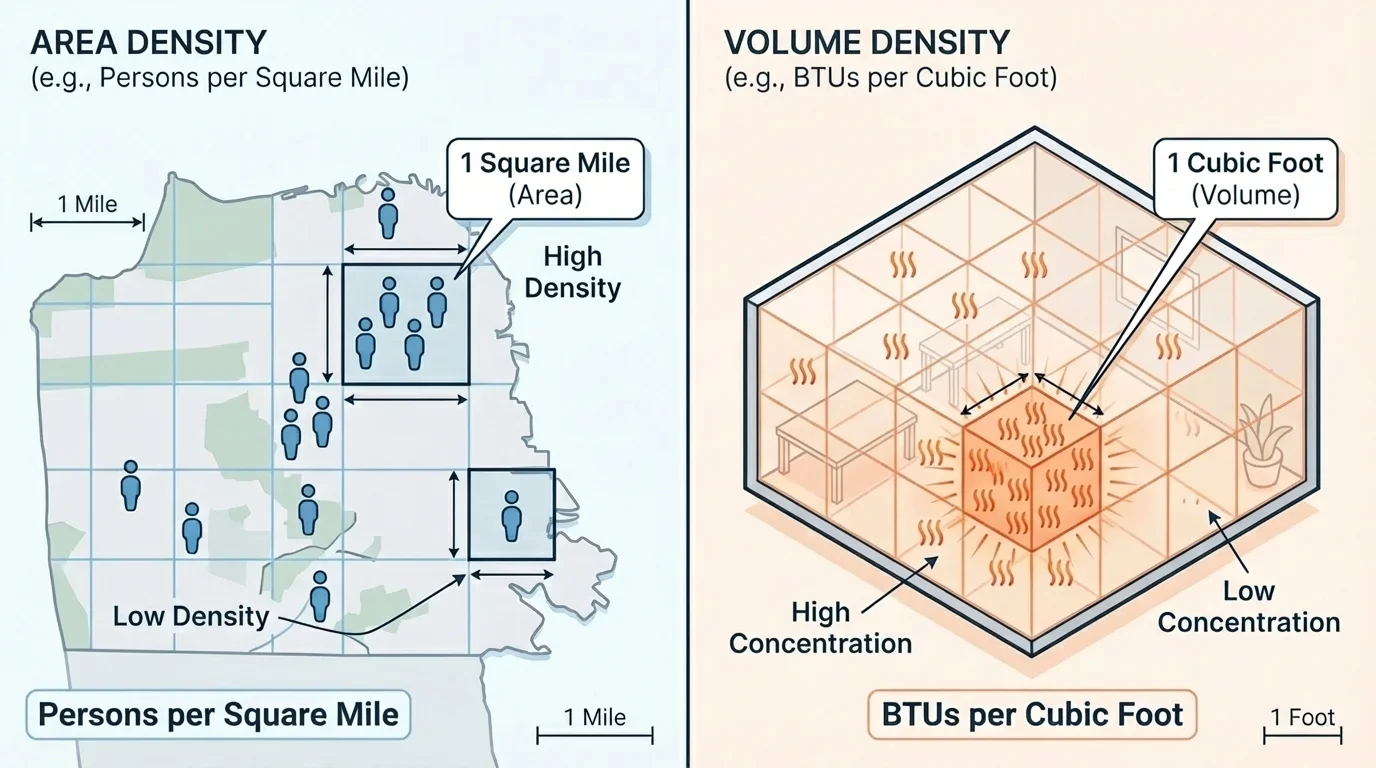
Area density measures amount per unit area, such as persons per square mile.
Volume density measures amount per unit volume, such as BTUs per cubic foot.
Notice that in this lesson, density is being used in a broad modeling sense. The same structure appears again and again: total amount divided by geometric size. The amount could be people, heat, trees, gallons, boxes, or even data-storage units in a server room. What changes are the context and the units.
As [Figure 1] shows, the kind of density you use depends on whether the situation is spread over a surface or fills three-dimensional space. If the model describes a region on a map, a floor plan, a field, or a parking lot, area density makes sense. If the model describes a room, tank, container, or building interior, volume density makes sense.
The general formulas are:
For area-based density,
\[\textrm{density} = \frac{\textrm{amount}}{\textrm{area}}\]
For volume-based density,
\[\textrm{density} = \frac{\textrm{amount}}{\textrm{volume}}\]
The units tell you how to read the answer. If a county has density \(250\) persons per square mile, that means that on average, each \(1 \textrm{ mi}^2\) contains about \(250\) people. If a room has density \(35\) BTUs per cubic foot, that means each \(1 \textrm{ ft}^3\) of space corresponds to \(35\) BTUs of heat energy.
A density value is usually an average over a region. Real places are not perfectly uniform. One neighborhood can be more crowded than another, and one part of a room can be warmer than another. But average density is still extremely useful because it lets us build a manageable mathematical model.
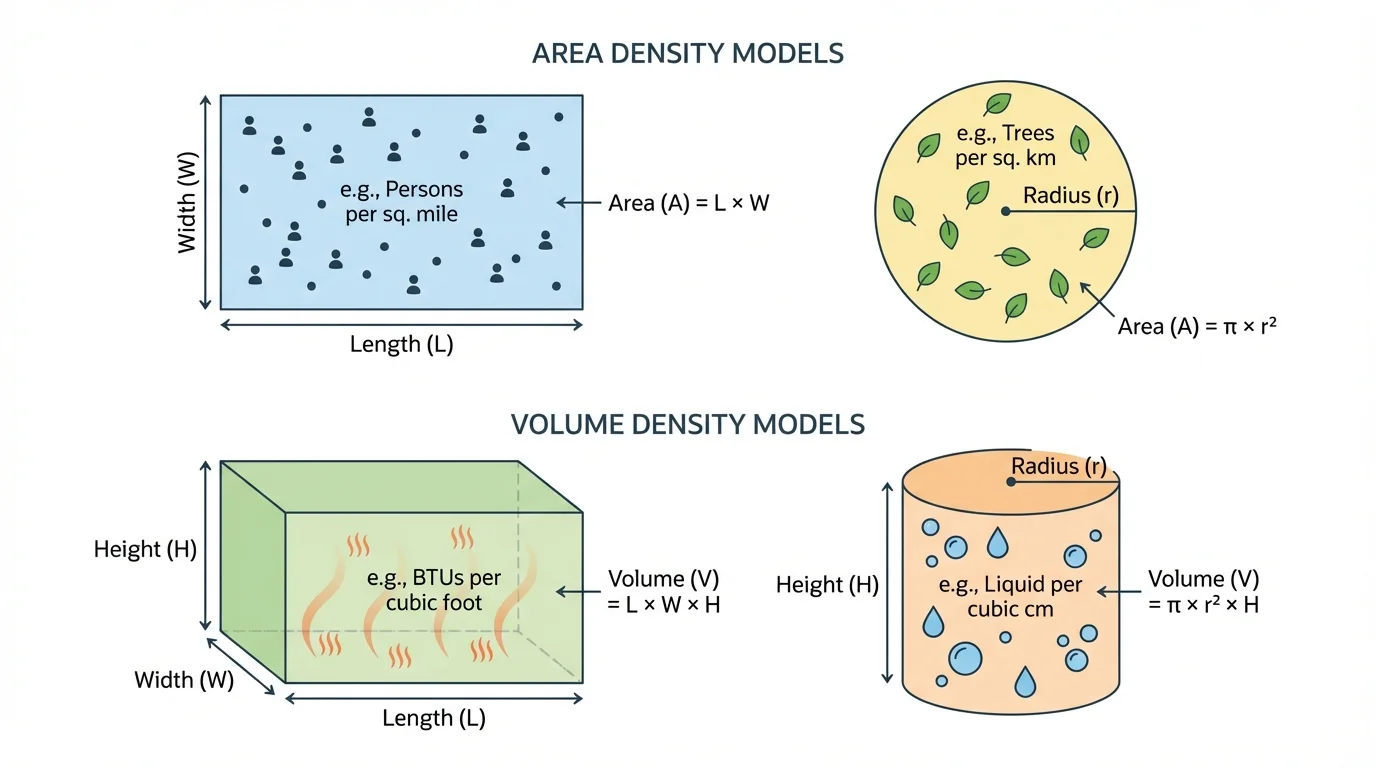
Geometry supplies the denominator in a density model, as [Figure 2] illustrates with common shapes. If you cannot find the area or the volume of the region involved, you cannot compute the density correctly. That is why modeling often begins with a geometric measurement.
Some common formulas are listed below.
Rectangle area: \(A = lw\)
Circle area: \(A = \pi r^2\)
Rectangular prism volume: \(V = lwh\)
Cylinder volume: \(V = \pi r^2 h\)
Sometimes the region is composite. A town might be approximated by a rectangle and a semicircle. A storage space might be a rectangular prism with a smaller prism removed. In that case, find the total area or total volume by adding or subtracting geometric parts before computing density.
Units matter at every stage. If dimensions are measured in feet, then area is in square feet and volume is in cubic feet. If dimensions are measured in miles, area is in square miles. If the units are mixed, convert before dividing.
Suppose a county has population \(186{,}000\) and land area \(620 \textrm{ mi}^2\). We want to find the population density in persons per square mile.
Worked example: Population density
Step 1: Identify the quantity and the geometric measure.
The amount is population, \(186{,}000\) persons. The region is measured by area, \(620 \textrm{ mi}^2\).
Step 2: Use the area-density formula.
\(\textrm{density} = \dfrac{\textrm{amount}}{\textrm{area}}\)
Step 3: Substitute the values.
\(\textrm{density} = \dfrac{186{,}000}{620}\)
Step 4: Compute and interpret.
\(\dfrac{186{,}000}{620} = 300\)
So the density is \(300\) persons per square mile.
Final answer:
\[300 \textrm{ persons per } \textrm{mi}^2\]
This does not mean every square mile contains exactly \(300\) people. It means the county averages \(300\) people for each square mile of land. This interpretation is essential in modeling: density is usually a simplification of a more uneven reality.
Now consider a heating situation. A mechanical analysis estimates that a room contains \(48{,}000\) BTUs of heat energy. The room is \(20 \textrm{ ft}\) long, \(15 \textrm{ ft}\) wide, and \(10 \textrm{ ft}\) high. Find the energy density in BTUs per cubic foot.
Worked example: BTUs per cubic foot
Step 1: Find the room volume.
Since the room is a rectangular prism, \(V = lwh\).
Substitute: \(V = 20 \cdot 15 \cdot 10 = 3{,}000\).
The volume is \(3{,}000 \textrm{ ft}^3\).
Step 2: Use the volume-density formula.
\(\textrm{density} = \dfrac{\textrm{amount}}{\textrm{volume}}\)
Step 3: Substitute the values.
\(\textrm{density} = \dfrac{48{,}000}{3{,}000}\)
Step 4: Compute and interpret.
\(\dfrac{48{,}000}{3{,}000} = 16\)
So the room has an energy density of \(16\) BTUs per cubic foot.
Final answer:
\[16 \textrm{ BTUs per } \textrm{ft}^3\]
This kind of model is useful in heating and air-conditioning design. Engineers compare energy needs with the size of the interior space. The idea from [Figure 1] is still the same: the numerator is the total amount, and the denominator is the appropriate geometric measure.
A floor area for an event is a rectangular section measuring \(120 \textrm{ ft}\) by \(80 \textrm{ ft}\). Organizers want to estimate the average crowd density if \(2{,}400\) people are allowed in that space.
Worked example: People per square foot
Step 1: Find the area of the floor.
\(A = lw = 120 \cdot 80 = 9{,}600\)
The area is \(9{,}600 \textrm{ ft}^2\).
Step 2: Compute area density.
\(\textrm{density} = \dfrac{2{,}400}{9{,}600} = 0.25\)
Step 3: Interpret the result.
The density is \(0.25\) persons per square foot.
Step 4: Rewrite in a more intuitive way.
If \(0.25\) people fit in each square foot on average, then one person has about \(\dfrac{1}{0.25} = 4\) square feet of floor area.
Final answer:
\[0.25 \textrm{ persons per } \textrm{ft}^2\]
This example shows that density can be interpreted in more than one direction. Sometimes "people per square foot" is useful. Sometimes "square feet per person" is easier to understand. Both describe crowding, but they emphasize different perspectives.
Density as a rate
Density behaves like a rate. "Persons per square mile" and "BTUs per cubic foot" work the same way as "miles per hour" in structure. A rate compares one quantity to another and helps us predict totals, compare situations, and make decisions.
Because density is a rate, it can be multiplied by area or volume to recover a total amount. That idea becomes especially important when you know the density and the size of the region but not the total amount.
If \(d\) stands for density, then for area models, \(d = \dfrac{Q}{A}\), where \(Q\) is the quantity and \(A\) is the area. For volume models, \(d = \dfrac{Q}{V}\), where \(V\) is the volume.
These formulas can be rearranged:
For area density,
\(Q = dA\)
For volume density,
\(Q = dV\)
You can also solve for area or volume:
\[A = \frac{Q}{d} \qquad V = \frac{Q}{d}\]
Suppose an urban region averages \(1{,}200\) persons per square mile and has area \(45 \textrm{ mi}^2\). Then the estimated population is \(Q = 1{,}200 \cdot 45 = 54{,}000\) persons. If a storage room is designed for \(9\) boxes per cubic foot and has volume \(800 \textrm{ ft}^3\), then it can hold about \(9 \cdot 800 = 7{,}200\) boxes, assuming the packing model is realistic.
These are not exact predictions in every case. They are model-based estimates. But they are often good enough to guide planning, budgeting, and design.
A mathematical model is only as good as its assumptions. When using density, ask what quantity is actually being spread through the region. People spread over a county suggest area density. Heat spread through a room suggests volume density. Rainfall over a watershed may involve area. Air pollutants in a chamber may involve volume.
Another key question is whether the region's shape needs approximation. A field may not be a perfect rectangle. A room may have a sloped ceiling. In practice, we often approximate with familiar geometric shapes, then decide whether the estimate is accurate enough for the purpose.
Unit rate thinking helps with interpretation. A density of \(18\) BTUs per cubic foot tells you the amount for exactly one cubic foot. A density of \(350\) persons per square mile tells you the average for exactly one square mile. Reading density as a unit rate makes it easier to compare different situations.
From earlier geometry work, area measures two-dimensional space and volume measures three-dimensional space. If the denominator has square units, the model is area-based. If the denominator has cubic units, the model is volume-based.
Always check unit consistency. If a room's dimensions are given in inches but the energy density is in BTUs per cubic foot, convert the dimensions first or convert the volume afterward. Dividing with mismatched units produces meaningless results.
Density models appear in far more places than a single textbook section might suggest. Planners, engineers, and scientists use area and volume density to make decisions about cities, buildings, storage systems, and environmental conditions.
As [Figure 3] illustrates, in urban planning, population density helps compare regions fairly. A city district with many residents in a small area may need more public transportation, schools, and utility infrastructure than a rural region with the same total population spread over a larger area.
In heating and cooling design, BTU-based volume density helps estimate how much thermal energy is associated with an interior space. While real HVAC calculations include insulation, airflow, windows, and occupancy, density gives a first useful model.
In warehousing, managers may estimate boxes per cubic foot to understand storage capacity. In agriculture, farmers may model planting density as plants per acre. In ecology, scientists may measure trees per hectare or fish per cubic meter of water, depending on whether the organisms mainly occupy a surface region or a three-dimensional environment.
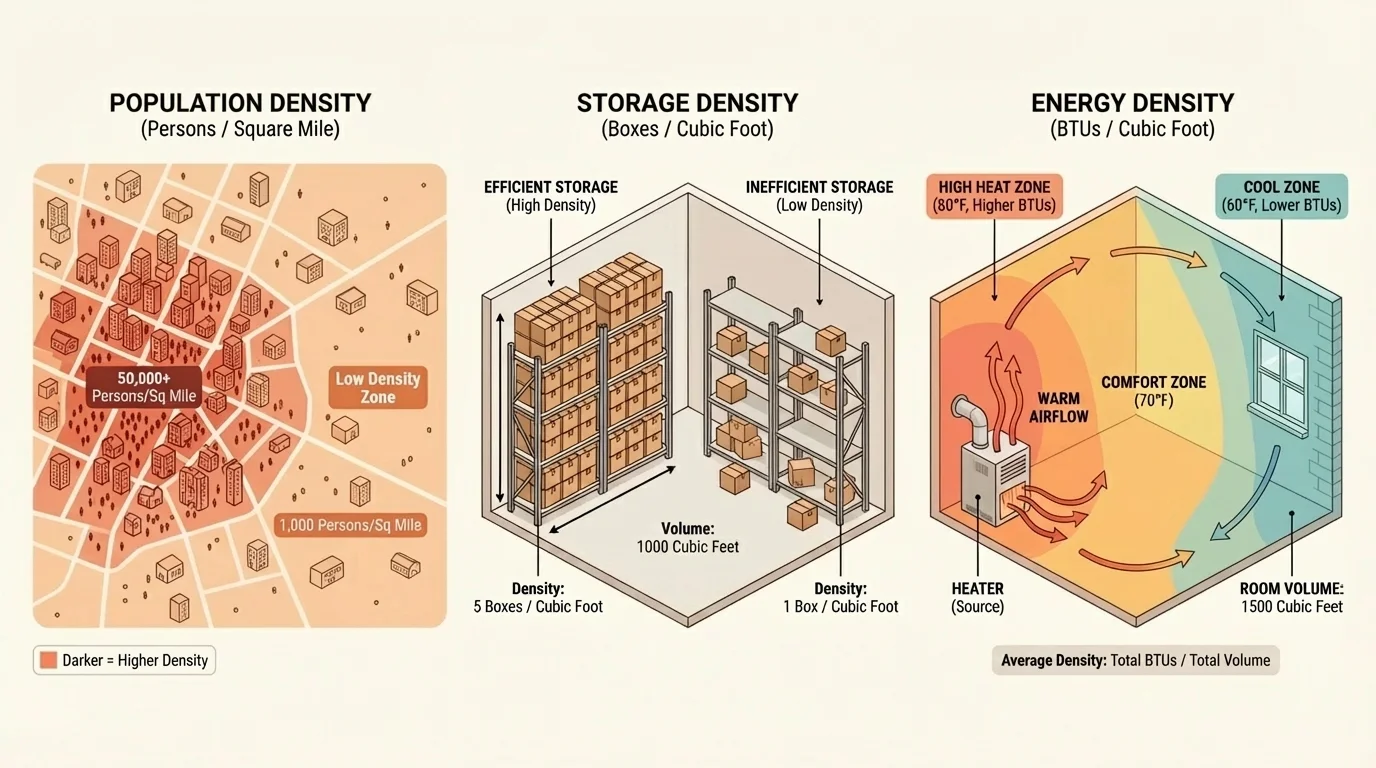
Even digital technology uses related ideas. Data centers care about equipment concentration within floor space and sometimes about heat generated within room volume. As with the city and room comparison, the correct model depends on whether the limiting factor is surface area, usable floor area, or total interior volume.
Some of the world's most densely populated places have population densities above \(50{,}000\) persons per square mile, while large rural regions may have fewer than \(10\) persons per square mile. The total population alone hides this dramatic difference.
These examples show why density is so powerful: it turns raw totals into comparable measures. A density model answers not just "how much?" but "how much for this amount of space?"
One common mistake is choosing area when the situation really requires volume, or volume when area is enough. If you are modeling people across a county, area is appropriate because the county is treated as a surface region on a map. If you are modeling heat in a room, volume is more appropriate because heat occupies a three-dimensional space.
Another common mistake is forgetting to compute the geometry first. For a cylindrical tank, for example, you need the volume \(V = \pi r^2 h\) before finding gallons per cubic foot or any other density measure.
A third mistake is ignoring units. If one length is in meters and another is in centimeters, the resulting area or volume will be wrong unless you convert. Unit errors can destroy an otherwise correct model.
Students also sometimes interpret density as an exact statement rather than an average. If a region has density \(200\) persons per square mile, that does not force every square mile to contain exactly \(200\) people. It is a simplified description of the entire region.
The big idea is simple but powerful. Density compares quantity to space. When the space is two-dimensional, use area density. When the space is three-dimensional, use volume density. The formulas are structurally alike, but the geometry changes the denominator and therefore the meaning of the result.
If you know the total amount and the relevant area or volume, divide to find density. If you know the density and the area or volume, multiply to estimate the total amount. If you know the amount and density, divide to estimate how much area or volume is needed.
Once you start looking for it, density appears everywhere: cities, stadiums, farms, rooms, storage buildings, forests, and environmental systems. Geometry makes those situations measurable, and density turns them into models that can be analyzed, compared, and used to make real decisions.
