A right triangle is only one special kind of triangle. In the real world, though, triangles appear in roof frames, bridges, radar systems, satellite paths, and land surveying, and most of them are not right triangles. So how do you find a missing side or angle when the triangle has no right angle at all? Two of the most powerful tools in geometry answer that question: the Law of Sines and the Law of Cosines.
You already know that in a right triangle, trigonometric ratios such as \(\sin \theta = \dfrac{\textrm{opposite}}{\textrm{hypotenuse}}\) connect angles and side lengths. But if a triangle is not right, there is no hypotenuse. That means the basic right-triangle formulas are not enough by themselves.
To handle any triangle, mathematicians use a standard labeling system. In triangle \(ABC\), side \(a\) is opposite angle \(A\), side \(b\) is opposite angle \(B\), and side \(c\) is opposite angle \(C\). This opposite-pair structure is extremely important. If you pair a side with the wrong angle, your work can fall apart very quickly.
In every triangle, the angle measures add to \(180^\circ\). Also, for any acute angle in a right triangle, \(\sin \theta = \dfrac{\textrm{opposite}}{\textrm{hypotenuse}}\), \(\cos \theta = \dfrac{\textrm{adjacent}}{\textrm{hypotenuse}}\), and \(\tan \theta = \dfrac{\textrm{opposite}}{\textrm{adjacent}}\).
We will use those right-triangle facts inside larger triangles by drawing an altitude. That one move turns a general triangle into two right triangles, and from there the new laws appear naturally.
Included angle is the angle formed by two given sides.
Acute triangle is a triangle with all angles less than \(90^\circ\).
Obtuse triangle is a triangle with one angle greater than \(90^\circ\).
Ambiguous case is the \(SSA\) case in the Law of Sines, where the given information may produce \(0\), \(1\), or \(2\) triangles.
When working with trigonometry in any triangle, standard notation matters. If angle \(A\) is opposite side \(a\), angle \(B\) is opposite side \(b\), and angle \(C\) is opposite side \(c\), then every formula is easier to read and remember.
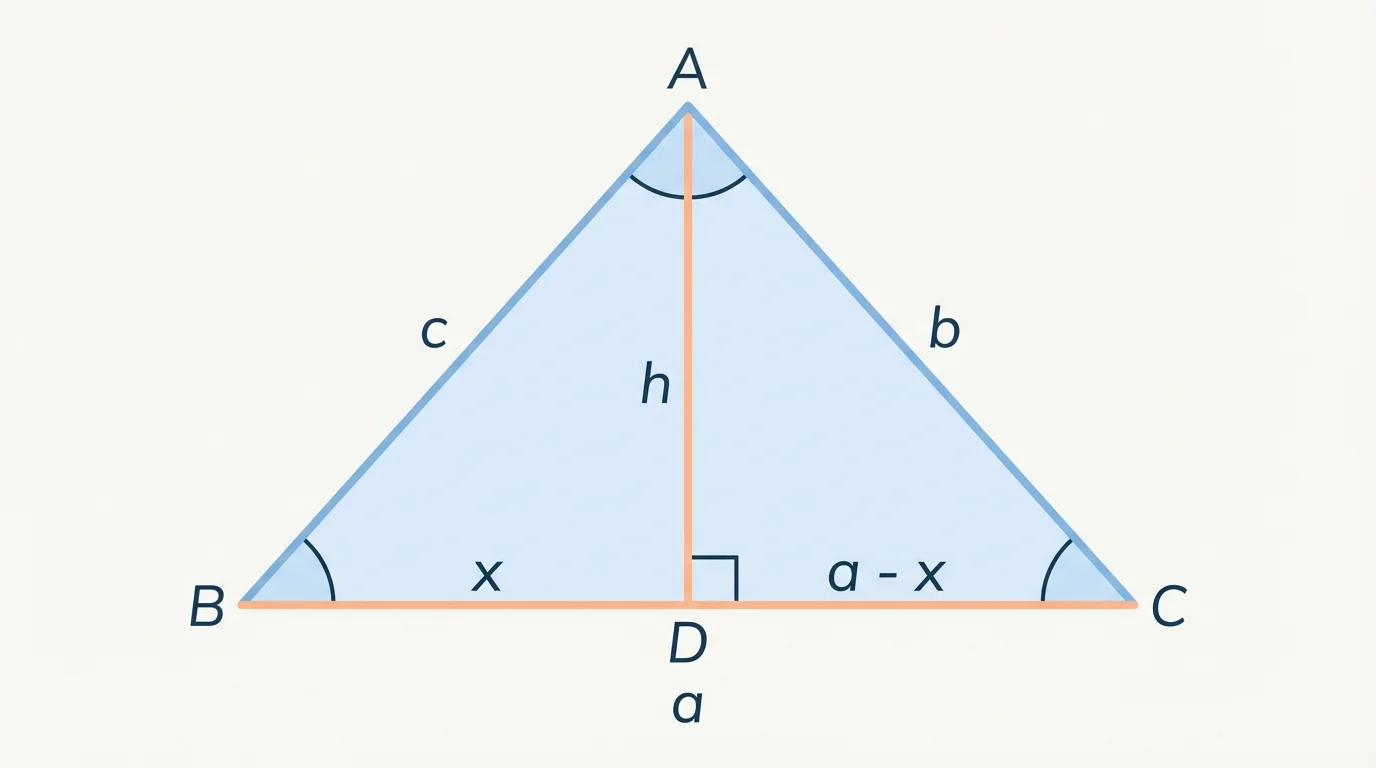
The first new idea we need is the Law of Sines, which links each side length to the sine of its opposite angle, as illustrated in [Figure 1].
The key idea is to draw an altitude inside the triangle. Suppose triangle \(ABC\) is acute, and draw an altitude from angle \(A\) to side \(a\). Let the altitude have length \(h\). This splits the triangle into two right triangles.
In one right triangle, \(\sin B = \dfrac{h}{c}\), so \(h = c \sin B\). In the other right triangle, \(\sin C = \dfrac{h}{b}\), so \(h = b \sin C\). Since both expressions equal the same altitude, we get \(c \sin B = b \sin C\).
Now divide both sides by \(bc\): \(\dfrac{\sin B}{b} = \dfrac{\sin C}{c}\). Rewriting gives \(\dfrac{b}{\sin B} = \dfrac{c}{\sin C}\). By drawing an altitude from a different vertex, we can include the third side-angle pair as well. The full result is
\[\frac{a}{\sin A} = \frac{b}{\sin B} = \frac{c}{\sin C}\]
This is the Law of Sines. It works for any triangle, not just acute ones. For an obtuse triangle, a similar altitude argument still works, although one of the right triangles extends outside the original triangle.
Another useful form comes from taking reciprocals:
\[\frac{\sin A}{a} = \frac{\sin B}{b} = \frac{\sin C}{c}\]
Both forms are equivalent. Students often choose the version that makes substitution more convenient.
Why the Law of Sines makes sense
If one angle in a triangle gets larger while the overall shape stays similar, the side opposite that angle must also get larger. The Law of Sines captures that relationship exactly: bigger angles are paired with bigger opposite sides through the sine function.
The same altitude picture also hints at an area formula, because the area can be written as \(K = \dfrac{1}{2}bc \sin A\), \(K = \dfrac{1}{2}ac \sin B\), or \(K = \dfrac{1}{2}ab \sin C\). We will return to that connection later.
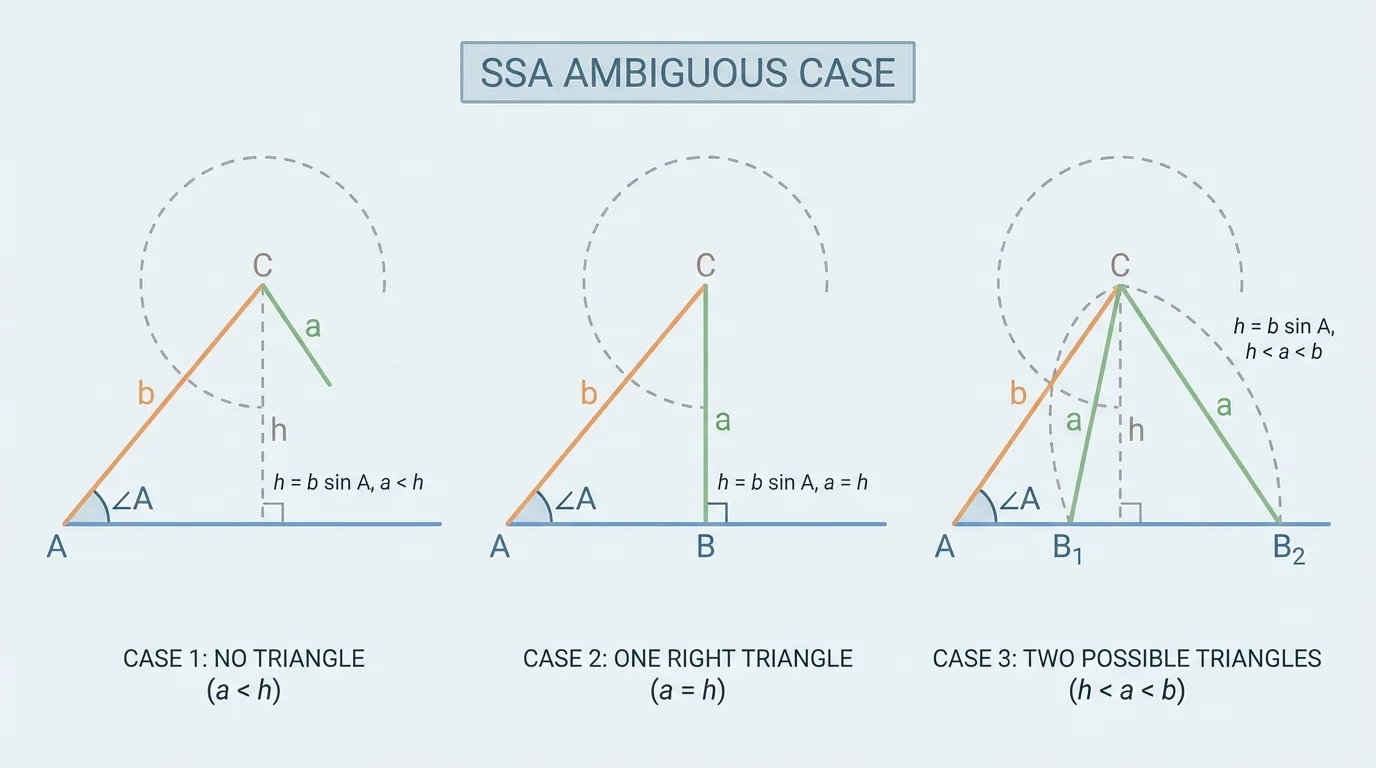
The Law of Sines is especially useful when you know an angle-side opposite pair. That happens in \(ASA\), \(AAS\), and sometimes \(SSA\) situations. If you can match one side with its opposite angle, you can usually set up a proportion immediately, and [Figure 2] helps show why the \(SSA\) case can be ambiguous.
Solved example 1: Finding a side with \(ASA\)
In triangle \(ABC\), suppose \(A = 42^\circ\), \(B = 68^\circ\), and \(a = 12\). Find side \(b\).
Step 1: Find the third angle.
Since the angles in a triangle sum to \(180^\circ\), \(C = 180^\circ - 42^\circ - 68^\circ = 70^\circ\).
Step 2: Write the Law of Sines using the known opposite pair.
\[\frac{a}{\sin A} = \frac{b}{\sin B}\]
Substitute: \(\dfrac{12}{\sin 42^\circ} = \dfrac{b}{\sin 68^\circ}\).
Step 3: Solve for \(b\).
\(b = \dfrac{12 \sin 68^\circ}{\sin 42^\circ}\).
Using a calculator, \(b \approx \dfrac{12(0.9272)}{0.6691} \approx 16.63\).
\[b \approx 16.6\]
The \(SSA\) case is different. Knowing two sides and a nonincluded angle does not always determine a unique triangle. Depending on the side lengths, there may be no triangle, one triangle, or two different triangles.
Why does this happen? If angle \(A\) is fixed and side \(a\) is fixed opposite it, another side of length \(b\) can sometimes swing into two positions. Geometrically, the endpoint of that side may land in two places, producing two different triangles with the same given data.
Solved example 2: The ambiguous case \(SSA\)
Suppose \(A = 35^\circ\), \(a = 8\), and \(b = 11\). Find all possible triangles.
Step 1: Use the Law of Sines to find \(\sin B\).
\[\frac{a}{\sin A} = \frac{b}{\sin B}\]
So \(\sin B = \dfrac{b \sin A}{a} = \dfrac{11 \sin 35^\circ}{8}\).
\(\sin B \approx \dfrac{11(0.5736)}{8} \approx 0.7887\).
Step 2: Find possible angles \(B\).
If \(\sin B \approx 0.7887\), then one solution is \(B \approx 52.1^\circ\).
Because sine is also positive in the second quadrant, another possibility is \(B \approx 180^\circ - 52.1^\circ = 127.9^\circ\).
Step 3: Check whether both fit in a triangle.
For \(B \approx 52.1^\circ\), \(C = 180^\circ - 35^\circ - 52.1^\circ = 92.9^\circ\), which works.
For \(B \approx 127.9^\circ\), \(C = 180^\circ - 35^\circ - 127.9^\circ = 17.1^\circ\), which also works.
Step 4: Find side \(c\) for each triangle.
Using \(\dfrac{a}{\sin A} = \dfrac{c}{\sin C}\), we get \(c = \dfrac{8 \sin C}{\sin 35^\circ}\).
First triangle: \(c \approx \dfrac{8 \sin 92.9^\circ}{0.5736} \approx 13.9\).
Second triangle: \(c \approx \dfrac{8 \sin 17.1^\circ}{0.5736} \approx 4.1\).
There are two possible triangles.
Whenever you use the ambiguous case, always ask whether the second angle from \(180^\circ - B\) is possible. If the angles add to more than \(180^\circ\), that second triangle must be rejected.
Surveyors historically solved large triangles across land by measuring one baseline carefully and then using angle measurements. Before modern GPS, this method allowed mapmakers to estimate long distances with surprising accuracy.
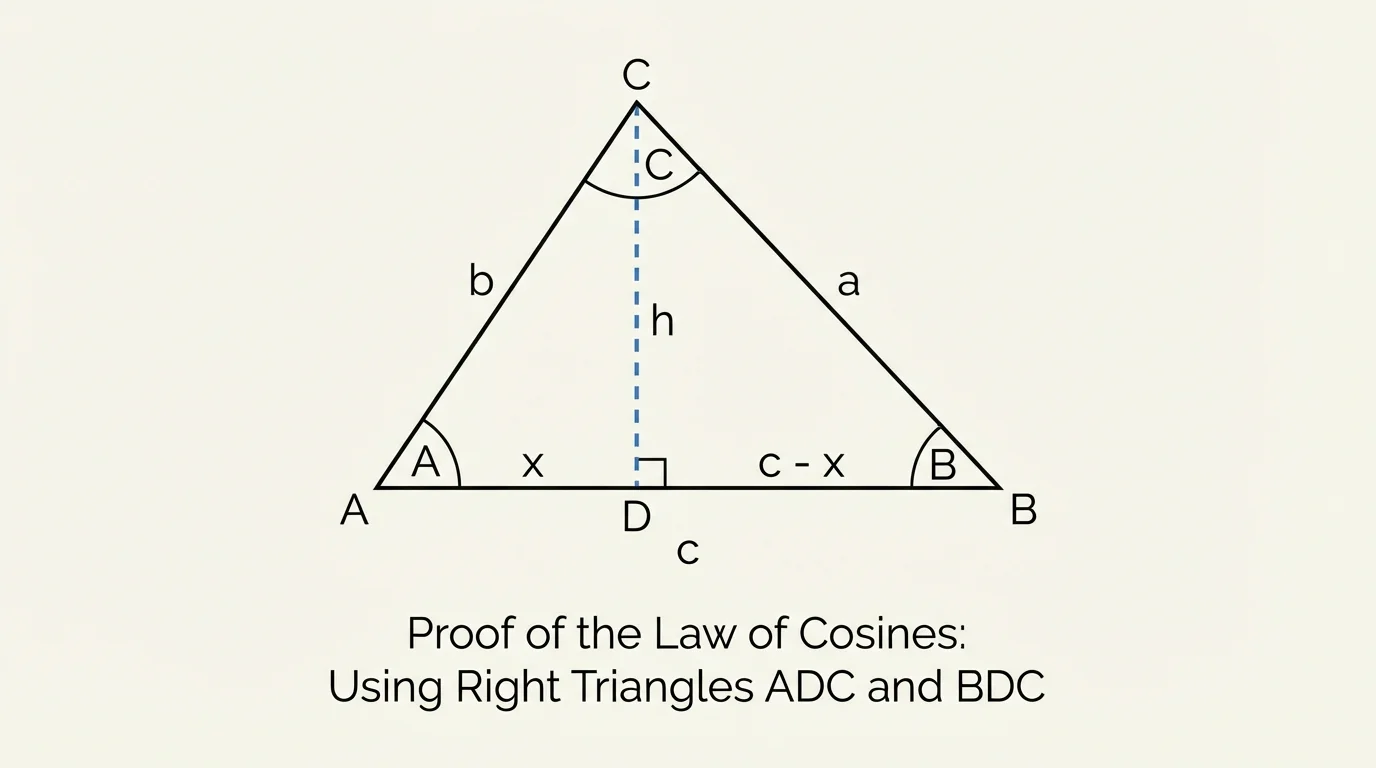
The Law of Cosines is the generalization of the Pythagorean theorem to any triangle. As shown in [Figure 3], if we drop an altitude and split one side into segments, we can express the side lengths using right-triangle relationships.
Suppose we want a formula for side \(c\), opposite angle \(C\). Place the triangle so side \(c\) lies horizontally. Let side \(b\) make angle \(C\) with side \(a\). Drop an altitude from the top vertex to side \(c\). The horizontal projection of side \(b\) is \(b \cos C\), and the altitude is \(b \sin C\).
The remaining horizontal part of the base is \(a - b \cos C\). Using the Pythagorean theorem on the right triangle formed by that segment and the altitude, we get
\[c^2 = (a - b\cos C)^2 + (b\sin C)^2\]
Expand and simplify:
\[\begin{aligned}c^2 &= a^2 - 2ab\cos C + b^2\cos^2 C + b^2\sin^2 C \\ &= a^2 - 2ab\cos C + b^2(\cos^2 C + \sin^2 C) \\ &= a^2 + b^2 - 2ab\cos C\end{aligned}\]
So the Law of Cosines is
\[c^2 = a^2 + b^2 - 2ab\cos C\]
By symmetry, the other two forms are
\[a^2 = b^2 + c^2 - 2bc\cos A\]
\[b^2 = a^2 + c^2 - 2ac\cos B\]
If \(C = 90^\circ\), then \(\cos 90^\circ = 0\), so the formula becomes \(c^2 = a^2 + b^2\). That is exactly the Pythagorean theorem. So the Law of Cosines is not a completely separate idea; it is a broader version of a familiar one.
Use the Law of Cosines when you know two sides and the included angle, \(SAS\), or when you know all three sides, \(SSS\). In \(SAS\), you find the missing side first. In \(SSS\), you solve for an angle by rearranging the formula.
Solved example 3: Finding a side with \(SAS\)
Suppose \(a = 9\), \(b = 13\), and \(C = 48^\circ\). Find \(c\).
Step 1: Choose the correct Law of Cosines formula.
Since \(C\) is the included angle between sides \(a\) and \(b\), use \(c^2 = a^2 + b^2 - 2ab\cos C\).
Step 2: Substitute the values.
\[c^2 = 9^2 + 13^2 - 2(9)(13)\cos 48^\circ\]
\(c^2 = 81 + 169 - 234(0.6691) \approx 250 - 156.6 = 93.4\).
Step 3: Take the square root.
\(c \approx \sqrt{93.4} \approx 9.66\).
\[c \approx 9.7\]
When all three sides are known, you can still use the Law of Cosines, but now you solve for an angle.
Solved example 4: Finding an angle with \(SSS\)
In triangle \(ABC\), let \(a = 7\), \(b = 10\), and \(c = 12\). Find angle \(C\).
Step 1: Start with the formula involving \(C\).
\[c^2 = a^2 + b^2 - 2ab\cos C\]
Step 2: Substitute the side lengths.
\(12^2 = 7^2 + 10^2 - 2(7)(10)\cos C\).
\(144 = 49 + 100 - 140\cos C\).
\(144 = 149 - 140\cos C\).
Step 3: Solve for \(\cos C\).
\(-5 = -140\cos C\), so \(\cos C = \dfrac{5}{140} = \dfrac{1}{28}\).
Step 4: Use inverse cosine.
\(C = \cos^{-1}\left(\dfrac{1}{28}\right) \approx 88.0^\circ\).
\[C \approx 88.0^\circ\]
The decomposition in [Figure 3] helps explain why cosine appears here: the formula depends on the horizontal projection of one side onto another, and projection is exactly what cosine measures.
Many errors happen not because students cannot compute, but because they choose the wrong tool. A quick decision guide helps.
| Given information | Best law to start with | Reason |
|---|---|---|
| \(ASA\) | Law of Sines | You know an angle-side opposite pair after finding the third angle if needed. |
| \(AAS\) | Law of Sines | Again, there is an angle-side opposite relationship. |
| \(SSA\) | Law of Sines | Works, but you must check the ambiguous case. |
| \(SAS\) | Law of Cosines | You know two sides and the included angle. |
| \(SSS\) | Law of Cosines | No angle-side opposite pair is available at the start. |
A useful habit is to look first for an opposite side-angle pair. If you see one, the Law of Sines is often the easiest start. If not, and you have \(SAS\) or \(SSS\), the Law of Cosines is usually the right choice.
There is one more formula closely connected to these laws: the formula for the area of a triangle using two sides and the included angle. If two sides and the included angle are known, then the area \(K\) of a triangle is
\[K = \frac{1}{2}ab\sin C\]
This formula comes directly from the idea that area is \(\dfrac{1}{2} \times \textrm{base} \times \textrm{height}\). If side \(a\) is the base, then the height relative to it is \(b \sin C\).
Solved example 5: Finding area with two sides and an angle
A triangle has sides \(11\) and \(15\) with included angle \(62^\circ\). Find its area.
Step 1: Use the area formula.
\[K = \frac{1}{2}ab\sin C\]
Step 2: Substitute the values.
\(K = \dfrac{1}{2}(11)(15)\sin 62^\circ\).
\(K = 82.5(0.8829) \approx 72.8\).
\[K \approx 72.8\]
This area formula and the Law of Sines are related because they both come from the same altitude idea. A single altitude can connect side lengths, angle sines, and area all at once.
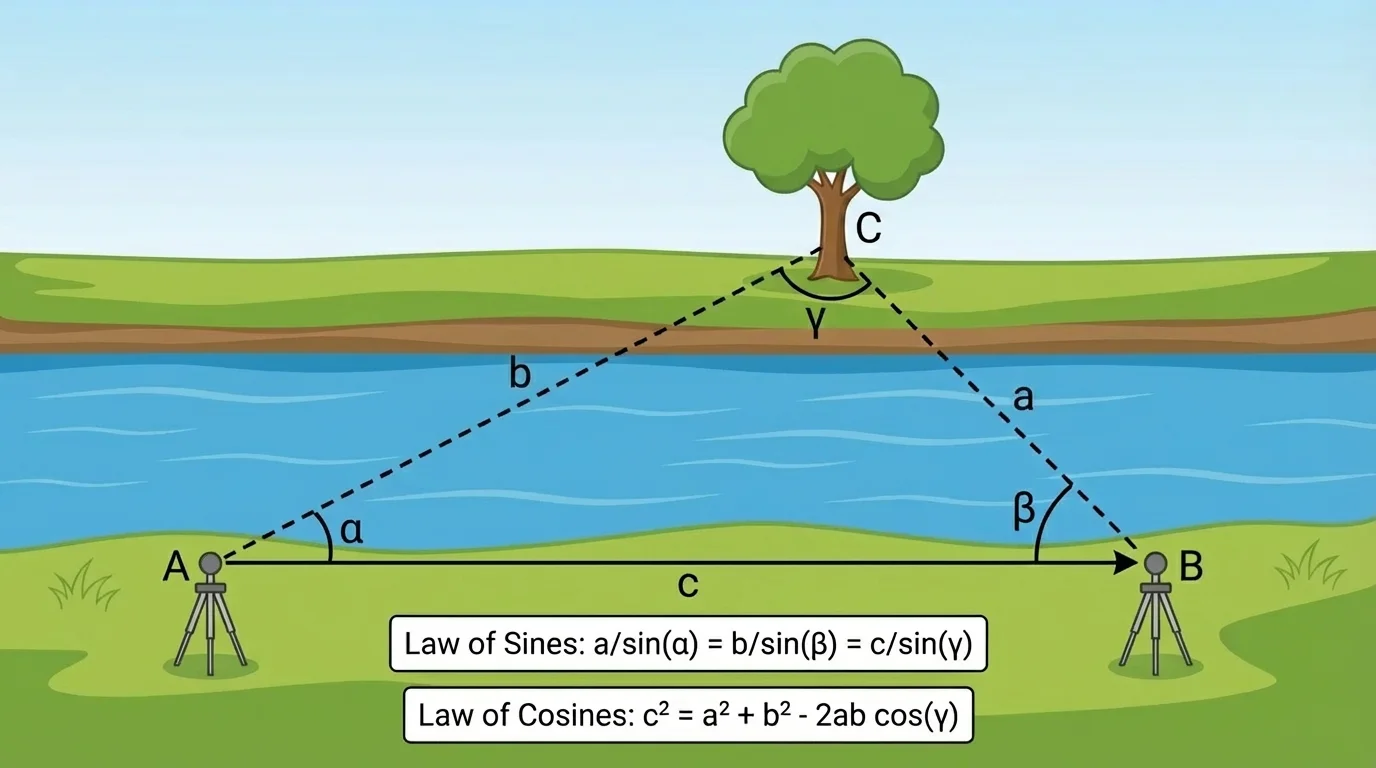
Suppose a surveyor wants the width of a river without crossing it. As shown in [Figure 4], by measuring a baseline along one bank and two sight angles to a tree on the opposite bank, the surveyor creates a triangle. Then the Law of Sines or the Law of Cosines can determine the unknown distance across the river.
Engineers use the same ideas when analyzing forces in truss structures, because force vectors often form triangles. Pilots and ship navigators also work with triangular paths when combining headings, wind directions, and travel distances.
Solved example 6: Surveying across a river
Two points \(P\) and \(Q\) on the same riverbank are \(80\) meters apart. A tree \(T\) is across the river. Suppose \(\angle P = 53^\circ\) and \(\angle Q = 71^\circ\). Find \(PT\).
Step 1: Find the third angle.
\(\angle T = 180^\circ - 53^\circ - 71^\circ = 56^\circ\).
Step 2: Use the Law of Sines.
Side \(PQ = 80\) is opposite angle \(T = 56^\circ\), and side \(PT\) is opposite angle \(Q = 71^\circ\).
\[\frac{80}{\sin 56^\circ} = \frac{PT}{\sin 71^\circ}\]
Step 3: Solve for \(PT\).
\(PT = \dfrac{80 \sin 71^\circ}{\sin 56^\circ}\).
\(PT \approx \dfrac{80(0.9455)}{0.8290} \approx 91.2\).
\[PT \approx 91.2 \textrm{ m}\]
Later, if the surveyor wants the perpendicular width of the river instead of the slanted distance \(PT\), an altitude can be drawn inside the triangle, just as in [Figure 1]. That connection between proof and application is one of the elegant features of trigonometry.
One common mistake is using degrees and radians inconsistently. In most geometry problems like these, your calculator should be in degree mode. If it is not, even correct setup can produce nonsense.
Another common mistake is pairing the wrong side with the wrong angle. Always check that side \(a\) is opposite angle \(A\), side \(b\) is opposite angle \(B\), and side \(c\) is opposite angle \(C\).
When using the Law of Sines, be especially alert for the ambiguous case. If you solve \(\sin B = k\), there may be two angle values with the same sine. You must test both in the triangle.
Reasonableness checks matter too. If one angle is the largest, then its opposite side should be the longest. If your answer violates that basic fact, something is wrong. Also, if the Law of Cosines gives a negative value for a squared side, then there has been an algebra or calculator error, because squared lengths cannot be negative.
"Geometry is not just about drawing shapes. It is about discovering the hidden relationships inside them."
These laws are powerful because they let you solve triangles that once seemed impossible. By adding one altitude or one projection, a general triangle becomes something the tools of trigonometry can fully describe.
