A single word can change a law, reshape a debate, or reveal an author's hidden attitude. In court opinions, political speeches, scientific articles, and historical essays, readers cannot afford to treat words as if they always mean the same thing. Strong readers notice when a term sounds neutral but carries emotion, when a phrase is literal in one paragraph and figurative in the next, and when an author slowly sharpens a key idea until it becomes the center of the argument.
Reading complex informational texts means doing more than finding facts. It means paying close attention to craft and structure: how an author chooses words, arranges ideas, repeats key terms, and guides readers toward a particular interpretation. Sometimes the challenge is figuring out what an unfamiliar word means. Other times the challenge is recognizing that a familiar word is being used in an unfamiliar, highly specific way.
When readers misread an important term, they often misread the entire text. If a writer uses the word "theory" in a scientific article, that word does not mean a random guess. If a journalist describes a policy as "aggressive," the word may suggest energy and confidence to one reader but recklessness to another. Meaning depends on context, purpose, and audience.
Authors of informational texts also build authority through precise language. Historians distinguish between a primary source and a secondary source because the terms identify different kinds of evidence. Economists distinguish "inflation" from a temporary price increase. Political writers distinguish "liberty" from "license." These are not small differences. They shape how readers understand the issue itself.
From earlier reading work, you already know that context matters. The next step is to use context more precisely: not just to decode an unfamiliar word, but to analyze why that exact word appears at that exact moment in the text.
That precision becomes especially important in argumentative writing, where key terms often do heavy intellectual work. A writer may define a term early, qualify it later, and then apply it in a more complex way near the conclusion. If you only look at the first definition, you may miss the author's full meaning.
A word can carry several layers of meaning at once, as [Figure 1] shows through side-by-side uses of the same kind of term in different contexts. Skilled readers separate these layers instead of collapsing them into one simple definition.
Denotative meaning is the basic, dictionary meaning of a word. If a text refers to a "river," the denotative meaning is a natural flowing body of water. Denotation matters because it gives language its core reference point.
Connotative meaning is the emotional, cultural, or suggestive meaning attached to a word. Compare "slim" and "skinny." Their denotations are close, but their connotations differ. "Slim" often sounds positive or admiring, while "skinny" can sound critical or harsh. In informational writing, connotation can subtly shape reader response even when the author appears objective.
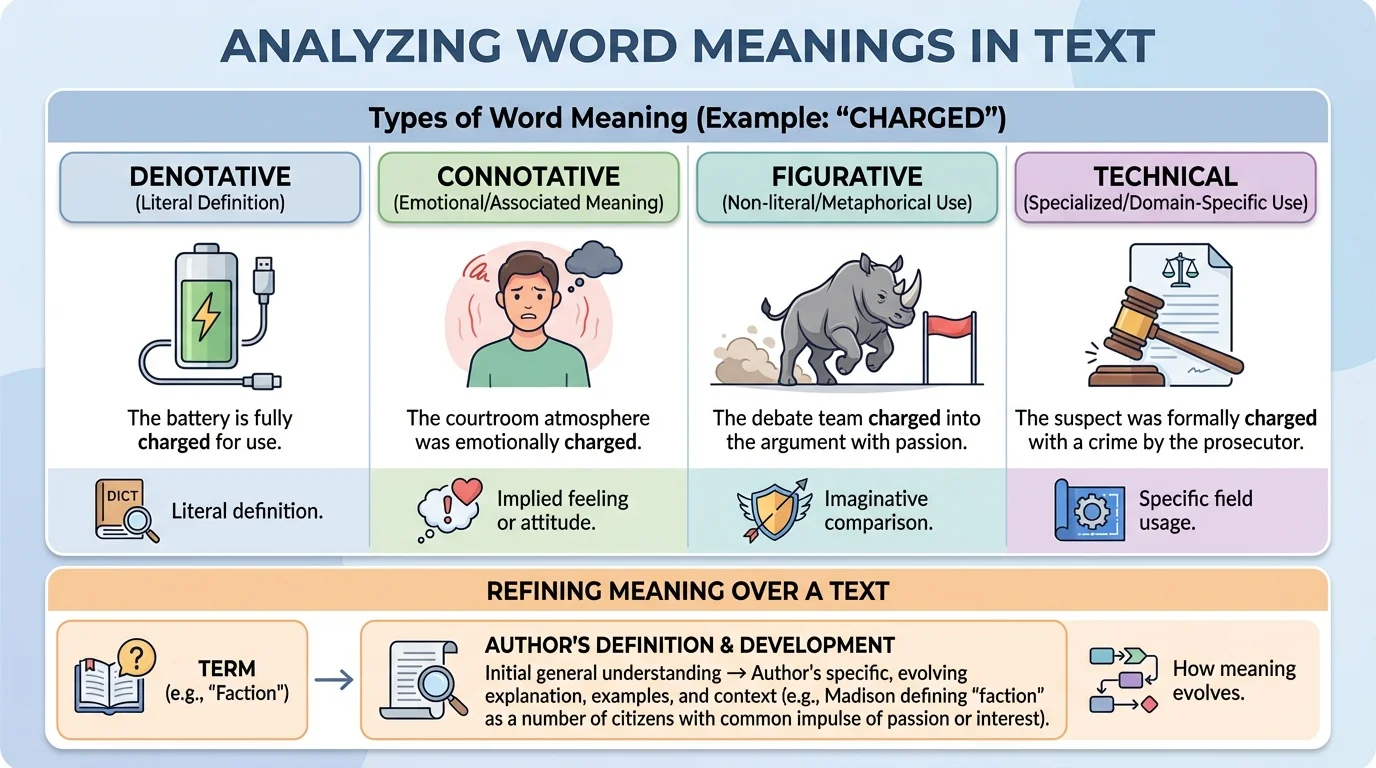
Figurative meaning appears when a phrase means more than its literal words state. Students often associate figurative language only with poetry, but nonfiction uses it constantly. A writer might say a proposal "gained traction," an economy "cooled," or public anger "boiled over." No literal boiling or cooling occurs, yet the phrasing helps readers visualize the situation.
Technical meaning is the specialized meaning a word has within a particular field. In everyday conversation, "bias" may mean unfairness. In statistics, bias has a more exact meaning related to systematic error. In government, "faction" is not just any group; in Madison's argument, it becomes a carefully defined political concept.
Denotation is a word's direct, dictionary-level meaning. Connotation is the feeling or association a word carries. Figurative language uses words in a nonliteral way to create comparison, emphasis, or imagery. Technical meaning is a precise meaning used in a discipline, profession, or field of study.
When analyzing a text, ask not only "What does this word mean?" but also "What kind of meaning is operating here?" A term can be denotative and connotative at the same time. A phrase can be figurative while still advancing a serious factual argument.
Strong readers do not guess blindly. They gather evidence from the sentence, the paragraph, and the larger structure of the text. One effective strategy is to look at how the author defines, restates, contrasts, or exemplifies the term.
For example, if an author writes, "The committee's response was measured rather than impulsive," the contrast with "impulsive" suggests that "measured" means careful, controlled, and deliberate. If a writer says, "Unlike propaganda, public education should invite questioning," the contrast helps define "propaganda" as one-sided persuasion rather than open inquiry.
Syntax also matters. The grammatical role of a word can reveal its function. A noun used as a category may signal a key concept. An adjective attached repeatedly to different nouns may reveal a pattern in tone. Repetition is especially important: when a writer returns to the same term, that repetition usually signals significance.
Another strategy is to examine nearby examples. If a text refers to "extractive industries" and then lists mining, drilling, and logging, the examples help you infer that "extractive" relates to removing natural resources from the earth. Definitions in informational texts are often built through these clusters of examples rather than through a formal glossary-style statement.
Context analysis example
Consider this sentence: "The senator adopted a pragmatic approach, choosing the policy that could actually pass rather than the one that sounded most inspiring."
Step 1: Find nearby clues.
The phrase "could actually pass" contrasts with "sounded most inspiring."
Step 2: Infer the meaning.
Pragmatic here means practical, realistic, and focused on workable results.
Step 3: Notice the tone.
The word may carry a positive connotation of effectiveness, but it can also hint that idealism was set aside.
This kind of inference is stronger than replacing the word with the first synonym that comes to mind. It is grounded in the author's own sentence.
Nonfiction writers often borrow the energy of figurative language to make abstract ideas understandable. A historian may describe a peace treaty as "fragile." A columnist may write that misinformation "spreads like wildfire." A scientist writing for general readers may say a virus "hijacks" a cell's machinery. These phrases are not merely decorative. They shape how the reader conceptualizes the issue.
Connotation often reveals attitude. Compare these descriptions of the same protest: "a large crowd gathered," "a restless crowd gathered," and "a mob gathered." The denotative situation may be similar, but the connotations shift dramatically. The final phrasing suggests danger and disorder. That is why readers must ask whether a word describes, evaluates, or both.
The comparison chart in [Figure 1] remains useful here because informational writing often mixes these layers of meaning rather than keeping them separate. A seemingly objective passage can still carry emotional force through carefully chosen diction.
Figurative language can also compress complex ideas. When a writer says democracy depends on "checks and balances," the phrase creates a structural image of forces limiting one another. When an editorial claims a rumor "poisoned" public debate, the metaphor suggests corruption, spread, and harm all at once. Readers should unpack those associations and consider why that metaphor was chosen instead of a more neutral phrase.
Many of the most famous terms in political and scientific writing began as ordinary words before acquiring specialized meanings. Language constantly moves between everyday use and disciplined, technical use.
That movement means you must stay alert. A word that seems familiar may be doing new work in a serious text.
Technical language allows experts to communicate precisely. In biology, "adaptation" refers to an inherited trait that increases survival or reproduction in a particular environment. In everyday speech, people sometimes use "adaptation" to mean any adjustment at all. Both uses relate to change, but the scientific meaning is narrower and more exact.
In economics, "capital" may refer not just to money, but to assets used to produce goods and services. In computer science, a "virus" is malicious code, not a biological organism. In civics, a "republic" is not simply any country; it names a form of government with specific features. Technical meanings matter because they prevent vague reading.
One clue that a word is being used technically is that the author defines it directly. Another clue is that the surrounding discussion becomes more precise, abstract, or field-specific. A third clue is consistency: once a term is established technically, the author tends to use it in that exact sense throughout the text.
| Word | Everyday Meaning | Technical Meaning in a Field |
|---|---|---|
| theory | a guess or personal idea | a well-supported explanatory framework in science |
| bias | prejudice or unfairness | systematic distortion in data, methods, or sampling |
| capital | money in general | productive assets in economics |
| faction | a group within a larger group | a politically defined group united by interests adverse to others or the whole community in Madison's argument |
Table 1. Comparison of everyday and technical meanings for selected academic terms.
When a text belongs to a discipline, readers should assume that familiar words may have specialized meanings. Looking for that possibility is part of advanced reading.
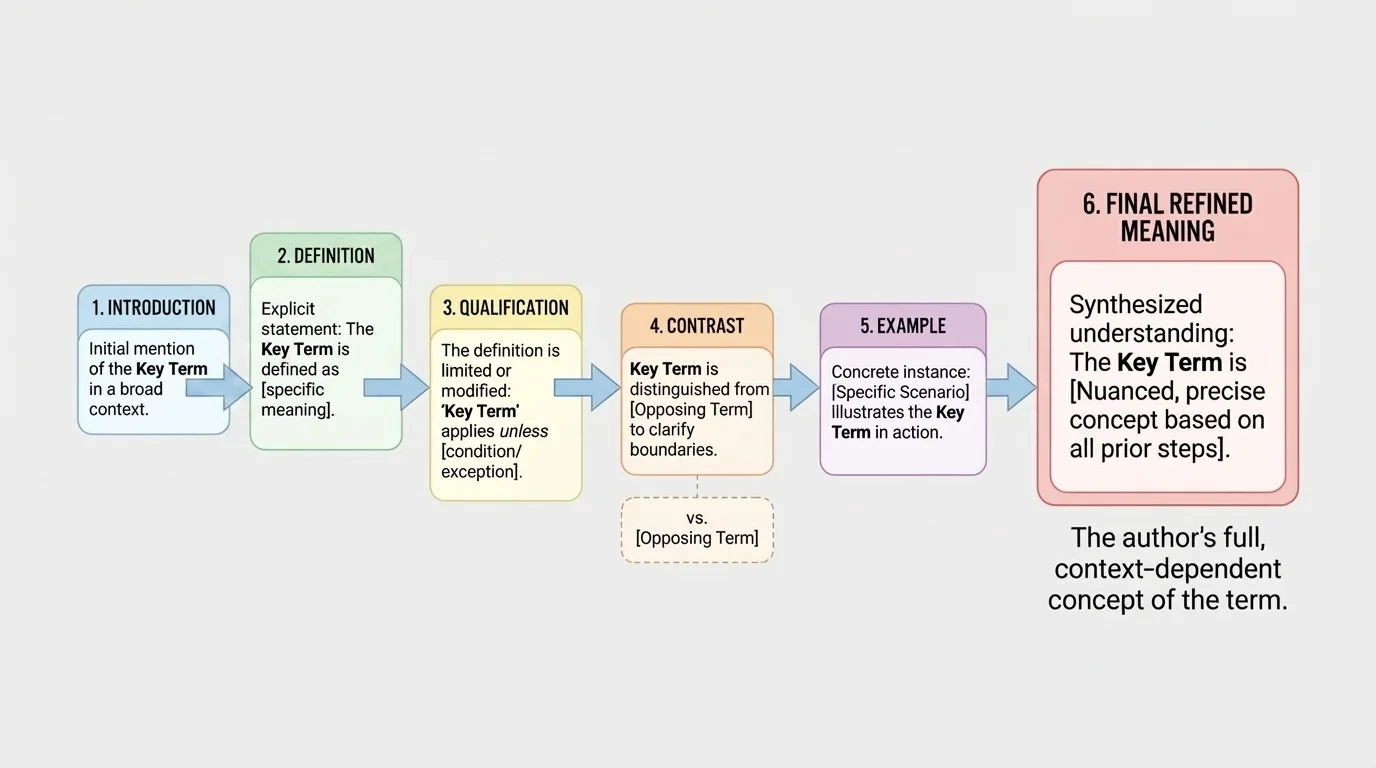
Authors do not always define a key term once and move on. Often they build it gradually, and [Figure 2] illustrates that development as a process rather than a single moment. The reader's task is to track where the term first appears, how it is clarified, what it is contrasted with, and how it finally functions in the author's conclusion.
A writer may begin with a broad meaning, then narrow it. Or the writer may begin with a common meaning and then revise it into a technical one. Sometimes the refinement happens through examples. Sometimes it happens through exclusions: the author tells you what the term does not mean so that its actual meaning becomes sharper.
Pay close attention to verbs around the term. Does the author "define," "distinguish," "limit," "expand," "defend," or "recast" it? Also notice whether the term appears in topic sentences, transitions, and conclusions. Placement often signals importance.
One useful method is to annotate every major appearance of the term and record what new detail is added each time. By the end, you can often see that the word has become more specific, more argumentative, and more central than it first seemed.
Refinement can also change the reader's judgment. If an author begins with a neutral-sounding term but gradually fills it with negative examples, the meaning becomes more charged. If the writer begins with a controversial word and then carefully narrows it, the argument may become more persuasive because the term feels more precise.
Following a term across a text means reading across the whole text, not just locally. Instead of asking what a word means in one sentence, you ask how the word's meaning grows through repetition, definition, contrast, and application. This turns vocabulary study into analysis of the author's overall design.
That skill is especially important in classic political writing, where a single key term can organize the entire essay.
James Madison's Federalist No. 10 offers a powerful example because the essay develops the key term faction in stages. [Figure 3] Madison does not treat the word as a casual label for disagreement. He turns it into a precise political concept.
Early in the essay, Madison gives a formal definition: a faction is a number of citizens, whether a majority or minority, united by a common impulse of passion or interest adverse to the rights of other citizens or to the permanent and aggregate interests of the community. This definition matters because it does several things at once. It shows that faction can involve either a minority or a majority. It ties faction to both emotion and self-interest. And it frames faction as dangerous not simply because people disagree, but because their interests can conflict with justice and the public good.
Madison then refines the term by discussing the causes of faction. He explains that differences in opinion, unequal property, and varied interests naturally produce factions. This matters because it shifts the issue from a moral complaint to a structural reality of political life. Faction is not presented as an accidental problem that good manners can erase. It is a predictable result of liberty and human diversity.
Next, Madison distinguishes between removing the causes of faction and controlling its effects. That distinction sharpens the meaning further. If liberty is essential to political life, then eliminating faction entirely would require destroying something valuable. As a result, faction becomes a problem to manage rather than a condition to eliminate.
Finally, Madison argues that a large republic can control the effects of faction better than a small democracy. At this stage, the term "faction" connects directly to constitutional design. The word now carries more than its original definition. It has become the hinge of the essay's logic: human nature produces factions, factions threaten justice, and the structure of the republic can limit their harmful power.
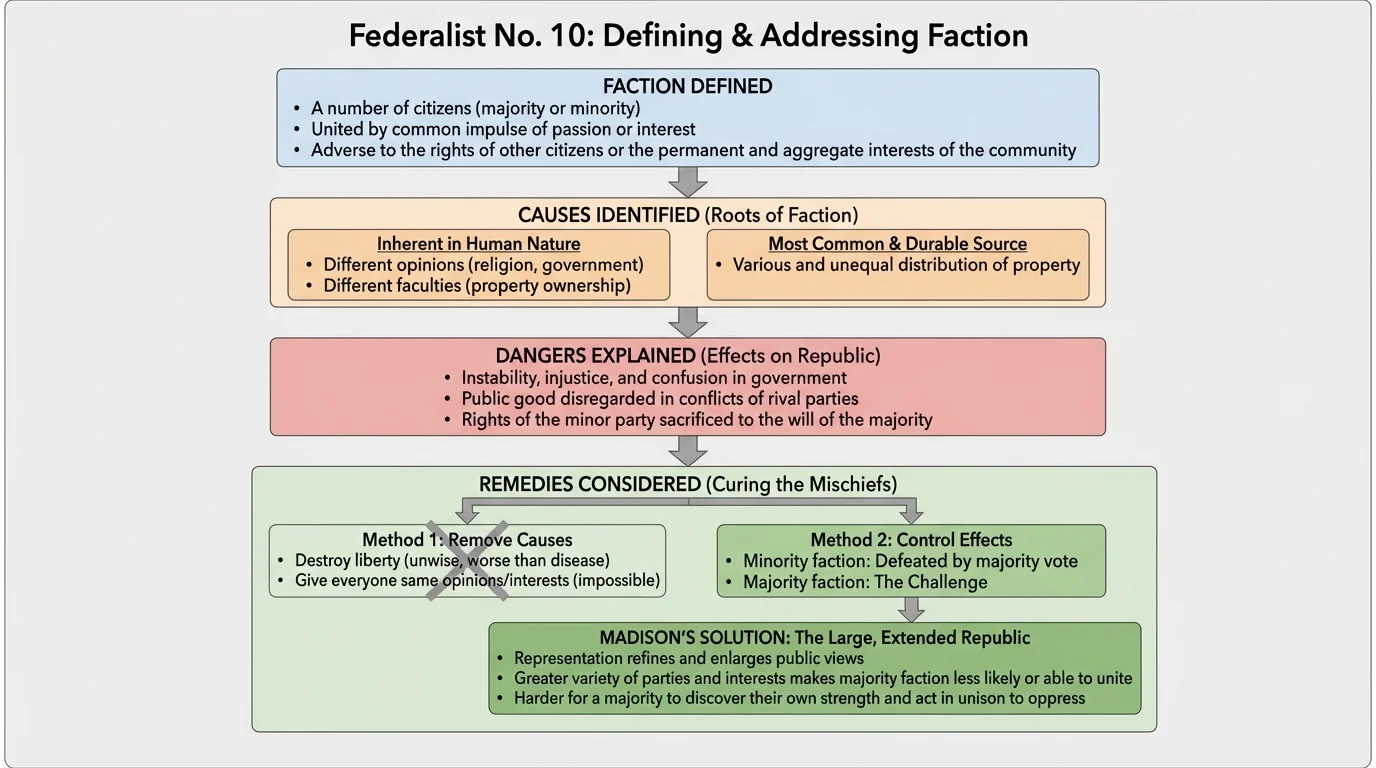
Notice how much richer the term becomes over the course of the text. Reading only the definition would not be enough. Madison's argument adds causes, consequences, and a political solution. The flowchart helps you see that the word has accumulated layers of meaning through the essay's structure.
"Liberty is to faction what air is to fire."
— James Madison, Federalist No. 10
This famous comparison is figurative, but it serves a serious analytical purpose. Madison uses the metaphor to argue that liberty feeds faction just as air feeds fire. The image makes a political principle vivid: removing liberty to eliminate faction would be as destructive as removing air to stop flame.
To analyze a key term across a full text, begin by locating the first important use. Then ask what kind of meaning is operating there: denotative, connotative, figurative, technical, or some combination. Next, mark every later appearance of the term and note what changes. Does the author add examples? Narrow the scope? Link the term to values such as justice, efficiency, safety, or freedom?
Also pay attention to related terms. Authors often build meaning through families of words rather than through repetition alone. A text discussing "authority" may also rely on "power," "legitimacy," "consent," and "coercion." These neighboring terms create a semantic network that deepens the central idea.
Tone matters too. A repeated term may stay logically consistent while its emotional force shifts. A writer may begin by presenting "risk" as a manageable calculation and end by treating it as a moral warning. The basic concept remains, but the implications intensify.
Tracing a term across a passage
Suppose an article begins by calling social media a "platform," later describes it as an "ecosystem," and finally warns that it functions as an "attention market."
Step 1: Identify each label.
"Platform" suggests a neutral space or structure.
Step 2: Compare the shift.
"Ecosystem" suggests interdependence and complexity.
Step 3: Analyze the final refinement.
"Attention market" gives the concept an economic meaning and implies competition, value, and exploitation.
This is how authors guide readers from a common understanding toward a more analytical one.
One common mistake is assuming that the everyday meaning of a word must be the meaning in the text. Another is focusing on a single sentence while ignoring how the rest of the text changes the term. A third is responding only to the emotional impact of a word without identifying how the author constructed that effect.
Stronger habits include rereading, annotating repeated terms, and quoting precisely when explaining your interpretation. Instead of writing, "The author uses a strong word," specify the word, describe its connotation or technical meaning, and explain its effect on the argument.
You should also distinguish your own associations from the author's intended use. A word may trigger a reaction in you, but interpretation requires textual evidence. The question is not merely "What does this word make me think of?" but "How does the surrounding text direct its meaning here?"
Analytical sentence frame
A strong response might say: "The author uses the term 'volatile' to suggest more than simple change; its connotation implies instability and danger, which supports the claim that the situation requires caution."
That kind of sentence connects meaning, evidence, and effect. It moves beyond paraphrase into analysis.
This skill matters far beyond historical documents. In news coverage, terms like "reform," "security," "crisis," and "freedom" often carry contested meanings. In science reporting, words such as "significant," "theory," and "model" may be misread if readers ignore their technical sense. In technology debates, terms like "algorithm," "privacy," and "artificial intelligence" often shift meaning depending on the speaker's purpose.
Public arguments frequently depend on who gets to define the central term. If two sides use the same word differently, the debate may be partly verbal and partly conceptual. Careful reading helps you detect that difference. It also makes you a more responsible writer, because you become more aware of how your own word choices guide interpretation.
Ultimately, determining meaning in complex texts is not a side skill. It is part of understanding argument itself. Words are not just containers for ideas; they are tools that shape ideas. The more carefully you track those tools, the more clearly you can interpret what a writer is really saying.
