If you walked all the way around a playground, how far would you travel? That question is about the total distance around a shape, and in math that distance has a special name: perimeter. Perimeter helps people build fences, frame pictures, and measure the edges of gardens, rooms, and sports fields.
A polygon is a closed flat shape made from straight sides. The perimeter of a shape is the total distance around the outside. The inside of a shape is different. It shows how much space is covered. As [Figure 1] shows, perimeter is around the border, but area is the space inside.
Perimeter is the distance around a plane figure.
Area is the amount of space inside a plane figure.
These two ideas are not the same. If you put ribbon around a poster, you are measuring perimeter. If you paint the whole poster, you are covering area. Perimeter is measured in units such as centimeters, inches, or feet. Area is measured in square units such as square centimeters or square inches.
When you find perimeter, you add side lengths. When you find area, you count square units or multiply side lengths for some shapes such as rectangles. Keeping those ideas separate is very important in geometry.
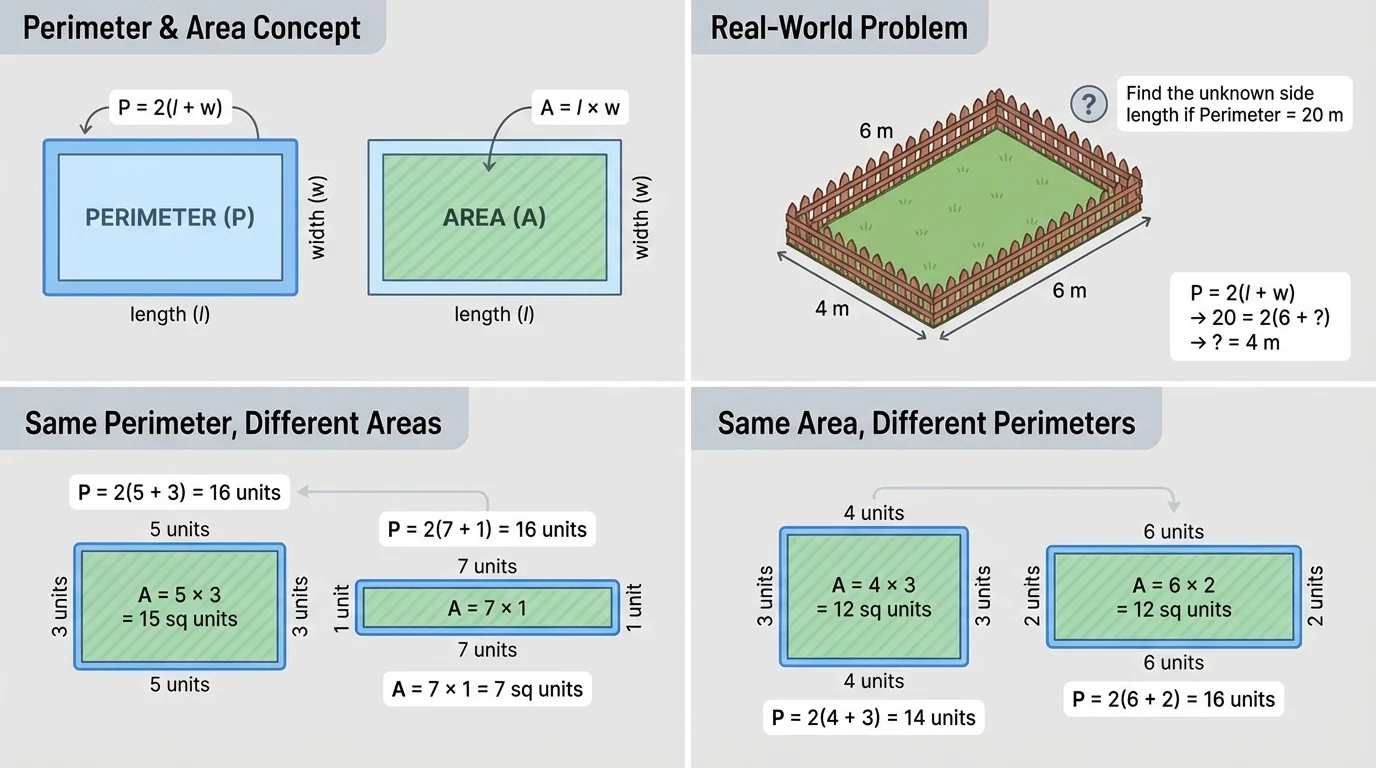
A good way to remember is this: perimeter is the path around. If an ant walks around the edge of a book, the ant travels the perimeter. If the ant crawls all over the cover, that is more like area.
You already know how to add numbers and measure lengths. Perimeter uses those skills together. Measure each side, then add the lengths.
Later, when we compare rectangles, remember the picture in [Figure 1]: the border and the inside are connected to the same shape, but they measure different things.
To find the perimeter of any polygon, add the lengths of all its sides. You can trace around the shape with your finger and add each side one at a time, as [Figure 2] illustrates. This works for triangles, quadrilaterals, pentagons, and other polygons.
If a polygon has side lengths of \(3\), \(5\), and \(4\) units, its perimeter is \(3 + 5 + 4 = 12\) units. Every side on the outside counts exactly once.
Solved example 1
Find the perimeter of a triangle with side lengths \(6\), \(7\), and \(5\) inches.
Step 1: Write the side lengths to add.
Perimeter \(= 6 + 7 + 5\)
Step 2: Add the numbers.
\[6 + 7 + 5 = 18\]
The perimeter is \(18\) inches.
Some polygons do not look regular or symmetrical. That is fine. You still add every outer side. The shape does not need matching side lengths for you to find the perimeter.
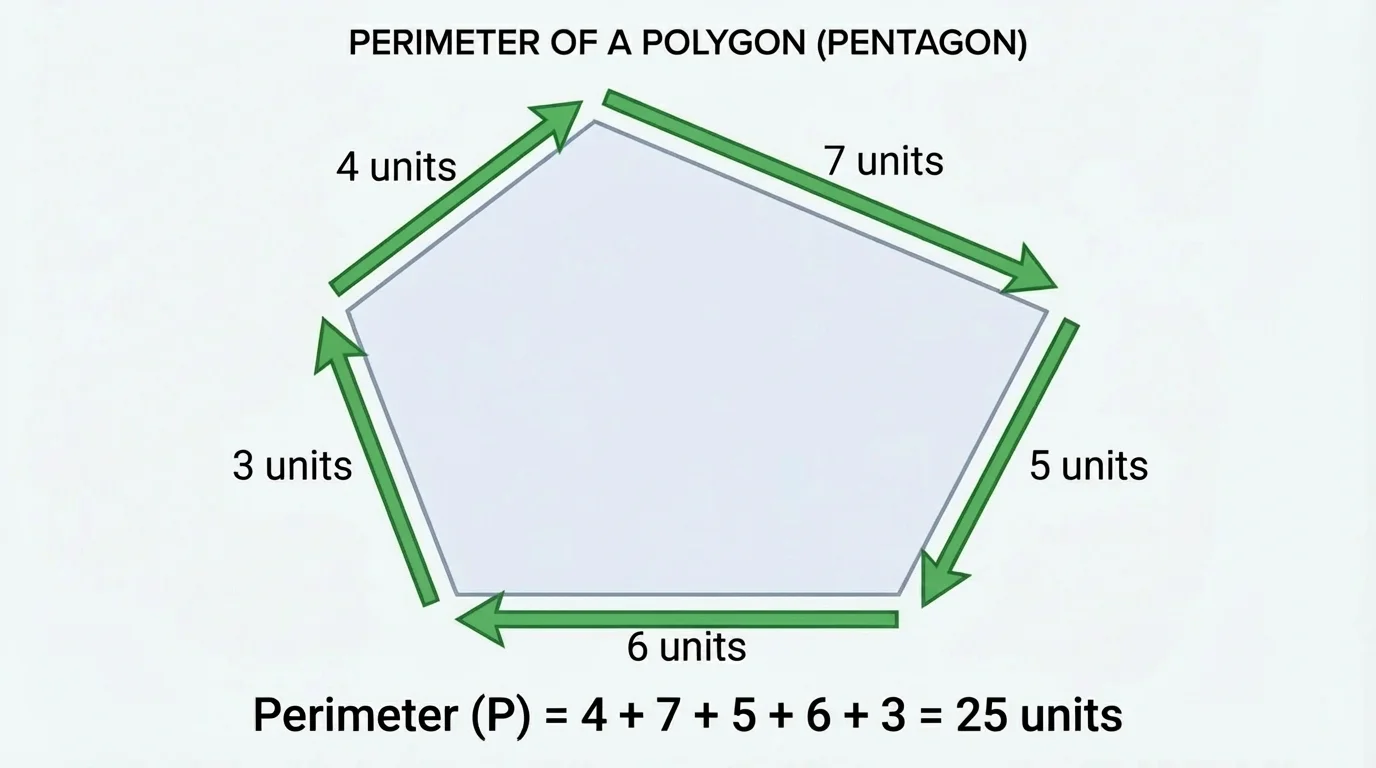
For example, a five-sided shape with side lengths \(2\), \(4\), \(3\), \(5\), and \(6\) centimeters has perimeter \(2 + 4 + 3 + 5 + 6 = 20\) centimeters. The order of addition does not change the total.
Solved example 2
Find the perimeter of a four-sided shape with sides \(8\) feet, \(3\) feet, \(8\) feet, and \(3\) feet.
Step 1: Add all four sides.
Perimeter \(= 8 + 3 + 8 + 3\)
Step 2: Group equal numbers to make adding easier.
\(8 + 8 = 16\) and \(3 + 3 = 6\)
Step 3: Add the totals.
\(16 + 6 = 22\)
The perimeter is \(22\) feet.
When you look back at [Figure 2], notice that the arrows move only along the outside edges. That helps you avoid counting a side twice or forgetting one.
A rectangle has two long sides and two short sides. Opposite sides are equal. A square has four equal sides. These shapes make perimeter a little quicker to find because some side lengths repeat.
For a rectangle with length \(7\) units and width \(4\) units, the perimeter is \(7 + 4 + 7 + 4 = 22\) units. You may also think of it as two lengths and two widths: \(2 \times 7 + 2 \times 4 = 14 + 8 = 22\).
For a square with side length \(5\) centimeters, the perimeter is \(5 + 5 + 5 + 5 = 20\) centimeters. Since all four sides are the same, you can also use \(4 \times 5 = 20\).
A fast way for rectangles and squares
Rectangles have two pairs of equal sides, so you can add one length twice and one width twice. Squares have four equal sides, so you can multiply one side length by \(4\).
These shortcuts work because they mean the same thing as adding every side. They do not change the answer; they just make the work faster.
Sometimes you know the total perimeter but one side length is missing. Then you can use subtraction. First, add the side lengths you do know. Next, subtract that sum from the total perimeter. The amount left is the unknown side length.
This is like knowing the total distance around a shape and figuring out the missing part of the path.
Solved example 3
A rectangle has perimeter \(24\) inches. Two side lengths are \(7\) inches and \(5\) inches. What are the lengths of the other two sides?
Step 1: Use what you know about rectangles.
In a rectangle, opposite sides are equal, so the four sides are \(7\), \(5\), \(7\), and \(5\).
Step 2: Check by adding the sides.
\(7 + 5 + 7 + 5 = 24\)
Step 3: State the missing side lengths.
The missing sides are \(7\) inches and \(5\) inches.
The rectangle's side lengths match the perimeter of \(24\) inches.
Now look at a shape that is not a rectangle. Suppose a polygon has perimeter \(30\) units. Three sides are \(8\), \(6\), and \(9\) units. The missing side length is \(30 - (8 + 6 + 9)\). First add: \(8 + 6 + 9 = 23\). Then subtract: \(30 - 23 = 7\). The missing side is \(7\) units.
Solved example 4
A four-sided shape has perimeter \(19\) centimeters. Its side lengths are \(4\) centimeters, \(3\) centimeters, \(5\) centimeters, and \(x\) centimeters. Find \(x\).
Step 1: Write an equation for the perimeter.
\(4 + 3 + 5 + x = 19\)
Step 2: Add the known side lengths.
\(12 + x = 19\)
Step 3: Subtract to find the missing side.
\[x = 19 - 12 = 7\]
The unknown side length is \(7\) centimeters.
Whenever you solve for a missing side, check your answer by adding all the sides back together. If the total matches the perimeter, your answer makes sense.
Here is a surprising idea: two rectangles can have the same perimeter but different amounts of space inside. As [Figure 3] shows, the border can be the same length while the inside changes.
Look at these two rectangles: one is \(6\) by \(2\), and the other is \(4\) by \(4\). For the first rectangle, the perimeter is \(6 + 2 + 6 + 2 = 16\) units. For the second rectangle, the perimeter is \(4 + 4 + 4 + 4 = 16\) units. The perimeters match.
But their areas are different. The \(6\) by \(2\) rectangle has area \(6 \times 2 = 12\) square units. The \(4\) by \(4\) rectangle has area \(4 \times 4 = 16\) square units. Same perimeter, different areas.
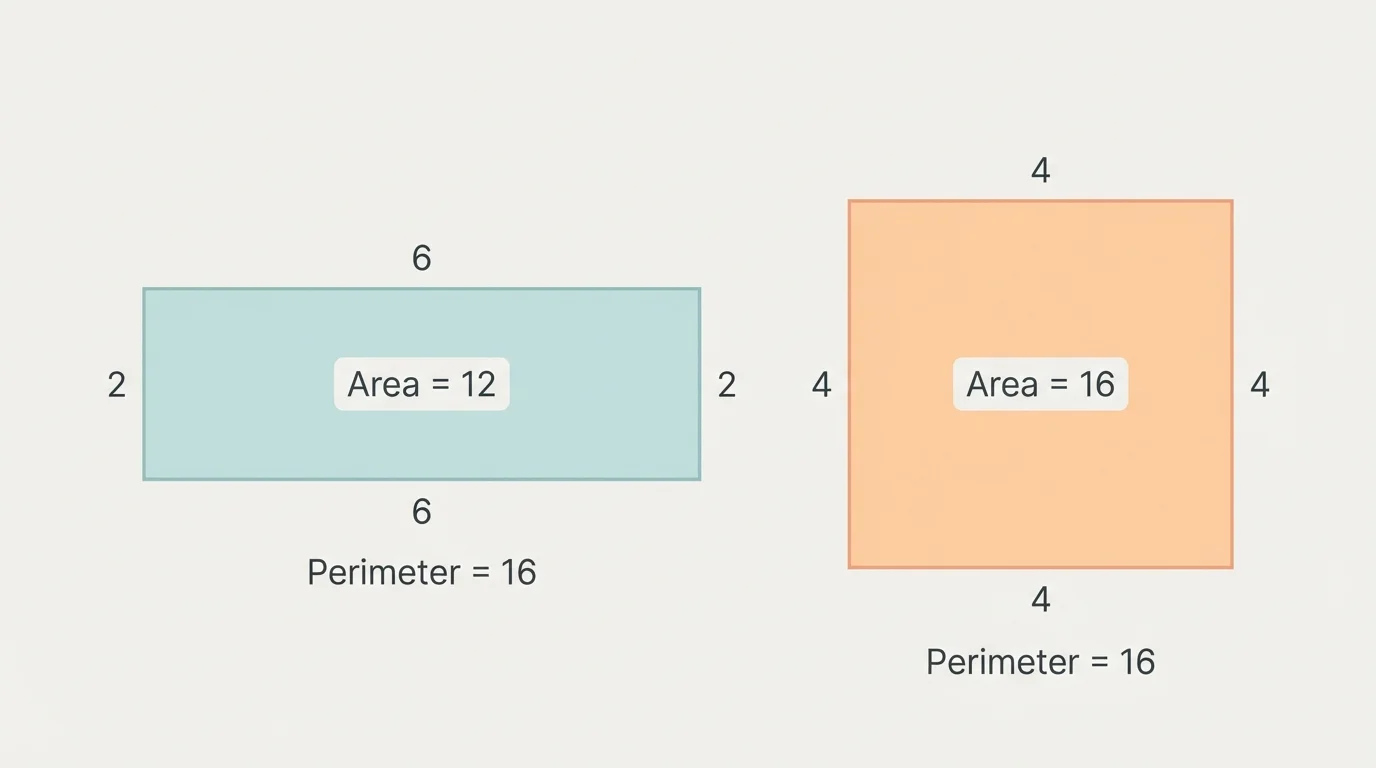
This matters in real life. Two gardens may need the same amount of fencing because their perimeters are equal, but one garden may have more space for plants because its area is larger.
Solved example 5
Show two rectangles with perimeter \(20\) units and compare their areas.
Step 1: Choose one rectangle.
Use \(7\) by \(3\). Its perimeter is \(7 + 3 + 7 + 3 = 20\).
Step 2: Choose another rectangle.
Use \(5\) by \(5\). Its perimeter is \(5 + 5 + 5 + 5 = 20\).
Step 3: Compare the areas.
First area: \(7 \times 3 = 21\) square units. Second area: \(5 \times 5 = 25\) square units.
Both rectangles have perimeter \(20\) units, but their areas are \(21\) and \(25\) square units.
The comparison helps explain why equal border length does not force shapes to cover the same inside space.
The opposite can also happen. Two rectangles can have the same area but different perimeters. As [Figure 4] illustrates, the same number of square units can be arranged in different ways.
Compare a \(3\) by \(4\) rectangle and a \(1\) by \(12\) rectangle. Their areas are both \(12\) square units because \(3 \times 4 = 12\) and \(1 \times 12 = 12\).
Now compare the perimeters. The \(3\) by \(4\) rectangle has perimeter \(3 + 4 + 3 + 4 = 14\) units. The \(1\) by \(12\) rectangle has perimeter \(1 + 12 + 1 + 12 = 26\) units. Same area, different perimeters.
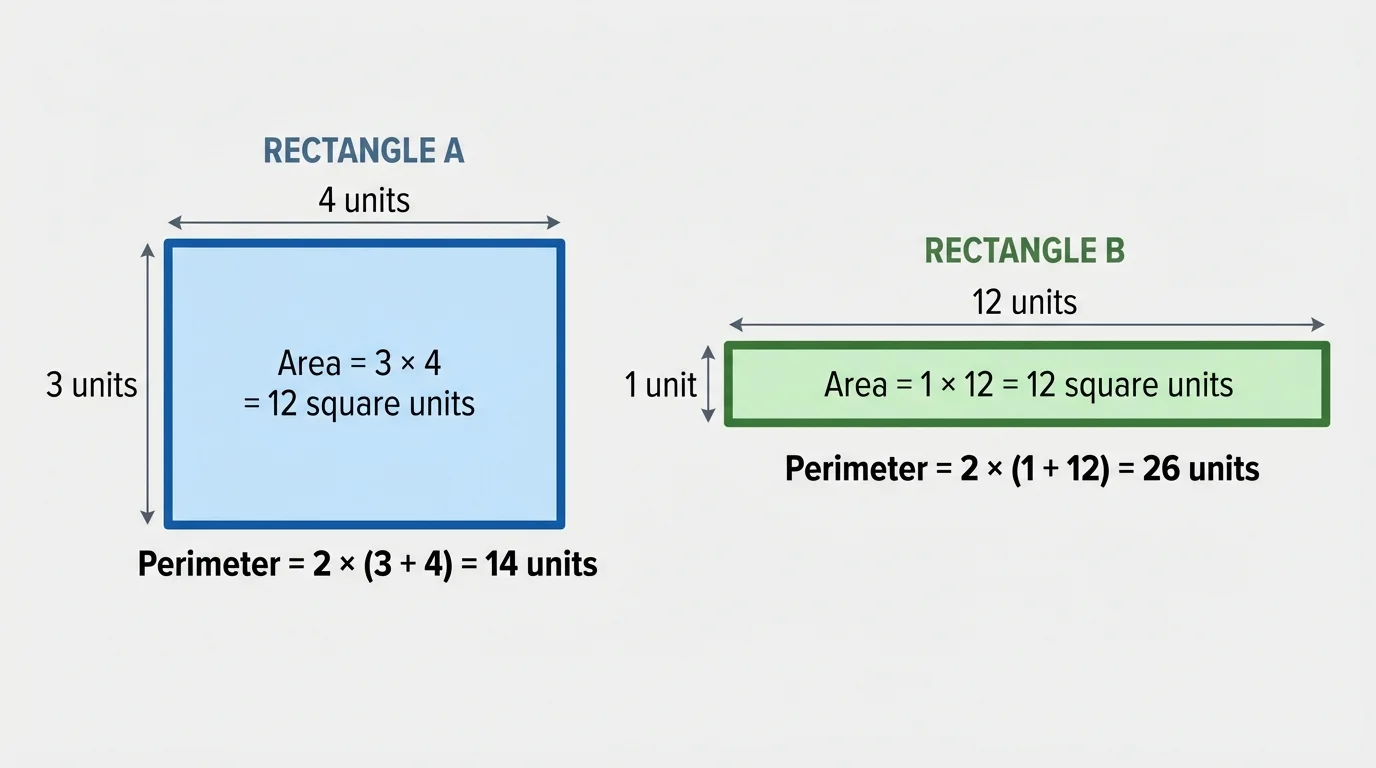
This is a useful idea for building and design. Two rooms might have the same floor space, but one room shape may need more baseboard around the walls because the perimeter is larger.
Looking back, you can see that a long skinny rectangle and a more balanced rectangle can hold the same area even though the distance around them is very different.
Perimeter is used in many everyday jobs and activities. A farmer measures perimeter to know how much fencing a field needs. A builder measures perimeter to know how much trim goes around a window. A runner can think about perimeter when jogging around the edge of a rectangular court.
A picture frame and the photo inside it use two different measurements. The frame length around the edge is about perimeter, while the photo surface is about area.
Suppose a small garden is a rectangle with length \(9\) feet and width \(4\) feet. The amount of fence needed is the perimeter: \(9 + 4 + 9 + 4 = 26\) feet. If someone bought only \(20\) feet of fencing, it would not be enough.
Suppose a bulletin board is \(8\) inches by \(6\) inches. Ribbon around the edge uses perimeter: \(8 + 6 + 8 + 6 = 28\) inches. Paper to cover the whole board would be about area, not perimeter.
One common mistake is mixing up perimeter and area. If the question asks for distance around, use perimeter. If it asks for space inside, use area.
Another mistake is forgetting a side. Count carefully around the shape. Touch each side once as you add. For rectangles, remember there are two lengths and two widths.
You can also estimate to check. If a rectangle is about \(10\) units by \(3\) units, the perimeter should be a little more than \(10 + 10 + 3 + 3 = 26\) units. An answer like \(13\) units would be too small.
| Question asks about | What to do | Example |
|---|---|---|
| Distance around a shape | Add side lengths | Fence around a yard |
| Missing side length | Subtract known sides from total perimeter | Find one unknown edge |
| Inside space | Find area, not perimeter | Grass covering a lawn |
Table 1. A comparison of when to use perimeter and how to solve common questions.
Perimeter connects arithmetic and geometry in a very practical way. It helps you solve math problems and answer real questions about borders, edges, and outside distances.
