A shape drawn on a coordinate plane may look like pure geometry, but it can be handled with algebra just as powerfully as any equation. A surveyor marking property lines, a game designer building a map, and an engineer checking a floor plan all rely on the same idea: if you know the coordinates, you can compute lengths, perimeters, and areas exactly. Coordinates turn pictures into numbers, and numbers let you prove things.
When a figure is placed on the coordinate plane, each vertex has an ordered pair such as \( (2, 5) \). From these coordinates, you can measure how far points are apart and use those distances to find the size of a figure. This is one of the most useful bridges between algebra and geometry.
If two points lie directly above one another, their horizontal distance is \(0\), so the segment length is just the difference in the \(y\)-coordinates. If two points lie side by side, their vertical distance is \(0\), so the segment length is the difference in the \(x\)-coordinates. When a segment is slanted, you usually need the distance formula.
Perimeter is the total distance around a polygon.
Area is the amount of space inside a figure.
Distance formula gives the length between \( (x_1, y_1) \) and \( (x_2, y_2) \):
\[d = \sqrt{(x_2 - x_1)^2 + (y_2 - y_1)^2}\]
Area of a rectangle is
\(A = lw\)
Area of a triangle is
\[A = \frac{1}{2}bh\]
[Figure 1] The power of coordinate geometry is that these formulas are not separate topics. They work together. First find side lengths from coordinates, then use those lengths in perimeter or area formulas.
A slanted segment can be understood as the hypotenuse of a right triangle. The horizontal change is often called the run, and the vertical change is the rise. These are found by subtracting coordinates.
Suppose the endpoints are \(A(x_1, y_1)\) and \(B(x_2, y_2)\). Then the horizontal change is \(|x_2 - x_1|\), and the vertical change is \(|y_2 - y_1|\). By the Pythagorean Theorem, the segment length is \(\sqrt{(x_2 - x_1)^2 + (y_2 - y_1)^2}\).
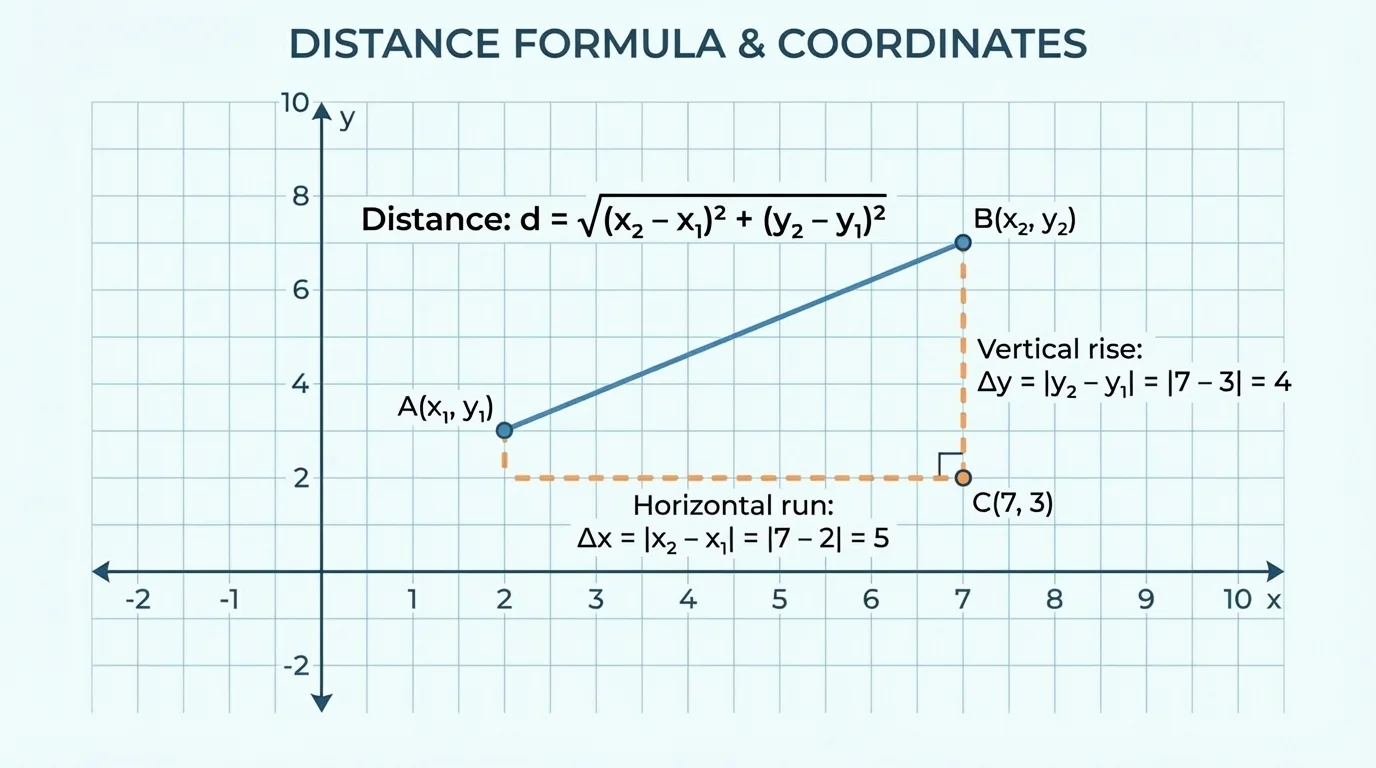
Notice an important detail: the formula squares the differences, so negative changes do not cause a problem. For example, if \(x_2 - x_1 = -4\), then \((-4)^2 = 16\). Length is always nonnegative.
Horizontal and vertical segments are simpler special cases. If a segment goes from \( (1, 3) \) to \( (7, 3) \), the length is \(|7 - 1| = 6\). If a segment goes from \( (4, -2) \) to \( (4, 5) \), the length is \(|5 - (-2)| = 7\).
From earlier geometry, a polygon's perimeter is found by adding all side lengths, and area formulas depend on the correct dimensions. Coordinates do not change those ideas; they only give a new way to find the needed lengths.
[Figure 2] That means coordinate geometry is often a two-step process: first compute missing lengths, then apply a familiar geometric formula.
To find the perimeter of a polygon on the coordinate plane, identify the vertices in order, find each side length, and add them. In many figures, some sides are horizontal or vertical and can be found by subtraction, while others are diagonal and require the distance formula.
For a polygon with vertices \(A, B, C, D, \dots\), the perimeter is
\[P = AB + BC + CD + \dots\]
Be careful to use the vertices in order around the shape. If you jump across the interior, you will accidentally compute a diagonal instead of a side.
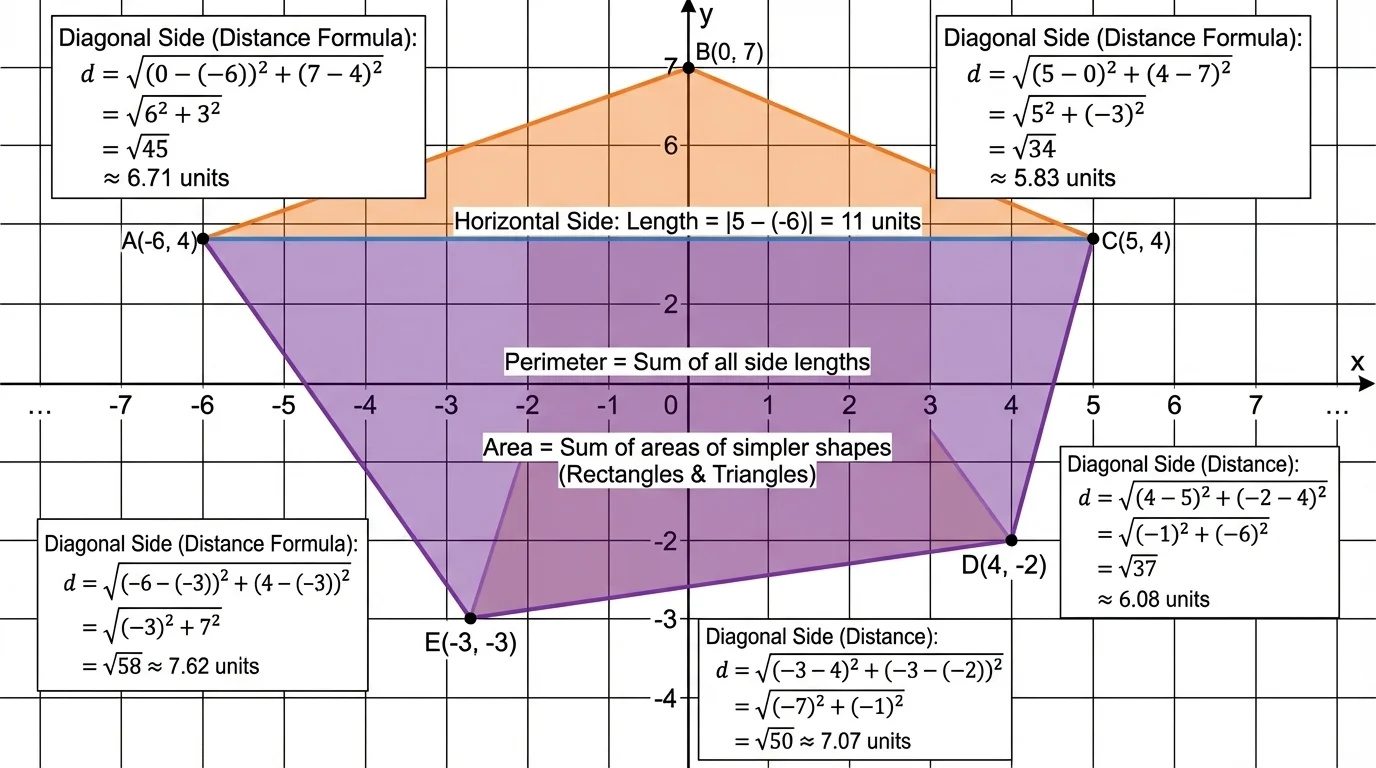
Sometimes the side lengths simplify nicely. For instance, a diagonal may come out to \(\sqrt{25} = 5\). Other times, the exact answer is an irrational number such as \(\sqrt{13}\). Exact values are often preferred unless the problem asks for a decimal approximation.
Later, when proving facts about polygons, the same length calculations help show that opposite sides are equal, that two segments are congruent, or that a figure has the dimensions required by a theorem. The mixed strategy seen earlier in [Figure 2] is especially common in coordinate proofs.
A rectangle may be especially easy to analyze if its sides are parallel to the axes. Then its length and width are simply the differences in coordinates. For example, if opposite corners are \( (1, 2) \) and \( (6, 7) \), then the horizontal side length is \(|6 - 1| = 5\), the vertical side length is \(|7 - 2| = 5\), and the area is \(5 \cdot 5 = 25\).
When a rectangle is not axis-aligned, you can still find its area if you know the lengths of two perpendicular sides. Coordinates allow you to calculate those side lengths, and then you use \(A = lw\) as usual.
Axis-aligned versus tilted figures
If a rectangle's sides are parallel to the \(x\)- and \(y\)-axes, coordinate differences give the dimensions directly. If the rectangle is tilted, subtraction alone may not give side lengths, but the distance formula still works. The geometry does not change; only the method for measuring the sides changes.
[Figure 3] This idea matters because the formula for area is always based on perpendicular dimensions. Coordinates help you verify both the lengths and the right-angle structure.
For a triangle on the coordinate plane, the area formula is still \(A = \dfrac{1}{2}bh\). The challenge is choosing a convenient base and the matching height. The height must be perpendicular to the base; it is not just any side of the triangle.
If one side is horizontal, the base is easy to measure by subtracting \(x\)-coordinates, and the height is the vertical distance from the opposite vertex to that line. If one side is vertical, the situation is similar. Those are often the most efficient coordinate-triangle problems.
When the triangle is positioned less conveniently, you may need to use the distance formula for the base and then determine the perpendicular height carefully. In many high school problems, at least one side is chosen to make the base-height computation manageable.
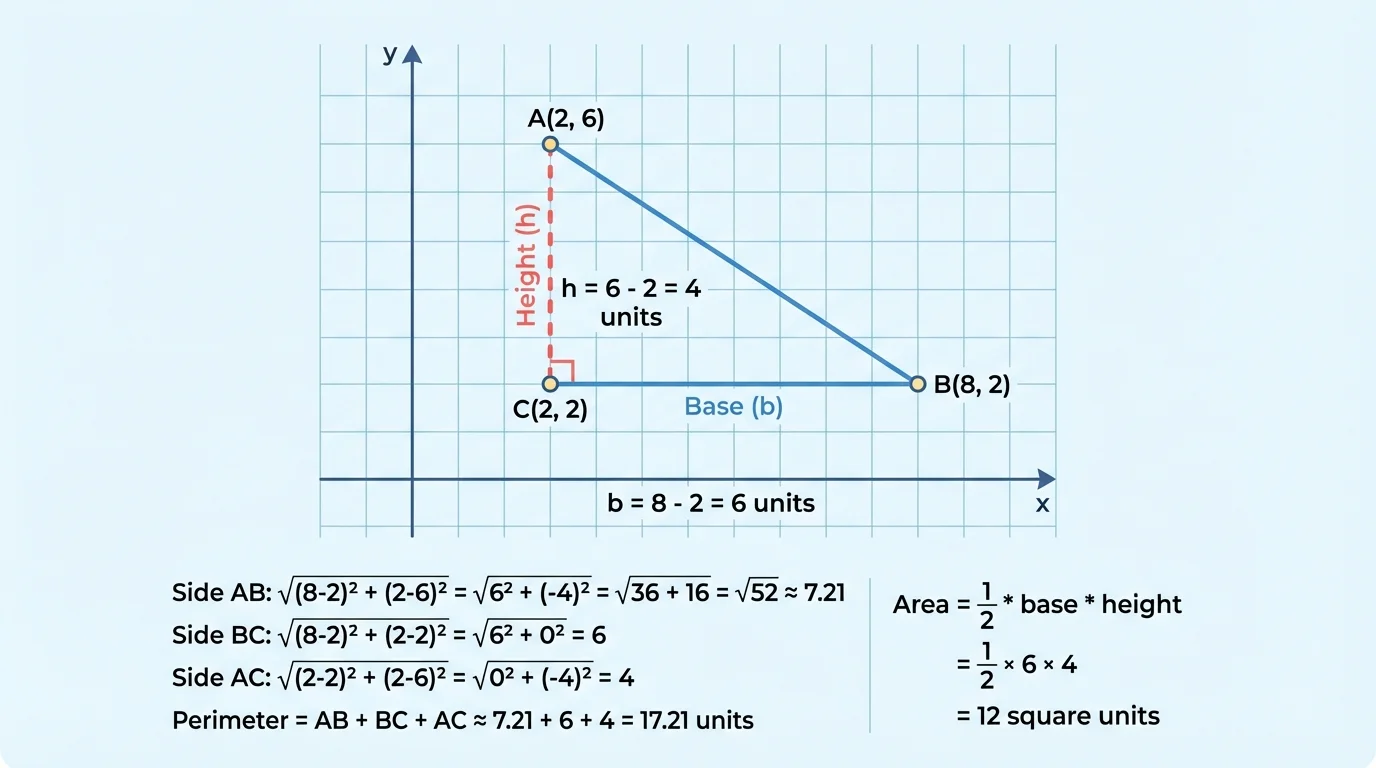
A useful shortcut appears when a triangle sits inside a rectangle. You can sometimes find the triangle's area by first finding the area of the rectangle and then subtracting extra triangular pieces. But even then, the central idea remains the same: coordinates provide exact lengths and distances.
Many errors happen because students use a slanted side as the height even when it is not perpendicular to the chosen base.
The best way to see these ideas in action is to work through complete coordinate calculations.
Worked example 1: Perimeter of a triangle
Find the perimeter of the triangle with vertices \(A(1, 1)\), \(B(5, 1)\), and \(C(5, 4)\).
Step 1: Find each side length.
\(AB\) is horizontal, so \(AB = |5 - 1| = 4\).
\(BC\) is vertical, so \(BC = |4 - 1| = 3\).
For \(AC\), use the distance formula:
\(AC = \sqrt{(5 - 1)^2 + (4 - 1)^2} = \sqrt{4^2 + 3^2} = \sqrt{16 + 9} = 5\).
Step 2: Add the side lengths.
\(P = 4 + 3 + 5 = 12\).
\(P = 12\)
This example forms a \(3\)-\(4\)-\(5\) right triangle, so the diagonal length simplifies to a whole number.
Worked example 2: Area of an axis-aligned rectangle
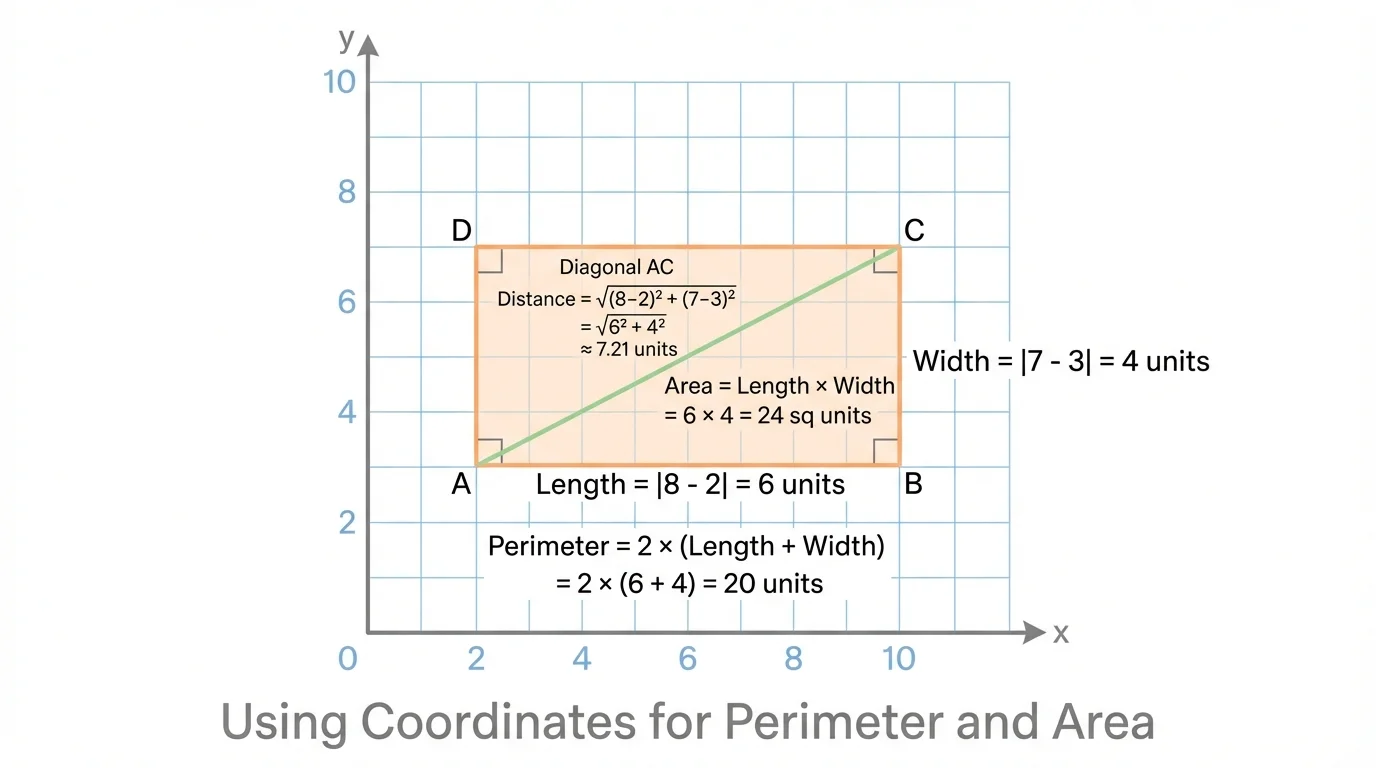
A rectangle has vertices \( (2, 3)\), \( (8, 3)\), \( (8, 7)\), and \( (2, 7)\). Find its area and perimeter.
Step 1: Find the side lengths.
The horizontal length is \(|8 - 2| = 6\).
The vertical width is \(|7 - 3| = 4\).
Step 2: Find the area.
\(A = lw = 6 \cdot 4 = 24\).
Step 3: Find the perimeter.
\(P = 2l + 2w = 2(6) + 2(4) = 12 + 8 = 20\).
\[A = 24 \qquad P = 20\]
Because the rectangle is axis-aligned, no distance formula is needed. Simple subtraction gives the dimensions immediately.
Worked example 3: Area of a triangle using base and height
Find the area of the triangle with vertices \(A(1, 2)\), \(B(7, 2)\), and \(C(4, 6)\).
Step 1: Choose a convenient base.
\(AB\) is horizontal, so it is a good base.
\(AB = |7 - 1| = 6\).
Step 2: Find the perpendicular height.
Point \(C\) has \(y\)-coordinate \(6\), and the base lies on \(y = 2\), so the height is \(|6 - 2| = 4\).
Step 3: Use the triangle area formula.
\(A = \dfrac{1}{2}bh = \dfrac{1}{2}(6)(4) = 12\).
\(A = 12\)
This is a classic coordinate-plane triangle because the horizontal base makes the height easy to read directly.
Worked example 4: Perimeter of a quadrilateral with diagonal sides
Find the perimeter of quadrilateral \(ABCD\) with vertices \(A(0, 0)\), \(B(4, 0)\), \(C(6, 3)\), and \(D(1, 3)\).
Step 1: Find each side.
\(AB = |4 - 0| = 4\).
\(BC = \sqrt{(6 - 4)^2 + (3 - 0)^2} = \sqrt{2^2 + 3^2} = \sqrt{13}\).
\(CD = |6 - 1| = 5\).
\(DA = \sqrt{(1 - 0)^2 + (3 - 0)^2} = \sqrt{1^2 + 3^2} = \sqrt{10}\).
Step 2: Add the side lengths.
\(P = 4 + \sqrt{13} + 5 + \sqrt{10} = 9 + \sqrt{13} + \sqrt{10}\).
\[P = 9 + \sqrt{13} + \sqrt{10}\]
[Figure 4] Not every answer becomes an integer. Exact radical form is often the most precise final answer.
Coordinates do more than measure. They also allow algebraic proofs. A rectangle placed on the coordinate plane can be analyzed by calculating side lengths, slopes, and diagonal properties.
Suppose rectangle \(ABCD\) has vertices \(A(0, 0)\), \(B(a, 0)\), \(C(a, b)\), and \(D(0, b)\), where \(a > 0\) and \(b > 0\). Then
\(AB = a\), \(BC = b\), \(CD = a\), and \(DA = b\). So opposite sides are equal. The diagonal \(AC\) has length \(\sqrt{a^2 + b^2}\), and diagonal \(BD\) also has length \(\sqrt{a^2 + b^2}\). Therefore, the diagonals are congruent.
You can go farther. The diagonal \(AC\) splits the rectangle into triangles \(ABC\) and \(ADC\). Each triangle has area \(\dfrac{1}{2}ab\), so the diagonal divides the rectangle into two triangles of equal area.
This is exactly the kind of algebraic reasoning that makes coordinate geometry powerful. A picture suggests a fact, and calculations confirm it. This structure is a model for many other proofs involving parallelograms, triangles, and midpoints.
Modern computer graphics depends heavily on coordinate geometry. Every triangle used in a \(3\)D model eventually gets translated into coordinate data so a computer can measure, shade, and render surfaces accurately.
That is one reason these methods matter beyond school: the same coordinate ideas help computers interpret shape and space.
One common error is subtracting coordinates incorrectly. If the points are \( (2, -3) \) and \( (7, 1) \), then the vertical change is \(1 - (-3) = 4\), not \(1 - 3\).
Another mistake is forgetting the square root in the distance formula. If \(\Delta x = 6\) and \(\Delta y = 8\), then the distance is \(\sqrt{6^2 + 8^2} = \sqrt{100} = 10\), not \(100\).
Students also sometimes confuse perimeter and area. Perimeter is a sum of lengths. Area measures the region inside. For a rectangle of side lengths \(6\) and \(4\), the perimeter is \(20\), but the area is \(24\). Same numbers, different meanings.
In triangles, the biggest trap is choosing a side length as the height when it is not perpendicular to the base. Always check that the height forms a right angle with the base. The perpendicular construction from earlier in [Figure 3] helps make this idea precise.
In surveying, land boundaries are often recorded using coordinate-based location systems. Once corner points are known, boundary lengths can be computed to find perimeter, and plots can be divided into rectangles and triangles to estimate area.
In architecture and construction, floor plans are often drafted on grids. An axis-aligned room is essentially a rectangle on a coordinate plane, and the methods used for side lengths and area can determine flooring needs, wall lengths, or fencing measurements.
In sports, the dimensions of courts and fields are carefully standardized. If key points are marked by coordinates, distances between them verify whether the layout meets regulation size. Small errors in coordinates can change the perimeter or area enough to matter.
In digital mapping and robotics, movement paths are tracked using points and line segments. A robot navigating from one coordinate to another must compute segment lengths, just as you do in geometry. The blend of geometry and algebra is not just elegant; it is practical.
| Figure type | What coordinates help you find | Typical method |
|---|---|---|
| Polygon | Perimeter | Add all side lengths, using subtraction or the distance formula |
| Axis-aligned rectangle | Area and perimeter | Subtract coordinates to get length and width |
| Triangle with horizontal or vertical base | Area | Use \(A = \dfrac{1}{2}bh\) with coordinate differences |
| Tilted rectangle or slanted side | Side length | Use the distance formula |
| Coordinate proof | Geometric properties | Compare lengths, slopes, or areas algebraically |
Table 1. Common uses of coordinates for perimeter, area, and simple geometric proofs.
Once you become comfortable moving between coordinates, lengths, and geometric formulas, many plane-geometry problems become more systematic. A graph may still look visual, but underneath it is a network of exact numerical relationships.
