Some of the most recognizable designs in the world work because of symmetry: road signs, sports-field markings, floor tiles, building facades, and even company logos. A shape can look unchanged after being flipped or turned, and that "unchanged" appearance is not just visual style. In geometry, it means a transformation maps the figure exactly onto itself.
When we talk about a transformation carrying a figure onto itself, we mean that every point of the shape moves to a point already on the same shape, and the whole figure matches perfectly after the motion. The most important motions here are reflections and rotations. These are rigid motions, so they preserve lengths, angle measures, and overall size.
Symmetry is more than decoration. Engineers use it for balance, architects use it for strength and aesthetics, and computer graphics systems use it to generate repeated patterns efficiently. In mathematics, symmetry helps classify shapes and predict what transformations are possible.
If a shape has symmetry, then certain reflections or rotations leave it looking exactly the same. If it does not, then those same transformations move vertices and sides to places where they no longer match. Understanding this is part of understanding congruence through transformations: the shape remains congruent to itself, but only some motions line everything up perfectly.
Reflection symmetry means a figure can be reflected across a line so that it matches itself exactly. That line is called a line of symmetry.
Rotational symmetry means a figure can be rotated about a point by an angle less than \(360^\circ\) and still match itself exactly. The point is the center of rotation.
To carry a figure onto itself means the image of the figure after the transformation coincides exactly with the original figure.
For polygons, the matching must be exact: vertices land on vertices, sides land on sides, and the order of points is preserved in a way consistent with the transformation. A shape may have reflection symmetry, rotational symmetry, both, or neither.
A reflection flips a figure across a line. Points on the line stay fixed, and points on one side move to the opposite side at equal distance from the line. If the line cuts the figure into two mirror-image halves, the reflection carries the figure onto itself.
A rotation turns a figure around a fixed point. A full turn is \(360^\circ\), but to count as rotational symmetry we usually focus on angles greater than \(0^\circ\) and less than \(360^\circ\). If turning the shape by some angle such as \(180^\circ\) or \(120^\circ\) makes it line up exactly, then the figure has rotational symmetry.
For many quadrilaterals, the center of rotation, if it exists, is where the diagonals intersect. For regular polygons, the center is the center of the polygon itself. The key question is always the same: after the flip or turn, does every part of the figure land exactly where some original part already was?
Recall that a regular polygon has all sides congruent and all angles congruent. Also recall that a rectangle has four right angles, a parallelogram has both pairs of opposite sides parallel, and a trapezoid has exactly one pair of parallel sides.
These definitions matter because symmetry depends strongly on the exact properties of the shape. A small change in side lengths or angle measures can remove a symmetry entirely.
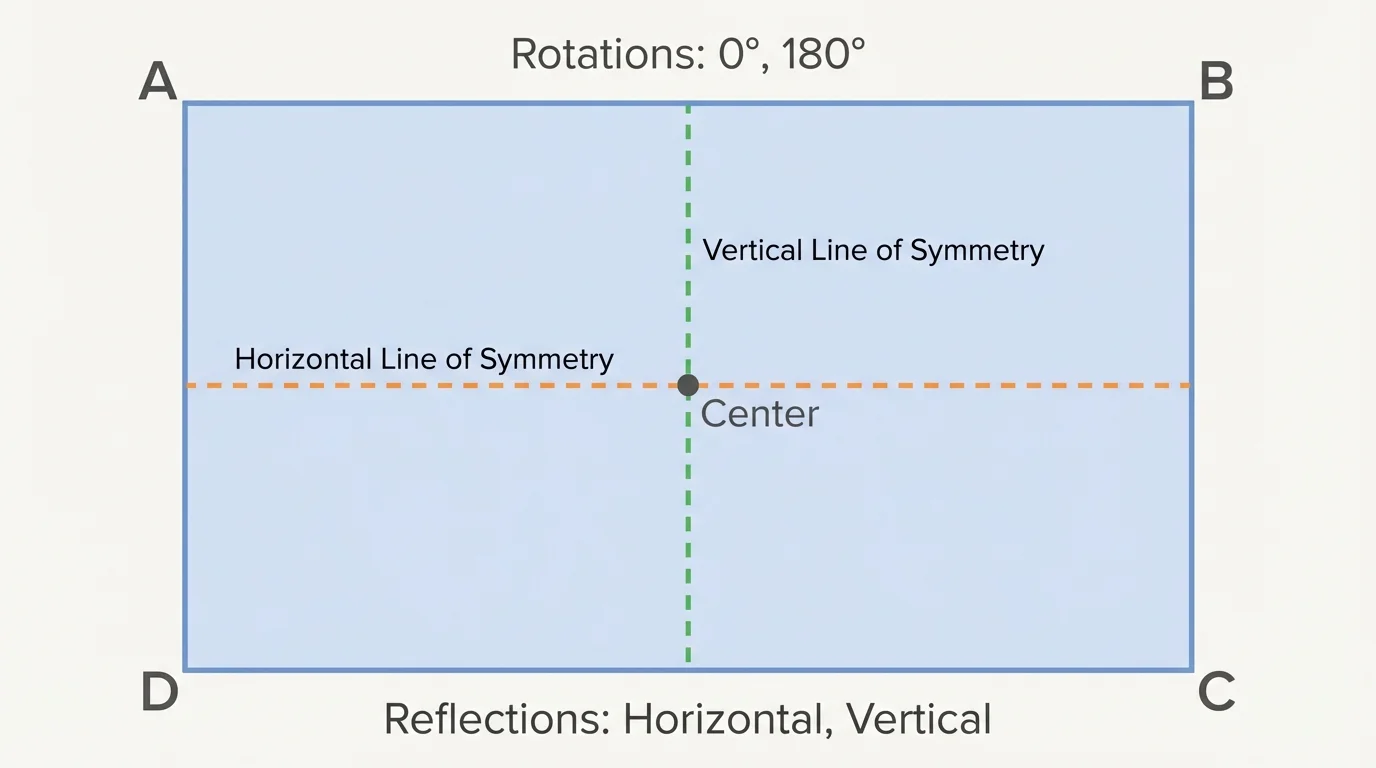
A non-square rectangle has two reflection symmetries and one rotational symmetry, as [Figure 1] shows through the lines passing through its center. The reflection lines are the horizontal and vertical lines through the center, each parallel to a pair of sides.
Why do those reflections work? Reflecting across the vertical line swaps the left and right sides while keeping the top and bottom sides in place as segments. Reflecting across the horizontal line swaps the top and bottom sides while keeping the left and right sides in place. In both cases, corresponding vertices match exactly.
A rectangle also has rotational symmetry of \(180^\circ\) about its center. Under this half-turn, each vertex moves to the opposite vertex, and each side lands on the opposite side. However, a non-square rectangle does not have reflection symmetry across its diagonals, because the diagonals do not divide it into mirror halves unless the rectangle is actually a square.
This is an important subtle point. A square is a special rectangle, so every square is a rectangle, but not every rectangle is a square. A square has more symmetries than a non-square rectangle. When the problem says rectangle, you should usually assume a general rectangle unless it specifically says square.
Worked example 1
Describe all reflections and rotations that carry a rectangle with side lengths 4 and 10 onto itself.
Step 1: Identify possible reflection lines.
Because opposite sides are equal and parallel, the lines through the center parallel to the sides are candidates. The vertical center line and horizontal center line each split the rectangle into matching halves.
Step 2: Test diagonal reflections.
A diagonal reflection would interchange a long side and a short side. Since \(4 \ne 10\), the figure would not match itself. So diagonal reflections do not work.
Step 3: Test rotations.
A rotation of \(180^\circ\) swaps each corner with the opposite corner and preserves the shape. Rotations of \(90^\circ\) or \(270^\circ\) would interchange long and short sides, so they do not work.
The rectangle has exactly two reflections, across the two center lines, and one nontrivial rotation, \(180^\circ\).
As seen earlier in [Figure 1], the center is crucial: both reflection lines pass through it, and the \(180^\circ\) rotation happens about it. For quadrilaterals with central symmetry, the center often controls the entire analysis.
A general parallelogram has rotational symmetry of \(180^\circ\) about the point where its diagonals intersect, as [Figure 2] illustrates. This works because opposite sides are parallel and equal, and opposite angles are equal, so a half-turn swaps each vertex with the opposite vertex.
But a general parallelogram usually has no reflection symmetry. If you reflect it across a line, the slanted sides and angles typically do not match the original placement. Unless the parallelogram is a special case such as a rectangle or a rhombus, there is no line of symmetry.
So the standard answer for a general parallelogram is: one nontrivial rotation, \(180^\circ\), and no reflections. This surprises many students because the shape looks balanced, but balance does not always mean mirror symmetry.
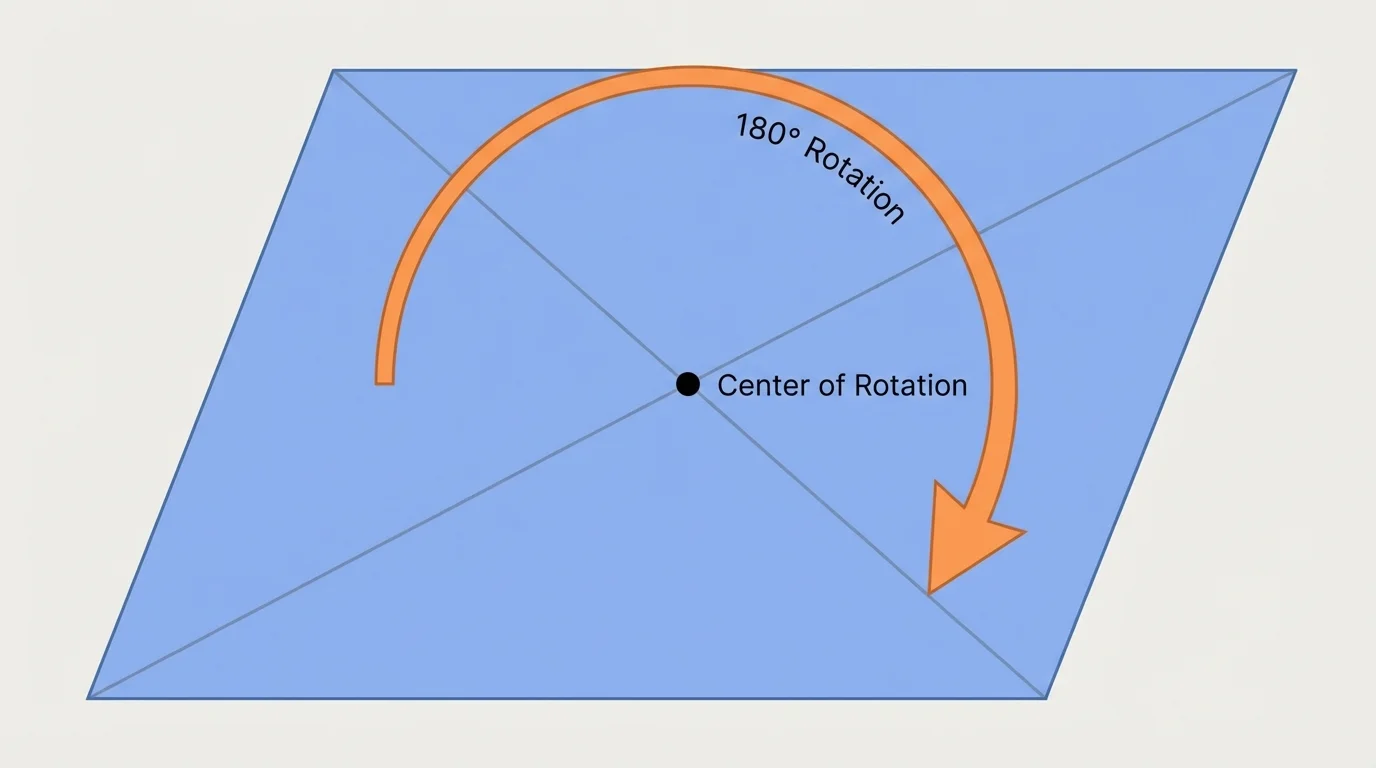
Why does the \(180^\circ\) rotation work so reliably? In a parallelogram, the diagonals bisect each other. That means their intersection is the midpoint of each diagonal. A half-turn about that point sends each endpoint of a diagonal to the other endpoint, so the whole figure matches itself.
Many printed patterns use half-turn symmetry because it is less obvious than mirror symmetry. Designers often choose it to create a pattern that feels balanced without looking too repetitive.
Looking back to [Figure 2], notice that the center is not just "inside" the parallelogram; it is the exact point that makes opposite vertices correspond under the rotation. Without that midpoint structure, the half-turn would fail.
A trapezoid needs careful attention because there are different kinds. As [Figure 3] shows, a general trapezoid usually has no reflection symmetry and no rotational symmetry. But an isosceles trapezoid is special.
An isosceles trapezoid has congruent nonparallel sides, called legs. In that case, there is exactly one line of reflection symmetry: the line perpendicular to the two bases and passing through their midpoints. That line cuts the trapezoid into mirror halves.
However, even an isosceles trapezoid does not have rotational symmetry of \(180^\circ\). A half-turn would place the shorter base where the longer base was, and unless the two bases are equal, the figure would not match. But if the bases were equal, the shape would not be a trapezoid in the usual exclusive definition; it would be a parallelogram.
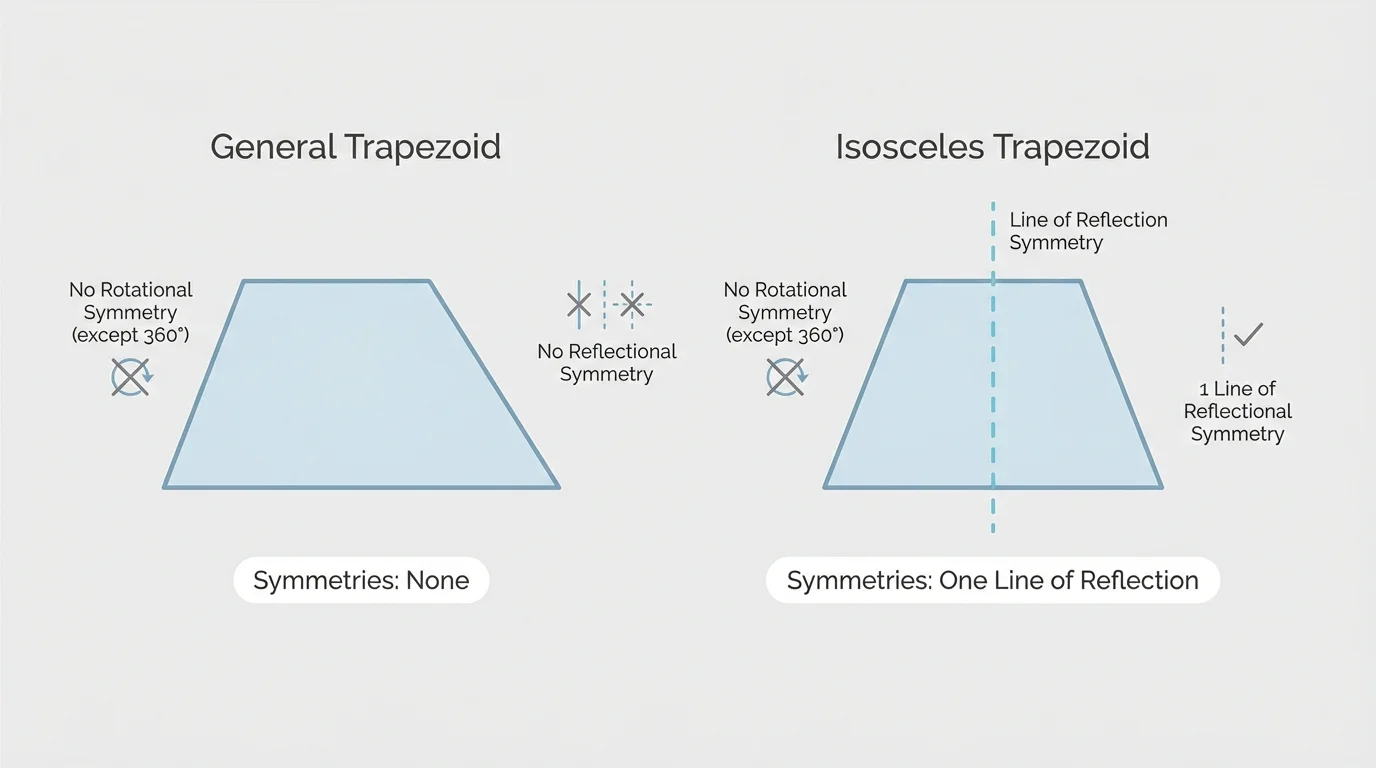
So the usual conclusions are these: a general trapezoid has no reflections and no nontrivial rotations; an isosceles trapezoid has one reflection and no nontrivial rotations. This distinction is one of the most tested ideas in this topic.
Worked example 2
An isosceles trapezoid has bases of lengths 8 and 14. Describe the transformations that carry it onto itself.
Step 1: Check for reflection symmetry.
Because the legs are congruent, the trapezoid is symmetric across the line through the midpoints of the bases and perpendicular to them. Reflecting across that line swaps the left and right halves.
Step 2: Check for rotational symmetry.
A \(180^\circ\) rotation would exchange the shorter base and longer base. Since \(8 \ne 14\), the image would not coincide with the original.
Step 3: State the result.
The only non-identity symmetry is one reflection across the perpendicular bisector of the bases.
This trapezoid has exactly one reflection symmetry and no nontrivial rotational symmetry.
The comparison in [Figure 3] makes the reason clear: equal legs create a mirror relationship, but unequal bases prevent a half-turn from working.
For a regular polygon, the symmetry pattern becomes beautifully predictable, and [Figure 4] makes this visible for one example. If a polygon has \(n\) sides and is regular, then it has \(n\) reflection symmetries and \(n\) rotational symmetries total if you count the identity rotation, or \(n - 1\) nontrivial rotations if you do not count the identity.
The rotations are multiples of the smallest angle
\[\frac{360^\circ}{n}\]
about the center of the polygon. So a regular \(n\)-gon matches itself after rotations of \(0^\circ\), \(\dfrac{360^\circ}{n}\), \(2\dfrac{360^\circ}{n}\), \(3\dfrac{360^\circ}{n}\), and so on, up to \((n-1)\dfrac{360^\circ}{n}\).
The reflection symmetries also pass through the center, but their exact placement depends on whether n is even or odd. If n is even, some lines go through opposite vertices and some go through midpoints of opposite sides. If n is odd, every symmetry line goes through one vertex and the midpoint of the opposite side.
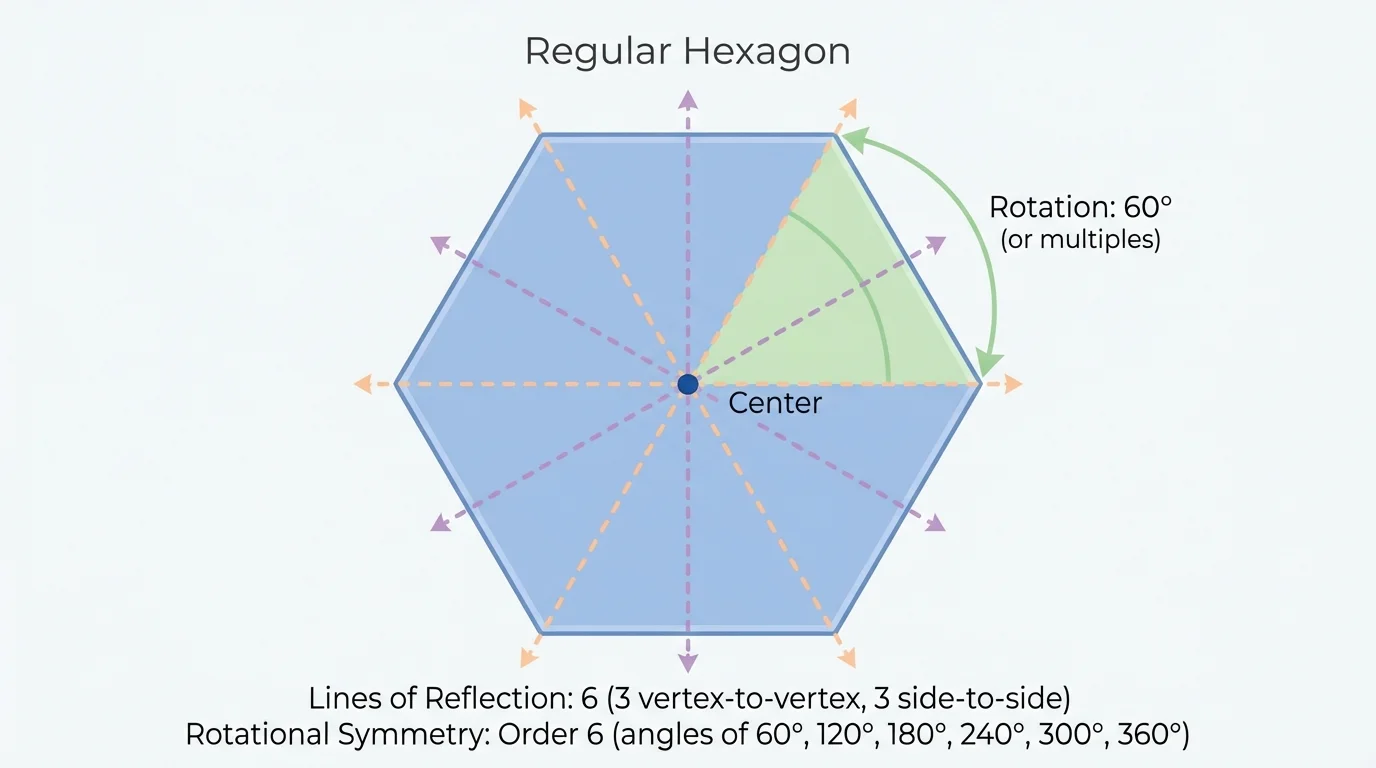
Examples make the rule easier to remember. A regular triangle has 3 reflections and rotations by \(120^\circ\) and \(240^\circ\). A square has 4 reflections and rotations by \(90^\circ\), \(180^\circ\), and \(270^\circ\). A regular pentagon has 5 reflections and nontrivial rotations by \(72^\circ\), \(144^\circ\), \(216^\circ\), and \(288^\circ\). A regular hexagon has 6 reflections and nontrivial rotations by \(60^\circ\), \(120^\circ\), \(180^\circ\), \(240^\circ\), and \(300^\circ\).
| Shape | Reflection symmetries | Nontrivial rotations |
|---|---|---|
| Non-square rectangle | 2 | \(180^\circ\) |
| General parallelogram | 0 | \(180^\circ\) |
| General trapezoid | 0 | none |
| Isosceles trapezoid | 1 | none |
| Regular n-gon | \(n\) | Multiples of \(\dfrac{360^\circ}{n}\) less than \(360^\circ\) |
As shown by the regular hexagon in [Figure 4], the symmetries are evenly distributed around the center. That is one reason regular polygons are so useful in tiling, design, and mechanical parts.
The general rule for regular polygons
A regular polygon is the most symmetric kind of polygon because all sides and all angles are equal. Its center acts as the natural point for rotations, and its equal spacing creates equally spaced reflection lines. This is why the number of reflection symmetries equals the number of sides.
The formula \(\dfrac{360^\circ}{n}\) gives the smallest positive rotation that works. Once you know that angle, all other rotational symmetries are just repeated turns by the same amount.
There is a reliable method for analyzing any figure in this topic. First, identify any obvious center or possible mirror line. Then ask whether vertices would land on matching vertices and whether side lengths and angle positions line up correctly after the transformation.
For reflections, test whether the proposed line splits the figure into mirror halves. For rotations, test whether the turn sends each corner to another corner in the correct order. If a transformation sends a long side to a short side, or an acute angle to an obtuse one in the wrong place, then it fails.
This method is especially useful when comparing similar-looking shapes. A rectangle and a parallelogram both have opposite sides parallel, but one has reflection symmetry and the other usually does not. An isosceles trapezoid and a general trapezoid both have one pair of parallel sides, but only one has a mirror line.
Worked example 3
Describe all rotations and reflections that carry a regular pentagon onto itself.
Step 1: Find the smallest rotation angle.
For a regular pentagon, the smallest positive rotation is \(\dfrac{360^\circ}{5} = 72^\circ\).
Step 2: List all nontrivial rotations.
The nontrivial rotations are \(72^\circ\), \(144^\circ\), \(216^\circ\), and \(288^\circ\).
Step 3: Count reflection symmetries.
A regular pentagon has 5 lines of symmetry. Each line passes through a vertex and the midpoint of the opposite side.
The regular pentagon has 5 reflections and 4 nontrivial rotations.
Notice how different this is from a non-regular pentagon, which usually has no symmetry at all. Regularity is what creates the full pattern.
Worked example 4
A student says that every trapezoid has a line of symmetry because it has one pair of parallel sides. Is the statement true?
Step 1: Examine the claim.
Having one pair of parallel sides does not guarantee mirror symmetry. Parallel sides alone do not force the two nonparallel sides to match.
Step 2: Identify the special case.
Only an isosceles trapezoid, where the legs are congruent, has a reflection symmetry.
Step 3: Give the conclusion.
The statement is false. A general trapezoid usually has no line of symmetry.
This is why precise definitions matter in geometry.
Symmetry appears in bridge trusses, machine parts, decorative tiling, and digital animation. If an object has rotational symmetry, engineers can sometimes rotate parts during assembly without changing function. If a design has reflection symmetry, it may distribute forces evenly or create visual balance.
Regular polygons are common in bolts, tiles, and repeated patterns because their symmetry makes manufacturing and alignment easier. Hexagons are especially useful because they combine strong rotational symmetry with efficient tessellation. Rectangles dominate architecture and screens because their symmetries support alignment and standardization.
Computer graphics and robotics also rely on these ideas. When software detects the symmetry of an object, it can compress data, recognize patterns faster, or generate repeated movements. In all these cases, the geometric question is the same one you ask in class: which transformations leave the object unchanged?
One common mistake is to give a square's symmetries when the problem asks about a rectangle. Unless the rectangle is specifically a square, do not include diagonal reflections or \(90^\circ\) rotations.
Another mistake is to assume any trapezoid has one line of symmetry. Only the isosceles trapezoid does. A general trapezoid has no such guarantee.
A third mistake is to forget that regular polygons follow a general rule but irregular polygons usually do not. The words regular polygon are doing a lot of work: equal sides and equal angles create the entire symmetry structure.
"Symmetry is a vast subject, significant in art and nature, and one of the deepest ways to understand structure in mathematics."
— Geometric principle
When you describe a symmetry, be specific. Name the line of reflection or give the exact rotation angle and center. Geometry values precision, and symmetry is one of the clearest places where precise language reveals precise structure.
