Every time you unlock a phone with a passcode, enter a search into a browser, or calculate the cost of a ride based on distance, a rule is taking an input and producing an output. Mathematics gives a powerful way to describe that idea: functions. Function notation may look small, like \(f(3)\), but it carries a big idea: one input, one output, and a clear rule connecting them.
A function helps us describe how one quantity depends on another. If the number of hours you work determines how much you earn, or if the side length of a square determines its area, that relationship can be written as a function. Function notation makes those relationships easier to read, analyze, and apply.
Instead of writing a long sentence such as "the cost for \(x\) tickets," mathematicians often write \(C(x)\), where \(C\) stands for cost. Then \(C(5)\) means the cost of \(5\) tickets. This notation is compact, but it is also precise.
Function: a rule that assigns exactly one output to each input.
Input: the value you put into the function.
Output: the value the function gives back.
Domain: the set of all allowed inputs for a function.
You have probably already worked with functions without calling them that. For example, the rule "multiply a number by \(2\) and add \(1\)" is a function because every input gives exactly one output.
A function matches each input with exactly one output, as [Figure 1] shows. If an input points to two different outputs, the rule is not a function.
For example, suppose a rule sends \(1 \to 4\), \(2 \to 7\), and \(3 \to 10\). That is a function because each input has only one output. But if the same input \(2\) is matched with both \(5\) and \(8\), then the rule is not a function.
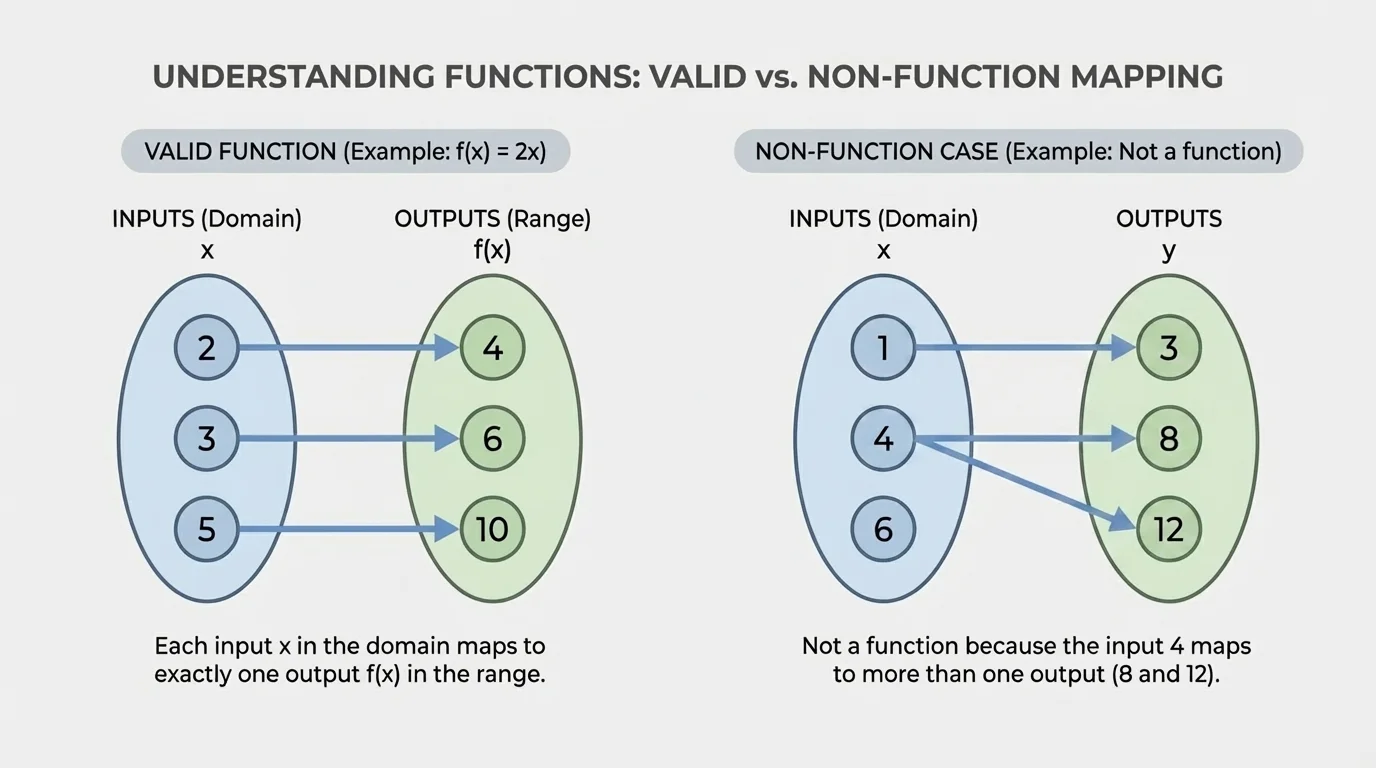
Notice an important detail: different inputs can have the same output. For instance, in the function \(f(x)=x^2\), both \(2\) and \(-2\) give the output \(4\). That is still a function because the rule does not assign more than one output to a single input.
Functions can be represented in several ways: by an equation, a table, a graph, a verbal rule, or a mapping diagram. No matter the representation, the key question stays the same: does each allowed input have exactly one output?
When you substitute a value into an expression, replace the variable everywhere it appears and then simplify using the order of operations. This idea is essential for evaluating functions.
That substitution skill becomes even more useful when the expression represents a real situation, such as cost, height, temperature, or speed.
Function notation is a way to name a function and show its output for a particular input. If the function is named \(f\), then \(f(x)\) means "the output of function \(f\) when the input is \(x\)."
In function notation, \(f\) is the name of the function and \(x\) is the input variable. The expression \(f(3)\) means "the value of the function when the input is \(3\)." It does not mean \(f \cdot 3\).
For example, if \(f(x)=2x+5\), then:
\(f(3)=2(3)+5=6+5=11\).
If the function has a different name, the idea is the same. If \(g(x)=x^2-1\), then \(g(4)=4^2-1=16-1=15\).
What the notation really says
Function notation helps separate the rule from the value. The expression \(f(x)=2x+5\) gives the rule for all inputs. The expression \(f(3)=11\) gives one specific output. The first is general; the second is particular.
This distinction matters because mathematics often moves back and forth between the general rule and specific cases. Scientists, economists, and engineers do this constantly.
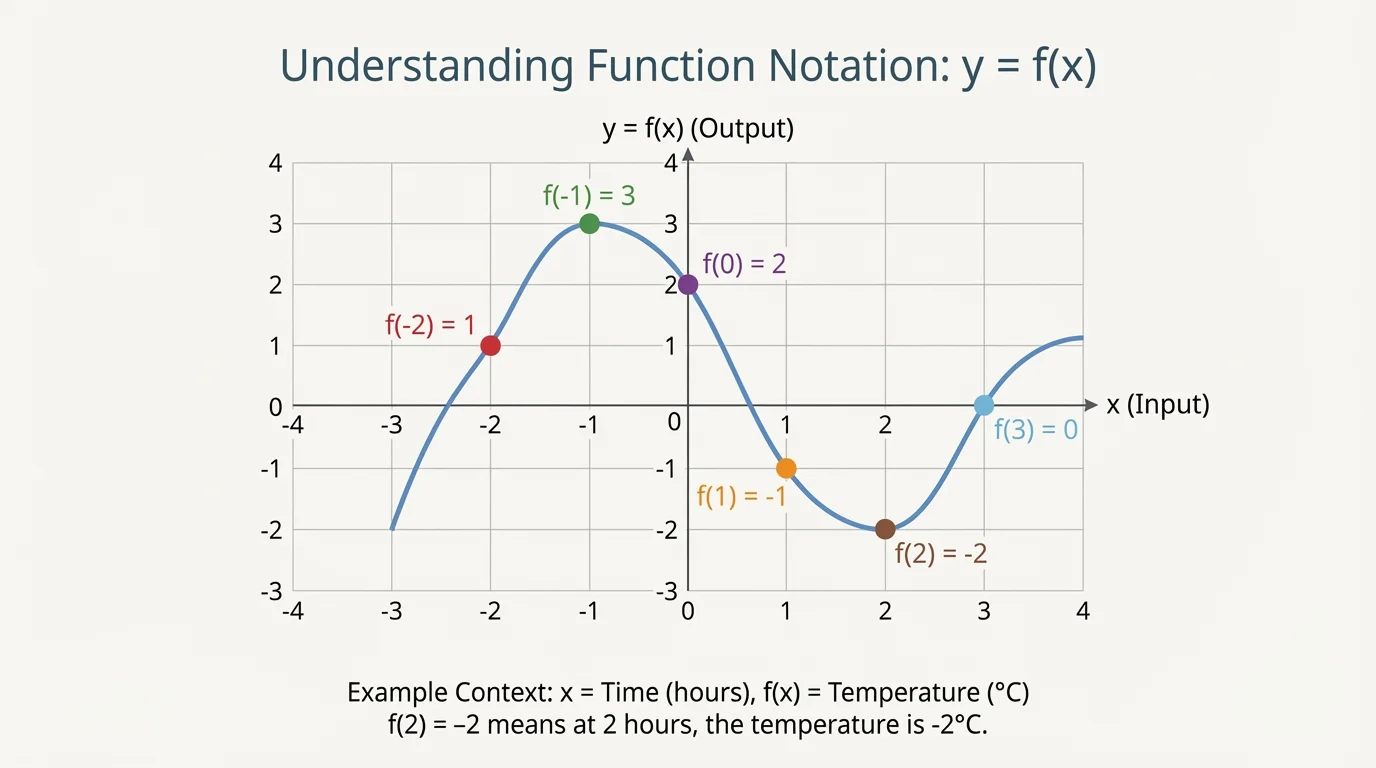
To evaluate a function, substitute the given input into the rule and simplify carefully. A graph can also provide function values, as [Figure 2] illustrates, because each \(x\)-value on the horizontal axis matches a \(y\)-value on the graph.
Evaluation works with whole numbers, fractions, negatives, and even algebraic expressions, as long as the input is in the domain.
Solved example 1
Given \(f(x)=3x-4\), find \(f(6)\).
Step 1: Substitute \(6\) for \(x\).
\(f(6)=3(6)-4\)
Step 2: Simplify.
\(3(6)=18\), so \(f(6)=18-4=14\).
The value is \(f(6)=14\)
The same process works even when the input is negative or fractional. You simply replace \(x\) with the given number and simplify with care.
Suppose \(g(x)=x^2+2x\). Then \(g(-3)=(-3)^2+2(-3)=9-6=3\). Negative inputs often cause errors when parentheses are omitted, so always include them during substitution.
Solved example 2
Given \(h(x)=\dfrac{x+1}{2}\), find \(h(-5)\).
Step 1: Substitute \(-5\) for \(x\).
\(h(-5)=\dfrac{-5+1}{2}\)
Step 2: Simplify the numerator.
\(-5+1=-4\), so \(h(-5)=\dfrac{-4}{2}\).
Step 3: Simplify the fraction.
\(\dfrac{-4}{2}=-2\).
The value is \(h(-5)=-2\)
Sometimes the input is itself an expression. In that case, treat the whole expression as the input.
Solved example 3
If \(p(x)=x^2-3x+1\), find \(p(a)\).
Step 1: Replace every \(x\) with \(a\).
\(p(a)=a^2-3a+1\)
Step 2: There is nothing more to simplify.
The answer stays in algebraic form.
The value is \[p(a)=a^2-3a+1\]
This kind of evaluation is important in algebra because it prepares you to compare forms of functions and to work with formulas symbolically.
Graphs provide another way to evaluate. If a point on a graph has coordinates \((2,5)\), then the graph tells you that \(f(2)=5\). Later, when comparing multiple representations, we will return to the graph in [Figure 2] to see how notation matches plotted points.
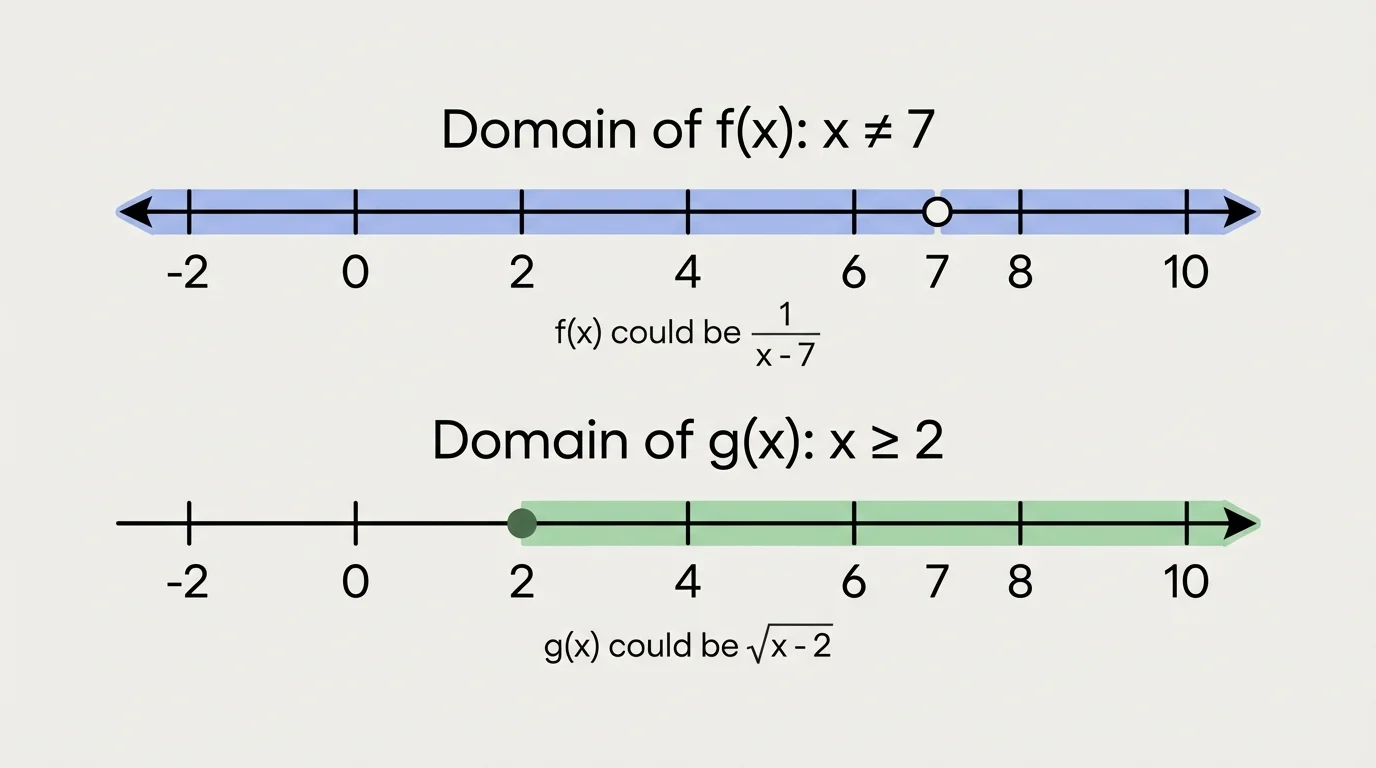
The domain of a function is the set of all inputs that are allowed. As [Figure 3] shows, it acts like a gatekeeper for the function: some values can go in, and some cannot.
Sometimes the domain is limited by the context. If \(n\) represents the number of students in a class, then \(n\) cannot be negative, and usually \(n\) must be a whole number. If \(t\) represents time in hours after a store opens, then \(t\) cannot be negative.
Sometimes the formula itself restricts the domain. Two common restrictions are:
For example, in \(q(x)=\dfrac{4}{x-7}\), the input \(x=7\) is not allowed because it makes the denominator \(0\).
In \(r(x)=\sqrt{x-2}\), the expression under the square root must be at least \(0\), so \(x-2 \ge 0\), which means \(x \ge 2\).
Solved example 4
Determine whether \(x=4\) is in the domain of \(m(x)=\dfrac{2x+1}{x-4}\).
Step 1: Check the denominator.
If \(x=4\), then \(x-4=4-4=0\).
Step 2: Decide whether the input is allowed.
Division by \(0\) is undefined, so \(x=4\) is not in the domain.
The input \(x=4\) is not allowed.
Now consider a context example. Let \(C(n)=12n+5\) represent the total cost of ordering \(n\) custom notebooks. In pure algebra, many numbers could be substituted for \(n\). But in context, \(n\) should be a whole number such as \(1\), \(2\), or \(30\). A value like \(n=-3\) or \(n=2.5\) would not make sense for the number of notebooks ordered.
Domain is one of the most important ideas in interpreting functions because a correct calculation can still be meaningless if the input does not belong to the situation.
A input-output relationship becomes most useful when it describes something real. Suppose \(C(t)\) represents the cost, in dollars, of renting a bike for \(t\) hours. If \(C(3)=24\), that means the cost for renting the bike for \(3\) hours is $24.
To interpret a statement in function notation, identify three things: the name of the function, the input, and what the output represents.
| Notation | How to read it | Meaning in context |
|---|---|---|
| \(C(3)=24\) | The cost at \(3\) hours is \(24\) | Renting for \(3\) hours costs $24 |
| \(h(2)=150\) | The height at time \(2\) is \(150\) | After \(2\) seconds, the object is \(150\) units high |
| \(P(10)=420\) | The population value at \(10\) is \(420\) | At year \(10\), the population is \(420\) |
Table 1. Examples of how function notation translates into words and context.
Notice how the same notation structure can describe many kinds of situations. The letter used to name the function is often chosen to match the quantity, such as \(C\) for cost, \(h\) for height, or \(P\) for population.
Interpreting versus calculating
When you calculate \(f(4)\), you are finding an output. When you interpret \(f(4)=18\), you explain what that output means in the situation. Mathematics is not only about getting a number; it is also about understanding what the number tells you.
For example, if \(T(d)\) is the temperature of a liquid \(d\) minutes after heating begins, and \(T(5)=72\), then the statement means that after \(5\) minutes, the liquid's temperature is \(72\) degrees. The exact unit depends on the context, such as degrees Celsius or degrees Fahrenheit.
Interpreting notation also works in reverse. If a sentence says, "At \(8\) miles, the taxi fare is $19," you can write that as \(F(8)=19\), where \(F(m)\) is the fare for \(m\) miles.
Functions appear in equations, tables, graphs, and words. You should be able to move among these forms easily.
If a table lists \(x=1\) with \(y=6\), then in function notation you can write \(f(1)=6\). If a graph includes the point \((4,-2)\), then \(f(4)=-2\). This is the same idea we saw earlier in [Figure 2]: the graph pairs an input on the horizontal axis with an output on the vertical axis.
Here is a small table representation:
| Input \(x\) | Output \(f(x)\) |
|---|---|
| \(-1\) | \(3\) |
| \(0\) | \(1\) |
| \(2\) | \(-3\) |
Table 2. A table of inputs and outputs for a function.
From this table, you can read that \(f(-1)=3\), \(f(0)=1\), and \(f(2)=-3\).
Different representations highlight different features. Equations are useful for calculating any value. Tables are useful when only certain values are known. Graphs reveal visual patterns such as increase, decrease, or intercepts. Verbal descriptions connect the mathematics to real situations.
Many computer programs treat a function almost exactly the way algebra does: an input is sent into a rule, and the system returns one output. This idea powers search engines, graphics, and encryption.
Because functions appear in so many forms, learning to interpret notation is a key step toward understanding algebra as a language, not just a list of procedures.
One common mistake is thinking that \(f(3)\) means \(f \cdot 3\). It does not. The parentheses show the input to the function, not multiplication.
Another mistake is forgetting parentheses when substituting negative numbers. If \(g(x)=x^2-1\), then \(g(-2)=(-2)^2-1=4-1=3\), not \(-2^2-1=-5\). The parentheses matter.
Students also sometimes evaluate a function at an input that is not in the domain. For instance, in \(\dfrac{1}{x-5}\), the input \(x=5\) is not allowed. As we saw with the restrictions in [Figure 3], the formula itself can block certain values.
A final mistake is giving a numerical answer without interpreting it in context. If \(C(4)=52\), the answer is not just \(52\). It might mean "the total cost for \(4\) items is $52," depending on the situation.
Function notation is not just an algebra exercise. It appears everywhere.
In business, a company might use \(R(n)\) to represent revenue from selling \(n\) products. In medicine, a function might describe how drug concentration changes over time. In environmental science, a function can model temperature, rainfall, or population changes.
Suppose a streaming service charges a monthly fee of $8 plus $2 per movie rented. If \(M(n)=8+2n\), then \(M(5)=8+2(5)=18\). This means the monthly total for \(5\) movie rentals is $18.
In geometry, if \(A(s)=s^2\) gives the area of a square with side length \(s\), then \(A(6)=36\). That means a square with side length \(6\) has area \(36\) square units.
In transportation, if \(d(t)=60t\) gives distance traveled at a constant speed of \(60\) miles per hour, then \(d(2.5)=150\). That means after \(2.5\) hours, the vehicle has traveled \(150\) miles.
Solved example 5
A concert hall charges $15 per ticket plus a one-time online fee of $4. Let \(C(n)=15n+4\), where \(n\) is the number of tickets. Find \(C(3)\) and interpret the result.
Step 1: Substitute \(3\) for \(n\).
\(C(3)=15(3)+4\)
Step 2: Simplify.
\(15(3)=45\), so \(C(3)=45+4=49\).
Step 3: Interpret the value.
The total cost for \(3\) tickets is $49.
The result is \(C(3)=49\)
These examples all use the same structure: name the quantity, choose a meaningful input, compute the output, and explain what it means.
Statements using function notation can describe single moments, comparisons, or trends. For example, if \(S(t)\) is the score of a game after \(t\) minutes, then \(S(0)=0\) might mean the game begins with a score of \(0\). If \(S(48)=102\), then after \(48\) minutes, the score is \(102\).
If a problem says that \(B(12)>B(8)\), and \(B(t)\) is the amount in a bank account after \(t\) months, that means the balance after \(12\) months is greater than the balance after \(8\) months. Function notation can therefore express not only exact values but also comparisons.
When reading notation, keep asking: what is the input, what is the output, and what do both represent? That question turns symbols into meaning.
