Here is a question that sounds simple but can completely change the meaning of a statistic: is the chance of having lung cancer if you are a smoker the same as the chance of being a smoker if you have lung cancer? Many people assume those are basically the same question. They are not. In probability, the order matters, the starting group matters, and the context matters. That is why conditional probability is so important in medicine, sports, economics, science, and everyday decision-making.
Probability often seems like it is only about games or dice, but in real life it is mostly about information. The moment someone says "given that," the situation changes. If you know a person is a smoker, that gives you one kind of information. If you know a person has lung cancer, that gives you a different kind of information. Those two facts lead you to different groups, different comparisons, and often very different numerical probabilities.
A probability tells how likely an event is. If an event is impossible, its probability is \(0\). If it is certain, its probability is \(1\). Many real situations fall somewhere in between. For example, if \(30\) students out of \(120\) are in drama club, then the probability that a randomly chosen student is in drama club is \(\dfrac{30}{120}=\dfrac{1}{4}=0.25\).
An event is just an outcome or a set of outcomes that we care about. For instance, "the student plays a sport" can be one event, and "the student is in drama club" can be another. Probability becomes more interesting when we ask whether knowing one event changes how likely another event is.
From earlier probability work, remember that a probability is often calculated as \(\dfrac{\textrm{number of favorable outcomes}}{\textrm{total number of possible outcomes}}\). In data-based situations, the "total number of possible outcomes" usually means the size of the group you are focusing on.
That last point is the key to this lesson: the group you focus on may change. If the group changes, the denominator changes. And when the denominator changes, the probability may change too.
A conditional probability is the probability of an event happening given that another event has already happened. The notation is \(P(A\mid B)\), which is read as "the probability of \(A\) given \(B\)."
For example, let \(A\) be "a student is in band," and let \(B\) be "the student is a junior." Then \(P(A\mid B)\) means the probability that a student is in band, given that the student is already known to be a junior. We are no longer looking at all students. We are only looking at juniors.
Conditional probability is the probability that one event happens when we already know another event has happened.
Notation: \(P(A\mid B)\) means "the probability of \(A\) given \(B\)."
Interpretation: the word given tells you which subgroup becomes the new whole group for the calculation.
If there are \(200\) students in a school, \(80\) are juniors, and \(20\) of those juniors are in band, then the probability that a randomly chosen junior is in band is \(\dfrac{20}{80}=0.25\). So \(P(\textrm{band}\mid \textrm{junior})=0.25\).
Notice what changed. If we asked for the probability that a randomly chosen student from the whole school is in band, we would use a different denominator. But because we are told the student is a junior, the juniors become the only relevant group.
[Figure 1] The most common mistake in this topic is to reverse the order of the events. The comparison between smoking and lung cancer makes this clear through two different starting groups. The question "What is the chance of lung cancer if a person is a smoker?" starts with smokers. The question "What is the chance of being a smoker if a person has lung cancer?" starts with people who have lung cancer. Those are not the same group, so they usually do not produce the same probability.
Suppose a study tracks \(1{,}000\) people. Out of these, \(200\) are smokers and \(800\) are non-smokers. Among the smokers, \(30\) have lung cancer. Among the non-smokers, \(10\) have lung cancer. Then the total number of people with lung cancer is \(40\).
| Group | Lung cancer | No lung cancer | Total |
|---|---|---|---|
| Smokers | \(30\) | \(170\) | \(200\) |
| Non-smokers | \(10\) | \(790\) | \(800\) |
| Total | \(40\) | \(960\) | \(1{,}000\) |
Table 1. Smoking and lung cancer data for a group of \(1{,}000\) people.
Now compare the two questions. The chance of having lung cancer if you are a smoker is \(P(\textrm{cancer}\mid \textrm{smoker})=\dfrac{30}{200}=0.15\). But the chance of being a smoker if you have lung cancer is \(P(\textrm{smoker}\mid \textrm{cancer})=\dfrac{30}{40}=0.75\). The numbers \(0.15\) and \(0.75\) are very different, even though both use the same count \(30\). The difference comes from the denominator.
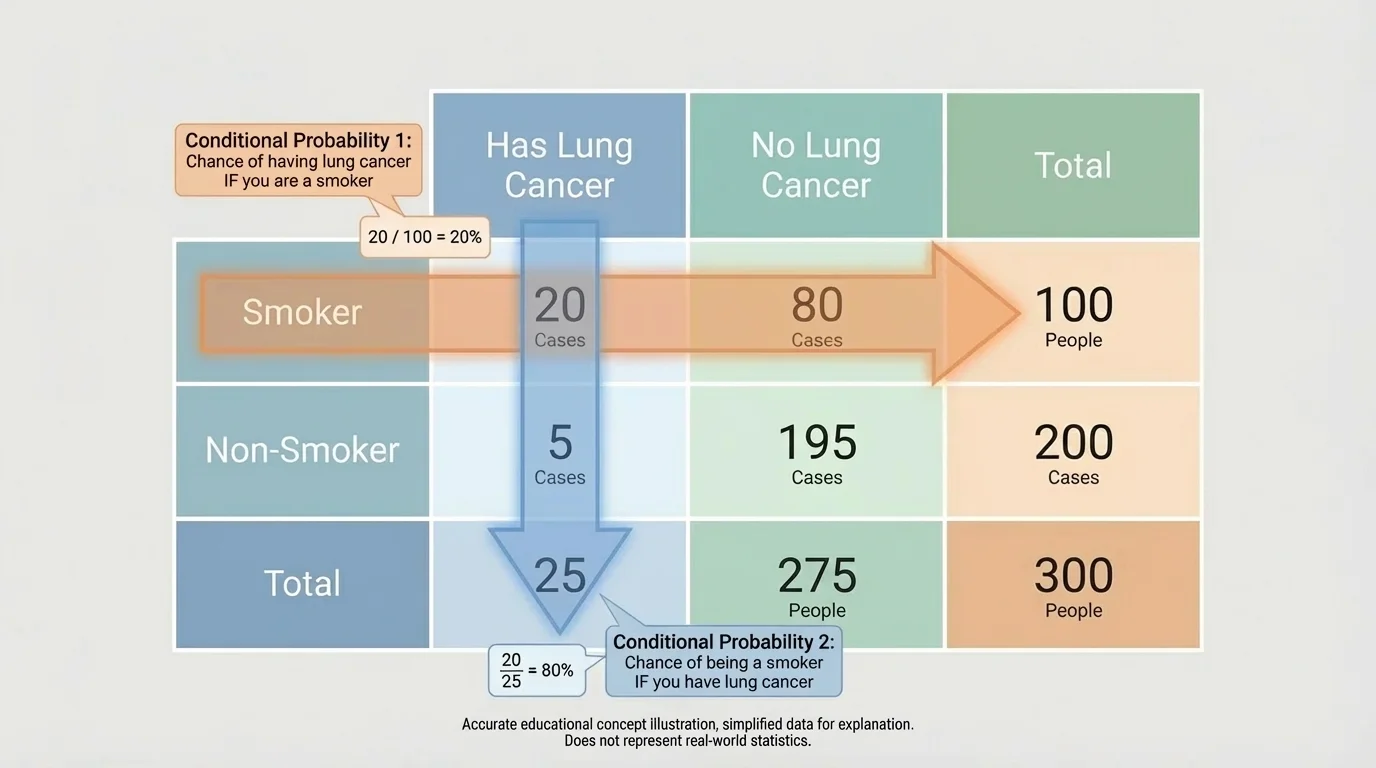
This is a powerful idea. A single real-world situation can create several different probabilities depending on what is known first. If a news report or social media post switches the order carelessly, the interpretation can become misleading.
Why the denominator matters
In a conditional probability, the denominator is not automatically the total number of people or outcomes. It is the number in the group described after the word given. In \(P(\textrm{cancer}\mid \textrm{smoker})\), the denominator is the number of smokers. In \(P(\textrm{smoker}\mid \textrm{cancer})\), the denominator is the number of people with lung cancer.
That is why you should translate every conditional probability into words before calculating anything. Ask: "Out of which group am I choosing?" If you can answer that question correctly, you are already halfway to the right solution.
[Figure 2] Two events are called independent events if knowing that one happened does not change the probability of the other. In an independent situation, the second probability stays the same even after the first event is known.
For example, if you flip a fair coin twice, the result of the first flip does not affect the second flip. If the probability of heads on one flip is \(\dfrac{1}{2}\), then it is still \(\dfrac{1}{2}\) on the next flip, no matter what happened first.
But many real situations are not independent. If you draw one card from a deck and do not replace it, the probabilities for the second draw change because the deck has changed. If you know a person smokes, that may change the probability of certain health outcomes. If one event changes the likelihood of another, the events are not independent.
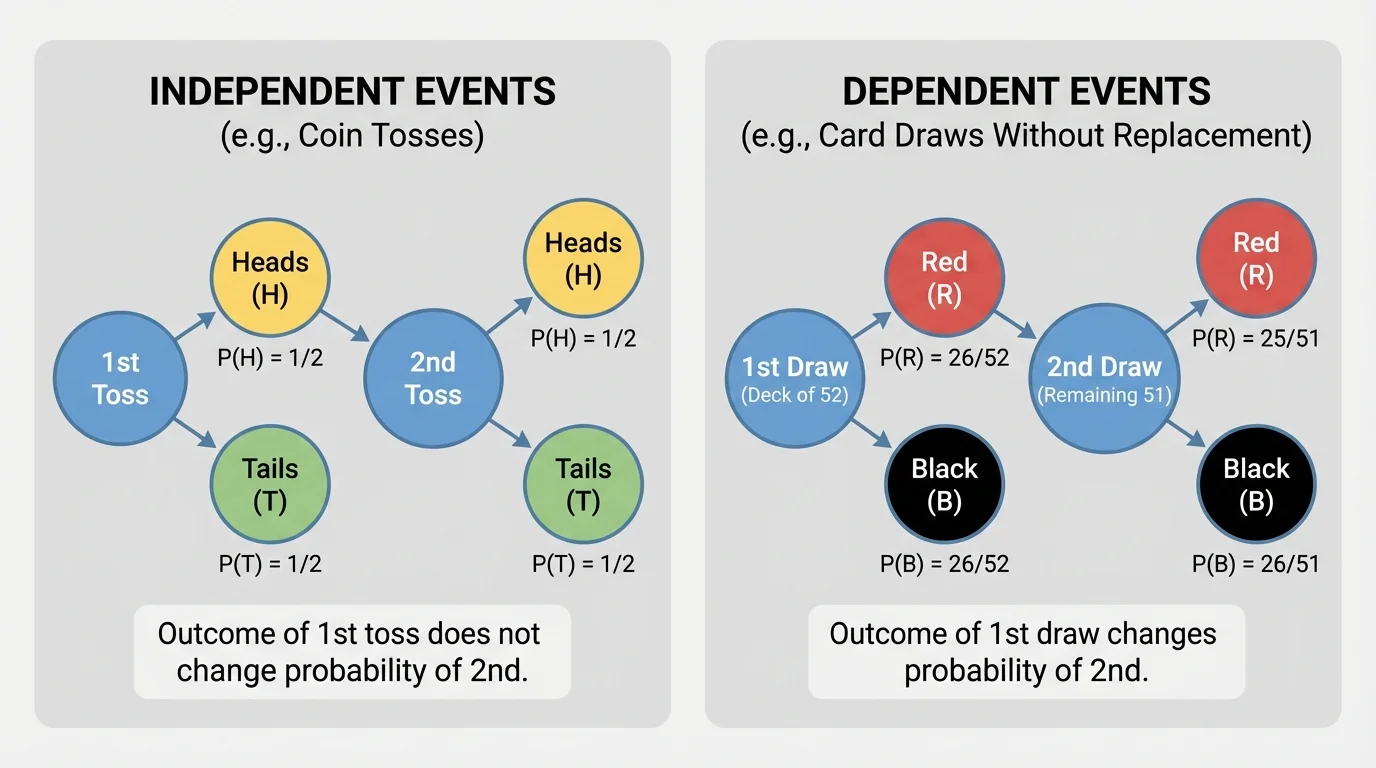
Independence is not about whether events happen together. It is about whether knowing one event gives useful information about the other. If it does, they are dependent. If it does not, they are independent.
People often think "independent" means "completely unrelated in every possible way," but in probability it has a very precise meaning: one event does not change the probability of the other.
This idea appears everywhere. In quality control at a factory, one product defect may or may not affect the chance of another defect. In genetics, some traits can be treated as independent in simple models, while others are linked. In sports, one play can shift the probability of the next play if the game situation changes.
Conditional probability has a standard formula. If \(P(B)\neq 0\), then
\[P(A\mid B)=\frac{P(A\cap B)}{P(B)}\]
Here, \(P(A\cap B)\) means the probability that both \(A\) and \(B\) happen. The symbol \(\cap\) means "and."
This formula matches the idea we have been using all along. The denominator \(P(B)\) represents the group we are given. The numerator \(P(A\cap B)\) represents the part of that group where \(A\) also happens.
If two events are independent, then knowing \(B\) does not change the probability of \(A\). That means
\[P(A\mid B)=P(A)\]
There is also a useful multiplication rule. For any two events,
\[P(A\cap B)=P(B)\cdot P(A\mid B)\]
If the events are independent, this becomes
\[P(A\cap B)=P(A)P(B)\]
That equation is often used to test independence. If the probability of both events happening equals the product of their individual probabilities, the events are independent.
Worked examples help because they force us to identify the correct group before calculating. Each example asks a slightly different question, so pay attention to the wording.
Example 1: School clubs and sports
At a school, \(120\) students were surveyed. Of these, \(48\) play a sport, \(30\) are in art club, and \(18\) do both. Find \(P(\textrm{art club}\mid \textrm{sport})\).
Step 1: Identify the group after "given."
The phrase "given that a student plays a sport" means the new total is the students who play a sport, so the denominator is \(48\).
Step 2: Find how many students are in both groups.
The number who are in art club and play a sport is \(18\).
Step 3: Form the conditional probability.
\[P(\textrm{art club}\mid \textrm{sport})=\frac{18}{48}=\frac{3}{8}=0.375\]
The probability is \(0.375\), or \(37.5\%\).
If the question had been reversed to \(P(\textrm{sport}\mid \textrm{art club})\), the denominator would have been \(30\), not \(48\). Then the answer would be \(\dfrac{18}{30}=0.6\). Same overlap, different conditional probability.
Example 2: Medical test data
A clinic studied \(500\) patients. Among them, \(80\) tested positive for a condition. Of those \(80\), \(60\) actually had the condition. Find \(P(\textrm{condition}\mid \textrm{positive test})\).
Step 1: Determine the given group.
Because the probability is "condition given positive test," the relevant group is the \(80\) patients who tested positive.
Step 2: Count how many in that group have the condition.
There are \(60\) such patients.
Step 3: Compute the conditional probability.
\[P(\textrm{condition}\mid \textrm{positive})=\frac{60}{80}=0.75\]
The result is \(0.75\), or \(75\%\).
This type of calculation matters in health decisions. A positive test does not automatically mean the condition is certain. It tells us the probability within the group of positive tests.
Example 3: Testing independence
In a survey, \(P(A)=0.4\), \(P(B)=0.5\), and \(P(A\cap B)=0.2\). Are \(A\) and \(B\) independent?
Step 1: Multiply the individual probabilities.
\[P(A)P(B)=0.4\cdot 0.5=0.2\]
Step 2: Compare with the probability of both events.
We are given \(P(A\cap B)=0.2\).
Step 3: Decide.
Since \(P(A\cap B)=P(A)P(B)\), the events are independent.
The events are independent.
You can also test the same example using conditional probability. Since \(P(B)=0.5\), we get \(P(A\mid B)=\dfrac{0.2}{0.5}=0.4\), which matches \(P(A)=0.4\). That again shows independence.
Example 4: Not independent
A bag contains \(5\) red marbles and \(5\) blue marbles. One marble is drawn, not replaced, and then a second marble is drawn. Let \(A\) be "the first marble is red," and let \(B\) be "the second marble is red." Are \(A\) and \(B\) independent?
Step 1: Find the probability of a red second marble with no extra information.
Before any draw is known, \(P(B)=\dfrac{5}{10}=0.5\).
Step 2: Find the probability of a red second marble given that the first was red.
If the first was red, then \(4\) red marbles remain out of \(9\) total, so \(P(B\mid A)=\dfrac{4}{9}\).
Step 3: Compare the probabilities.
Since \(\dfrac{4}{9}\neq 0.5\), knowing \(A\) changes the probability of \(B\).
The events are not independent.
One major misunderstanding is the reverse conditional. Students may see \(P(A\mid B)\) and assume it should be close to \(P(B\mid A)\). Sometimes they are close, but often they are not. As we saw earlier with smoking and cancer, the switch can produce a dramatic change, and [Figure 1] keeps that difference visible by highlighting different reference groups.
Another misunderstanding is to confuse independence with mutually exclusive events. Mutually exclusive events cannot happen at the same time. For example, on one roll of a die, getting a \(2\) and getting a \(5\) are mutually exclusive. But they are not independent, because if one happens, the other definitely does not.
In fact, if two events are mutually exclusive and each has probability greater than \(0\), they cannot be independent. Why? Because for mutually exclusive events, \(P(A\cap B)=0\). But for independent events, we would need \(P(A\cap B)=P(A)P(B)\), which would be greater than \(0\) if both probabilities are greater than \(0\).
Independence is different from causation
If two events are dependent, that means they are statistically connected in some way. It does not automatically prove that one event causes the other. Real-world data can be influenced by many factors, so interpretation requires care.
This is especially important in science and public policy. A pattern in data might show that two variables are related, but researchers still have to study whether one causes the other, whether a third factor is involved, or whether the pattern happened by chance.
Conditional probability is used constantly in medicine. Doctors and researchers need to interpret statements such as the chance of disease given a symptom, the chance of recovery given a treatment, or the chance of a false positive given a test result. These are not just numbers; they influence real decisions.
In public health, the smoking and lung cancer example is powerful because it helps people understand risk in a more accurate way. The statement \(P(\textrm{cancer}\mid \textrm{smoker})\) is a risk question. The statement \(P(\textrm{smoker}\mid \textrm{cancer})\) is a description of a subgroup. They answer different real-world questions.
Sports analysts also use conditional probability. For example, they may ask for the probability a basketball player makes the second free throw given that the first was made. If the probability changes because of momentum, fatigue, pressure, or game context, then the two events may not behave independently.
Recommendation systems on streaming platforms and shopping websites rely on related ideas too. They estimate probabilities such as the chance a person watches a certain movie given what they already watched, or the chance a shopper buys an item given past purchases. The entire system works by updating probabilities when new information becomes available.
Weather forecasts are full of conditional thinking. A forecast might effectively use a question like "What is the chance of rain given this pressure pattern, humidity level, and wind direction?"
Even everyday choices involve this reasoning: the chance that traffic is heavy given that it is raining, the chance that a phone battery will die before evening given several hours of video streaming, or the chance that a student is late given that the bus was delayed.
When you work with data, the decision path helps you choose the correct denominator: first identify what information is already known, then restrict your attention to that subgroup. This simple habit prevents many mistakes.
[Figure 3] When a problem says "given," mentally draw a box around the known group. If the known group is smokers, your denominator is the number of smokers. If the known group is students in band, your denominator is the number of band students. If the known group is positive test results, your denominator is the number of positive tests.
Many students get conditional probability questions wrong not because the arithmetic is hard, but because they use the wrong total. The denominator tells you what whole you are measuring against.
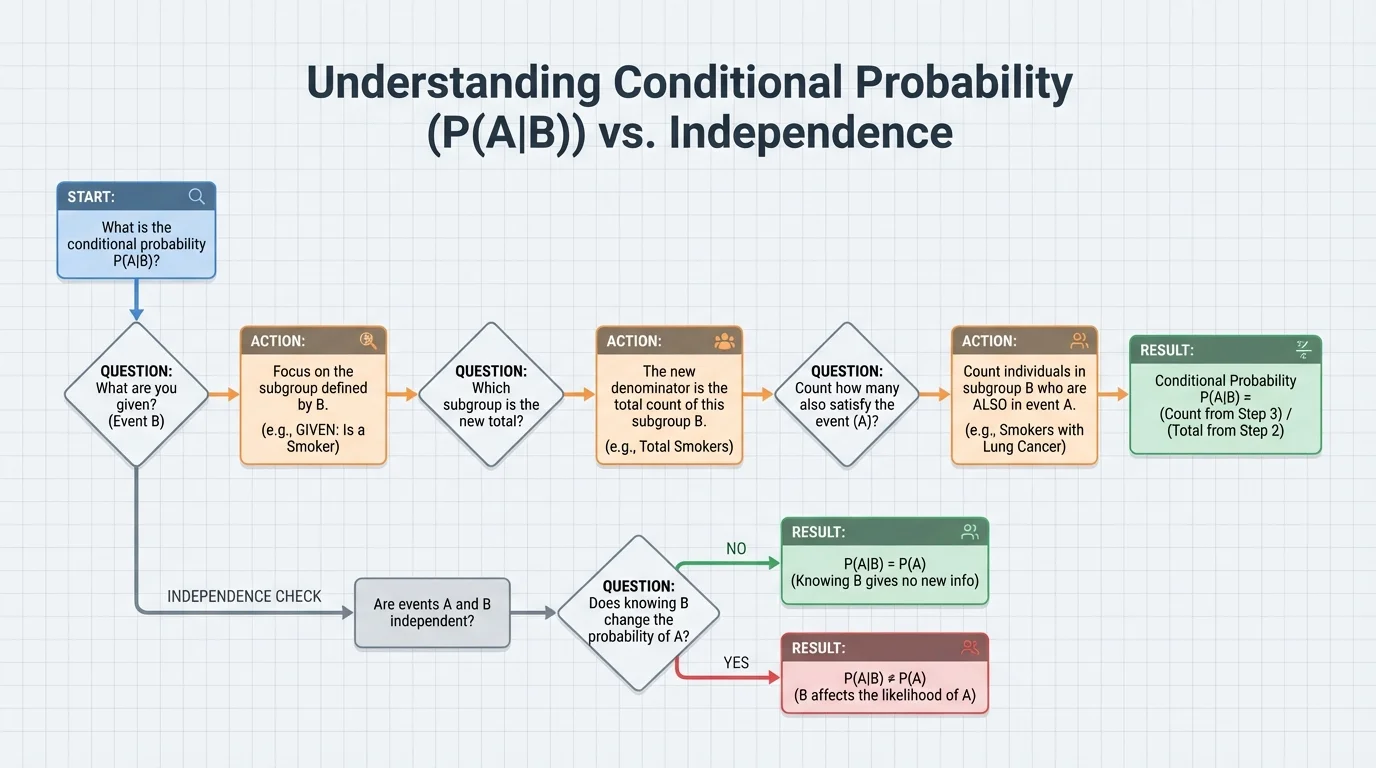
A useful strategy is to rewrite every symbolic expression in words. For example, \(P(A\mid B)\) becomes "probability of \(A\), given \(B\)." Then ask: out of the \(B\) group, how many are also in \(A\)? This wording connects the formula directly to the data.
You can also organize information in a two-way table, as in the smoking example. Tables make it easier to see row totals, column totals, and overlaps. Later, when you revisit a table such as the one highlighted in [Figure 1], you can quickly check whether the question is asking for a row-based or column-based conditional probability.
The same careful thinking helps with independence. If knowing one event changes the subgroup or changes the probability calculation, the events are not independent. If the probability stays the same, then they are independent, just as the comparison in [Figure 2] shows.
"The right probability starts with the right question."
That idea may sound simple, but it is the heart of this topic. Conditional probability and independence are really about interpreting information correctly. Once you know what is given, what group you are using, and whether one event changes another, the formulas make sense instead of feeling mysterious.
