An expression can change its form without changing its value. That is one of the most powerful ideas in algebra. For example, \(3(2+x)\) and \(6+3x\) may look different at first, but they represent the same amount. Learning how to move between forms like these helps you solve problems more efficiently, spot patterns, and understand what an expression really means.
When two expressions always have the same value, they are useful in different situations. One form might be easier to calculate, while another form might make a pattern easier to see. In real life, this is like giving directions in two ways: both lead to the same place, but one may be clearer for the job you are doing.
Suppose a school orders \(3\) snack packs, and each pack has \(2\) granola bars and \(x\) juice boxes. The total number of items is \(3(2+x)\). If you count all the granola bars and juice boxes separately, you get \(6+3x\). These are two different forms of the same total.
You already know important arithmetic properties from earlier grades. For example, \(2(4+5)=2\cdot 4+2\cdot 5\), and \(7+7+7=3\cdot 7\). Algebra uses the same ideas, but now numbers can be replaced by variables such as \(x\) and \(y\).
In algebra, a variable stands for a number that can change. Expressions can include numbers, variables, and operation symbols. The goal in this lesson is not to solve equations but to rewrite expressions so they are easier to understand or use.
An expression is a math phrase made of numbers, variables, and operations. Examples include \(4x+7\), \(3(a+b)\), and \(2y+y\).
A variable is a symbol, usually a letter, that represents a number. In \(5x\), the number \(5\) tells how many groups of \(x\) there are. In \(8+y\), the variable \(y\) can stand for different values.
A term is one part of an expression separated by addition or subtraction. In \(24x+18y\), the terms are \(24x\) and \(18y\). Recognizing terms helps when you combine like terms or factor expressions.
Equivalent expressions are expressions that have the same value for every value of the variable. For example, \(2x+x\) and \(3x\) are equivalent because both mean three groups of \(x\).
Here are a few simple pairs of equivalent expressions:
Equivalent does not mean identical in appearance. It means equal in value. This idea is central to algebra because many problems become easier when you rewrite an expression in a more useful form.
Distributive property means multiplying a number by each term inside parentheses. In symbols, \(a(b+c)=ab+ac\). It also works with subtraction: \(a(b-c)=ab-ac\).
Like terms are terms that have the same variable part. For example, \(3y\) and \(8y\) are like terms, but \(3y\) and \(3x\) are not.
One major tool for generating equivalent expressions is the distributive property. Another is combining like terms. Together, these ideas let you change the form of an expression while keeping its value the same.
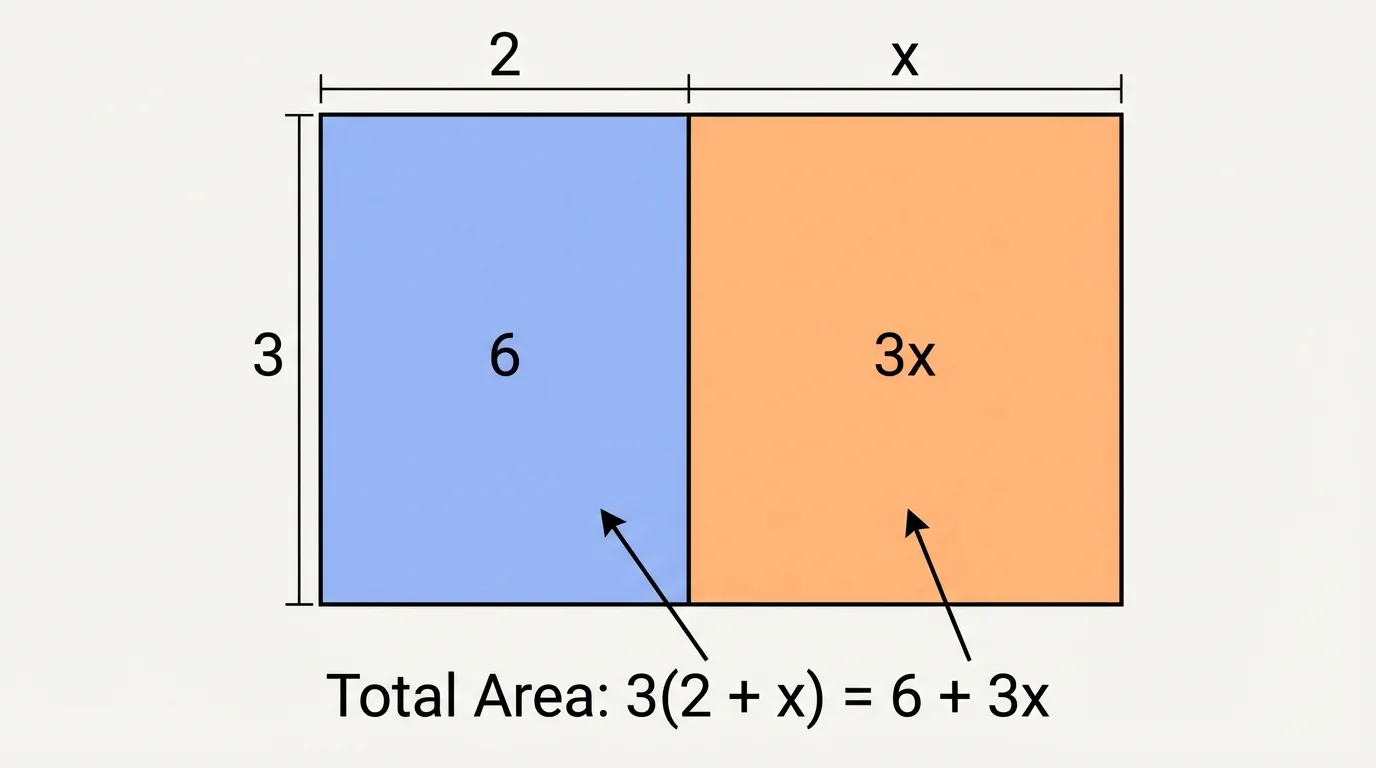
[Figure 1] The distributive property tells you to multiply the number outside the parentheses by each term inside. An area model helps make this visible: one large rectangle is split into smaller rectangles, and the total area stays the same whether you see it as one product or a sum of parts.
Take the expression \(3(2+x)\). The \(3\) multiplies both \(2\) and \(x\). That gives \(3\cdot 2+3\cdot x\), which simplifies to \(6+3x\). So \(3(2+x)\) and \(6+3x\) are equivalent expressions.
You can also distribute over subtraction. For example, \(4(7-y)=28-4y\). The \(4\) multiplies \(7\), and it also multiplies \(-y\), giving \(-4y\).
This property is useful because sometimes an expression in parentheses is easier to understand as separate parts. Later, when solving equations or working with formulas, distributing often helps you remove parentheses and simplify.
Why distribution works
If one group contains \(2+x\), then \(3\) groups contain three copies of \(2+x\): \((2+x)+(2+x)+(2+x)\). Grouping the numbers and variables gives \(2+2+2+x+x+x=6+3x\). The distributive property is a shortcut for this repeated addition.
The area model remains helpful later, too. When you look back at [Figure 1], you can see that the total area does not change; only the way it is written changes. That is exactly what equivalent expressions do.
[Figure 2] The distributive property also works in reverse. This is called factoring. Instead of expanding \(a(b+c)\) into \(ab+ac\), you start with a sum and pull out a common factor. A visual grouping helps you see when two terms share the same factor.
Consider \(24x+18y\). Both terms can be divided by \(6\). Since \(24x=6\cdot 4x\) and \(18y=6\cdot 3y\), you can factor out \(6\) and write the expression as \(6(4x+3y)\).
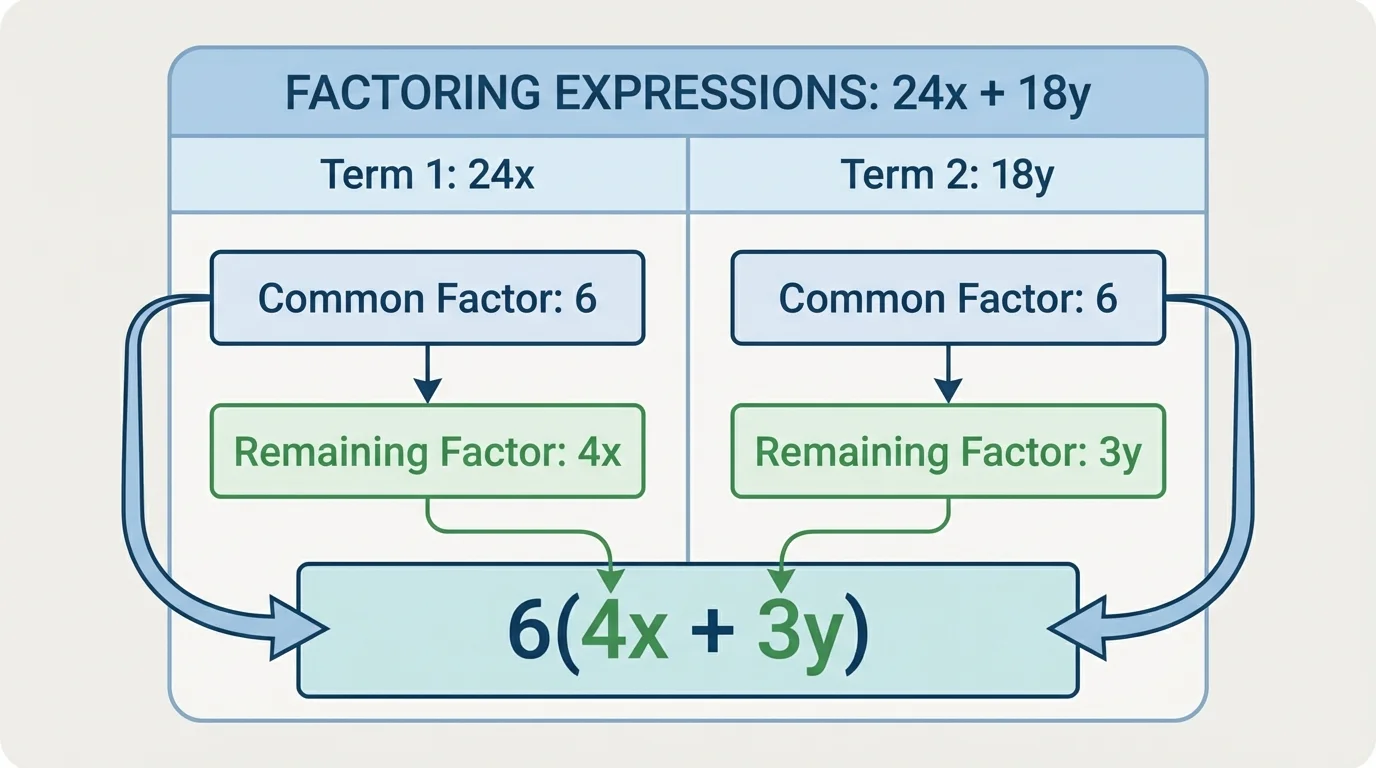
Factoring is helpful when you want to show shared parts. For example, if \(24x\) and \(18y\) are both in packs of \(6\), then \(6(4x+3y)\) makes that shared grouping clear.
Sometimes more than one common factor is possible, but using the greatest common factor often gives the most compact form. In this lesson, the main goal is to recognize that reversing the distributive property creates another equivalent expression.
Later, when you compare forms of expressions, [Figure 2] still helps: the expanded form \(24x+18y\) shows the separate parts, while the factored form \(6(4x+3y)\) shows the common factor.
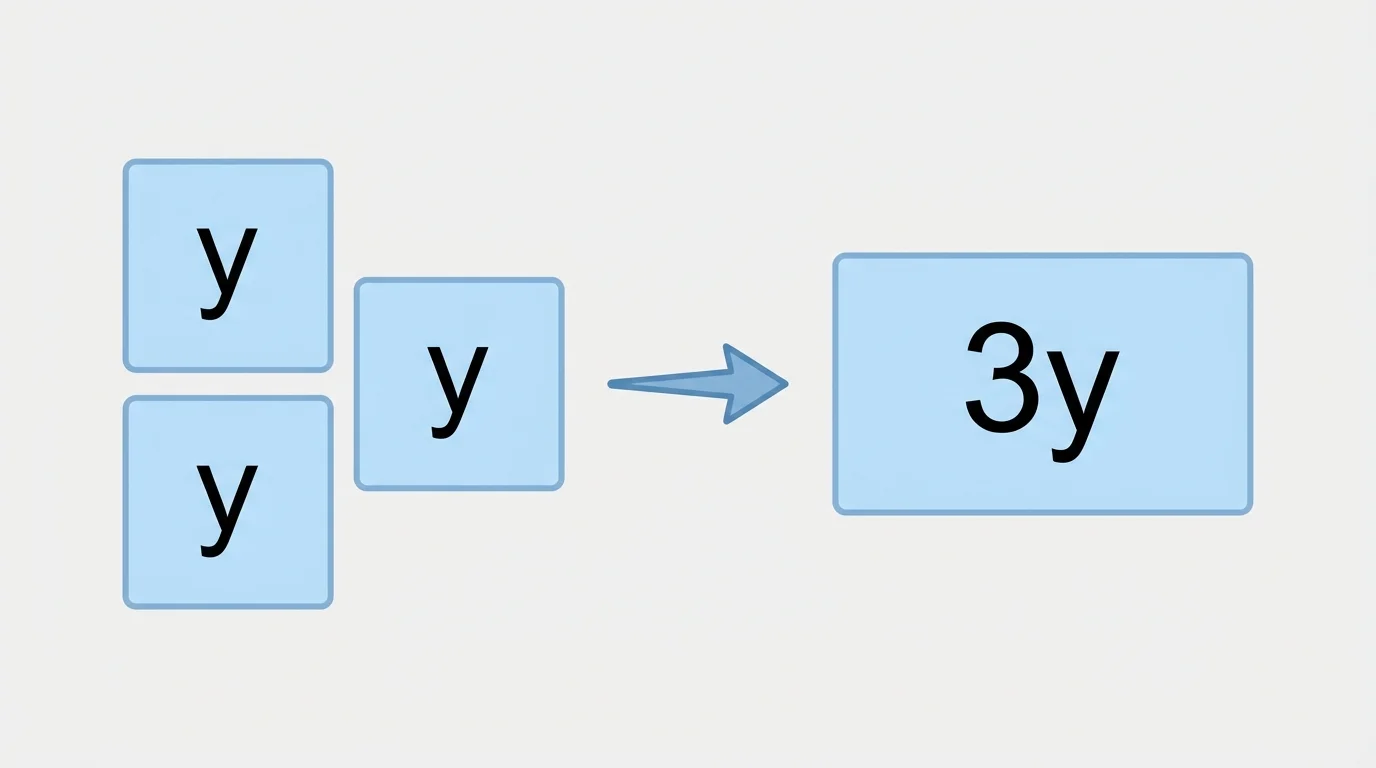
[Figure 3] Another important way to create equivalent expressions is by combining like terms. Terms can be combined only when they have the same variable part. Counting matching variable tiles is a good way to picture this idea.
For example, \(y+y+y\) means one \(y\) plus another \(y\) plus another \(y\). That is the same as \(3y\). You are counting three copies of the same variable.
Here are more examples:
But be careful: unlike terms cannot be combined. For example, \(2x+3y\) cannot become \(5xy\) or \(5x\). The variables are different, so the terms do not match.
The model in [Figure 3] reminds you that only identical variable pieces can be counted together. Three \(y\)-tiles make \(3y\), but a \(y\)-tile and an \(x\)-tile do not combine into one like term.
The distributive property is the star of this topic, but other properties help you rewrite expressions too.
The commutative property says order can change in addition or multiplication: \(a+b=b+a\) and \(ab=ba\). So \(x+2\) and \(2+x\) are equivalent.
The associative property says grouping can change in addition or multiplication: \((a+b)+c=a+(b+c)\). So \((x+x)+y\) and \(x+(x+y)\) are equivalent.
The identity property says adding \(0\) changes nothing and multiplying by \(1\) changes nothing: \(a+0=a\) and \(1a=a\). These are useful when checking whether an expression is already simplified.
These properties support the main work of rewriting expressions. For example, to combine \(y+y+y\), you can think of the associative property letting you group the terms, then repeated addition giving \(3y\).
Worked example 1
Rewrite \(3(2+x)\) as an equivalent expression.
Step 1: Identify the number outside the parentheses.
The number outside is \(3\). It must multiply each term inside the parentheses.
Step 2: Distribute to each term.
\(3(2+x)=3\cdot 2+3\cdot x\).
Step 3: Simplify each product.
\(3\cdot 2=6\) and \(3\cdot x=3x\).
The equivalent expression is \(6+3x\).
This example shows expansion: one product becomes a sum. This is often the easiest way to remove parentheses.
Worked example 2
Rewrite \(24x+18y\) in factored form.
Step 1: Find a common factor.
Both \(24x\) and \(18y\) are divisible by \(6\).
Step 2: Write each term as a product with \(6\).
\(24x=6\cdot 4x\) and \(18y=6\cdot 3y\).
Step 3: Factor out the common factor.
\(24x+18y=6(4x+3y)\).
The equivalent expression is \(6(4x+3y)\).
This example shows factoring, which is the reverse of distribution. It helps reveal shared structure in an expression.
Worked example 3
Rewrite \(y+y+y\) as an equivalent expression.
Step 1: Notice that all terms are like terms.
Each term is \(y\), so they can be counted together.
Step 2: Count the number of \(y\) terms.
There are \(3\) copies of \(y\).
Step 3: Write the product.
\(y+y+y=3y\).
The equivalent expression is \(3y\).
Repeated addition of the same variable becomes multiplication. That is why \(4x\) means \(x+x+x+x\).
Worked example 4
Rewrite \(5(a+4)\) as an equivalent expression.
Step 1: Distribute \(5\) to both terms.
\(5(a+4)=5\cdot a+5\cdot 4\).
Step 2: Simplify the products.
\(5a+20\).
The equivalent expression is \(5a+20\).
Notice that the order of terms may vary. For example, \(20+5a\) is also equivalent to \(5a+20\) because of the commutative property of addition.
Computer algebra systems and calculators often rewrite expressions automatically. They may expand an expression, factor it, or combine like terms depending on what will be most useful for the next step.
Checking with a number can help confirm your thinking. If \(x=4\), then \(3(2+x)=3(6)=18\), and \(6+3x=6+12=18\). Since both expressions give the same value, that supports the idea that they are equivalent.
Equivalent expressions appear in many everyday situations. One common example is area. A rectangle with height \(3\) and width \(2+x\) has area \(3(2+x)\). If the width is split into \(2\) and \(x\), the total area becomes \(6+3x\). Builders, designers, and engineers often break shapes into smaller parts in this same way.
Shopping provides another example. Suppose one art kit contains \(4\) markers and \(p\) pencils. If a class buys \(6\) kits, the total number of items is \(6(4+p)\), which is equivalent to \(24+6p\). One form shows the number of kits; the other shows the totals of each item.
Repeated amounts also appear in sports and games. If a player earns \(y\) points in each of \(3\) rounds, then \(y+y+y=3y\). Writing \(3y\) is faster and clearer.
A common mistake is forgetting to distribute to every term inside parentheses. For example, \(2(x+5)\) is not \(2x+5\). The correct result is \(2x+10\) because the \(2\) multiplies both \(x\) and \(5\).
Another mistake is combining unlike terms. For example, \(4x+3\) cannot become \(7x\). The \(4x\) term and the \(3\) term are different kinds of terms.
Students also sometimes factor incorrectly. For example, \(12x+8\) should factor to \(4(3x+2)\), not \(4(3x+8)\). After factoring, multiplying back out should return the original expression.
A good habit is to check your rewritten expression by distributing, factoring back, or substituting a simple number for the variable.
Algebra becomes easier when you can move comfortably among forms. Expanded form, such as \(6+3x\), shows the separate pieces. Factored form, such as \(3(2+x)\), shows the common factor. A combined form, such as \(3y\), shows repeated equal terms in a shorter way.
| Original expression | Equivalent expression | What changed |
|---|---|---|
| \(3(2+x)\) | \(6+3x\) | Distributed |
| \(24x+18y\) | \(6(4x+3y)\) | Factored |
| \(y+y+y\) | \(3y\) | Combined like terms |
| \(5(a+4)\) | \(5a+20\) | Distributed |
| \(2m+7m\) | \(9m\) | Combined like terms |
Table 1. Examples of expressions rewritten using properties of operations.
Being able to rewrite expressions is like having more than one lens for the same idea. Different forms reveal different information, but the value stays the same.
